Two days ago, the Golden State Valkyries completed one of the great stories in women’s professional sports, winning the WNBA championship in just their second season. Gabby Williams scored 30 points in a decisive Game 7 against the Atlanta Dream, and the entire season felt like another enormous step forward for women’s basketball.
This week, women’s college basketball begins another season, with extraordinary expectations, increasingly recognizable stars, and an audience that has learned to care about these athletes for what they do on the court.
And over in professional women’s tennis? We’re getting Hello Kitty.
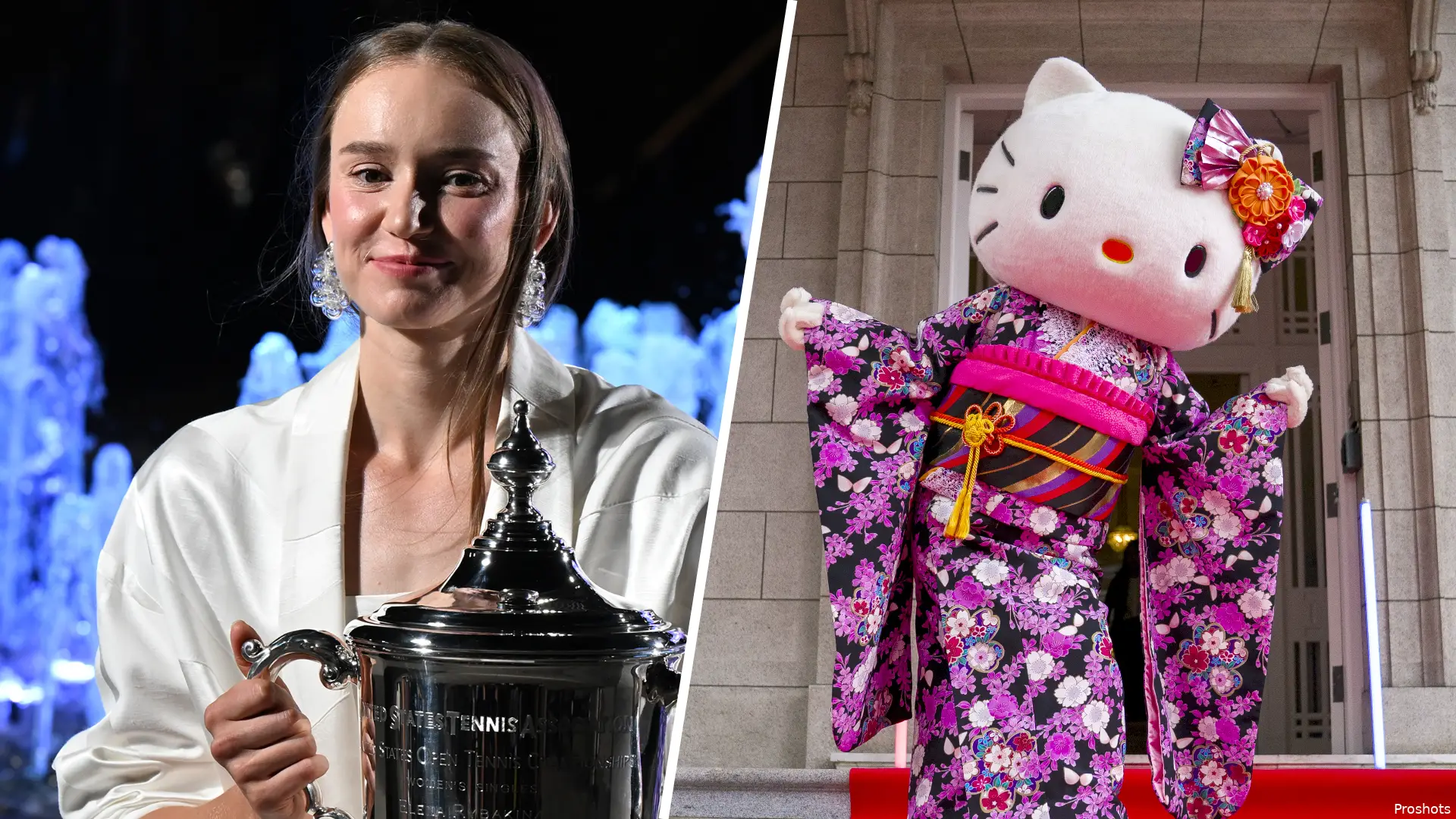
I’m not making this up. The Women’s Tennis Association announced this week that its first official merchandise collaboration will be with Hello Kitty, the globally recognizable Japanese character owned by Sanrio. The collection will debut at the WTA Finals in Indian Wells, featuring shirts, sweatshirts and a collectible plush toy.

Elena Rybakina with the WTA Finals trophy.
Apparently, this is how we’re celebrating the best female tennis players on the planet. I spend a considerable amount of my professional life thinking about brands. What makes them valuable, how they develop an identity, what they communicate to the public and, perhaps most importantly, how they occasionally manage to undermine themselves through decisions that probably sounded terrific in a conference room.
I’ve been in enough of those rooms to know how these conversations go. Somebody presents a partnership opportunity. The numbers look attractive. There’s a PowerPoint about audience expansion, another slide about reaching younger consumers, and probably something about engaging fans at the intersection of sport and popular culture.
Everyone nods. And sometimes nobody asks the one question that matters.
Is this actually right for us? Had I been in the room when this partnership was proposed, I suspect I would have needed about six seconds to offer my assessment.
Hey, everyone. This is a truly terrible idea. Before anyone accuses me of being culturally insensitive to Hello Kitty, let me be absolutely clear about something. Hello Kitty is a remarkable brand. It has survived for more than half a century, developed an enormous international following and demonstrated an ability to remain commercially relevant across generations. From a branding perspective, there’s plenty to admire.
But recognizing that a brand is enormously successful doesn’t mean it’s an appropriate partner for every other brand. That’s where the WTA seems to have lost the plot.
Consider what women’s professional tennis actually represents. These are some of the most physically and mentally formidable athletes in the world. They spend years developing their bodies and games, endure relentless international travel, manage injuries, confront enormous public pressure and compete in a sport where the smallest lapse in concentration can cost someone a championship.
Think about what it takes to survive three hours against Aryna Sabalenka. Think about the extraordinary discipline of Iga Świątek, the athletic brilliance of Coco Gauff, or the competitive intensity of Elena Rybakina. These women are warriors.
WTA Finals with a cartoon kitten holding a tennis racket?
And the WTA’s big merchandising announcement, timed to coincide with its season-ending championship, features a cartoon kitten holding a tennis racket. Seriously?
The timing makes this particularly frustrating because women’s sports are enjoying a moment that previous generations of athletes could scarcely have imagined.
The WNBA has spent the past several seasons demonstrating that women’s professional basketball can generate passionate fandom, compelling rivalries, cultural influence and serious commercial interest. Its athletes have become recognizable personalities far beyond basketball. Their competitive identities, personal stories and accomplishments are central to how the league presents itself.
The Valkyries’ championship is an extraordinary example. Here is a franchise that has barely existed for two years, yet has already built a recognizable identity and delivered a championship. Fans didn’t fall in love with Golden State because someone attached an adorable cartoon character to the team’s logo. They embraced a basketball team with a personality, a story and players worth following.
And yes, the Valkyries have Hello Kitty merchandise too. There’s nothing inherently wrong with that. Sports teams can have fun with licensed products, and fans can enjoy them. The difference is that the Valkyries have already established who they are. Hello Kitty is an accessory to that identity, not the headline announcing the beginning of their merchandise strategy.
The WTA has chosen to make this collaboration its first major statement in a new retail initiative.
That’s a meaningful distinction. The tour’s official announcement describes the partnership as an opportunity to combine sport, style and popular culture. Sarah Swanson, the chief brand officer of WTA Ventures, explained that sport can be serious while also being fun. Of course it can.
Nobody is suggesting that women’s tennis needs to become an entirely humorless enterprise. Tennis has always had room for fashion, personality, entertainment and creative commercial partnerships. Some of the most commercially successful players in the sport’s history understood that better than anyone.
But fun isn’t a brand strategy. Neither is simply borrowing the recognition of somebody else’s intellectual property.
And there’s something particularly unfortunate about this decision coming from an organization whose history is inseparable from the fight to have female athletes treated as serious professionals.
Billie Jean King and the women who helped build the WTA weren’t simply trying to create another entertainment product. They were fighting for recognition, opportunity, compensation and respect. They wanted women to be judged by their abilities and achievements, rather than by the limiting expectations society placed upon them.
More than 50 years later, the organization they helped establish is introducing its first official merchandise collection with Hello Kitty.
I don’t believe that makes the WTA sexist, and I certainly don’t believe that everyone who buys one of these shirts is somehow diminishing women’s sports. That would be ridiculous. There are undoubtedly WTA fans who love Hello Kitty, and they’ll probably enjoy the collection.
The issue is much larger than whether a particular sweatshirt sells.
It’s about the story the WTA chooses to tell about itself.
The organization has an extraordinary collection of assets that other sports properties would love to possess. It has globally recognizable athletes, a genuinely international audience, compelling rivalries, generations of history and an increasingly valuable position in the women’s sports marketplace.
It also has a commercial challenge. Women’s tennis needs to find new revenue, develop stronger relationships with fans and build a retail business that extends beyond individual tournaments. Those are legitimate priorities, and the WTA deserves credit for finally taking merchandise seriously.
But when you’re building a brand, particularly one with the stature and history of women’s professional tennis, the first move matters.
Why not launch a collection built around the players themselves? Why not create something that celebrates the ferocity, individuality and extraordinary athleticism of the women competing in Indian Wells? Why not develop merchandise that a young fan would wear because she wants to be like Coco Gauff, rather than because she recognizes a cartoon character?
There’s an enormous opportunity to make the WTA brand itself desirable.
That’s the opportunity I fear the organization is missing. I keep returning to something I’ve learned from working with brands over the years. Good leadership requires people who are willing to tell you when an idea isn’t as good as you think it is.
Sometimes those people are colleagues. Sometimes they’re advisers. Sometimes they’re the friends who know you well enough to tell you that the expensive jacket you’re about to buy looks absolutely ridiculous.
The WTA needs more of those people in its decision-making rooms.
People who can recognize the commercial appeal of a proposal while still questioning what it does to the organization’s identity. People who understand that the goal isn’t merely to generate transactions, but to build something that fans respect, identify with and ultimately want to support.
And people who are comfortable saying that just because a partnership might make money doesn’t mean it’s the right partnership.
Perhaps the Hello Kitty collection will sell out. Perhaps it will attract consumers who have never watched a professional tennis match. If so, the WTA will undoubtedly call it a success.
But selling a lot of merchandise and building a great sports brand aren’t necessarily the same thing. At a moment when women’s basketball is showing the world how powerful female athletes can be as the central attraction, women’s tennis should be making an equally ambitious statement.

The WTA has some of the most extraordinary competitors in sports. It has a history that deserves celebration and a future that should be enormously exciting. It doesn’t need a cartoon kitten to make any of that interesting.
It needs to believe more strongly in the women who already make its product extraordinary. And, quite frankly, it needs better friends in the room.

Aron SolomonGuest Author
A Pulitzer Prize-nominated journalist for his groundbreaking op-ed in The Independent exposing the NFL’s “race-norming” policies, Aron Solomon, JD, is a globally recognized thought leader in law, media, and strategy.
As Chief Strategy Officer for AMPLIFY, he leverages his deep expertise to shape the future of legal marketing. Aron has taught entrepreneurship at McGill University and the University of Pennsylvania and was honored as a Fastcase 50 recipient, recognizing him among the world’s top legal innovators. A prolific commentator on law, business, and culture, his insights regularly appear in Newsweek, The Hill, Crunchbase News, and Literary Hub.
He has also been featured in The New York Times, Fast Company, Fortune, Forbes, CBS News, CNBC, USA Today, ESPN, TechCrunch, BuzzFeed, Venture Beat and countless other leading global media outlets. We are proud to have Aron on board at TennisUpToDate, where his deep tennis expertise enriches the site with sharp, original columns that connect the sport to wider cultural debates.
claps 1visitors 1
Just In


Popular News

Latest Comments
- This woman is gradually becoming a problem interjecting her personal problems into the tennis tour. I've been fed-up with her Holier-Than-Thou attitude for quite some time. SVITOLINA IS NOT THE ONLY UKRAINIAN PROFESSIONAL DEALING WITH THE INVASION IN HER COUNTRY. At some point the general public is going to have had enough of the "poor me' performances. My friends and colleagues from, or still living in, Ukraine do not care for her "distant approach" in addressing this sad time in Ukranian history. Perhaps it's best if she take a leave from tennis and go fight for her cause? The constant nonsense dissing her Russian colleagues on the courts (and now in the media) has run its course. As much as she may believe she's 'fighting' for her country -- she is not.
 mandoist24-11-2026
- Damn! This is not the news we wanted to hear. Hopefully, surgery will help and Sinner will be back to competition soon.Rapunzel23-11-2026
- Well... at least someone in that camp finally 'saw the Light'. No one wants to go down with a sinking ship.mandoist23-11-2026
- At a time when WTA should be reducing the ridiculously unhealthy schedule, their collective greed and ignorance is adding to the risks.mandoist21-11-2026
- It's bullshit to apologize for something most of us already knew/know (and what others are afraid to admit) about her. Time to fine her in a Big, Big way for screaming and cursing DIRECTLY at fans. It's a shame she's not the sharpest pencil in the box -- but that should not excuse her from paying a price when necessary. Time to quiet the Fake Screamer down a few notches.mandoist21-11-2026
- Allow me to summarise this wonderful article. We have been inundated with TOO MUCH tennis! Let the players go home, spend some time with families and loved ones and allow them to breathe and have a merry Christmas.Rapunzel20-11-2026
- It's been apparent to people that remember who Saba acted and spoke (before her win streak) that she's been gradually reverting to her old nasty, argumentative, excuse-making self. Even Championships cannot hide one's personality forever.mandoist18-11-2026
- Great list of players to watch! Really like Lilli Tagger. Nice looking game. I’m most interested in seeing how good Victoria Mboko becomes. She and Jovic and Eala might just be the ones fighting alongside Andreeva for Grand Slam titles soon.DaveyWavey16-11-2026
- Mirra's very funny words have been in my head since yesterday. "If I win the car I have 5 people in my box that can drive me around. I will forever be a passenger princess. I have a plan..." And I will never forget how she had me rolling on the floor laughing when asked how she beat Jess Pegula so handily: "I don't know what happened; It must have been the Diva in me". CLASSIC STUFF !mandoist15-11-2026
- Can whomever has a microphone in the Final... PLEASE STOP YAMMERING ABOUT YOURSELVES NONSTOP THROUGHOUT THE MATCH???? Get a grip and STFU once in awhile so we can 'hear' the actual play on court.mandoist15-11-2026
