
Forget “Rybakina finally wins New York.” What happened at Arthur Ashe Stadium on Saturday night was bigger than that. Elena Rybakina did not just win her first US Open title — she took the world No. 1 ranking away from Aryna Sabalenka days earlier, then beat her for the title itself, 6-4, 5-7, 6-2, in a rematch of January’s Australian Open final. That combination does not look like the story of one exceptional week. It looks like a changing of the guard, and one that has been building for longer than most people realized.
For the past two years, the conversation around women’s tennis has largely revolved around Sabalenka and Iga Swiatek. Sabalenka arrived in New York as the defending champion and two-time reigning US Open winner, while Swiatek had spent much of the period following Ashleigh Barty’s retirement at the top of the rankings.
Rybakina, meanwhile, was often viewed as the dangerous player capable of beating anyone on her day, but rarely as the one setting the terms at the top of the game. That perception is now difficult to justify.
The numbers behind Rybakina's rise
This was Rybakina’s third Grand Slam title and her second of the season, following her Australian Open triumph in January. Her first came at Wimbledon in 2022, and both of her major titles this year have come against Sabalenka.
She is now the sixth woman since 1988 to win both hard-court Grand Slam tournaments in the same season, joining Steffi Graf, Monica Seles, Martina Hingis, Angelique Kerber and Sabalenka. She is also only the second player in the Open Era to defeat a reigning world No. 1 in two Grand Slam finals in the same season, matching a feat previously achieved only by Graf in 1995.
The deeper numbers underline just how far Rybakina has come. Saturday’s victory was her 10th career win over a reigning world No. 1, her 41st against a Top-10 opponent and her 49th match win of the season.
Those are not the numbers of a player who has simply put together one outstanding fortnight. They are the numbers of someone who has been operating at the highest level of the sport for years, even if she has often done so without receiving the same attention as the players who have dominated the headlines and the top of the rankings.

Elena Rybakina Vs Naomi Osaka in Louis Armstrong Stadium during the US Open
A rise that was easy to overlook
That lack of recognition has arguably been a recurring theme throughout Rybakina’s career. After winning Wimbledon in 2022, she arrived at the US Open without even being inside the Top 20, partly because ranking points were not awarded at Wimbledon that year following the decision to ban Russian and Belarusian players.
Despite being the reigning Wimbledon champion, she was still playing on some of the tournament’s less prominent courts rather than receiving the treatment normally reserved for a recent Grand Slam champion. It was an unusual position for a player who had just announced herself on the biggest stage.
Her progress since then has also unfolded during an era dominated by Swiatek and Sabalenka. Between them, they collected the majority of the biggest titles and repeatedly traded the No. 1 ranking, leaving Rybakina in an awkward middle ground: too successful to be considered an outsider, but rarely the first name mentioned when the conversation turned to the players defining women’s tennis.
Injuries and interruptions have also complicated her ability to build the same continuous momentum as her main rivals, despite the level she has repeatedly shown when healthy.
Now, at 27, Rybakina has reached the top of the rankings while adding two Grand Slam titles to her résumé in the same season. She will become the 30th woman to reach world No. 1 and, at 27 years and 89 days, the second-oldest player ever to achieve the milestone for the first time, behind only Angelique Kerber, who was 28 years and 238 days old.
The timing matters: Rybakina is not simply arriving at the top because the previous generation has stepped aside. She has beaten the player who had occupied that position and then defeated her again for one of the biggest prizes in the sport.
For years, Rybakina looked like the player waiting for her opportunity to fully arrive. After Saturday night, that description no longer fits. She is a Grand Slam champion twice over in 2026, the new world No. 1 and the player who has beaten Sabalenka in two major finals this season. The landscape at the top of women’s tennis has changed, and Rybakina is now at the center of it.
Rybakina's 2026 season
| Win-Loss record | 49-13 |
| Grand Slam record | 17-2 |
| Titles | 3 |
| Grand Slam titles | 2 (Australian Open, US Open) |
| vs top-10 players | 10-5 |
What it means for Sabalenka
The flip side of this story is significant. Sabalenka’s 99-week reign at No. 1 has ended, while her bid to become the first woman since Serena Williams to win three consecutive US Open titles fell short against the player who has now emerged as her biggest rival. She also leaves New York without a Grand Slam title in 2026, despite winning four majors between 2023 and 2025.
The rivalry numbers underline how quickly the balance has shifted. Sabalenka led their head-to-head 10-7 before Saturday’s final, but Rybakina already held a 4-2 advantage in their previous tour finals. Her latest victory extends that lead to 5-2 and gives her a 2-1 edge in Grand Slam finals. Rybakina has now beaten Sabalenka in both major finals they have played in 2026, making their rivalry one of the defining stories of her rise to No. 1.

Sabalenka vs. Rybakina — the full picture
| Overall head-to-head | Sabalenka leads 10-8 after 18 meetings |
| Head-to-head on hard courts | Rybakina leads 8-7 |
| Tour finals | Rybakina leads 5-2 |
| Grand Slam finals | Rybakina leads 2-1 (2023 AO: Sabalenka; 2026 AO & US Open: Rybakina) |
| Grand Slam meetings overall | Tied 2-2 (2021 Wimbledon R4, 2023 AO final, 2026 AO final, 2026 US Open final) |
| Grand Slam titles | Sabalenka: 4 (AO 2023, 2024; US Open 2024, 2025) — Rybakina: 3 (Wimbledon 2022; AO, US Open 2026) |
Why this feels different
Rybakina has spent years being described as one of the most dangerous players on tour without quite being regarded as the best. That conversation is now much harder to sustain. She heads into the rest of the season with a significant lead in the Race to the WTA Finals, two hard-court majors already secured and, for the first time in her career, the world No. 1 ranking to match the résumé.
She is achieving all of this at 27, an age when some of her rivals are already being discussed in terms of the back half of their primes.
Read also

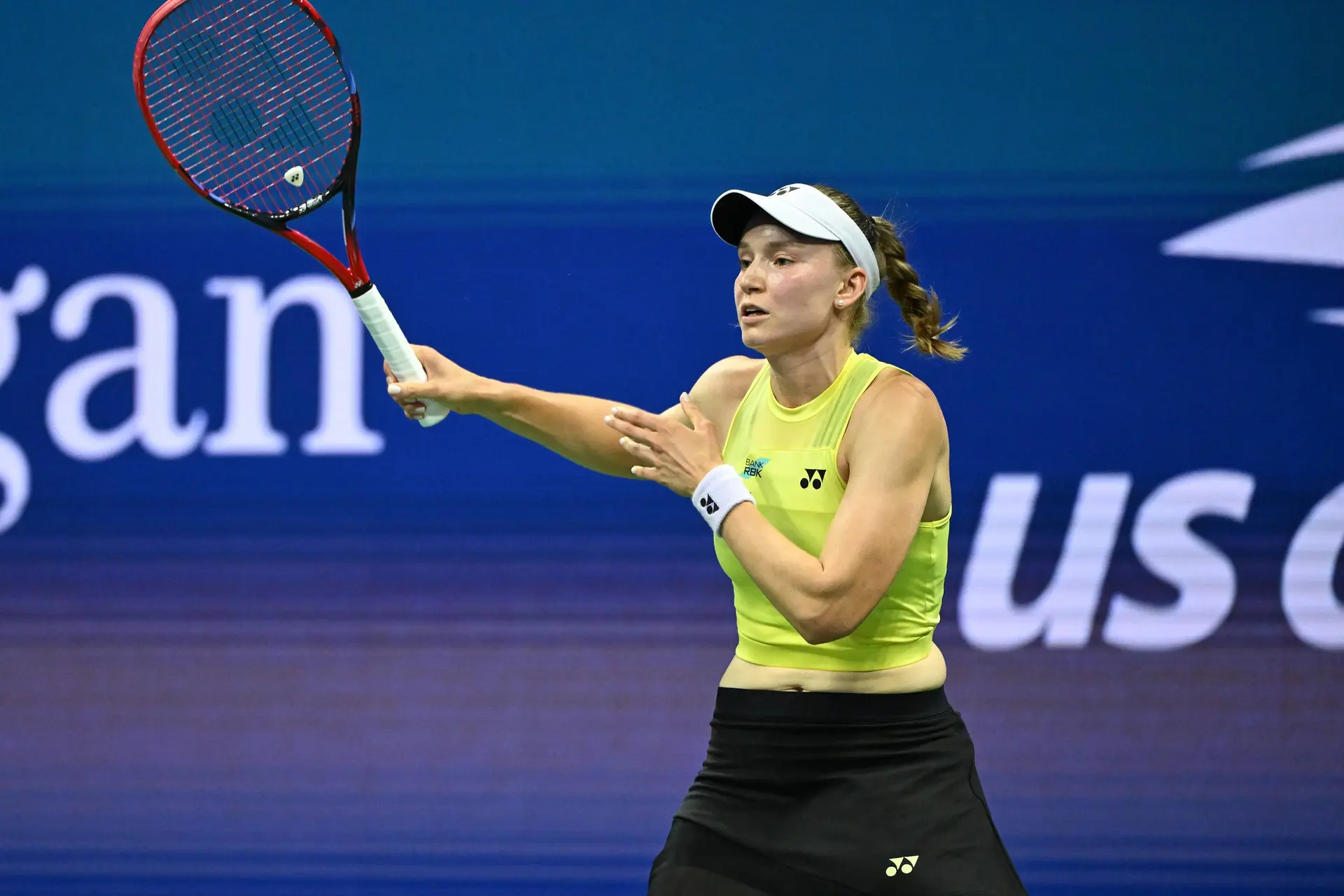
The only major missing from Rybakina’s résumé is Roland Garros, meaning she is now one title away from completing the career Grand Slam. Given the level she has shown on hard courts this season, that can no longer be dismissed as a distant possibility.

Elena Rybakina will compete for the Career Grand Slam when she returns to Roland Garros. Her best results in Paris are two quarterfinal appearances (2021, 2024).
Her US Open run also showed the breadth of her game. Rybakina came through a demanding draw before beating Iga Swiatek in the semifinal and Sabalenka in the final, repeatedly raising her level when the pressure increased. It was not simply a case of surviving the tournament as the favorite; she beat two of the players who had defined the top of the women's game to claim the biggest title of her season.
That is the clearest sign of what has changed. Rybakina is no longer the player waiting for her chance behind Swiatek and Sabalenka. She has now beaten both on the way to a Grand Slam title, taken the No. 1 ranking and built a season that already includes two major trophies. The question is no longer whether Rybakina belongs at the top, but how long she can stay there.
Elena Rybakina's 2026 US Open run
| Round | Opponent | Opp. Rank | Result | Score |
| R128 | Thea Frodin | 585 | W | 6-3, 6-2 |
| R64 | Jessica Bouzas Maneiro | 105 | W | 6-2, 6-4 |
| R32 | Yuliia Starodubtseva | 58 | W | 7-6(6), 6-3 |
| R16 | Naomi Osaka | 13 | W | 6-1, 6-4 |
| QF | Qinwen Zheng | 121 | W | 3-6, 6-1, 6-4 |
| SF | Coco Gauff | 4 | W | 3-6, 6-4, 6-4 |
| F | Aryna Sabalenka | 1 | W | 6-4, 5-7, 6-2 |

Cristhián AvilaTennis Journalist
Cristhián Ávila is a tennis journalist based in Santiago, Chile, and has been part of the TennisUpToDate team since early 2023. He covers the ATP and WTA Tours as well as all four Grand Slams, producing breaking news, match reports, analysis, and regular liveblogs from major tournaments.
His reporting combines statistical analysis with clear explanation, helping readers understand tactical developments, player form, and broader storylines across the tour. Working fluently in both Spanish and English, Cristhián collaborates with an international editorial team and contributes to comprehensive global coverage. As part of his work, he has conducted interviews and media interactions with leading figures in the sport, including Caroline Wozniacki and John McEnroe.
In his journalism, Cristhián places strong emphasis on careful sourcing, editorial accuracy, and updating articles promptly when new, verified information becomes available. His coverage is grounded in research, context, and direct engagement with professional tennis.
claps 1visitors 1
Just In

Popular News
Latest Comments
- Does Sinner need that 4.5 mil? I doubt it. He can make that with three modelling gigs!😅🤣Rapunzel21-10-2026
- Did "People Magazine" purchase this website? This nonstop storyline is bullshit.
 mandoist21-10-2026
 - Listen... this is of no concern to anyone but these two. Deal with your own issues -- most of us have our own. Thanks, media, for these insignificant follow-ups which are meaningless.mandoist21-10-2026
- This is so very very sad, for all three of them. I truly thought they had an unbreakable bond, but life throws up so many differing challenges. Having your homeland suffering in such a terrible way, makes happiness lose out to guilt as well. Our thoughts are with them. X💔bjsexton20-10-2026
- I have lost all respect for Svitolina! Could she not have waited until he had played at the Paris Masters!!! She is selfish and don't give a damn about Gael. That is NOT how love is demonstrated Elina!!Rapunzel19-10-2026
- Perhaps convenient tennis tour sex is not a strong enough experience in which to base a marriage?mandoist19-10-2026
- Fight the Good Fight... Tennis (sports in general) need more Humans such as yourself.mandoist18-10-2026
- When is WTA going to mandate Genetic Testing (DNA) ???mandoist18-10-2026
- Hey, Dan... you just wake up from a coma? Regardless -- Thanks for the comedy this morning!mandoist18-10-2026
- Two Things: 1. Stop allowing these Spoiled Trust-Fund Elitists to behave badly. Your little hand-slaps do not deter them. 2. STOP the incessantly annoying "towel wiping" nonsense!!!!mandoist15-10-2026

Loading