“You're not going to get this kind of pressure in practice”: Iga Swiatek finds unexpected benefit in toughest US Open test yet
WTAMonday, 07 September 2026 at 02:30
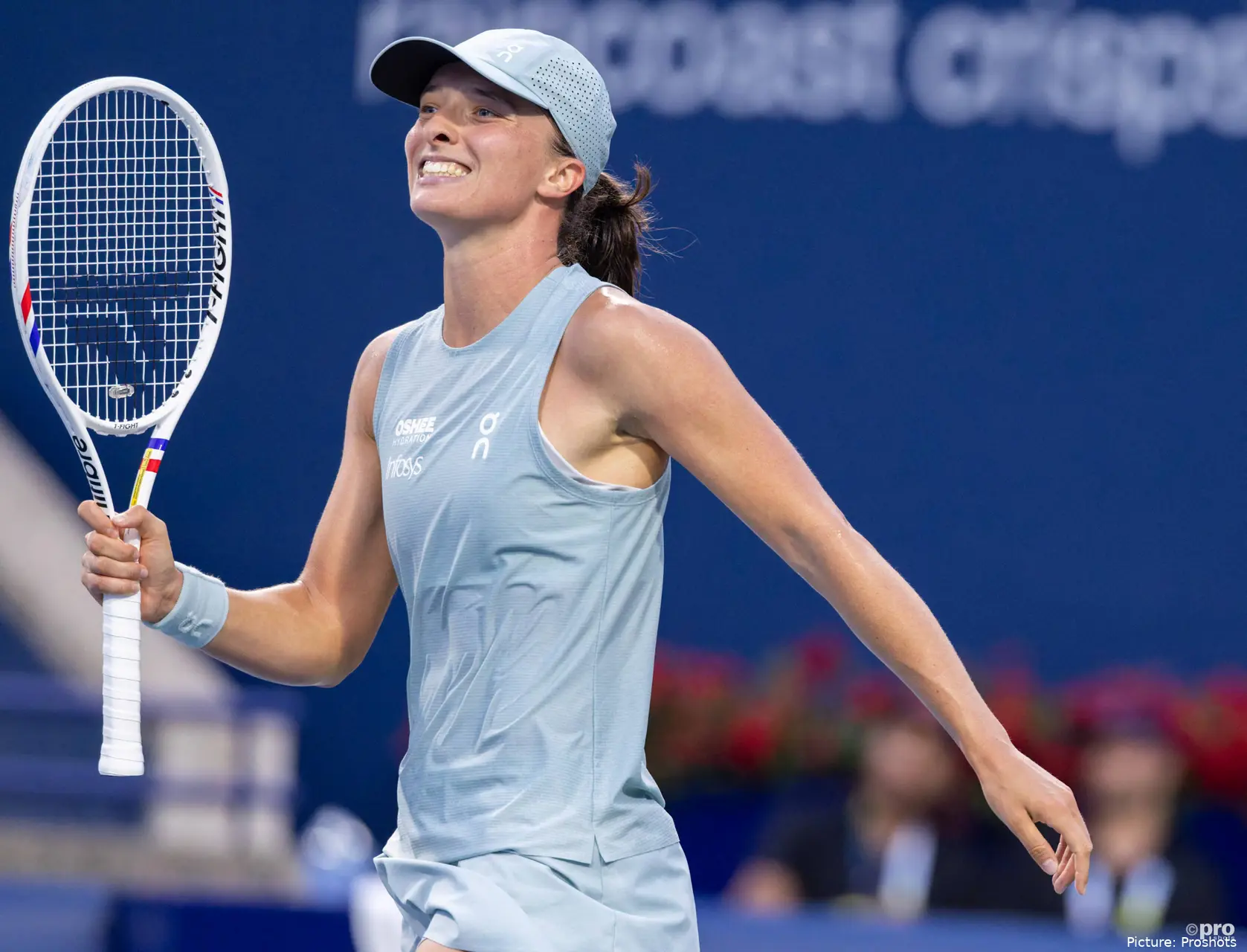
Iga Swiatek's formula for handling pressure sounds almost counterintuitive. When the biggest points arrive, she tries to stop thinking about the score altogether. The Pole explained that her ability to survive several difficult moments during her third-round US Open victory came from treating set points and ordinary points exactly the same way.
It was a philosophy put under serious examination against Marie Bouzkova. Swiatek needed two tiebreaks to overcome the Czech, 7-6(3), 7-6(3), and had to save three set points in the second set before eventually booking her place in the fourth round.
Yet rather than viewing those moments as a crisis, Swiatek saw them as another opportunity to focus on the task immediately in front of her. It is an approach that has helped her collect six Grand Slam titles already, and one she believes offers something even practice cannot replicate.
Now through to the second week in New York, Swiatek is chasing a seventh major title and another deep run at a tournament where she has become increasingly consistent. The 2022 champion has reached at least the quarterfinals in six of her last eight Grand Slam appearances and will attempt to make the last eight at Flushing Meadows for the third consecutive year when she faces Zheng Qinwen next.
Swiatek explains how she switches off the scoreboard
Asked about the set points she saved, Swiatek initially admitted that she could barely remember the individual moments. That, in itself, perhaps explained her mentality.
“I don't remember them quite well, honestly,” Swiatek said at press conference. “The thing is that I tried not to think of these points as set points. I tried to play them as I would any other point. I didn't want to create too much pressure.”
The world No. 8 explained that her objective is to become completely absorbed in the immediate task rather than allowing the scoreboard to dictate her emotions or decision-making.
“Obviously, if I'm focused well, I don't know what the score is. So that's this time in the match where I can just focus on my tasks, and then I can be more consistent, no matter what the score is.”

That approach was particularly important against Bouzkova, whose defensive abilities repeatedly forced Swiatek into long and physically demanding exchanges. The Czech had her opportunities to take control of the match, but Swiatek refused to become frustrated by either the quality coming from the other side of the net or the mistakes she made herself.
“She was playing great,” Swiatek said. “I just focused on using my chances when I did, and I'm happy that I did that. I was just accepting that she's playing good, accepting that some mistakes may happen, and just trying to really stay present and not think about the previous games and just focus on the next point, and that's it.”
It was not necessarily vintage Swiatek throughout. She made 34 errors during the two-and-a-half-hour encounter, but found another level when the match reached its decisive moments, winning both tiebreaks by the same 7-3 score.
For a player whose recent Grand Slam record remains remarkably consistent, surviving matches when everything is not clicking perfectly has become almost as important as producing dominant victories. Swiatek has now reached at least the quarterfinals in six of her last eight major appearances, underlining why she remains one of the most reliable players when the biggest tournaments arrive.
A difficult match can become an advantage
Swiatek did not simply leave the court happy to have escaped. She also believes that being forced into genuinely uncomfortable situations early in a Grand Slam can provide valuable preparation for what comes later.
“For sure, getting through these tough moments, it's a nice practice for the head a little bit,” she said. “You're not going to get this kind of pressure in practice, so I'm happy that I went through them, and that gives you the ability to maybe do that better next time, I guess.”
It is an interesting way to look at a difficult third-round match. Instead of seeing the two tiebreaks and three saved set points purely as warning signs, Swiatek views them as competitive experiences that could become useful during the second week.
Her next opponent will provide another entirely different challenge. Zheng Qinwen produced a stunning comeback to defeat Madison Keys 1-6, 7-6(3), 7-5, recovering from 5-0 down in the deciding set and saving a match point to become the first qualifier since Emma Raducanu in 2021 to reach the fourth round in New York.
The pair also share some significant history. Zheng's most memorable victory over Swiatek came in the semifinal of the Paris Olympics, where she ended the Pole's hopes of winning gold before going on to claim the title herself. This time, however, Zheng arrives having rebuilt her confidence after a difficult period following elbow surgery and a dramatic fall down the rankings.
For Swiatek, every match is, as she said herself, “a different story.” But her latest victory may have offered exactly the kind of story she needed before entering the decisive stages of another Grand Slam.
She did not dominate. She was pushed to the limit. She faced moments where one mistake could have completely changed the direction of the match.
And according to Swiatek's own formula, perhaps the best way to survive them was simply not to think about how important they were at all.

Cristhián AvilaTennis Journalist
Cristhián Ávila is a tennis journalist based in Santiago, Chile, and has been part of the TennisUpToDate team since early 2023. He covers the ATP and WTA Tours as well as all four Grand Slams, producing breaking news, match reports, analysis, and regular liveblogs from major tournaments.
His reporting combines statistical analysis with clear explanation, helping readers understand tactical developments, player form, and broader storylines across the tour. Working fluently in both Spanish and English, Cristhián collaborates with an international editorial team and contributes to comprehensive global coverage. As part of his work, he has conducted interviews and media interactions with leading figures in the sport, including Caroline Wozniacki and John McEnroe.
In his journalism, Cristhián places strong emphasis on careful sourcing, editorial accuracy, and updating articles promptly when new, verified information becomes available. His coverage is grounded in research, context, and direct engagement with professional tennis.
claps 0visitors 0
Just In


Popular News
Latest Comments
- Here we go again…. Different rules for Americans! Especially THESE Americans. Yuck!DaveyWavey07-09-2026
- It almost feels like they’re on their own “Legacy Tour” by playing these events … but losing each one! No press = $$$ fineDaveyWavey07-09-2026
- Love to listen to Mirra. However, I'm worried about her eyesight if she thinks oversized lips is "pretty".
 mandoist06-09-2026
 - One of the most amazing comebacks in a long, long time. It happens (and Keys shouldn't lose her crackers over this). If Madison starts playing Dress-up and walking out on court like some fantasy character with a Mental Problem... then she should really start worrying!mandoist06-09-2026
- STOP the "Look at Me" Tour now... and forever!!mandoist05-09-2026
- This article is SPOT ON!!!Rapunzel04-09-2026
- This article is SPOT ON!!!Rapunzel04-09-2026
- Is there no one in Pro Tennis willing to give this one some form of intervention before she crashes??mandoist04-09-2026
- Double Standards for the male players? Gross. BTW: This "apology" reads like the one his lawyers wrote for him when he had to go to the Kangaroo Court for slapping his girlfriend around.mandoist04-09-2026
- From Day One, legalizing Sports Betting was never going to end well (for The Sport... not just the thousands who lose their livelihoods and bank accounts). We're not even close to the end of the damage this is causing.mandoist03-09-2026

Loading