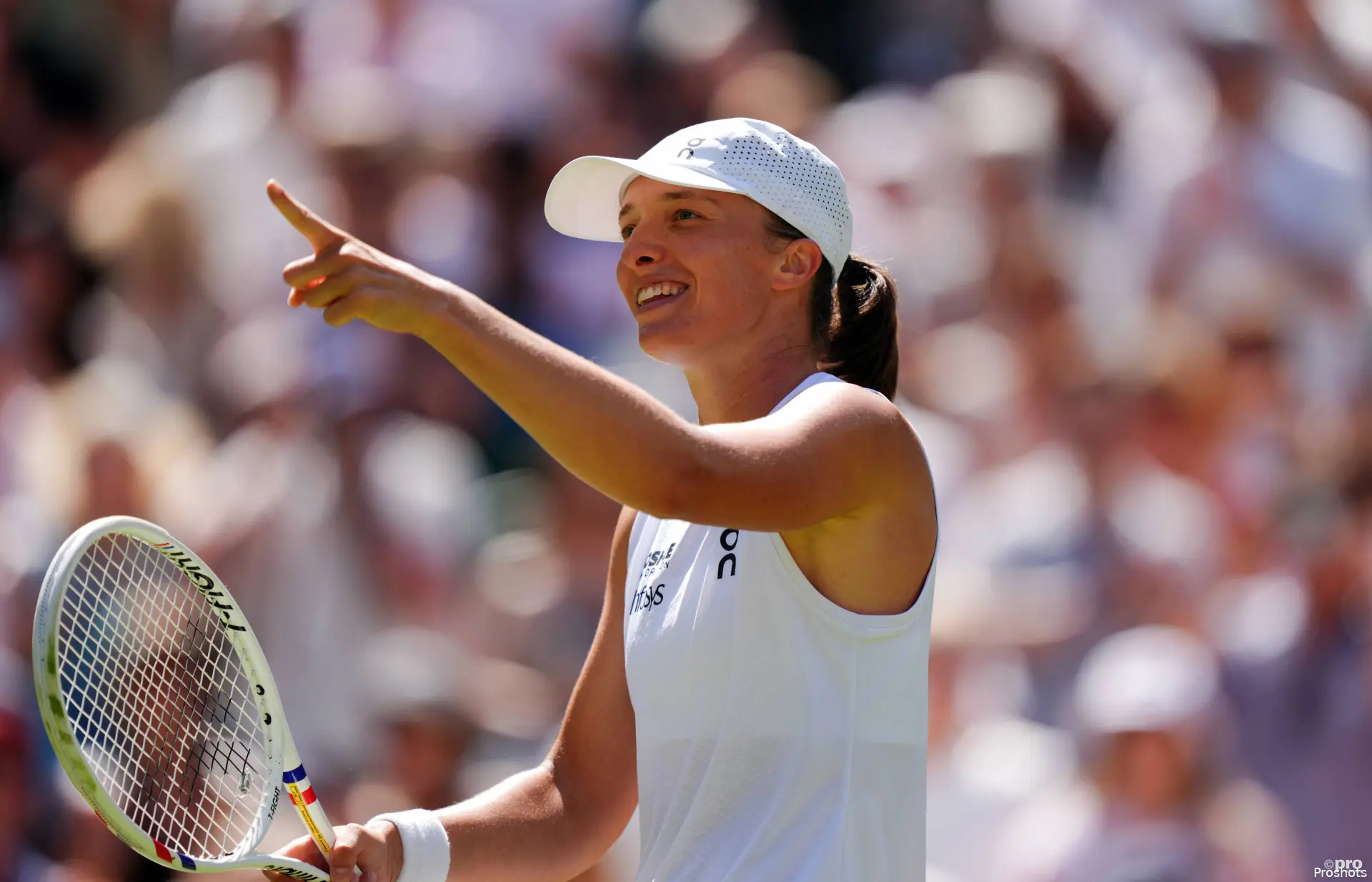
Iga Swiatek has no Grand Slam title this year, will miss the WTA Finals for the first time since 2020 and is ninth in the WTA rankings with 4,188 points. In the UTR women's ranking, she is No. 1. Her rating of 12.97 is the highest on the professional list, ahead of Coco Gauff (12.95) and Elena Rybakina (12.93), who is the world No. 1 in the WTA with 8,099 points.
The list also moves other names. Gauff is second, Marta Kostyuk is fourth and Linda Noskova is fifth, while Aryna Sabalenka, second in the WTA list with 6,485 points, is seventh. Naomi Osaka and Victoria Mboko, who are 16th and 20th in the WTA rankings, are ninth and tenth. Svitolina and Muchova, who qualified for the WTA Finals as the sixth and seventh players in the standings, do not appear in the UTR top 10.
A warning on how to read it: the entire top 10 is separated by only 0.19 rating points, from 12.97 to 12.78, and Swiatek leads Gauff by 0.02. UTR is not an official ranking and decides nothing, including the Indian Wells field. It is better read as a tight cluster of ten players than as a clear No. 1, but it is a useful second opinion on a season in which the WTA list and the court have not always agreed.
The WTA Finals take place November 8-15 in Indian Wells. Six of the UTR top 10 will be there, and the four who will not are Swiatek, Kostyuk, Osaka and Mboko.
How the UTR ranking works
The WTA ranking is a points system. It adds up the points a player earns at each tournament over the past 52 weeks, and the points depend on the level of the event and how far she goes. A title at a WTA 1000 is worth far more than a quarterfinal, whoever the opponents were.

Poland's Iga Swiatek celebrates her 6-2, 6-3 win over Kazakhstan's Elena Rybakina to clinch the National Bank Open final
UTR, the Universal Tennis Rating, works differently. It runs on a single scale from 1.00 to 16.50 and is built from individual match results. Each match produces a rating based on the share of games a player wins and on the rating of her opponent: winning more games than the algorithm expects raises the match rating, and the opponent's drops by the same amount.
A player's UTR is then a weighted average of up to 30 of her most recent matches, using only the last 12 months. Not all matches weigh the same. The weight is higher for longer formats, for opponents with a more reliable rating and for more recent matches, and lower for matches between players with very different ratings.
The result is a ranking that rewards how convincingly a player beats good opponents and how well she has played recently, and does not look at the tournament or how far she advanced. The "3-month trend" in the table below is the same idea over a shorter window.
UTR and WTA, side by side
| UTR rank | Player | UTR | 3-month trend | WTA rank | WTA points | WTA Finals |
| 1 | Iga Swiatek | 12.97 | 13.04 | 9 | 4,188 | Out |
| 2 | Coco Gauff | 12.95 | 12.99 | 4 | 5,763 | In |
| 3 | Elena Rybakina | 12.93 | 12.97 | 1 | 8,099 | In |
| 4 | Marta Kostyuk | 12.89 | 12.80 | 10 | 3,910 | Out |
| 5 | Linda Noskova | 12.84 | 12.87 | 8 | 4,343 | In |
| 6 | Mirra Andreeva | 12.84 | 12.83 | 3 | 6,306 | In |
| 7 | Aryna Sabalenka | 12.83 | 12.82 | 2 | 6,485 | In |
| 8 | Jessica Pegula | 12.81 | 12.81 | 5 | 5,760 | In |
| 9 | Naomi Osaka | 12.79 | 12.79 | 16 | 2,315 | Out |
| 10 | Victoria Mboko | 12.78 | n/a | 20 | 2,143 | Out |
The trend column tells a second story. Swiatek has the highest 3-month trend in the group, 13.04, which is above her current rating. Gauff (12.99) and Rybakina (12.97) are also trending up. Kostyuk is the one whose recent matches are rated clearly below her overall figure: 12.80 against 12.89.
Why Swiatek leads in a year without a major
Her season is a good example of how a rating and a ranking can disagree. She has a 39-15 record, after her Ningbo withdrawal, and one title, the Canadian Open, where she beat Rybakina 6-2, 6-3 in the final. She did not go past the quarterfinals at any of the four Grand Slams, so the streak of at least one major a year that she had kept for five years ended.

The points ranking punishes that clearly. Her results at the Slams, an Australian Open quarterfinal and exits in the round of 16 at Roland Garros and the round of 32 at Wimbledon, are not worth much, and her gap to Rybakina is 3,911 points.
UTR sees it differently. It rewards the share of games won against strong opposition and not the round reached, so a Canadian Open title over Rybakina and semifinals in Rome and Cincinnati weigh more than a few early exits. These are readings of how the rating is built, not a game-by-game breakdown of her season, which I could not check.
| Event | Swiatek in 2026 |
| Australian Open | Quarterfinal (lost to Rybakina 5-7, 1-6) |
| Roland Garros | Round of 16 (lost to Kostyuk 5-7, 1-6) |
| Wimbledon | Round of 32 (lost to Eala 6-7(9), 2-6) |
| Italian Open | Semifinal (lost to Svitolina 4-6, 6-2, 2-6) |
| Canadian Open | Champion (beat Rybakina 6-2, 6-3) |
| Cincinnati | Semifinal (lost to Pegula 5-7, 6-4, 4-6) |
| Wuhan | Semifinal (lost to Chwalinska 7-5, 6-1, with a thigh injury) |
The honest reading is that the numbers and the context point in two directions. UTR says her level, match for match, has stayed at the very top. The standings say that this level has not turned into the titles that carry the most points, and the thigh injury that ended her season in Ningbo only widens the gap.
Where the two rankings disagree most
Sabalenka is the clearest case. She is second in the WTA with 6,485 points after three titles (Brisbane, Indian Wells and Miami) and two Grand Slam finals, both lost to Rybakina, but is seventh in UTR with 12.83. She is 0.14 behind Swiatek and 0.12 behind Gauff. Gauff goes the other way: she is fourth in the WTA with 5,763 points, just three more than Pegula, yet second in UTR.

The biggest gaps belong to players who are far from the top of the WTA list. Kostyuk is fourth in UTR and 10th in the WTA with 3,910 points. Her Ningbo retirement is what sent Muchova to the Finals. Osaka (9th in UTR, 16th in the WTA) and Mboko (10th and 20th) make the top 10 with 2,315 and 2,143 points respectively, which suggests that their match results have been stronger than the points they have collected.
| Player | UTR rank | WTA rank | Difference (WTA minus UTR) |
| Victoria Mboko | 10 | 20 | +10 |
| Iga Swiatek | 1 | 9 | +8 |
| Naomi Osaka | 9 | 16 | +7 |
| Marta Kostyuk | 4 | 10 | +6 |
| Linda Noskova | 5 | 8 | +3 |
| Coco Gauff | 2 | 4 | +2 |
| Elena Rybakina | 3 | 1 | -2 |
| Mirra Andreeva | 6 | 3 | -3 |
| Jessica Pegula | 8 | 5 | -3 |
| Aryna Sabalenka | 7 | 2 | -5 |
A positive number means the player is rated better by UTR than by the WTA list. Six of the ten are in that group, and four are below, all of them players who qualified for Indian Wells and who have the titles that the points reward. Rybakina has two majors this year and is third in UTR, Andreeva has Roland Garros and is sixth, and Pegula has won Dubai and Charleston and is eighth.
The same logic applies to Svitolina and Muchova: with a Rome title and a Doha title, both WTA 1000 events, they are sixth and seventh in the WTA rankings but outside the UTR top 10.

Cristhián AvilaTennis Journalist
Cristhián Ávila is a tennis journalist based in Santiago, Chile, and has been part of the TennisUpToDate team since early 2023. He covers the ATP and WTA Tours as well as all four Grand Slams, producing breaking news, match reports, analysis, and regular liveblogs from major tournaments.
His reporting combines statistical analysis with clear explanation, helping readers understand tactical developments, player form, and broader storylines across the tour. Working fluently in both Spanish and English, Cristhián collaborates with an international editorial team and contributes to comprehensive global coverage. As part of his work, he has conducted interviews and media interactions with leading figures in the sport, including Caroline Wozniacki and John McEnroe.
In his journalism, Cristhián places strong emphasis on careful sourcing, editorial accuracy, and updating articles promptly when new, verified information becomes available. His coverage is grounded in research, context, and direct engagement with professional tennis.
claps 0visitors 0
Just In



Popular News
Latest Comments
- Vacherot is Mongasque, rather than Swiss. The tournament was Swiss :DTrwd7702-11-2026
- After a couple decades traveling to IIHF tourneys overseas... our family is done with it... and I will not be the only one!! Bad enough the NHL allows Ovachenko (a Putin Supporter and Campaigner) to live and play in the USA. Let's not forget the STATE SPONSORED RUSSIAN DOPING PROGRAMS still in effect today.
 mandoist31-10-2026
- Osaka's mental state apparently does not allow her to reach any more Quarter Finals? I mean, she doesn't really have the time for tennis with all the pre-planning that must go into her 12 year-old "fashion" goals.mandoist29-10-2026
- With her money one would think she could afford a better team of Psychiatrists?mandoist29-10-2026
- Boss move, Sinner !Rapunzel27-10-2026
- Apparently still refusing to seek 'help' ...and still playing Dress-Up like a 10 year-old.mandoist27-10-2026
- Lena... Takin' care of businessmandoist25-10-2026
- Can you please stop publishing this nonsense? Stick to Tennis.mandoist25-10-2026
- Does Sinner need that 4.5 mil? I doubt it. He can make that with three modelling gigs!😅🤣Rapunzel21-10-2026
- Did "People Magazine" purchase this website? This nonstop storyline is bullshit.mandoist21-10-2026
