“It was also painful”: Kim Clijsters reflects after Sinner overturns Alcaraz in Monte-Carlo final
ATPThursday, 16 April 2026 at 06:30
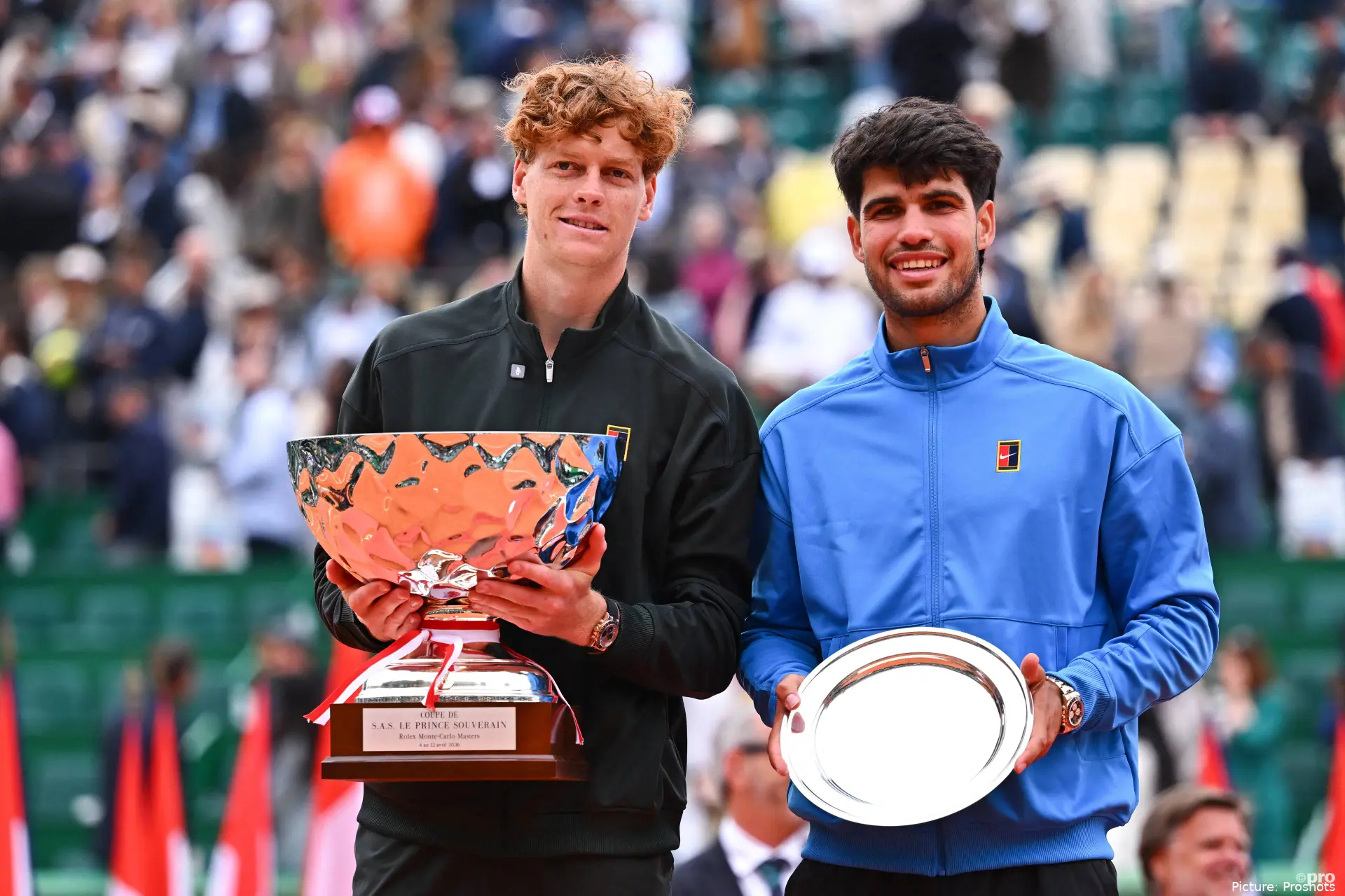
Kim Clijsters addressed the dynamic between Jannik Sinner and Carlos Alcaraz following the 2026 Monte-Carlo Masters final, where Sinner defeated Alcaraz 7-6(5), 6-3 to claim the title, return to World No. 1 and push the Spaniard down to No. 2 in the ATP rankings.
The result marked a significant shift in their rivalry. It was Sinner’s first Masters 1000 title on clay and his first win over Alcaraz in a clay-court final, reversing the outcome of the 2025 Roland Garros final. The Italian has now won Indian Wells, Miami and Monte-Carlo in succession, becoming only the second player after Novak Djokovic to complete that sequence in a single season.
Alcaraz arrived in Monte-Carlo as defending champion and had built much of his advantage over Sinner on clay, making the result particularly relevant in the context of their head-to-head. With both players consistently reaching the latter stages of Masters events, their meetings continue to shape the ranking battle at the top of the ATP Tour.
Clijsters’ focus moved beyond the result, pointing instead to the interaction between the two players. Their behaviour during and after matches, including Alcaraz remaining courtside during Sinner’s celebrations, has become a central element of how their rivalry is perceived.
Read also

A rivalry defined by proximity, not distance
Clijsters identified the Sinner–Alcaraz relationship as different from earlier rivalries, where leading players often maintained distance from each other off court. In this case, she noted a more open dynamic, visible in Monte-Carlo and across previous meetings.
She pointed out that this approach has generated discussion, particularly given the stakes involved when two players competing directly for the No. 1 ranking face each other in finals.
“Yeah, the conditions were tough. It was very windy. But people even talk about it and say it’s kind of weird to see a rivalry where you feel like they’re really good friends and there’s so much respect for each other.”
Clijsters contrasted this with past rivalries, where interactions were more limited and often shaped by competitive separation rather than familiarity.
“There have been so many rivalries where players can’t stand each other and try to stay away as much as possible. Whereas with these guys, they really embrace it. There’s a lot of respect, but they also enjoy it.”
The context of their recent meetings reinforces that contrast. Despite competing for the top ranking and splitting key results across surfaces, both players have maintained a consistent pattern of interaction that reflects mutual respect rather than distance.
The emotional cost remains unchanged
Clijsters emphasised that this visible respect does not reduce the internal demands of competition. The outcome of matches at this level continues to carry significant emotional weight, regardless of how players interact off court.
She referenced the Monte-Carlo final directly, where Alcaraz remained present during Sinner’s post-match celebrations, framing it as an example of behaviour that is both respectful and difficult. “Alcaraz actually stayed and watched the guy that just beat him celebrate. I was always good at giving my opponent their moment, but it was also painful.”
She added that reactions to this type of rivalry vary, with some preferring a more traditional dynamic between leading players. “To go and see them celebrate is something that is hurtful at times as well. Some people like that, and others say they want real rivalry.”
The result itself reinforces the competitive stakes behind these interactions. Sinner’s victory not only secured the Monte-Carlo title but also confirmed his ability to translate his hard-court dominance onto clay, a surface where Alcaraz had previously held the edge.
With the clay season continuing through Madrid and Rome before Roland Garros, both players are expected to remain central to the title race. Their consistency, combined with their head-to-head frequency in later rounds, continues to define the structure at the top of the ATP Tour.

Cristhián AvilaTennis Journalist
Cristhián Ávila is a tennis journalist based in Santiago, Chile, and has been part of the TennisUpToDate team since early 2023. He covers the ATP and WTA Tours as well as all four Grand Slams, producing breaking news, match reports, analysis, and regular liveblogs from major tournaments.
His reporting combines statistical analysis with clear explanation, helping readers understand tactical developments, player form, and broader storylines across the tour. Working fluently in both Spanish and English, Cristhián collaborates with an international editorial team and contributes to comprehensive global coverage. As part of his work, he has conducted interviews and media interactions with leading figures in the sport, including Caroline Wozniacki and John McEnroe.
In his journalism, Cristhián places strong emphasis on careful sourcing, editorial accuracy, and updating articles promptly when new, verified information becomes available. His coverage is grounded in research, context, and direct engagement with professional tennis.
claps 0visitors 0
Just In

Popular News

Latest Comments
- Let's not BS the general public -- Sabalenka started showing cracks in her game last season. Her losses and near-losses started at about the same time she began being distracted by Fame (constant Selfies, making TV commercials, magazine shoots, endless Social Media nonsense, etc., etc.) One would think even Saba could recognize the parallels with others who failed before her -- Raducanu, Giorgi, Bouchard to name a few.
 mandoist25-09-2026
 - Gross!! Hey Raducanu, Girogi, and Bouchard -- reserve a seat at your Social Media Selfie table for Saba + Naomi. They're heading in your direction soon enough.mandoist24-09-2026
- And then these same players will complain about how lengthy their season’s were and need more time-off. I’m all for more tennis but the amount of tennis we get now is actually kind of crazy! We all need a break, especially the players.DaveyWavey23-09-2026
- You should do a comparison article for "different kinds of justice" the courts decide for tennis players. I can think of at least three players who received very small bans of a few months, however Tara Moore has been fighting for her literal survival the past few years. It seems odd considering she is not a "name" player, unlike the other cases.DaveyWavey22-09-2026
- PRIZE MONEY & POINTS Winner - $185,500 Finalist - $114,500 Semi-Finalist - $66,003 Quarter-Finalist - $35,000 Round of 16 - $18,045 Round of 32 - $13,005 Winner - 500 Finalist - 325 Semi-Finalist - 195 Quarter-Finalist - 108 Round of 16 - 60 Round of 32 - 1DaveyWavey20-09-2026
- Pegula withdrew from this Singapore event
 tennishappens19-09-2026
 - Serena Williams chose her tournaments. It's not such a bad idea.MuswellHillbilly17-09-2026
- This child is just too fragile. Step away from tennis for a year. Get healthy, get fit; train hard;ranking be damned, and come back as strong contender. Anisimova did it. So can Emma.Rapunzel17-09-2026
- Double standards, what can be said!? Venus is p**ing on media and public. Can't face defeat. Cowerdness! Shouldn't be given any other wild cards ever. That's gross disrespect.DragosJacob16-09-2026
- Anywhere is better than Saudi Arabia!DaveyWavey16-09-2026

Loading