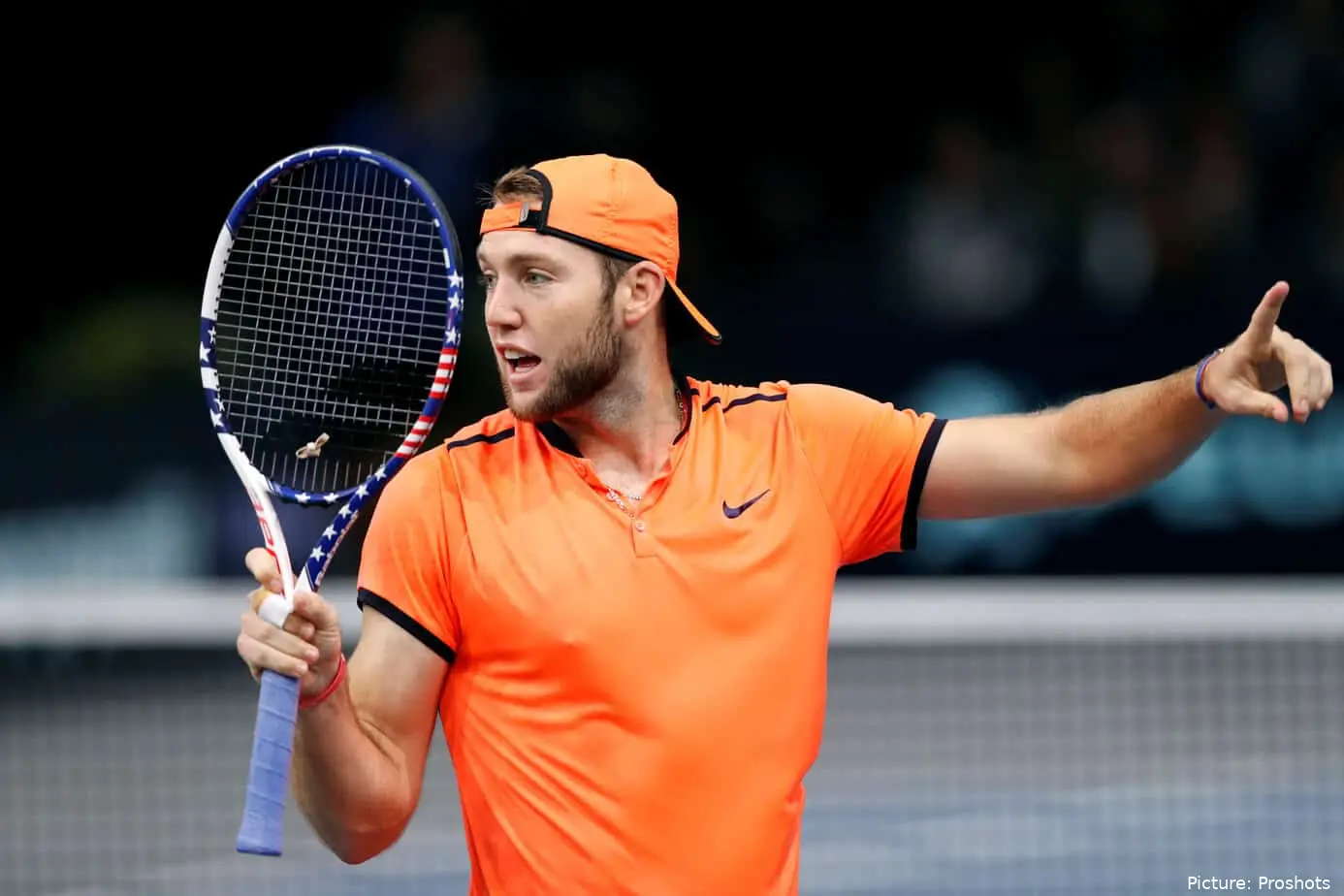
In November 2017, Jack Sock was the world No. 8 singles player, fresh off winning a Masters 1000 title and reaching the semifinals of the ATP Finals. Barely 12 months later, he had no singles ranking at all. Not a low ranking — none. Few careers in the modern game have gone from a genuine top-10 breakthrough to total freefall as quickly, or as strangely, as Sock's did.
What makes his story stand out isn't just the speed of the collapse. It's that while his singles career was disappearing, his doubles career was doing the exact opposite — rising to world No. 2 and producing back-to-back Grand Slam titles during that very same stretch. Two versions of the same player, moving in completely opposite directions at exactly the same time.
Jack Sock's career snapshot
| Achievement | Record |
| Career-high singles ranking | No. 8 (November 2017) |
| Career-high doubles ranking | No. 2 (September 2018) |
| ATP singles titles | 4, including Paris Masters 2017 |
| Grand Slam doubles titles | 4 (Wimbledon 2014 & 2018, US Open 2018, plus 2011 US Open mixed) |
| Olympic medals | 2 (mixed doubles gold, men's doubles bronze — Rio 2016) |
| Career singles record | 181–154 |
| Retired | September 2023, aged 30 |
The rise: a Masters 1000 title that came out of nowhere
Sock's path to the top wasn't a teenage prodigy story. He won the US Open boys' singles title in 2010, turned pro the following year, and built his game steadily, picking up his first tour-level singles title in Houston in 2015. By 2017, at 25, everything came together at once.
He won titles in Auckland and Delray Beach early in the year, then capped the season at the Paris Masters, beating Filip Krajinović in the final after saving a match point earlier in the tournament, to become the first American man to win a Masters 1000 title since Andy Roddick in 2010.
The win included a victory over then-world No. 3 Alexander Zverev, the best win of Sock's career, and it catapulted him into the ATP Finals for the only time, where he reached the semifinal. He ended 2017 at a career-high No. 8, the top-ranked American man in the world. It looked, at the time, like the start of a genuine run near the top of the sport.
The fastest fall from the world's top 10
It barely lasted a month. Sock opened 2018 as the defending champion and top seed in Auckland — and lost his first match in straight sets. The rest of the season followed the same script: persistent injuries, early exits, and almost none of the form that had carried him to No. 8. When he returned to Paris in November to defend his Masters title, he lost in the quarter-finals to Dominic Thiem, a result that dropped him out of the top 100 entirely, having started the season inside the top 10.
2019 was worse still. Sock lost all eight singles matches he played that year, several to opponents ranked outside the top 300, with his only win of any kind coming in an exhibition — the Laver Cup, which carries no ranking points. By the end of the season, he had fallen out of the ATP rankings system altogether. A player who had beaten a top-3 opponent to win a Masters title two years earlier no longer had a singles ranking to speak of.
Jack Sock's singles collapse, in numbers
| Year | Singles ranking | What happened |
| 2017 | No. 8 (career high) | Wins the Paris Masters; reaches the ATP Finals semi-final |
| 2018 | Outside the top 100 | Loses Auckland opener as defending champion; loses Paris Masters QF to Thiem |
| 2019 | Unranked | Loses all 8 singles matches played |
| 2022 | Outside the top 200 | Best late singles result: 3R Wimbledon |
| 2023 | No. 485 | Retires after the US Open, having survived mainly on wildcards |
The stranger part: his doubles career was peaking at the same time
Here is where Sock's story stops looking like a simple decline. In September 2018 — the same season his singles ranking was in free fall — he reached No. 2 in the world doubles rankings, partnering Mike Bryan to titles at both Wimbledon and the US Open that year. He was, for a stretch, one of only two active players competing at the ATP Finals in both singles and doubles, even as one half of that résumé was collapsing and the other was thriving.
That split personality defined the rest of his career. Singles never recovered in any meaningful way — he survived largely on wildcards from 2019 onward, with a third-round run at Wimbledon in 2022 standing out as his best result in years — while doubles remained the platform that kept him relevant on tour, right through to his final professional matches.
A wildcard existence, and a tearful goodbye
Sock spent his final tennis seasons as, essentially, a doubles specialist who occasionally still entered singles draws. He announced in August 2023 that the US Open would be his last tournament, timing his retirement alongside fellow big-serving American John Isner, with whom he'd first played the US Open as a 17-year-old. The two teamed up in men's doubles one final time, and Sock also played mixed doubles with Coco Gauff on his farewell day.
Fittingly for a career defined by near-misses in its second half, he served for both of his final matches and was broken each time, losing both. He left the court in tears to a standing ovation, 30 years old, with a singles ranking of 485 and a doubles ranking of 199 — numbers that told only part of the story of a player who had once beaten a top-3 opponent to win one of tennis's biggest non-major titles.
Life after tennis: pickleball, and no regrets
Sock didn't wait long to find his next competitive outlet. Within a day of his retirement announcement, he had signed with the Professional Pickleball Association tour, later explaining that fatherhood, more than a lack of tennis ambition, drove the decision — he wanted to be present at home rather than living out of a suitcase. By late 2025, he had climbed to around world No. 6 in pickleball singles, and said he felt increasingly confident a couple of years into the switch.
Asked to reflect on his tennis career, Sock didn't point to the Masters title or the Grand Slam doubles trophies as his proudest achievement — he named representing the United States at the 2016 Rio Olympics instead. It's a fitting note for a career that never quite followed the script: a singles run that vanished almost overnight, a doubles career that thrived in its shadow, and an ending that came not from injury or decline alone, but from a 30-year-old deciding, on his own terms, that there was somewhere else he'd rather be.

Cristhián AvilaTennis Journalist
Cristhián Ávila is a tennis journalist based in Santiago, Chile, and has been part of the TennisUpToDate team since early 2023. He covers the ATP and WTA Tours as well as all four Grand Slams, producing breaking news, match reports, analysis, and regular liveblogs from major tournaments.
His reporting combines statistical analysis with clear explanation, helping readers understand tactical developments, player form, and broader storylines across the tour. Working fluently in both Spanish and English, Cristhián collaborates with an international editorial team and contributes to comprehensive global coverage. As part of his work, he has conducted interviews and media interactions with leading figures in the sport, including Caroline Wozniacki and John McEnroe.
In his journalism, Cristhián places strong emphasis on careful sourcing, editorial accuracy, and updating articles promptly when new, verified information becomes available. His coverage is grounded in research, context, and direct engagement with professional tennis.
claps 0visitors 0
Just In

Popular News
Latest Comments
- great articlestennisseserver07-10-2026
- Medvedev was leading Djokovic 7-5, 3-5 when an attempted return..' NO you ignorants, Djokovic was leading .weiss05-10-2026
- No more bullshit "Wildcards" to these two. Qualify like everyone else -- there will be cameras there, too. Time to scream... WTF ????!!!!
 mandoist29-09-2026
 - Let's not BS the general public -- Sabalenka started showing cracks in her game last season. Her losses and near-losses started at about the same time she began being distracted by Fame (constant Selfies, making TV commercials, magazine shoots, endless Social Media nonsense, etc., etc.) One would think even Saba could recognize the parallels with others who failed before her -- Raducanu, Giorgi, Bouchard to name a few.mandoist25-09-2026
- Gross!! Hey Raducanu, Giorgi, and Bouchard -- reserve a seat at your Social Media Selfie table for Saba + Naomi. They're heading in your direction soon enough.mandoist24-09-2026
- And then these same players will complain about how lengthy their season’s were and need more time-off. I’m all for more tennis but the amount of tennis we get now is actually kind of crazy! We all need a break, especially the players.DaveyWavey23-09-2026
- You should do a comparison article for "different kinds of justice" the courts decide for tennis players. I can think of at least three players who received very small bans of a few months, however Tara Moore has been fighting for her literal survival the past few years. It seems odd considering she is not a "name" player, unlike the other cases.DaveyWavey22-09-2026
- PRIZE MONEY & POINTS Winner - $185,500 Finalist - $114,500 Semi-Finalist - $66,003 Quarter-Finalist - $35,000 Round of 16 - $18,045 Round of 32 - $13,005 Winner - 500 Finalist - 325 Semi-Finalist - 195 Quarter-Finalist - 108 Round of 16 - 60 Round of 32 - 1DaveyWavey20-09-2026
- Pegula withdrew from this Singapore event
 tennishappens19-09-2026
 - Serena Williams chose her tournaments. It's not such a bad idea.MuswellHillbilly17-09-2026

Loading