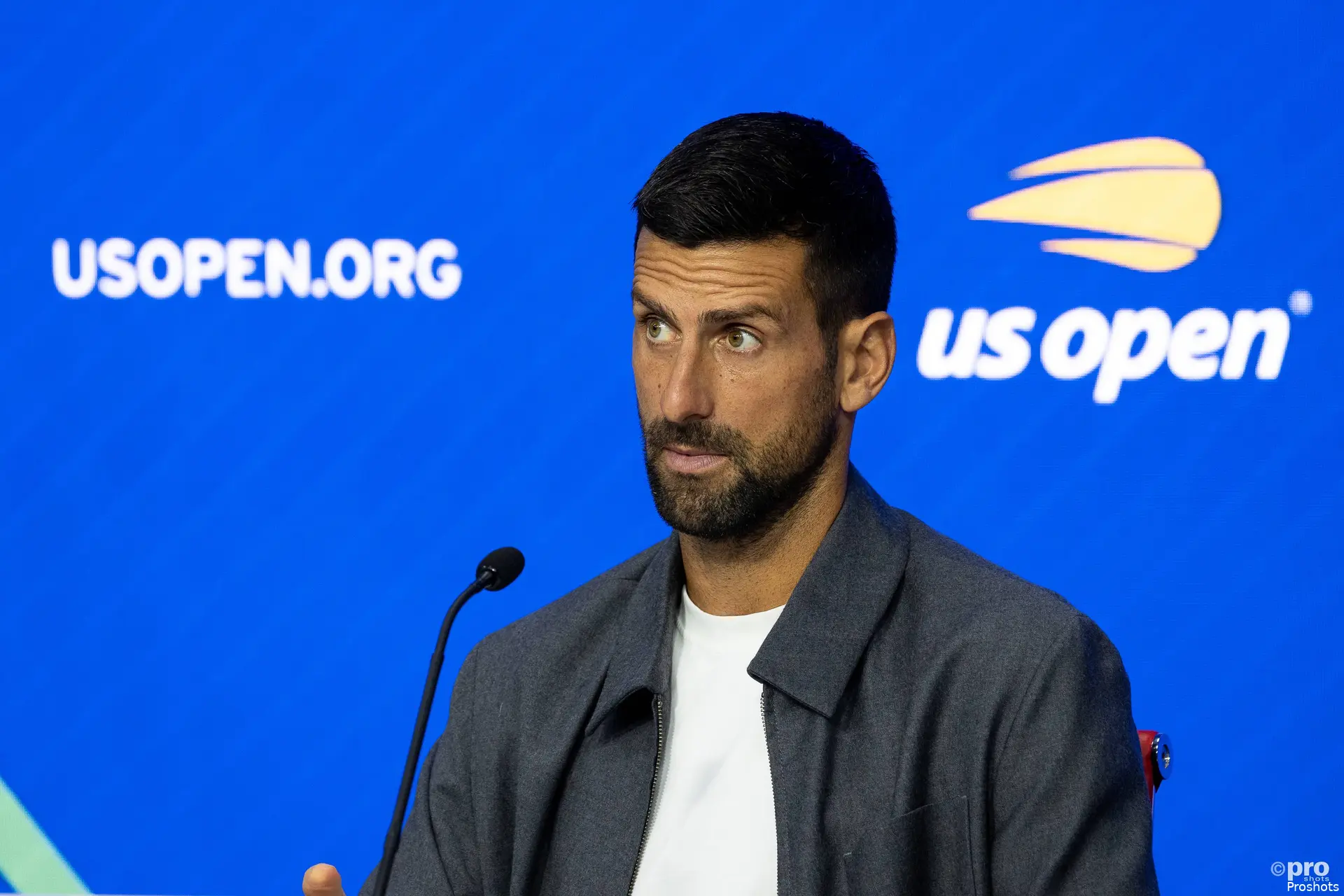
Novak Djokovic hasn't played the China Open since 2015. He's also lost his last two matches — a first-round exit in Cincinnati to Thiago Agustin Tirante, then a five-set collapse against Mariano Navone in the opening round of the US Open, 6-7, 7-5, 6-4, 2-6, 1-6. He enters Beijing this week ranked No. 11, out of the top 10 for the first time since 2018, and seeded sixth at a tournament where he has never lost a match.
That contradiction is the entire story of this week's China Open. On paper, a 39-year-old coming off back-to-back opening-round losses shouldn't be the headline of an ATP 500. But Djokovic's history in Beijing is strange enough, and his seeding low enough, that his return doesn't just add a storyline to the tournament — it rearranges the entire bottom half of the draw around him.
How Djokovic got here
The slide to No. 11 didn't happen overnight, but it accelerated fast. Djokovic's best result of 2026 came in January, when he reached the Australian Open final and lost to Carlos Alcaraz — still a strong result by any normal measure, but one that came without a single ATP title attached to the rest of his season.
He then went through the spring and summer accumulating quarterfinal and semifinal results without closing any of them out, culminating in a Wimbledon semifinal loss to Jannik Sinner that was, by his own admission, one of his more competitive matches of the year.
What followed was not competitive at all. Djokovic hasn't won a match since that Wimbledon semifinal. Cincinnati ended in the first round against Tirante, a player ranked well outside the top 50, and the US Open ended the same way against Navone, a match in which Djokovic led two sets to one before physically fading over the final two sets. He was visibly compromised, not just outplayed, which is why his own team flagged Beijing specifically as a target for a fitness reset rather than a routine tour stop.
That context matters for how to read this week. Djokovic isn't arriving in China chasing ranking points or trying to defend anything — this is his first Beijing appearance in eleven years, so there's no prior result on the line. He's chasing rhythm, and specifically chasing his 102nd tour-level title, which would move him within one of Roger Federer's all-time mark of 103. Beijing, of all the stops on the calendar, is the one place where recent form and this history don't obviously point in the same direction.
A record that borders on absurd
Here is the part that makes the sixth seeding almost comedic: Djokovic has played the China Open six times. He has won it all six times. His record at the event, dating back to his debut in 2009, sits at 29-0, and across those six title runs he dropped a total of two sets. No player in the Open Era has a comparable perfect record at a tournament played more than five times.
The list of runner-ups reads like a murderers' row of the sport's last two decades — Rafael Nadal twice, Andy Murray, Tomas Berdych, David Ferrer, Jo-Wilfried Tsonga, Marin Cilic. Djokovic didn't back into this record against weak fields; he went through legitimate contenders every year and still never lost, which is part of why he's described the streak, more than once, as one of the accomplishments he's proudest of in his career.
Djokovic has been candid about why Beijing works for him specifically: the rhythm of the swing, the conditions on the center court, and — by his own account — a level of comfort and support in China that he says compares to almost nowhere else on tour. None of that guarantees anything in 2026, coming off two brutal losses and an eleven-year layoff from the venue. But it's the one data point in this preview that actively contradicts everything else being said about his season right now.

Djokovic's six China Open titles
| Year | Final opponent | Score |
| 2009 | Marin Cilic | 6-2, 7-6 |
| 2010 | David Ferrer | 6-2, 6-4 |
| 2012 | Jo-Wilfried Tsonga | 7-6, 6-2 |
| 2013 | Rafael Nadal | 6-3, 6-4 |
| 2014 | Tomas Berdych | 6-0, 6-2 |
| 2015 | Rafael Nadal | 6-2, 6-2 |
The draw itself
Djokovic opens Wednesday against Nuno Borges, and this is not an unfamiliar matchup — the two met exactly once before, in the final of Athens last year, where Djokovic won 7-6(1), 6-4 to collect his 101st career title. Borges has made a point this week of noting that he had break points in that first set, and that the pressure sits with Djokovic given the state of his last two results, a dynamic no-lucky first-round opponent usually gets to lean into publicly.
Survive Borges, and the second round brings either Juan Manuel Cerundolo or wildcard Bu Yunchaokete, both very much winnable matches on paper for a healthy Djokovic. The complication is what waits in the quarterfinals: top seed Alexander Zverev, who inherited the No. 1 seeding after Jannik Sinner withdrew from the tournament with an ongoing knee issue.
Zverev opens against Cameron Norrie and is a three-time Beijing semifinalist himself, meaning both players in a potential quarterfinal have a track record at this specific event, just not against each other in this specific building.
Beyond that, the draw only gets heavier. A semifinal would likely mean third seed Daniil Medvedev — who beat Zverev in Beijing last year — or eighth seed Jakub Menšík, two players with very different games but both capable of ending a run built on adrenaline rather than form. A final would put Djokovic across the net from second seed Félix Auger-Aliassime or one of fifth seed Alex de Minaur and fourth Flavio Cobolli. It's about as difficult a path as a 39-year-old coming off consecutive first-round losses could be handed.
Djokovic's projected path
| Round | Likely opponent(s) |
| R1 | Nuno Borges |
| R2 | Juan Manuel Cerundolo |
| QF | Alexander Zverev (1) |
| SF | Daniil Medvedev (3) or Jakub Menšík (8) |
| F | Félix Auger-Aliassime (2), Alex de Minaur (5), or Flavio Cobolli (4) |
The Zverev question
If the draw holds, the quarterfinal is the match that actually decides how seriously to take this week. Djokovic leads Zverev 9-5 in their head-to-head, and their most recent meeting, at Roland Garros in 2025, went the Serbian's way. On hard courts specifically the record still favors Djokovic (7-4), though by a tighter margin than the overall number suggests, and Zverev has been the more physically dominant player in their last several meetings even when he hasn't won.
What makes this matchup interesting beyond the raw numbers is timing. Zverev arrives with a full hard-court season behind him and the No. 1 seeding by default rather than by beating Sinner for it, while Djokovic arrives with almost no hard-court form at all since the US Open disaster. A quarterfinal between them in Beijing would be less a continuation of their rivalry and more a genuine test of whether Djokovic's body can hold up across three rounds in a row, something neither Cincinnati nor New York suggested was currently true.
Zverev has the pressure of proving that he can genuinely compete for the world No. 1 ranking, and he has not had much success against the best players this season. He owns a 2-8 record against Top 10 opponents, and while Djokovic has recently dropped outside that group, the Serbian still represents a high-level test for Zverev to show that his strong form is not simply a product of injuries to Sinner and Alcaraz.

Why this week matters more than a typical ATP 500
Djokovic said outright that Beijing had been on his 2026 priority list for years, unable to fit it around his schedule until now, which tells you this isn't a tournament he's treating as a throwaway stop during a rough patch. For a player chasing his 102nd title and closing in on Federer's all-time mark, a venue with a 29-0 record attached to it is about as favorable a place as exists on the calendar to try to end a two-match losing streak.
There's also a psychological angle specific to 2026. Losing in the first round of consecutive tournaments, at his age and after the year he's had, invites exactly the retirement speculation that followed him out of New York.
Read also
A strong result in Beijing — even a run to the quarterfinals against Zverev rather than a title — would blunt a lot of that narrative heading into the rest of the Asian swing and, eventually, the ATP Finals conversation, where his ranking currently sits outside the automatic qualification picture.
And there's the matter of the field itself. With Sinner out and Alcaraz not entered, Beijing's top half is more open than it looks on paper, which raises the stakes on whatever Djokovic does in his own quarter regardless of the outcome against Zverev. A win there would be the most significant result of his season not measured in Grand Slam rounds. A loss, especially an early one to Borges, would be very hard to spin as anything other than confirmation of the pattern set in Cincinnati and New York.

Cristhián AvilaTennis Journalist
Cristhián Ávila is a tennis journalist based in Santiago, Chile, and has been part of the TennisUpToDate team since early 2023. He covers the ATP and WTA Tours as well as all four Grand Slams, producing breaking news, match reports, analysis, and regular liveblogs from major tournaments.
His reporting combines statistical analysis with clear explanation, helping readers understand tactical developments, player form, and broader storylines across the tour. Working fluently in both Spanish and English, Cristhián collaborates with an international editorial team and contributes to comprehensive global coverage. As part of his work, he has conducted interviews and media interactions with leading figures in the sport, including Caroline Wozniacki and John McEnroe.
In his journalism, Cristhián places strong emphasis on careful sourcing, editorial accuracy, and updating articles promptly when new, verified information becomes available. His coverage is grounded in research, context, and direct engagement with professional tennis.
claps 0visitors 0
Just In

Popular News

Latest Comments
- Does Sinner need that 4.5 mil? I doubt it. He can make that with three modelling gigs!😅🤣Rapunzel21-10-2026
- Did "People Magazine" purchase this website? This nonstop storyline is bullshit.
 mandoist21-10-2026
 - Listen... this is of no concern to anyone but these two. Deal with your own issues -- most of us have our own. Thanks, media, for these insignificant follow-ups which are meaningless.mandoist21-10-2026
- This is so very very sad, for all three of them. I truly thought they had an unbreakable bond, but life throws up so many differing challenges. Having your homeland suffering in such a terrible way, makes happiness lose out to guilt as well. Our thoughts are with them. X💔bjsexton20-10-2026
- I have lost all respect for Svitolina! Could she not have waited until he had played at the Paris Masters!!! She is selfish and don't give a damn about Gael. That is NOT how love is demonstrated Elina!!Rapunzel19-10-2026
- Perhaps convenient tennis tour sex is not a strong enough experience in which to base a marriage?mandoist19-10-2026
- Fight the Good Fight... Tennis (sports in general) need more Humans such as yourself.mandoist18-10-2026
- When is WTA going to mandate Genetic Testing (DNA) ???mandoist18-10-2026
- Hey, Dan... you just wake up from a coma? Regardless -- Thanks for the comedy this morning!mandoist18-10-2026
- Two Things: 1. Stop allowing these Spoiled Trust-Fund Elitists to behave badly. Your little hand-slaps do not deter them. 2. STOP the incessantly annoying "towel wiping" nonsense!!!!mandoist15-10-2026

Loading