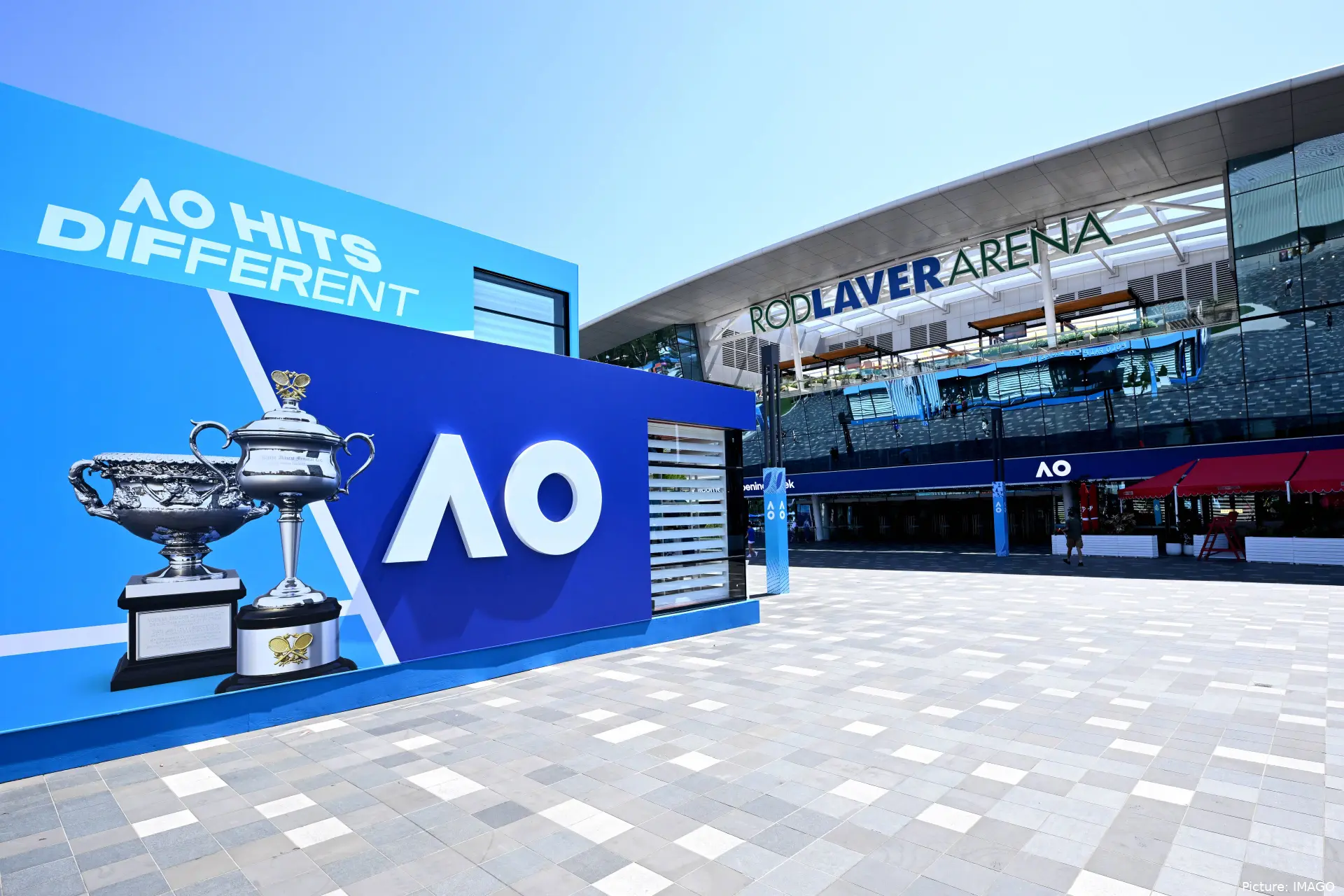
The Australian Open has a slightly different feeling from the other Grand Slams. It’s the first big test of the year, where everyone arrives with fresh legs and a clear mind, bracing for Melbourne heat that can turn a normal match into a survival contest. This year the AO is leaning toward the opening week, the prize money has jumped again, and the men’s title race is being framed more and more as a two man battle.
The main draw begins on Sunday, January 18th, 2026, and the tournament runs through to Sunday, February 1st, 2026, with the women’s final on Saturday night, January 31st and the men’s final on Sunday night, February 1st, 2026.
The schedule is the usual Slam rhythm: first round over three days, then the field slowly thins until quarterfinal week and finals weekend. Qualifying takes place during the week before the main draw, and organizers have been pushing the idea of Melbourne Park being more “open” earlier, with practice viewing and extra events in the build up.
What Really Decides Matches in Melbourne?
The Australian Open is played at Melbourne Park on hard courts. It’s a surface that usually rewards clean serving, early striking, and the ability to defend without panicking when the points turn to rallies. The men still play best of five sets, which is why stamina and injury management play a crucial part in the tournament.
The current format is also why some players who look unbeatable in a warm up tournament can still get dragged into five set chaos in later rounds.
For fans who are looking for how to bet on the Australian Open, there are a few dates to keep in mind. The draw is scheduled for Thursday, January 15th at 2:30pm local Melbourne time, which is when you finally get clarity on who is landing in whose quarter. And the key stage dates, fourth round weekend, quarterfinals, then semifinals are the moments when outright markets tend to move fast. Prize money is another quiet storyline because it affects everything from player motivation in early rounds to the broader politics of the tour.
The Australian Open announced a record total prize pool of A$111.5 million and the singles champions will earn A$4.15 million each.
Form Guide Heading into Melbourne
The tricky part of previewing a Slam is that you want “real matches”, but you don’t want to overreact to a single hot week in January. Still, some warm up results could present some useful information.
On the women’s side, the biggest favorite so far is Aryna Sabalenka who is arriving with momentum. She won the Brisbane International without dropping a set, beating Marta Kostyuk 6-4, 6-3 in the final.
That doesn’t automatically mean she wins Melbourne, but it does paint a picture of a tennis player who hits the ball cleanly with great precision and is handling the pressure with poise.
Iga Swiatek comes in with a different kind of mindset, focusing on technical improvement rather than on results. She had another long year and a demanding schedule. Swiatek played the United Cup, losing the final to Belinda Bencic, but at least she had some kind of warm up before the Grand Slam. On the men’s side, Daniil Medvedev has already lifted a trophy in Australia, winning the Brisbane Open by beating Brandon Nakashima 6-2, 7-6(1) making him one of the favorites to go deep into the championship in the Australian Open sportsbook. Prep on the hard court is exactly what Medvedev needed, confidence in long rallies, and a reminder that he can close big matches again.
And then there’s the headline rivalry: Carlos Alcaraz vs Jannik Sinner. They opened their year with an exhibition match in South Korea that Alcaraz won in two tight sets, which doesn’t “prove” anything on its own, but it goes to show how closely matched they are.
Key Player Performances and Storylines to Watch
Jannik Sinner is chasing a three peat feeling
Sinner is the defending champion and the man the market is treating as the center of the tournament. The key question isn’t whether his level is Slam winning, he’s already shown it in Melbourne, it’s whether he arrives sharp enough early. In best of five, being slightly undercooked can still be dangerous if you run into a big server or a fearless hitter in round one or two.
Stake.com market reflects that respect very clearly. In the Australian Open Men’s Singles 2026 winner market, Sinner is priced at 1.88. That is not a “normal favorite” price for a Slam. That is the sportsbook basically saying: “The winner is likely the person who beats him”, unless he wins it himself.
Carlos Alcaraz and the pressure of being No. 1
Alcaraz arrives as the top seed with the burden of missing the AO title to complete the career set. The Spaniard is coming into this season with a new coach after ending his long partnership with Juan Carlos Ferrero. This kind of shake up can either free the player to try some new strategies or disturb his confidence in critical moments of the match.
For now, in the sportsbooks Alcaraz is the clear second favorite at 2.60 odds.
That gap of Sinner being at 1.88, and Alcaraz at 2.60 is telling us that the real battle is going to unfold between these two players.
Novak Djokovic as the “do you dare” bet
Djokovic’s Australian Open history is impossible to ignore, but the market is no longer treating him like the default king of Melbourne. On Stake he’s sitting at 15.00 in the outright winner market.
However, his 10 Australian Open men's singles titles stand as an alltime record for men and an Open era record for any player, where he has won a staggering 91% of his AO matches.
The fact that fans and punters don’t give him much chance of winning this year is reasonable and is considered to be a “respectful doubt”. If you’re the kind of bettor who likes narrative and experience, this is the spot where you start thinking about whether there’s still one more deep run in him, especially if the draw breaks kindly. Keep in mind that Djokovic is 39 years old and would have to beat players who are almost half his age.
Aryna Sabalenka is arriving with form and hunger
Sabalenka isn’t the defending champion, which makes a difference in the player’s mental state. Still, Sabalenka got over last year’s final loss and finished 2025 with major success, then began 2026 by winning Brisbane without dropping a set and setting the stage for what’s possibly to come.
Stake has her as the women’s favorite at 3.00. In women’s Slams, being at 3.00 means the fans are convinced that Sabalenka is a true favorite and the player to beat in 2026.
Swiatek and the career-Slam gap
Swiatek’s story is simple: she has won majors on other surfaces, but Melbourne is the missing piece, and she’s trying to arrive with the right mindset rather than forcing the moment. She is trying to focus on her play and fitness along with giving her all on the court. Beyond that she can only let the chips fall where they may.
Stake prices her at 6.00, the clear second favorite behind Sabalenka. If she manages to keep the form and not let Sabalenka get into her head, Swiatek might have a real shot at the title.
Coco Gauff, Elena Rybakina and the power cluster
One reason the women’s market is interesting is how quickly it bunches. On Stake, Coco Gauff is 9.00 and Elena Rybakina is also 9.00, meaning that punters don’t see them as favorites, but they will surely play some interesting and intense matches in Melbourne.
The Tournament Favorites
Odds move constantly, but it helps to anchor yourself with a clear snapshot of where the market is right now. In the Stake’s Men’s Singles winner market, the top of the board is essentially Sinner and Alcaraz, and then a steep drop. Sinner is standing at 1.88, Alcaraz 2.60, then Zverev 12.00, Djokovic 15.00, and Medvedev 21.00.
In the Women’s Singles winner market, the top tier is tighter: Sabalenka 3.00, Swiatek 6.00, then Gauff 9.00 and Rybakina 9.00, with Amanda Anisimova 11.00, Mirra Andreeva 15.00, Naomi Osaka 17.00, and defending champ Madison Keys 19.00.
Those numbers are more than just prices. They’re a map of what the betting public and the book both believe. On the men’s side, it’s “two players, then everyone else”. On the women’s side, it’s “one clear favorite, one strong challenger, then a cluster that can absolutely win if the draw and form line up”.
Market Movement and What’s Driving It in the Final Week
Even without staring at every hourly adjustment, you can usually explain the market’s direction by looking at the week’s biggest triggers: warm up titles, injury news, and draw placement.
Sabalenka’s Brisbane title is a perfect example of the kind of result that tends to shorten a favorite or at least keep them firmly on top, because it confirms fitness and sharpness. Swiatek playing meaningful matches at the United Cup also keeps her price honest, because she’s obviously arriving ready to take on any challenge.
On the men’s side, Medvedev winning Brisbane is the type of thing that often sparks interest, but it’s telling that on Stake he’s still 21.00. That suggests the market still sees his path as hard: best of five, the likely need to beat at least one of the top two, and the physical grind of Melbourne.
Generally, sportsbooks are marking this to be mostly the Alcaraz-Sinner era that will keep the numbers mostly unchanged, at least when it comes to Grand Slams.
Picks And Predictions Based on the Draw
This is the part where being honest matters: your prediction before the draw is really a prediction about power level, not the exact path. Once the draw lands, everything becomes more specific. Still, here’s the clean way to read it right now.
On the men’s side, Jannik Sinner is the simplest “if you’re forcing a pick” choice, because his game style fits Melbourne, he’s already proven he can win here, and Stake’s 1.88 price shows how strongly the market agrees.
If you want the “main challenger,” it’s Carlos Alcaraz at 2.60. He can win this championship. The question is whether he can stay calm through the messy matches like the four set tests where he has a dip, loses focus for 20 minutes, and suddenly the match is on fire.
If you’re looking for a value bet among the elite names, Medvedev at 21.00 is the kind of number that becomes interesting if the draw opens up and the top two land in the same half. He has already shown, again, that he can win big matches on Australian hard courts this month.
On the women’s side, the straightforward pick is Aryna Sabalenka, because she’s the favorite at 3.00 and she’s coming from the Brisbane run where she didn’t drop a set. She has the power to hit through the court even when conditions get heavy, and in Melbourne that’s often the case.
If you want the “highest quality challenger”, it’s Swiatek at 6.00, especially because she’s openly focused on improving and has already been in competitive matches this month, while for the spicier bets, Gauff and Rybakina are where the market starts to offer genuine upside.
In a women’s Slam, one clean two week serving stretch from either of them can be enough to win the whole thing.
Betting Angles Beyond the Outright Winner
The outright markets are fun, but they’re also the hardest place to be perfect because the bet has to survive two weeks of random chaos. The heat and best of five format often create swingy in play moments, especially when a player wins a tight first set and then relaxes for 20 minutes. That’s where live markets can become more valuable than pre match picks.
Once the draw is out on January 15th, the most practical betting shift is moving from “who wins the tournament” to “who wins the quarter” or “who reaches the semifinal” because then you’re betting against a smaller slice of the field and a clearer path.

Samuel GillEditor-in-Chief
Samuel Gill is the Chief Content Officer (CCO) of TennisUpToDate.com, a role he has held since 2020. He is responsible for editorial governance across the platform, including setting content standards, overseeing accuracy and consistency, and guiding long-term editorial strategy. Since joining, he has contributed more than 10,000 articles and editorial pieces across the TennisUpToDate network, playing a central role in the daily operation and development of the site.
Based in Leicester, Samuel has a broad background in tennis media. In his current role, he works closely with editors and writers to ensure coverage meets clear journalistic standards, with particular attention to verification, consistency, and timely updates when new information becomes available.
claps 0visitors 0
Just In


Popular News
Latest Comments
- A healthy Qinwen may be hard to stop next season. She was already scaring her opponents before her medical leave(s). Unfortunately, Zheng insisted on singing again. On the positive side -- Mirra did not sing!! ;~}
 mandoist11-10-2026
 - Where is it written that athletes, entertainers... People in general... are mandated to keep looking at -- or even using [anti]Social Media? Public & private figures consistently complain and reveal their concerns about negativity and violence thrown at them -- yet they insist on participating. Avoid it, don't use it, don't read it. It's okay to occasionally look up at the World instead beating your eyes & thumbs to death on The Inventions out there.mandoist11-10-2026
- great articlestennisseserver07-10-2026
- Medvedev was leading Djokovic 7-5, 3-5 when an attempted return..' NO you ignorants, Djokovic was leading .weiss05-10-2026
- No more bullshit "Wildcards" to these two. Qualify like everyone else -- there will be cameras there, too. Time to scream... WTF ????!!!!mandoist29-09-2026
- Let's not BS the general public -- Sabalenka started showing cracks in her game last season. Her losses and near-losses started at about the same time she began being distracted by Fame (constant Selfies, making TV commercials, magazine shoots, endless Social Media nonsense, etc., etc.) One would think even Saba could recognize the parallels with others who failed before her -- Raducanu, Giorgi, Bouchard to name a few.mandoist25-09-2026
- Gross!! Hey Raducanu, Giorgi, and Bouchard -- reserve a seat at your Social Media Selfie table for Saba + Naomi. They're heading in your direction soon enough.mandoist24-09-2026
- And then these same players will complain about how lengthy their season’s were and need more time-off. I’m all for more tennis but the amount of tennis we get now is actually kind of crazy! We all need a break, especially the players.DaveyWavey23-09-2026
- You should do a comparison article for "different kinds of justice" the courts decide for tennis players. I can think of at least three players who received very small bans of a few months, however Tara Moore has been fighting for her literal survival the past few years. It seems odd considering she is not a "name" player, unlike the other cases.DaveyWavey22-09-2026
- PRIZE MONEY & POINTS Winner - $185,500 Finalist - $114,500 Semi-Finalist - $66,003 Quarter-Finalist - $35,000 Round of 16 - $18,045 Round of 32 - $13,005 Winner - 500 Finalist - 325 Semi-Finalist - 195 Quarter-Finalist - 108 Round of 16 - 60 Round of 32 - 1DaveyWavey20-09-2026

Loading