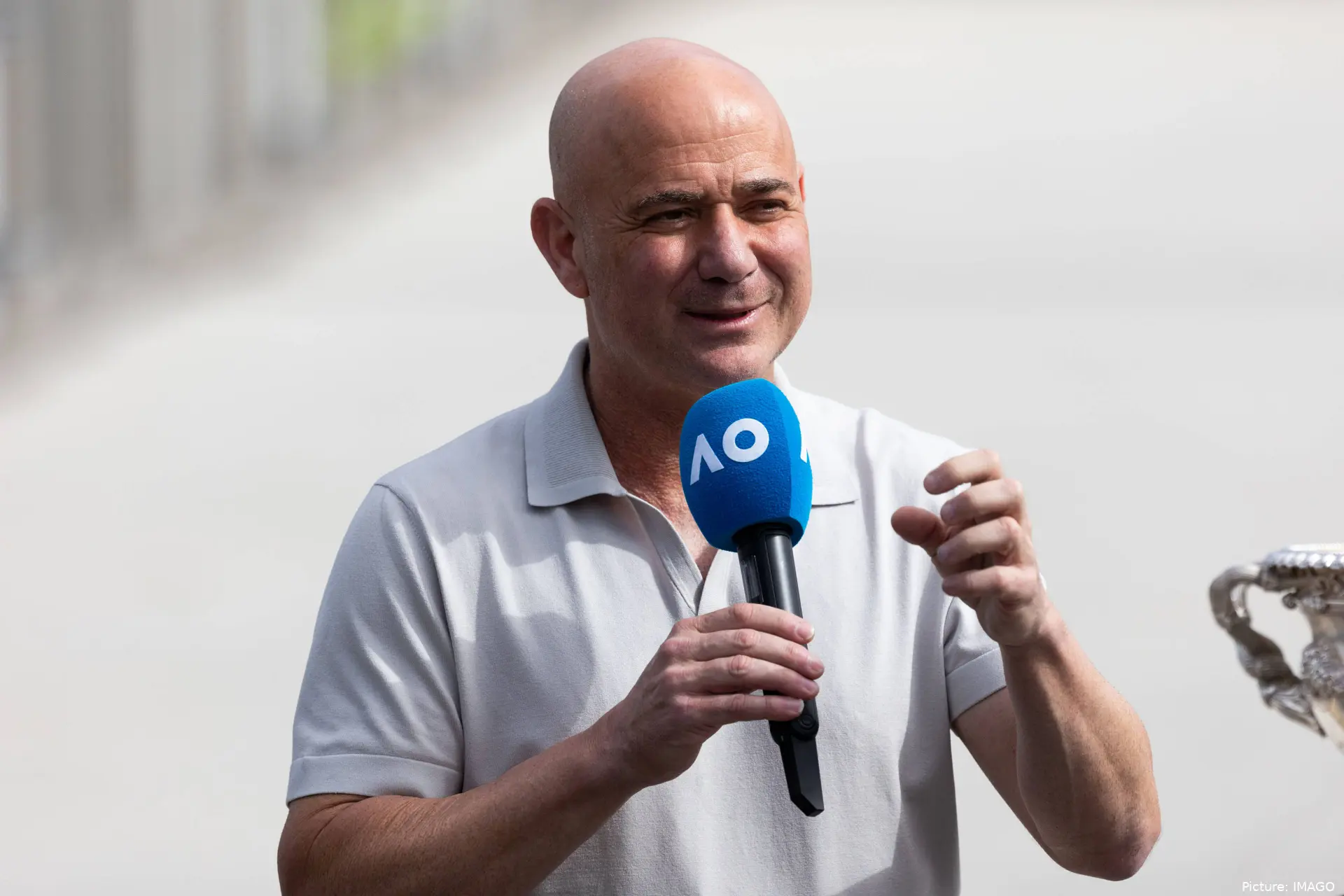
Andre Agassi and Eugenie Bouchard headline the latest edition of the Pickleball Slam, an event that continues to position itself at the intersection of tennis legacy and pickleball’s rapid expansion. The fourth edition of the exhibition, staged in Florida and broadcast on ESPN, maintains its established formula: combining recognisable tennis figures with emerging names from the newer discipline.
Agassi, an eight-time Grand Slam champion, enters as the central figure once again, having won all three previous editions of the event. Now partnering former ATP world No. 4 James Blake, he leads the “tennis side” of a format explicitly designed to test whether elite racket-sport experience can offset specialist knowledge of pickleball.
Bouchard, a former Wimbledon finalist and ex-world No. 5, represents a more recent crossover case. Unlike Agassi, whose involvement comes post-retirement, Bouchard’s transition has been more fluid, maintaining relevance within tennis media while actively competing within pickleball structures, including the PPA Tour.
The event itself retains a simplified competitive structure, featuring two singles matches followed by a decisive doubles encounter. Each singles match carries one point, with doubles worth two, ensuring that the final result remains open until the closing stages of the contest, a format deliberately designed for broadcast engagement.
Tennis pedigree remains the backbone of the event
Despite the inclusion of dedicated pickleball players, the Pickleball Slam continues to rely heavily on tennis identity to define its narrative. Agassi’s presence, in particular, serves as both competitive anchor and commercial driver, reinforcing the event’s positioning as a crossover spectacle rather than a pure pickleball contest.
The American has framed his involvement as part of a broader engagement with the sport, acknowledging both its growth and its distinct place relative to tennis.
“I believe pickleball and tennis have had their share of frustrations early on," Andre Agassi said according to New York Times. "But I think the growth is undeniable. Tennis players are a lot more secure in tennis being the Everest of racket sports, and pickleball has its own place in the community.”
That perspective reflects a wider shift among former tennis players, many of whom have moved from initial scepticism to active participation or investment. For Agassi, the Pickleball Slam operates less as a competitive pivot and more as an extension of his presence within racket sports.
His pairing with Blake reinforces that dynamic, with both players relying on transferable skills—court positioning, anticipation, and shot tolerance—while adapting to the shorter court dimensions and faster exchanges characteristic of pickleball.
Bouchard bridges tennis relevance and pickleball transition
Bouchard’s role within the event is structurally different, positioned between two competitive ecosystems. Her transition into pickleball has been more direct, competing within the professional circuit while maintaining her identity as a tennis player, both in media and public perception.
Her assessment of the relationship between the two sports highlights key structural differences, particularly in accessibility and development pathways. “I’m a tennis player at heart. I love the traditions of tennis and the history of our game. But at the same time, it is such a long learning curve to be good at tennis.”
She also emphasised that the growth of pickleball does not inherently threaten tennis, framing the two as parallel rather than competing systems. “There are stories of people going from tennis to pickleball, but what if a kid starts in pickleball and goes over to tennis? I think it’s a big world and there’s room for everybody.”
Within that framework, the Pickleball Slam continues to function as a hybrid platform. While the inclusion of players such as Anna Leigh Waters signals the sport’s attempt to establish its own hierarchy, the event’s core appeal remains tied to tennis—its names, its narratives, and its ability to translate established star power into a new competitive environment.


Cristhián AvilaTennis Journalist
Cristhián Ávila is a tennis journalist based in Santiago, Chile, and has been part of the TennisUpToDate team since early 2023. He covers the ATP and WTA Tours as well as all four Grand Slams, producing breaking news, match reports, analysis, and regular liveblogs from major tournaments.
His reporting combines statistical analysis with clear explanation, helping readers understand tactical developments, player form, and broader storylines across the tour. Working fluently in both Spanish and English, Cristhián collaborates with an international editorial team and contributes to comprehensive global coverage. As part of his work, he has conducted interviews and media interactions with leading figures in the sport, including Caroline Wozniacki and John McEnroe.
In his journalism, Cristhián places strong emphasis on careful sourcing, editorial accuracy, and updating articles promptly when new, verified information becomes available. His coverage is grounded in research, context, and direct engagement with professional tennis.
claps 0visitors 0
Just In



Popular News
Latest Comments
- Lena... Takin' care of business
 mandoist25-10-2026
 - Can you please stop publishing this nonsense? Stick to Tennis.mandoist25-10-2026
- Does Sinner need that 4.5 mil? I doubt it. He can make that with three modelling gigs!😅🤣Rapunzel21-10-2026
- Did "People Magazine" purchase this website? This nonstop storyline is bullshit.mandoist21-10-2026
- Listen... this is of no concern to anyone but these two. Deal with your own issues -- most of us have our own. Thanks, media, for these insignificant follow-ups which are meaningless.mandoist21-10-2026
- This is so very very sad, for all three of them. I truly thought they had an unbreakable bond, but life throws up so many differing challenges. Having your homeland suffering in such a terrible way, makes happiness lose out to guilt as well. Our thoughts are with them. X💔bjsexton20-10-2026
- I have lost all respect for Svitolina! Could she not have waited until he had played at the Paris Masters!!! She is selfish and don't give a damn about Gael. That is NOT how love is demonstrated Elina!!Rapunzel19-10-2026
- Perhaps convenient tennis tour sex is not a strong enough experience in which to base a marriage?mandoist19-10-2026
- Fight the Good Fight... Tennis (sports in general) need more Humans such as yourself.mandoist18-10-2026
- When is WTA going to mandate Genetic Testing (DNA) ???mandoist18-10-2026

Loading