"Wanted to organize Davis Cup and completely destroyed it, you don't understand": Adriano Panatta suggests Gerard Piqué should "drop" new proposal
Tennis News
Adriano Panatta has sharply criticised Gerard Piqué’s new proposal to scrap the second serve in tennis, calling the former footballer’s ideas misguided and damaging to the sport. Piqué, who remains a controversial figure in tennis after radically reshaping the format of the Davis Cup, recently suggested that tennis should do away with the second serve entirely.
“If you miss the first serve, it’s a point for the opponent. Why serve twice? People don’t want to see that. They want to see action,” he said.
As expected, the proposal stirred a wide debate among tennis fans, pundits, and legends of the sport. Among the most vocal critics: Panatta. "There’s a former Spanish player, a Spanish gentleman, who is trying his hand at tennis. He wanted to organize the Davis Cup and completely destroyed it. And now he wants to remove the second serve? Here’s Piqué, drop it. You don’t understand.”
For Panatta, Piqué’s latest proposal is more than just a radical rule change, it's a further attack on the traditions and integrity of tennis.
Piqué’s controversial idea
Piqué’s argument is rooted in a desire to speed up the game, reduce downtime, and make tennis more appealing to modern audiences. In his view, second serves and recent routines slow the pace and reduce excitement.
He also suggested going further: eliminating the traditional deuce-advantage cycle and replacing it with a “golden point” at 40–40, a single deciding point instead of potentially long, drawn-out duels.
On paper, the plan is intended to modernise tennis. Still, many inside the tennis world and beyond see it as a threat to what makes the sport unique: its balance of finesse and strategy, the mental and physical battle, and the traditions that have endured for decades.
Panatta’s criticism does not come from nostalgia alone. He points to the legacy of Piqué’s previous efforts as evidence that his innovations backfired. When Piqué’s company tried to revamp the Davis Cup, the result drew heavy criticism: many felt the changes diluted the spirit of the competition, leading to widespread dissatisfaction among players and fans.
Read also
What fans and the tennis community say
Reactions among tennis fans and experts have been largely negative. On social media and in comment sections, many dismissed Piqué’s suggestion as a shallow “marketing” idea that fails to respect the sport’s essence. In one commonly echoed sentiment: tennis isn’t just about rapid points or spectator-friendly pace, it’s about skill, strategy, and resilience under pressure.
Even beyond fans, long-time members of the tennis establishment appear wary: changing core aspects of the serve, one of the few constants across generations, is bound to shake up more than just how matches are played.
Piqué’s proposal arrives at a time when tennis is grappling with questions about its future appeal. With other racket sports like padel or pickleball rising in popularity, especially among younger players, some argue that tennis must evolve to stay relevant.
But critics like Panatta warn against throwing tradition out for the sake of novelty. They argue that tennis’s identity lies in its balance: the serve-return duel, the tactical depth, the comeback potential even after a bad first serve. Changing that balance risks undermining what made tennis great in the first place.
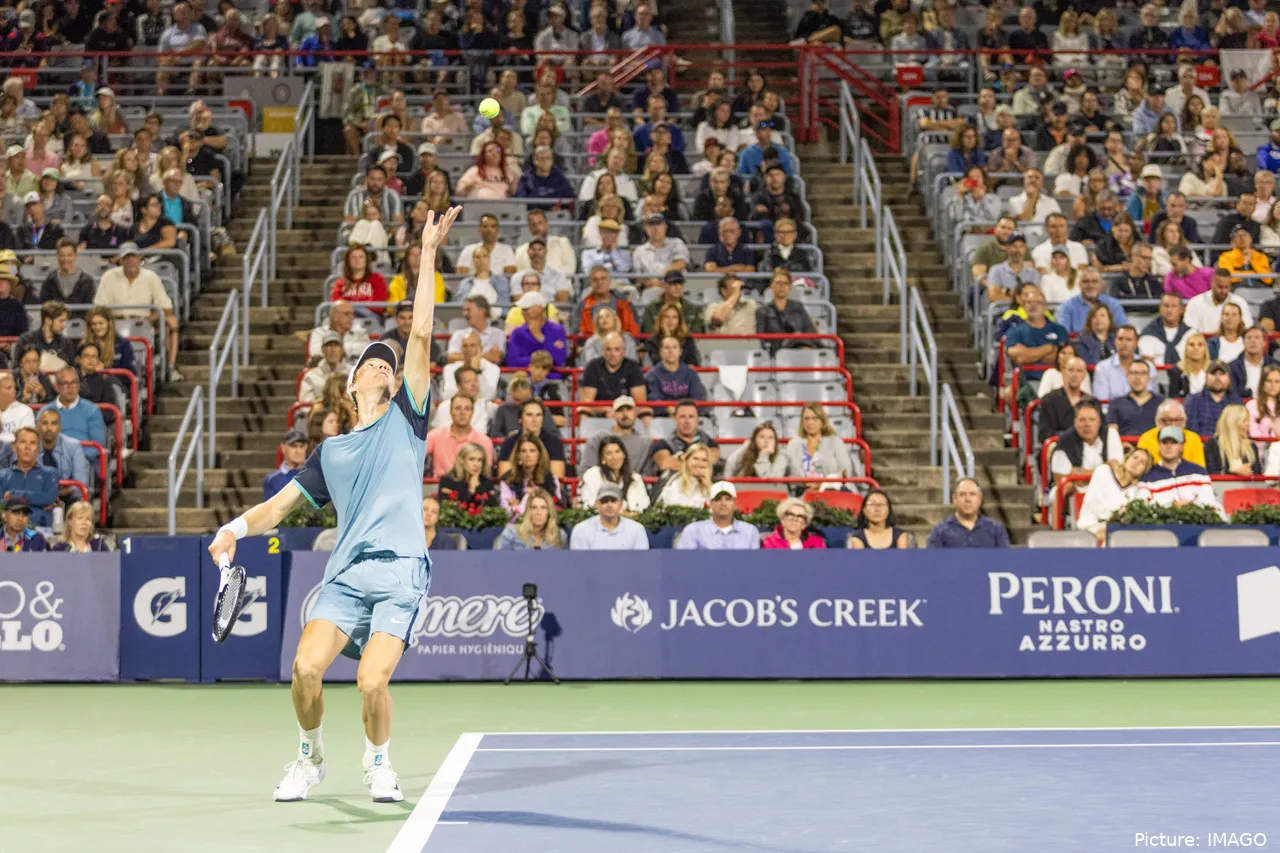
Jannik Sinner serving in Canada.
The future of Tennis
For now, Piqué’s idea remains just that: an idea. It would require support from tennis’s governing bodies and likely face strong resistance from players, coaches, and federations.
But the debate it sparked reveals deeper tensions between tradition and modernisation, between short-term spectacle and long-term integrity, between fan-friendly pace and player-driven drama.
With figures like Panatta leading the backlash, any attempt to radically change the serve rule appears doomed, at least without a far broader discussion involving players, fans, and stakeholders.
Whether Piqué’s vision ever becomes reality or not, it has already reignited an important conversation about what tennis is and what it should remain.

claps 0visitors 0
Just In

Popular News
Latest Comments
- Fight the Good Fight... Tennis (sports in general) need more Humans such as yourself.
 mandoist18-10-2026
 - When is WTA going to mandate Genetic Testing (DNA) ???mandoist18-10-2026
- Hey, Dan... you just wake up from a coma? Regardless -- Thanks for the comedy this morning!mandoist18-10-2026
- Two Things: 1. Stop allowing these Spoiled Trust-Fund Elitists to behave badly. Your little hand-slaps do not deter them. 2. STOP the incessantly annoying "towel wiping" nonsense!!!!mandoist15-10-2026
- A healthy Qinwen may be hard to stop next season. She was already scaring her opponents before her medical leave(s). Unfortunately, Zheng insisted on singing again. On the positive side -- Mirra did not sing!! ;~}mandoist11-10-2026
- Where is it written that athletes, entertainers... People in general... are mandated to keep looking at -- or even using [anti]Social Media? Public & private figures consistently complain and reveal their concerns about negativity and violence thrown at them -- yet they insist on participating. Avoid it, don't use it, don't read it. It's okay to occasionally look up at the World instead beating your eyes & thumbs to death on The Inventions out there.mandoist11-10-2026
- great articlestennisseserver07-10-2026
- Medvedev was leading Djokovic 7-5, 3-5 when an attempted return..' NO you ignorants, Djokovic was leading .weiss05-10-2026
- No more bullshit "Wildcards" to these two. Qualify like everyone else -- there will be cameras there, too. Time to scream... WTF ????!!!!mandoist29-09-2026
- Let's not BS the general public -- Sabalenka started showing cracks in her game last season. Her losses and near-losses started at about the same time she began being distracted by Fame (constant Selfies, making TV commercials, magazine shoots, endless Social Media nonsense, etc., etc.) One would think even Saba could recognize the parallels with others who failed before her -- Raducanu, Giorgi, Bouchard to name a few.mandoist25-09-2026

Loading