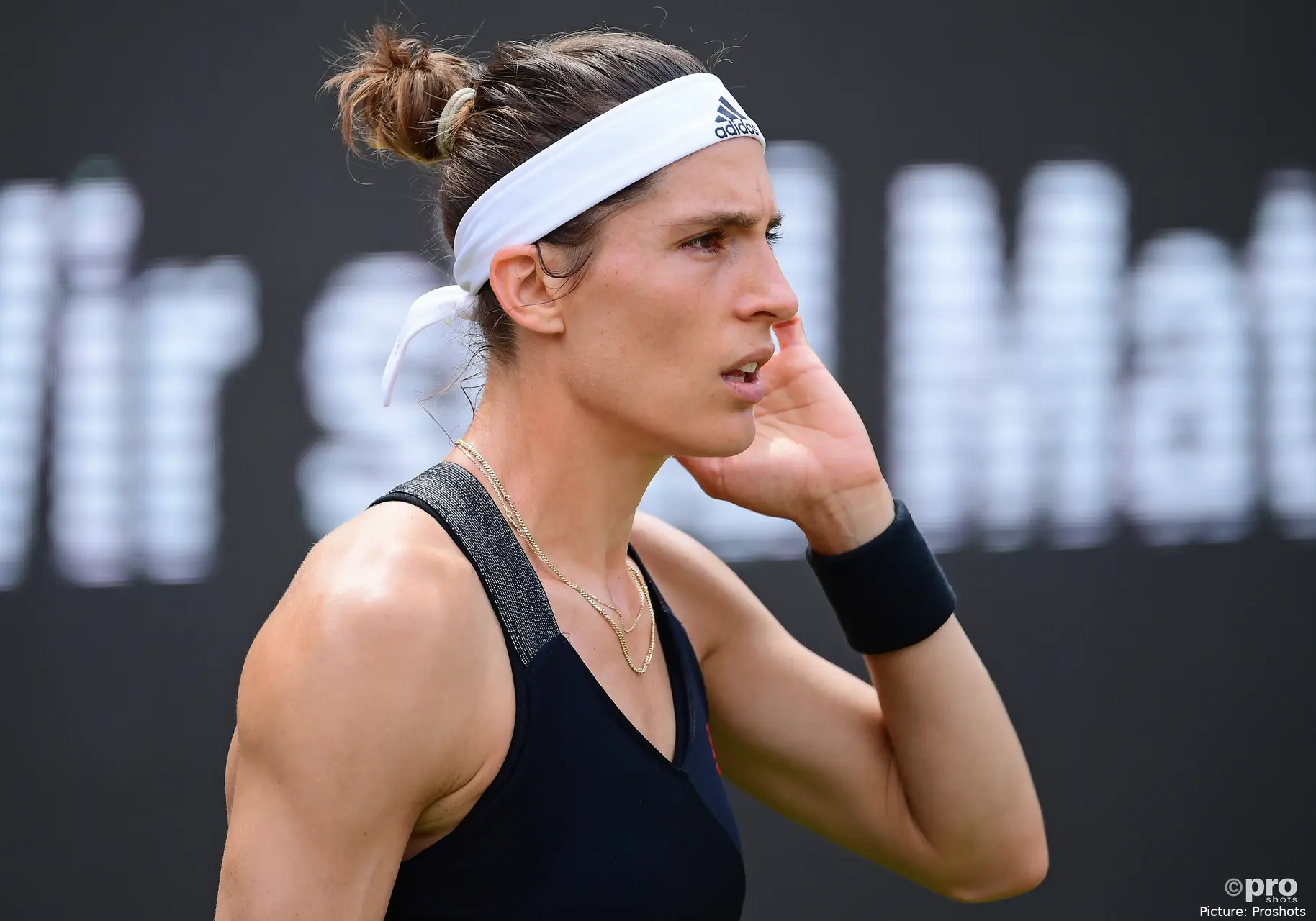
Andrea Petkovic reached world No. 9 in 2011 and looked like the next great German women's tennis star. She had reached three Grand Slam quarterfinals that season, won her first WTA title and became the first German woman to break into the top 10 since Steffi Graf.
Then the injuries came. A knee problem, a back injury, torn ankle ligaments and another knee injury helped turn a world No. 9 player into someone ranked outside the world's top 200. At one point, Petkovic seriously considered walking away from tennis altogether.
Yet that wasn't where her story ended. She rebuilt herself, reached a Grand Slam semifinal at Roland Garros, won three titles in 2014 and eventually retired in 2022 with seven WTA titles to her name. And what came next made her story even more unusual: Petkovic built a second career around broadcasting, writing and the intellectual interests that had always made her different from the stereotypical professional tennis player. That's why Andrea Petkovic belongs in the Tennis Graveyard.
A promising start, interrupted early
Petkovic played her first Grand Slam main draw at the 2007 French Open, coming through qualifying without dropping a set before losing to future Wimbledon finalist Marion Bartoli in the second round. She backed it up with another second-round finish at that year's US Open, and by early 2008 looked like a rising presence on tour — only for a serious knee injury at that January's Australian Open to derail her almost entirely, keeping her out for close to eight months.
She rebuilt from there patiently rather than quickly, working her way back through the rankings and the Fed Cup team over the next few seasons. The real breakthrough arrived in 2011: quarterfinal runs at the Australian Open, French Open and US Open in the same season, a title in Strasbourg, and a year-end ranking of world No. 10 that made her the first German woman inside the top 10 since Graf's retirement.
Petkovic — career snapshot
| Career-high ranking | No. 9 (2011) |
| Best Grand Slam result | Semifinal, French Open 2014 |
| WTA singles titles | 7 |
| Career prize money | Over $8.7 million |
| Fed Cup | Runner-up with Germany, 2014 |
| Retired | August 2022, aged 34 |
| Date | Event |
| January 2008 | Suffers a serious knee injury at the Australian Open; out for roughly eight months |
| January 2012 | Back injury forces her out of the Australian Open |
| April 2012 | Torn ankle ligaments in Stuttgart, sidelined four months |
| December 2012 | Torn meniscus at the Hopman Cup; ranking falls outside the top 200 |
| 2014 | Rebuilds to a career-high Grand Slam semifinal at Roland Garros |
| August 2022 | Retires at the US Open, ranked No. 104 |
2012: the year injuries nearly ended everything
The follow-up season undid most of what 2011 had built. A back injury forced Petkovic out of the Australian Open in January. Later that year, she tore ligaments in her ankle, and in December she tore the meniscus in her knee at the Hopman Cup, an injury serious enough to also wipe out her start to the following season. Three separate injuries inside roughly twelve months cost her the better part of a year on tour.
The damage to her ranking was severe — she fell outside the world's top 200, a staggering drop for someone who'd been top 10 barely a year earlier — and Petkovic has said openly that she seriously considered walking away from the sport during that stretch. What kept her going, by her own account, was a Fed Cup memory from years earlier: an unglamorous doubles rubber played in front of a nearly empty stadium that had taught her not to give up when things got hard.

Andrea Petkovic now interviews players and maintains a presence on tour.
Petkovic's injury timeline
| Date | Event |
| January 2008 | Serious knee injury at the Australian Open; out for roughly eight months |
| October 2011 | Reaches career-high ranking of No. 9 |
| January 2012 | Back injury forces her out of the Australian Open |
| 2012 | Torn ankle ligaments |
| December 2012 | Torn meniscus at the Hopman Cup; ranking falls outside the top 200 |
| 2014 | Rebuilds to a career-high Grand Slam semifinal at Roland Garros |
| August 2022 | Retires at the US Open, ranked No. 104 |
The comeback: a Grand Slam semifinal and a title to end the season
What followed was one of the more underrated comeback stories of the era. Petkovic rebuilt her ranking through 2013 and arrived at the 2014 French Open in career-best form, reaching the semifinal — still the only Grand Slam singles semifinal of her career, where she lost to eventual runner-up Simona Halep. That same season she won WTA titles in Charleston and Bad Gastein, and capped the year by winning the WTA Tournament of Champions in Sofia, beating Garbiñe Muguruza in the semifinal and Flavia Pennetta in the final.
Two years after wondering if she was finished, Petkovic was playing some of the best tennis of her career, and doing it on the tournament that would go on to define her legacy more than any other result. The rest of her career never quite matched that single season again, but it also never collapsed the way 2012 once threatened to make permanent.
Steady years, and the Petko Dance
The remainder of her career settled into a long, resilient middle stretch rather than another peak. She won a title in Antwerp in 2015 and returned to a career-high ranking that May, reached the Doha semifinal in 2016 by beating a top-five Garbiñe Muguruza, and picked up a notable win over Petra Kvitova at the 2019 US Open — one of 14 career victories over top-10 opponents. In 2021, she reached a final in Hamburg and then won in Cluj-Napoca for her seventh and final WTA singles title.
Through all of it, her "Petko Dance" — an unmistakable, joyful on-court celebration after big wins — made her one of the tour's most consistently popular figures, regardless of where her ranking happened to sit that week. It's the image most casual fans remember first, even ahead of the Roland Garros run or the top-10 ranking.
Who she became after the rankings stopped mattering
Her retirement press conference was emotional, with Petkovic admitting that she still loved the game but that her body was no longer allowing her to train and compete in the way she wanted. Fittingly, her final match went three sets. Belinda Bencic eventually beat the former world No. 9 6-2, 4-6, 6-4, but Petkovic left the court to an emotional reception from the New York crowd.
The more unusual part of her story had already been unfolding for years by then. While still competing, she studied philosophy and literature at university. That intellectual curiosity had never been a secret during her playing career. Petkovic studied philosophy and literature, wrote extensively and counted Goethe, Oscar Wilde and Gustave Flaubert among her favourite authors.
Read also

Since retiring, she's built a respected second career as a broadcaster and tournament ambassador — a former top-10 player better known today, in some circles, for thoughtful, literary commentary than for her forehand.
Plenty of players fight back from career-threatening injuries, and plenty retire to become broadcasters. Few do both while also being the rare tour professional who spent her downtime reading Flaubert instead of just resting an aching knee. Her ranking chart tells a familiar tale of promise interrupted by injury. Everything she built around it tells a much rarer one.
So what happened to Andrea Petkovic?
In sporting terms, her career never quite recovered the trajectory it seemed destined to follow in 2011. Injuries took away some of her best years, and although she rebuilt herself brilliantly enough to reach a Grand Slam semifinal and win seven WTA titles, she never returned to the sustained heights of her first breakthrough.
But that is also what makes Petkovic different from so many names in the Tennis Graveyard.
Her story isn't simply one of a player who peaked early and faded away. It is the story of someone whose career was repeatedly interrupted, who came back when many would have walked away, and who eventually discovered that her identity was bigger than her ranking.
World No. 9 was the peak of Andrea Petkovic's tennis career.
It wasn't the peak of her story.

Cristhián AvilaTennis Journalist
Cristhián Ávila is a tennis journalist based in Santiago, Chile, and has been part of the TennisUpToDate team since early 2023. He covers the ATP and WTA Tours as well as all four Grand Slams, producing breaking news, match reports, analysis, and regular liveblogs from major tournaments.
His reporting combines statistical analysis with clear explanation, helping readers understand tactical developments, player form, and broader storylines across the tour. Working fluently in both Spanish and English, Cristhián collaborates with an international editorial team and contributes to comprehensive global coverage. As part of his work, he has conducted interviews and media interactions with leading figures in the sport, including Caroline Wozniacki and John McEnroe.
In his journalism, Cristhián places strong emphasis on careful sourcing, editorial accuracy, and updating articles promptly when new, verified information becomes available. His coverage is grounded in research, context, and direct engagement with professional tennis.
claps 0visitors 0
Just In


Popular News
Latest Comments
- Does Sinner need that 4.5 mil? I doubt it. He can make that with three modelling gigs!😅🤣Rapunzel21-10-2026
- Did "People Magazine" purchase this website? This nonstop storyline is bullshit.
 mandoist21-10-2026
 - Listen... this is of no concern to anyone but these two. Deal with your own issues -- most of us have our own. Thanks, media, for these insignificant follow-ups which are meaningless.mandoist21-10-2026
- This is so very very sad, for all three of them. I truly thought they had an unbreakable bond, but life throws up so many differing challenges. Having your homeland suffering in such a terrible way, makes happiness lose out to guilt as well. Our thoughts are with them. X💔bjsexton20-10-2026
- I have lost all respect for Svitolina! Could she not have waited until he had played at the Paris Masters!!! She is selfish and don't give a damn about Gael. That is NOT how love is demonstrated Elina!!Rapunzel19-10-2026
- Perhaps convenient tennis tour sex is not a strong enough experience in which to base a marriage?mandoist19-10-2026
- Fight the Good Fight... Tennis (sports in general) need more Humans such as yourself.mandoist18-10-2026
- When is WTA going to mandate Genetic Testing (DNA) ???mandoist18-10-2026
- Hey, Dan... you just wake up from a coma? Regardless -- Thanks for the comedy this morning!mandoist18-10-2026
- Two Things: 1. Stop allowing these Spoiled Trust-Fund Elitists to behave badly. Your little hand-slaps do not deter them. 2. STOP the incessantly annoying "towel wiping" nonsense!!!!mandoist15-10-2026

Loading