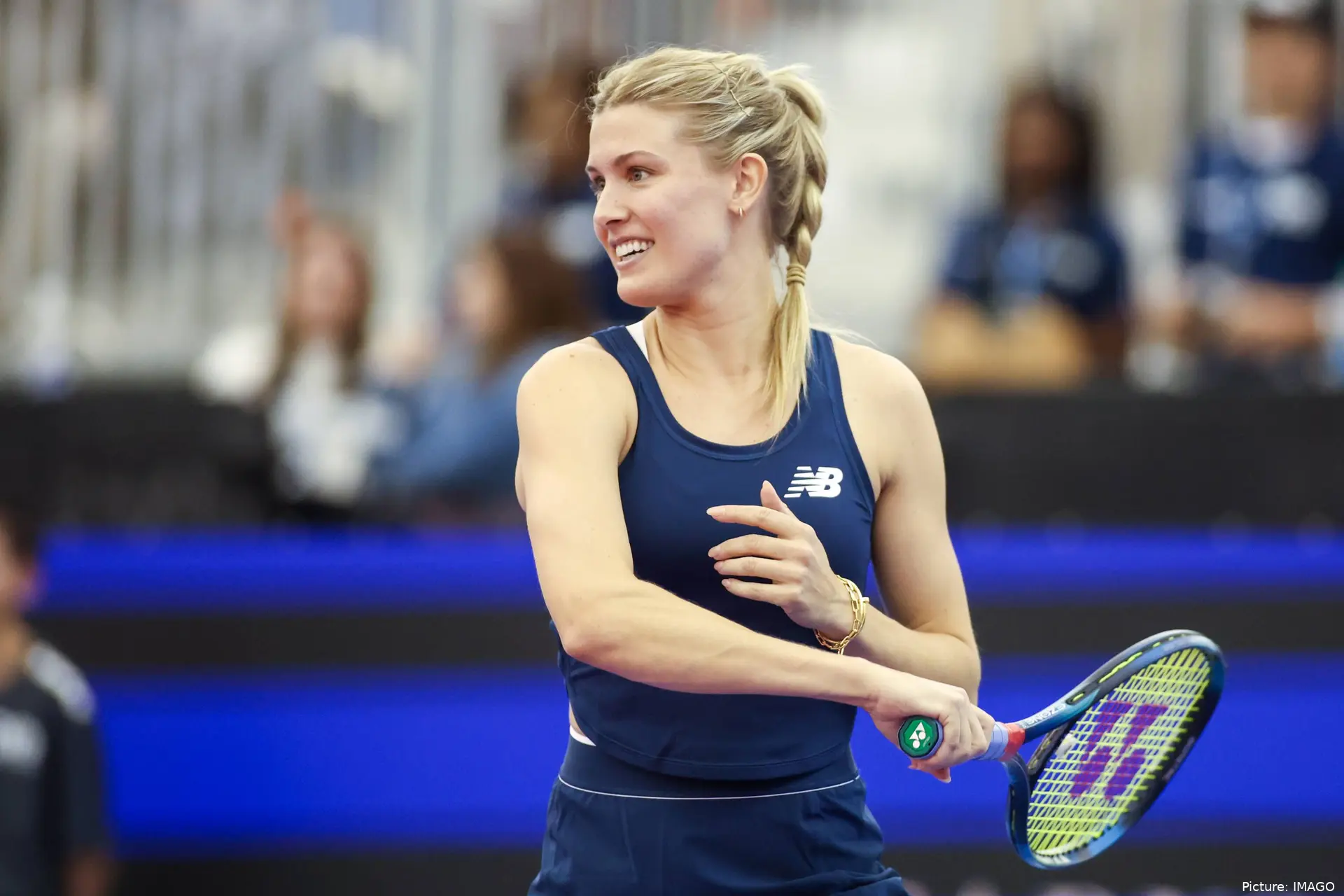
Eugenie Bouchard appeared to be on the verge of becoming one of the defining stars of women's tennis when she reached her first Grand Slam final at Wimbledon in 2014. At just 20 years old, the Canadian had already broken into the world's top five and established herself as a consistent presence at the biggest tournaments.
There was a moment when Eugenie Bouchard looked like the next great star of women's tennis. She reached the Australian Open semi-finals, the French Open semi-finals and the Wimbledon final in the same year, climbed to No. 5 in the world and became one of the most recognisable young players on the WTA Tour. Then everything changed. What followed was one of the most dramatic declines of the modern WTA era.
Injuries, confidence issues, coaching changes and difficulties maintaining consistency all played a role, but her decline cannot be attributed to a single factor. Her career raises a more interesting question: why did a player who seemed so close to becoming a Grand Slam champion fall so far from that level?
Eugenie Bouchard - Then v now
| Then | |
| Ranking | No. 5 |
| Grand Slam | 2014 Wimbledon finalist |
| Grand Slam semifinals | 3 in 2014 |
| Career titles | 1 |
| Career high | No. 5 |
| Age at breakthrough | 20 |
| 2025/26 status | Retired |
Read also
The rise: How Bouchard became a top-five star
Bouchard began attracting attention during her junior career, winning multiple ITF junior titles from an early age. At just 15, she won the under-18 indoor championship in Toronto in 2009, already showing signs of the talent that would eventually take her onto the biggest stages of professional tennis.
Her rapid progression continued over the following years, with Bouchard reaching the Australian Open junior semifinals in 2011 at 16 before winning her first ITF title later that season.

That same year, she also recorded her first WTA Tour main-draw victory against Alison Riske, who was ranked No. 114 at the time. Bouchard was only 16. A year later, she won the Wimbledon girls' singles title at 17 and continued competing on the lower levels of the professional tour, eventually finishing the 2012 season inside the world's top 150. Her development was unusually quick, and she appeared increasingly comfortable competing against older and more experienced opponents.
Between 2013 and 2014, that progression accelerated into a genuine breakthrough. Bouchard recorded her first Grand Slam main-draw victories and reached the third round at Wimbledon in 2013. She also made the quarterfinals of the Toray Pan Pacific Open, defeating players such as Monica Puig, Sloane Stephens and Jelena Jankovic along the way.
These results established her as more than a promising young player; she was beginning to prove that she could consistently compete against established names on the WTA Tour.
Let the Hunger Games begin 😉 pic.twitter.com/P9Gxm7VMQV
— Genie Bouchard (@geniebouchard) October 18, 2014
But 2014 was the season that transformed Bouchard from prospect into a potential future Grand Slam champion. She reached the semifinals at both the Australian Open and Roland Garros before going one step further at Wimbledon, where she reached her first Grand Slam final before losing to Petra Kvitova. She also won her first WTA title in Nuremberg, which would ultimately remain the only singles title of her career.
Bouchard's rise was remarkably fast. She collected multiple victories over top-10 opponents, reached a career-high ranking of No. 5 and became one of the youngest players inside the WTA's top 10. At only 20, she was already being discussed as a potential future Grand Slam champion and one of the leading figures of the next generation.
Read also
Eugenie Bouchard's 2014 Wimbledon Final Run
| Round | Opponent | Opp. ranking | Score |
| R128 | Daniela Hantuchova | 34 | 7-5, 7-5 |
| R64 | Silvia Soler Espinosa | 75 | 7-5, 6-1 |
| R32 | Andrea Petkovic | 20 | 6-3, 6-4 |
| R16 | Alize Cornet | 25 | 7-6(5), 7-5 |
| QF | Angelique Kerber | 9 | 6-3, 6-4 |
| SF | Simona Halep | 3 | 7-6(5), 6-2 |
| Final | Petra Kvitova | 6 | 3-6, 0-6 |
The turning point: From Wimbledon finalist to struggling for consistency
The 2014 season established Bouchard as one of the biggest emerging stars on the WTA Tour, during an era dominated by Serena Williams alongside established Grand Slam champions such as Maria Sharapova and Petra Kvitova.
Her performances earned her the WTA Most Improved Player award, while her consistency across the majors also allowed her to qualify for the WTA Finals in Singapore. At that stage, there was little reason to believe her rise would soon come to an end.
The 2015 season initially appeared to confirm that expectation. Bouchard reached the quarterfinals of the Australian Open, giving her another deep Grand Slam run and suggesting that her 2014 breakthrough had been sustainable. However, her results began to deteriorate as the season progressed. The expectations created by her previous year increasingly became a source of pressure, while injuries began to interfere with her ability to maintain momentum and compete consistently.
The Australian Open quarterfinal would ultimately be Bouchard's last appearance in the final eight of a Grand Slam. She still produced some strong results during 2015, including a fourth-round appearance at the US Open, but a concussion suffered after a fall in the tournament's locker room forced her to withdraw. She ended the season outside the top 40 after having spent the previous year among the world's elite.
The decline was particularly significant because Bouchard's game had been built around an aggressive baseline style, early ball striking and the ability to take control of rallies. Those characteristics had made her extremely effective when she was playing with confidence.
But as the results became less consistent, maintaining that level of aggression became more difficult. The player who had once dictated matches increasingly found herself fighting simply to regain the consistency that had previously appeared natural.
What went wrong? Injuries, coaching and the mental pressure
Bouchard's decline was not caused by one dramatic collapse, but by several problems that gradually interrupted the momentum she had built in 2014. After reaching the Wimbledon final, she struggled to maintain the same consistency and began dealing with injuries that disrupted her schedule and limited her ability to build confidence through regular competition. Her ranking fell quickly, and the pressure of trying to reproduce her breakthrough season became increasingly difficult to manage.
Read also
Coaching also became a recurring variable in Bouchard's career. She worked with several coaches after parting ways with Nick Saviano, who had guided her through her breakthrough, as she searched for a way back to the top. At the same time, the expectations surrounding her became difficult to separate from her results. Every early defeat was viewed against the standard she had established in 2014, creating a cycle in which poor results damaged her ranking and confidence, while the pressure to recover her previous level made consistency even harder to find.
The physical setbacks became particularly damaging because Bouchard never managed to establish a sustained period of health and form after her breakthrough. The concussion suffered at the 2015 US Open was followed by further injuries and periods away from the tour.
Eugenie Bouchard's career at a glance
| Category | Record |
| Career high | No. 5 |
| Grand Slam titles | 0 |
| Grand Slam finals | 1 |
| Grand Slam semi-finals | 3 |
| WTA singles titles | 1 |
| Wimbledon | Runner-up, 2014 |
| Australian Open | Semi-final, 2014 |
| French Open | Semi-final, 2014 |
| WTA Finals | Qualified, 2014 |
By the time she returned to regular competition, she was no longer developing from the position of a rising Grand Slam contender, but trying to rebuild a ranking and confidence that had already been lost. That distinction was crucial: the player who had once been progressing rapidly was now constantly trying to recover lost ground.
There was also a tactical element to her decline. Bouchard's aggressive baseline game had been highly effective when she was playing with confidence, allowing her to take the ball early and dictate rallies. But as her results deteriorated, the margins in that style of tennis became harder to manage. She struggled to reproduce the level of serving, returning and ball-striking that had made her so dangerous in 2014. Without the same consistency behind her first-strike tennis, matches increasingly became battles she could not control on her own terms.

What could Bouchard's career have been?
The obvious counterfactual is tempting: Bouchard reached the Australian Open and Roland Garros semifinals and the Wimbledon final in 2014, all before turning 21. She also reached No. 5 in the WTA rankings. Those achievements created the expectation that Grand Slam titles were a matter of when, rather than if. But the reality is more complicated.
Her 2014 season demonstrated that she could compete with the best players in the world, but it did not necessarily prove that she could sustain that level over several years.
The clearest indication of the gap between expectation and reality came in the years that followed. Bouchard never returned to a Grand Slam semifinal after Wimbledon 2014, and her ranking eventually fell far outside the position occupied by the game's elite.
The contrast is particularly striking because players from her generation who reached the top around the same period were able to turn their breakthrough seasons into sustained careers. Bouchard instead spent much of her career attempting to recreate a level she had reached only once.
That makes her a particularly interesting case for the Tennis Career Graveyard. The question is not whether Bouchard was secretly destined to win multiple Grand Slams; there is no way to establish that. Rather, her career represents one of the clearest examples of how a player can reach the edge of superstardom without being able to convert that potential into longevity. Her 2014 season was not an illusion — it was evidence of a genuine elite level. The missed opportunity was turning that level into a sustainable career.

Cristhián AvilaTennis Journalist
Cristhián Ávila is a tennis journalist based in Santiago, Chile, and has been part of the TennisUpToDate team since early 2023. He covers the ATP and WTA Tours as well as all four Grand Slams, producing breaking news, match reports, analysis, and regular liveblogs from major tournaments.
His reporting combines statistical analysis with clear explanation, helping readers understand tactical developments, player form, and broader storylines across the tour. Working fluently in both Spanish and English, Cristhián collaborates with an international editorial team and contributes to comprehensive global coverage. As part of his work, he has conducted interviews and media interactions with leading figures in the sport, including Caroline Wozniacki and John McEnroe.
In his journalism, Cristhián places strong emphasis on careful sourcing, editorial accuracy, and updating articles promptly when new, verified information becomes available. His coverage is grounded in research, context, and direct engagement with professional tennis.
claps 0visitors 0
Just In



Popular News
Latest Comments
- Does Sinner need that 4.5 mil? I doubt it. He can make that with three modelling gigs!😅🤣Rapunzel21-10-2026
- Did "People Magazine" purchase this website? This nonstop storyline is bullshit.
 mandoist21-10-2026
 - Listen... this is of no concern to anyone but these two. Deal with your own issues -- most of us have our own. Thanks, media, for these insignificant follow-ups which are meaningless.mandoist21-10-2026
- This is so very very sad, for all three of them. I truly thought they had an unbreakable bond, but life throws up so many differing challenges. Having your homeland suffering in such a terrible way, makes happiness lose out to guilt as well. Our thoughts are with them. X💔bjsexton20-10-2026
- I have lost all respect for Svitolina! Could she not have waited until he had played at the Paris Masters!!! She is selfish and don't give a damn about Gael. That is NOT how love is demonstrated Elina!!Rapunzel19-10-2026
- Perhaps convenient tennis tour sex is not a strong enough experience in which to base a marriage?mandoist19-10-2026
- Fight the Good Fight... Tennis (sports in general) need more Humans such as yourself.mandoist18-10-2026
- When is WTA going to mandate Genetic Testing (DNA) ???mandoist18-10-2026
- Hey, Dan... you just wake up from a coma? Regardless -- Thanks for the comedy this morning!mandoist18-10-2026
- Two Things: 1. Stop allowing these Spoiled Trust-Fund Elitists to behave badly. Your little hand-slaps do not deter them. 2. STOP the incessantly annoying "towel wiping" nonsense!!!!mandoist15-10-2026

Loading