Every August, the tennis world knows where it is supposed to look. This week, that’s Toronto. The stars are there. The television cameras are there. The million-dollar prize money is there. Every match seems to carry implications for the US Open, and every highlight finds its way onto social media within minutes.
It’s exactly where most fans should be paying attention. Except maybe it isn’t. Because while the spotlight shines on a WTA 1000 event in Canada, one of the most revealing stories in professional tennis is unfolding many thousands of miles away at a WTA 125 tournament in Warsaw.
Her name is Gabriela Knutson. If you’re a casual tennis fan, you’ve probably never heard of her. That isn’t an indictment of your tennis knowledge. It’s evidence of how much of the sport exists beyond the tournaments most people watch. As this week began, Knutson sat well outside the Top 200 in the live rankings. She arrived in Warsaw defending only a modest number of ranking points, trying to keep climbing in a profession where a handful of victories can change an entire season. Now she’s into the quarterfinals, quietly putting together one of the best weeks of her year.
Read also

The numbers alone don’t tell her story. Born to an American father and Czech mother, Knutson moved from California to the Czech Republic as a child to pursue tennis. She became an All-American at Syracuse University, earned postgraduate degrees in England, built a growing presence as a tennis content creator, and chose the uncertain life of the professional tour over the stability that someone with her résumé could easily have found elsewhere.
Along the way, she even declined a U.S. Open wildcard that reportedly came with one condition: compete under the American flag instead of the Czech one. There are easier ways to make a living. That’s what makes players like Knutson so fascinating.
Occupy a tier of the sport that television rarely shows
Professional tennis has somehow created a strange illusion. We celebrate the Top 10. We occasionally talk about the Top 100. Beyond that, the rankings become little more than numbers scrolling across a screen. World No. 225. World No. 318. World No. 407. Those numbers sound ordinary until you stop and think about what they actually represent.
Gabriela Knutson would almost certainly defeat every recreational player reading this column without losing a game. So would Océane Dodin. So would Katrina Scott. So would Andreea Prisacariu. They aren’t “almost professionals.” They are professionals. They simply occupy a tier of the sport that television rarely shows.
That’s the astonishing depth of women’s tennis today. The difference between No. 25 and No. 225 is real. It’s enormous. That’s why one player is competing for Grand Slam titles while another is grinding through qualifying draws and WTA 125 events. But the difference between No. 225 and everyone else? It’s almost impossible to comprehend. These are athletes who have spent decades refining serves that land within inches of the lines, groundstrokes struck at speeds most club players have never experienced, and movement so efficient it often looks effortless until you try to imagine producing it yourself.

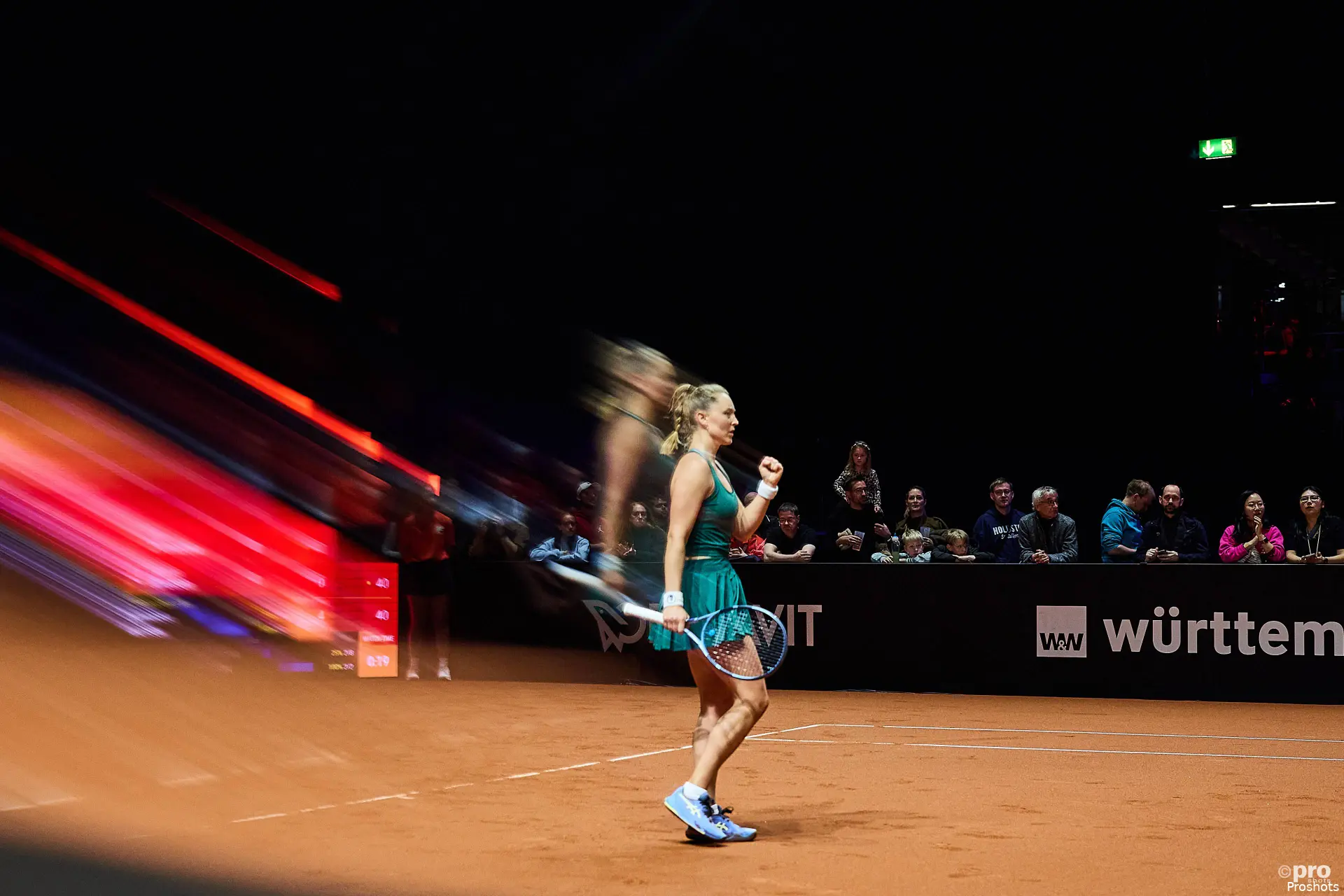
Gabriela Knutson in action in Stuttgart.
Every week they travel to tournaments that most fans never notice. Sometimes they lose in qualifying. Sometimes they earn enough points to move up twenty places. Sometimes they spend months defending points won at tournaments that disappeared from everyone’s memory almost as soon as they ended. Then they pack another suitcase and do it all again. There is something deeply admirable about that existence.
Not because it is glamorous. Because it isn’t. Because it requires waking up every Monday believing that this might finally be the week everything changes.
For a handful of players each season, it does. For everyone else, the pursuit continues. That, to me, is the real beauty of professional tennis. Not Centre Court. Not the trophy ceremonies. Not the endorsement deals. The beauty is found on outside courts in places like Warsaw, where careers are built one match at a time, largely unnoticed by the people who claim to love the sport.
The WTA has never been deeper than it is today. Former college stars, accomplished juniors, experienced veterans and rising teenagers collide every week in draws filled with players whose rankings often disguise just how extraordinary they really are.
It’s easy to admire Coco Gauff, Iga Świątek or Aryna Sabalenka. They deserve every bit of that admiration. It’s a little harder—and perhaps more rewarding—to appreciate the hundreds of professionals beneath them, players whose names rarely trend but whose tennis is breathtaking all the same.
So yes, enjoy Toronto. The world’s biggest stars deserve your attention. But save a little of it for Warsaw. Because while everyone else is watching the brightest lights in women’s tennis, Gabriela Knutson is reminding us what the sport actually looks like for most of the people talented enough to call themselves professionals. And that story may be even better.

Aron SolomonGuest Author
A Pulitzer Prize-nominated journalist for his groundbreaking op-ed in The Independent exposing the NFL’s “race-norming” policies, Aron Solomon, JD, is a globally recognized thought leader in law, media, and strategy.
As Chief Strategy Officer for AMPLIFY, he leverages his deep expertise to shape the future of legal marketing. Aron has taught entrepreneurship at McGill University and the University of Pennsylvania and was honored as a Fastcase 50 recipient, recognizing him among the world’s top legal innovators. A prolific commentator on law, business, and culture, his insights regularly appear in Newsweek, The Hill, Crunchbase News, and Literary Hub.
He has also been featured in The New York Times, Fast Company, Fortune, Forbes, CBS News, CNBC, USA Today, ESPN, TechCrunch, BuzzFeed, Venture Beat and countless other leading global media outlets. We are proud to have Aron on board at TennisUpToDate, where his deep tennis expertise enriches the site with sharp, original columns that connect the sport to wider cultural debates.
claps 0visitors 0
Just In



Popular News

Latest Comments
- Lena... Takin' care of business
 mandoist25-10-2026
 - Can you please stop publishing this nonsense? Stick to Tennis.mandoist25-10-2026
- Does Sinner need that 4.5 mil? I doubt it. He can make that with three modelling gigs!😅🤣Rapunzel21-10-2026
- Did "People Magazine" purchase this website? This nonstop storyline is bullshit.mandoist21-10-2026
- Listen... this is of no concern to anyone but these two. Deal with your own issues -- most of us have our own. Thanks, media, for these insignificant follow-ups which are meaningless.mandoist21-10-2026
- This is so very very sad, for all three of them. I truly thought they had an unbreakable bond, but life throws up so many differing challenges. Having your homeland suffering in such a terrible way, makes happiness lose out to guilt as well. Our thoughts are with them. X💔bjsexton20-10-2026
- I have lost all respect for Svitolina! Could she not have waited until he had played at the Paris Masters!!! She is selfish and don't give a damn about Gael. That is NOT how love is demonstrated Elina!!Rapunzel19-10-2026
- Perhaps convenient tennis tour sex is not a strong enough experience in which to base a marriage?mandoist19-10-2026
- Fight the Good Fight... Tennis (sports in general) need more Humans such as yourself.mandoist18-10-2026
- When is WTA going to mandate Genetic Testing (DNA) ???mandoist18-10-2026

Loading