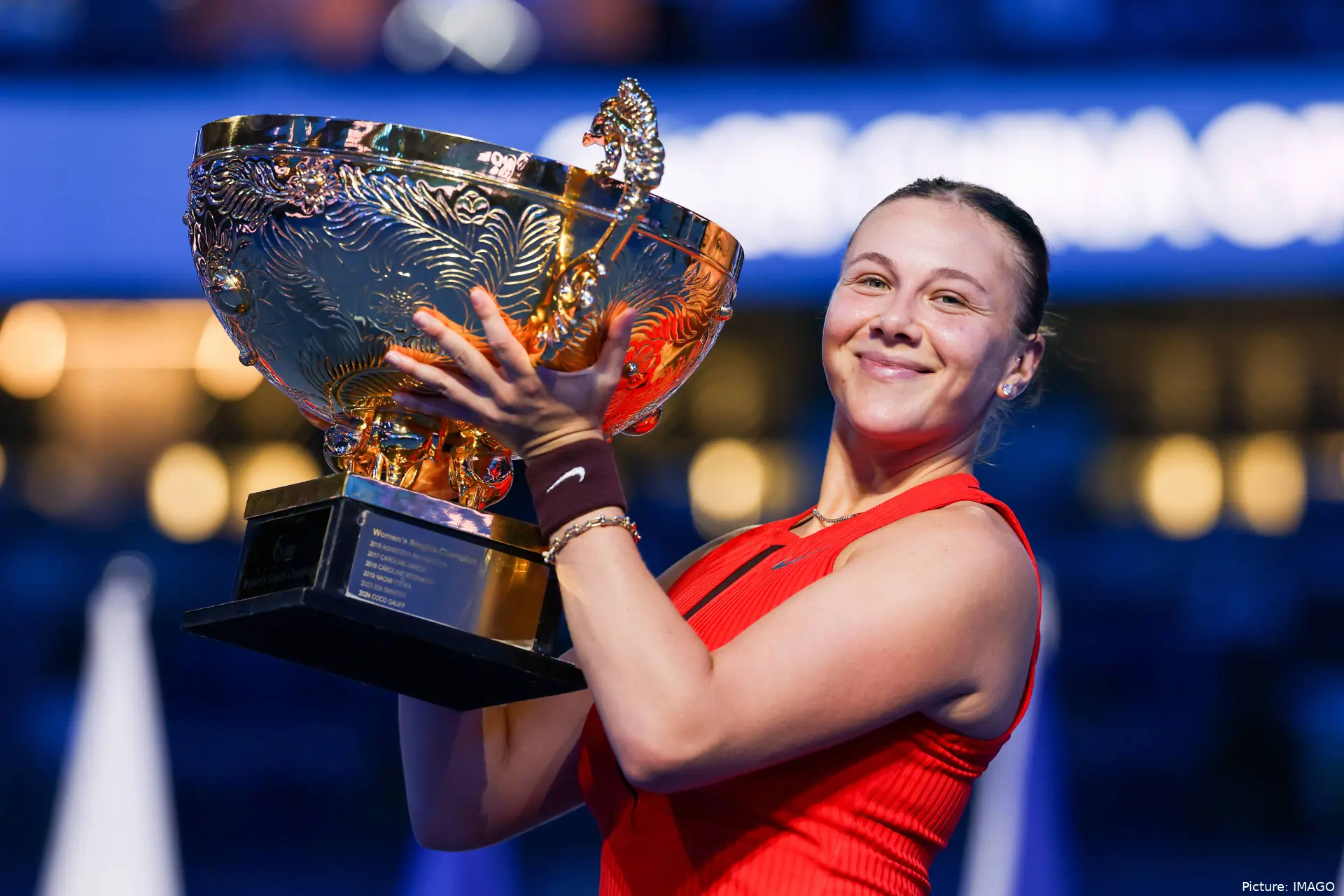
Every so often in tennis, a player resurfaces with such force that the sport has no choice but to pause and recalibrate. Amanda Anisimova’s 2025 season is one of those moments. A year ago, the idea of her winning two WTA 1000 titles, reaching the finals at both Wimbledon and the US Open, and booking her place in the season-ending Tour Finals would have been filed under fantasy. Today, it’s reality—and it’s one of the most improbable comeback stories the sport has seen in years.
Anisimova, just 24, is closing the season ranked world No. 4. While she predictably pulled out of the Wuhan 1000 today, she’s positioned to earn close to $10 million this year if she makes a deep run in her first Tour Finals in Saudi Arabia. Yet as dazzling as the numbers are, they are not the real story. Her rise in 2025 is not just about winning matches—it’s about resilience, reinvention, and the long shadow of potential finally being lit.
A career once on pause
Tennis fans have been waiting for Anisimova to become this player for years. In 2019, at just 17, she stunned the French Open by reaching the semifinals and seemed destined to join the new wave of American champions. Then life intervened.
Her father and longtime coach, Konstantin Anisimov, passed away suddenly in 2019. The loss was not just personal—it was existential. Tennis is a sport where parents often double as coaches, drivers, financial backers, and emotional anchors. To lose that at 17 was devastating. The early shine dimmed. Her ranking slipped. Injuries mounted.
Then, in 2023, Anisimova stepped away entirely, announcing an indefinite mental health break. She spoke candidly about the burnout, anxiety, and pressures that had accumulated since her teenage years. In a sport notorious for grinding down even its most resilient players, her decision to stop was as brave as anything she’s done on the court.
The 2025 breakthrough
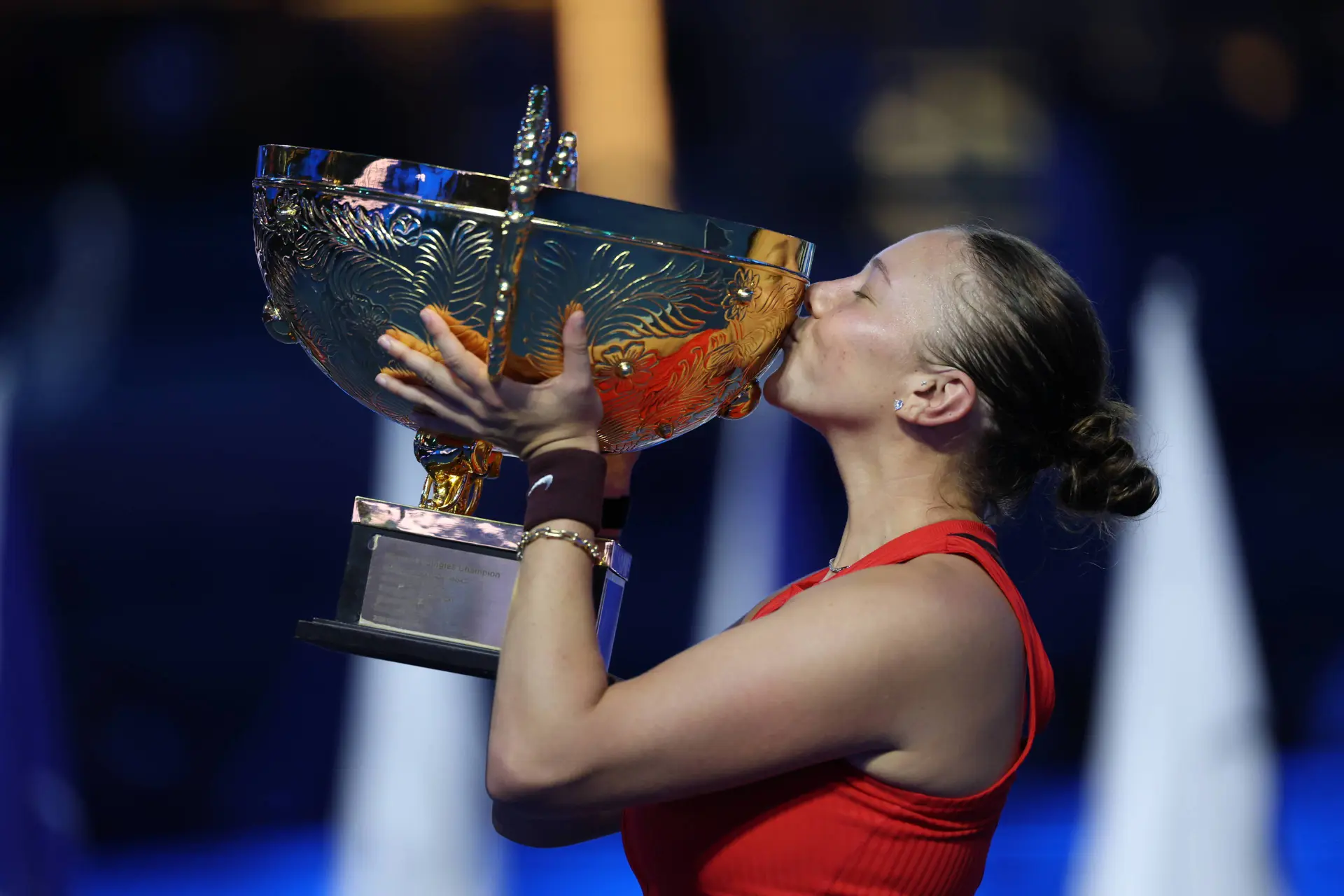
Fast forward to this year, and Anisimova’s resurgence has been breathtaking. Doha set the tone, where she blasted through a field stacked with top-10 players to win her first WTA 1000 title. A few months later in Beijing, she did it again—cementing herself not as a streak but as a force.
Her runs at Wimbledon and the US Open, where she finished runner-up both times, revealed a different side. She wasn’t just overpowering opponents with her flat, penetrating groundstrokes—she was managing matches, keeping composure in pressure moments, and showing tactical maturity that had once (well, always) been missing.
The statistics tell one story: multiple finals at our sport’s biggest events, more than 50 match wins, and a leap to No. 4 in the world. But the intangibles tell a better one: Anisimova plays with a looseness that suggests she’s finally playing for herself, not for expectation, not for ghosts, and not for rankings.
Resilience at the core
The spine of this season is resilience. Resilience to keep believing that her career wasn’t already written. Resilience to take the unpopular step of walking away and coming back only when she was ready. Resilience to shoulder the weight of her father’s absence and still carve her own identity in the sport they once shared.
There’s a temptation in sportswriting to romanticize comebacks as inevitable, as if champions always find their way back. But Anisimova’s story was never guaranteed. For every player who steps away and returns stronger—think Ash Barty or Kim Clijsters—there are countless others who disappear. What makes her 2025 run improbable isn’t just the scale of her success, but the fact that it happened at all.
A decade ahead?
At 24, Anisimova is still a young player in tennis terms. The sport has shifted: careers are longer, peak years now stretch into the early thirties, and players manage their schedules with more care. If this is Anisimova’s foundation, the ceiling remains sky-high.
The Tour Finals in Saudi will be her proving ground in one more way: it’s the first time she’ll compete against the season’s eight best players in a concentrated, high-stakes round robin. Win there, and her improbable rise becomes a coronation.
But even without lifting that trophy, Anisimova has reintroduced herself not as a promising talent, but as a leading contender.
She’s not “the next big thing” knocking at the door. In the words of Walter White, she IS the one who knocks.
More than tennis
Sports narratives resonate most when they mirror broader human truths. Anisimova’s story resonates because it is about more than tennis. It’s about grief, about burnout, about the courage to pause when the world is screaming “go.” It’s about the fact that sometimes, potential is not a straight line—it bends, it stalls, it fractures, and if you’re lucky, it rises again.
This season, Amanda Anisimova has reminded the tennis world—and perhaps herself—that resilience is the true currency of greatness. The trophies and checks matter, but the comeback is priceless.

Aron SolomonGuest Author
A Pulitzer Prize-nominated journalist for his groundbreaking op-ed in The Independent exposing the NFL’s “race-norming” policies, Aron Solomon, JD, is a globally recognized thought leader in law, media, and strategy.
As Chief Strategy Officer for AMPLIFY, he leverages his deep expertise to shape the future of legal marketing. Aron has taught entrepreneurship at McGill University and the University of Pennsylvania and was honored as a Fastcase 50 recipient, recognizing him among the world’s top legal innovators. A prolific commentator on law, business, and culture, his insights regularly appear in Newsweek, The Hill, Crunchbase News, and Literary Hub.
He has also been featured in The New York Times, Fast Company, Fortune, Forbes, CBS News, CNBC, USA Today, ESPN, TechCrunch, BuzzFeed, Venture Beat and countless other leading global media outlets. We are proud to have Aron on board at TennisUpToDate, where his deep tennis expertise enriches the site with sharp, original columns that connect the sport to wider cultural debates.
claps 1visitors 1
Just In

Popular News
Latest Comments
- After a couple decades traveling to IIHF tourneys overseas... our family is done with it... and I will not be the only one!! Bad enough the NHL allows Ovachenko (a Putin Supporter and Campaigner) to live and play in the USA. Let's not forget the STATE SPONSORED RUSSIAN DOPING PROGRAMS still in effect today.
 mandoist31-10-2026
- Osaka's mental state apparently does not allow her to reach any more Quarter Finals? I mean, she doesn't really have the time for tennis with all the pre-planning that must go into her 12 year-old "fashion" goals.mandoist29-10-2026
- With her money one would think she could afford a better team of Psychiatrists?mandoist29-10-2026
- Boss move, Sinner !Rapunzel27-10-2026
- Apparently still refusing to seek 'help' ...and still playing Dress-Up like a 10 year-old.mandoist27-10-2026
- Lena... Takin' care of businessmandoist25-10-2026
- Can you please stop publishing this nonsense? Stick to Tennis.mandoist25-10-2026
- Does Sinner need that 4.5 mil? I doubt it. He can make that with three modelling gigs!😅🤣Rapunzel21-10-2026
- Did "People Magazine" purchase this website? This nonstop storyline is bullshit.mandoist21-10-2026
- Listen... this is of no concern to anyone but these two. Deal with your own issues -- most of us have our own. Thanks, media, for these insignificant follow-ups which are meaningless.mandoist21-10-2026
