I need to begin with something that should be obvious to anyone who has read me for more than about five minutes: I love women’s tennis.
Not in the abstract. Not because supporting women’s sports is fashionable. I watch absurd amounts of it. I write about it constantly. I will happily rearrange a day around a first-round WTA match that approximately 11 other people on earth appear to care about.
So when Simon Briggs of The Telegraph reported this week that the WTA could be on course to run out of money, my reaction surprised even me. Maybe that wouldn’t be the worst thing in the world.
Let me be very precise about what I mean. I am not rooting for people to lose their jobs. I am not rooting for tournaments to disappear, players to lose prize money or young women trying to build careers on the professional tour to have the ground pulled out from underneath them.
And I am certainly not rooting against women’s tennis. Quite the opposite. I am wondering whether an institution that has spent years demonstrating how badly it can manage an extraordinary sporting product finally reaching an existential crisis might force tennis to do something it should have done years ago. Build something better.
These numbers are terrifying
The numbers Briggs reported are difficult to overstate. According to financial projections presented during meetings in New York, the WTA expects to finish 2026 with only around $15 million in cash. Its projected operating loss for the year is $23 million.
Continue losing money at anything resembling that rate and the organization could move into the red by the autumn of 2027.
That is not the same thing as saying bankruptcy is inevitable. New chair Valerie Camillo has time to cut expenses, find revenue and restructure the organization. By early accounts, she has also made a positive impression since taking over from Steve Simon.
But $15 million is not a lot of runway for an organization responsible for a worldwide professional sports tour. Especially when you consider something else. In 2023, CVC bought 20 percent of the WTA’s commercial operations in exchange for $150 million, paid over five years.
That works out to approximately $30 million annually. That money ends next year. Think about that for a moment.
The WTA received an enormous injection of outside capital. It is operating one of the most recognizable women’s sports properties on the planet. And as that financial lifeline approaches its end, we are discussing whether the organization itself could run out of cash. At some point, you have to stop calling that a difficult market. You have to start asking whether the structure itself works.
Women’s tennis is not failing
This is the part that makes me crazy. If nobody wanted to watch women’s tennis, we could have a completely different conversation.
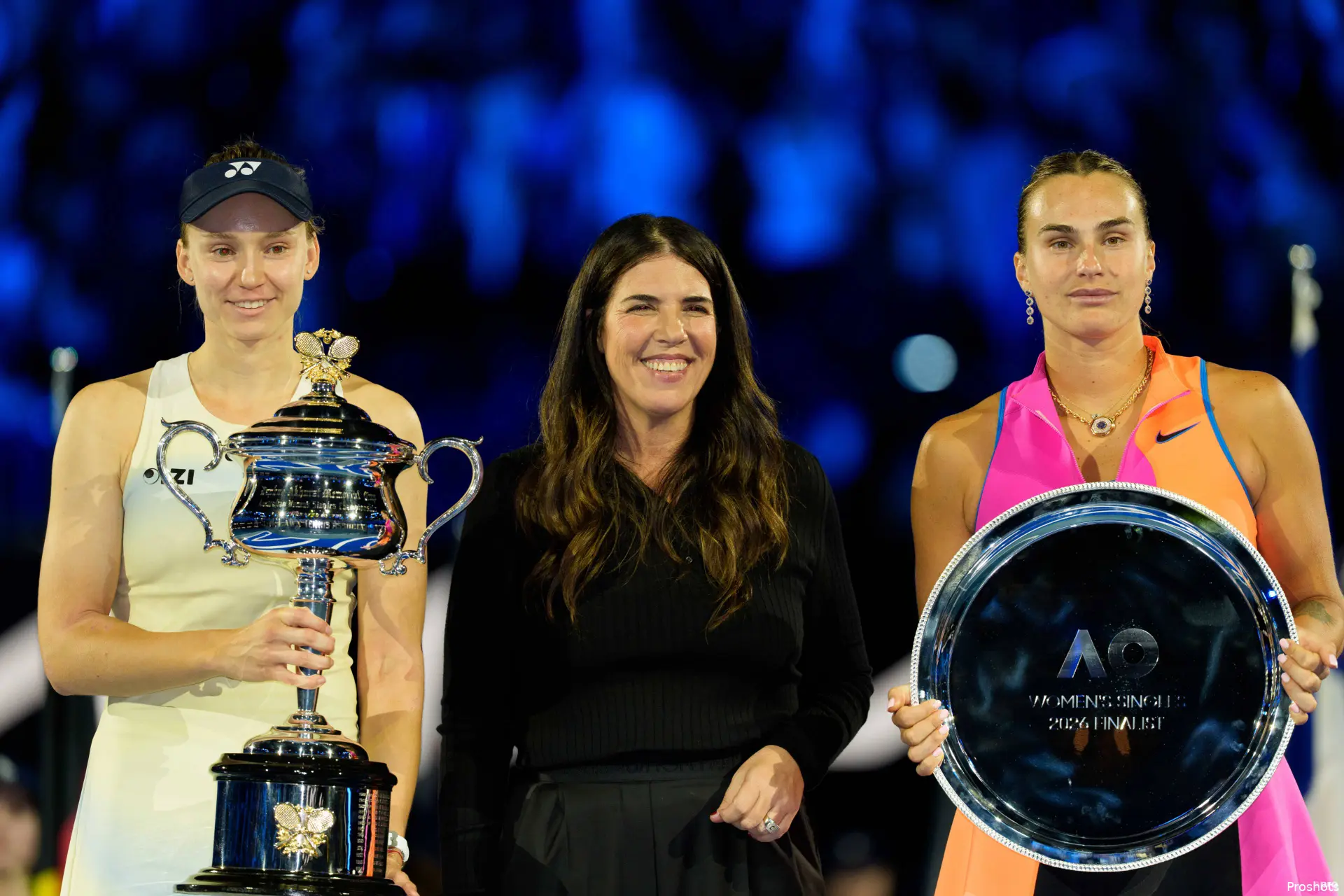
But have you watched women’s tennis lately? The sport has Coco Gauff. Aryna Sabalenka. Iga Świątek. Elena Rybakina. Zheng Qinwen. Amanda Anisimova. Mirra Andreeva. Jessica Pegula.

Elena Rybakina Vs Naomi Osaka in Louis Armstrong Stadium during The US Open
Behind them is another generation arriving almost absurdly quickly. There are personalities. Rivalries. Different styles. Different countries. Huge markets. Young stars. Established stars. Players who are enormously marketable well beyond tennis.
The product is not broken. The institution responsible for packaging, selling and governing much of that product is. That distinction matters enormously.
The WTA is not women’s tennis. It is an organization that administers women’s tennis.
Those are not remotely the same thing. Wimbledon would still be Wimbledon without the WTA. The U.S. Open would still happen. Roland Garros and the Australian Open would still happen. The great players would still be great players.
Nobody fell in love with women’s tennis because of an organizational chart. They fell in love with Billie Jean King and Chris Evert and Martina Navratilova. Steffi Graf and Monica Seles. Venus and Serena Williams. Justine Henin and Maria Sharapova.
And now they fall in love with the players competing today. Institutions have an amazing ability to persuade us that preserving the institution is the same thing as preserving the thing the institution exists to serve. It isn’t.
We have been watching this coming
Steve Simon deserves enormous credit for the stand he took over Peng Shuai. I said it then and I believe it now. Suspending tournaments in China carried an enormous financial cost, and Simon was willing to absorb it over a matter far more important than tennis. But one admirable act of leadership does not make the rest of the WTA’s recent history disappear.
We have watched disastrous scheduling decisions. We watched the embarrassing 2023 WTA Finals in Cancún, where one of the premier events in women’s sports was played at a temporary venue that was barely completed before the tournament. Then the Finals went to Saudi Arabia. Now they are back in California after the WTA ended its Riyadh agreement early, a decision that has created another significant financial hit because the WTA will largely have to bankroll this year’s event itself.
Players have complained about the calendar. Fans have complained about the calendar. The tour expanded mandatory events and stretched major tournaments across nearly two weeks while simultaneously talking about player welfare. And somehow, after all of this, the business is still burning cash.
This is not one bad quarter. It is not one unfortunate tournament. It is years of decisions finally arriving on the same balance sheet.
Maybe we should stop trying to save the wrong thing
There will now be an understandable instinct throughout tennis to save the WTA. I would ask a different question. Why? Why is preserving this particular corporate structure automatically the goal? The goal should be preserving and growing women’s professional tennis. If the current WTA can do that, wonderful. Valerie Camillo should be given every opportunity to make radical changes. But if it cannot, tennis should not be afraid of what comes next. Maybe what comes next is a much deeper relationship with the ATP.
Maybe it is eventually one commercial organization representing professional tennis rather than two tours endlessly duplicating operations and negotiating against the same broadcasters, sponsors and tournaments.
Attempts to create a joint ATP-WTA commercial venture have already run into the ugly reality of the two organizations’ financial positions. The ATP generated roughly twice the WTA’s revenue in 2024, and the proposed structure reportedly involved an 80-20 division of existing assets.
Those negotiations stalled. Fine. Maybe the next negotiation becomes very different if everyone stops pretending the existing system is sacred. Imagine building professional tennis today with a blank sheet of paper.
Would anyone seriously create two separate global commercial operations? Two sets of media rights? Two sponsorship operations? Two governance structures?
Would we design a calendar that requires fans to consult three websites and a minor in international logistics simply to determine where everyone is playing? Would we create sprawling mandatory tournaments, endless travel and a season that barely seems to end before the next one begins?
Of course not. We would build one coherent global product. So perhaps the crisis staring at the WTA is also an opportunity to finally do exactly that.
Billie Jean King did not fight for a bureaucracy
There is something almost poetic about the fact that this conversation arrives 53 years after Billie Jean King and the Original Nine helped create the WTA.
But we should remember what that revolution was actually about. It was not about creating an institution that must exist forever in precisely the same form.
It was about women controlling their professional futures. It was about women receiving the opportunities, respect and economic value their talent deserved.

Is that what Billie Jean King fought for?
That principle matters far more than the letters W-T-A. If the organization can reinvent itself, terrific.
If Camillo can slash unnecessary costs, rebuild the commercial model, repair the calendar, improve the product and put the WTA on sustainable financial footing, she will deserve enormous credit.
I hope she does. But I am done believing that the survival of women’s tennis depends upon the survival of the organization currently governing it. It may be exactly the opposite. Sometimes institutions need a crisis before they are willing to change.
Sometimes they need to be rebuilt. And sometimes something has to die before something much better can take its place.
Read also


If the WTA really is approaching that moment, the tennis world should absolutely worry about what happens next. But it should not fear the rubble.
Because women’s tennis is not dying. Women’s tennis is fantastic. And whatever rises from that rubble might finally be worthy of it.

Aron SolomonGuest Author
A Pulitzer Prize-nominated journalist for his groundbreaking op-ed in The Independent exposing the NFL’s “race-norming” policies, Aron Solomon, JD, is a globally recognized thought leader in law, media, and strategy.
As Chief Strategy Officer for AMPLIFY, he leverages his deep expertise to shape the future of legal marketing. Aron has taught entrepreneurship at McGill University and the University of Pennsylvania and was honored as a Fastcase 50 recipient, recognizing him among the world’s top legal innovators. A prolific commentator on law, business, and culture, his insights regularly appear in Newsweek, The Hill, Crunchbase News, and Literary Hub.
He has also been featured in The New York Times, Fast Company, Fortune, Forbes, CBS News, CNBC, USA Today, ESPN, TechCrunch, BuzzFeed, Venture Beat and countless other leading global media outlets. We are proud to have Aron on board at TennisUpToDate, where his deep tennis expertise enriches the site with sharp, original columns that connect the sport to wider cultural debates.
claps 1visitors 1
Just In

Popular News



Latest Comments
- Does Sinner need that 4.5 mil? I doubt it. He can make that with three modelling gigs!😅🤣Rapunzel21-10-2026
- Did "People Magazine" purchase this website? This nonstop storyline is bullshit.
 mandoist21-10-2026
 - Listen... this is of no concern to anyone but these two. Deal with your own issues -- most of us have our own. Thanks, media, for these insignificant follow-ups which are meaningless.mandoist21-10-2026
- This is so very very sad, for all three of them. I truly thought they had an unbreakable bond, but life throws up so many differing challenges. Having your homeland suffering in such a terrible way, makes happiness lose out to guilt as well. Our thoughts are with them. X💔bjsexton20-10-2026
- I have lost all respect for Svitolina! Could she not have waited until he had played at the Paris Masters!!! She is selfish and don't give a damn about Gael. That is NOT how love is demonstrated Elina!!Rapunzel19-10-2026
- Perhaps convenient tennis tour sex is not a strong enough experience in which to base a marriage?mandoist19-10-2026
- Fight the Good Fight... Tennis (sports in general) need more Humans such as yourself.mandoist18-10-2026
- When is WTA going to mandate Genetic Testing (DNA) ???mandoist18-10-2026
- Hey, Dan... you just wake up from a coma? Regardless -- Thanks for the comedy this morning!mandoist18-10-2026
- Two Things: 1. Stop allowing these Spoiled Trust-Fund Elitists to behave badly. Your little hand-slaps do not deter them. 2. STOP the incessantly annoying "towel wiping" nonsense!!!!mandoist15-10-2026

Loading