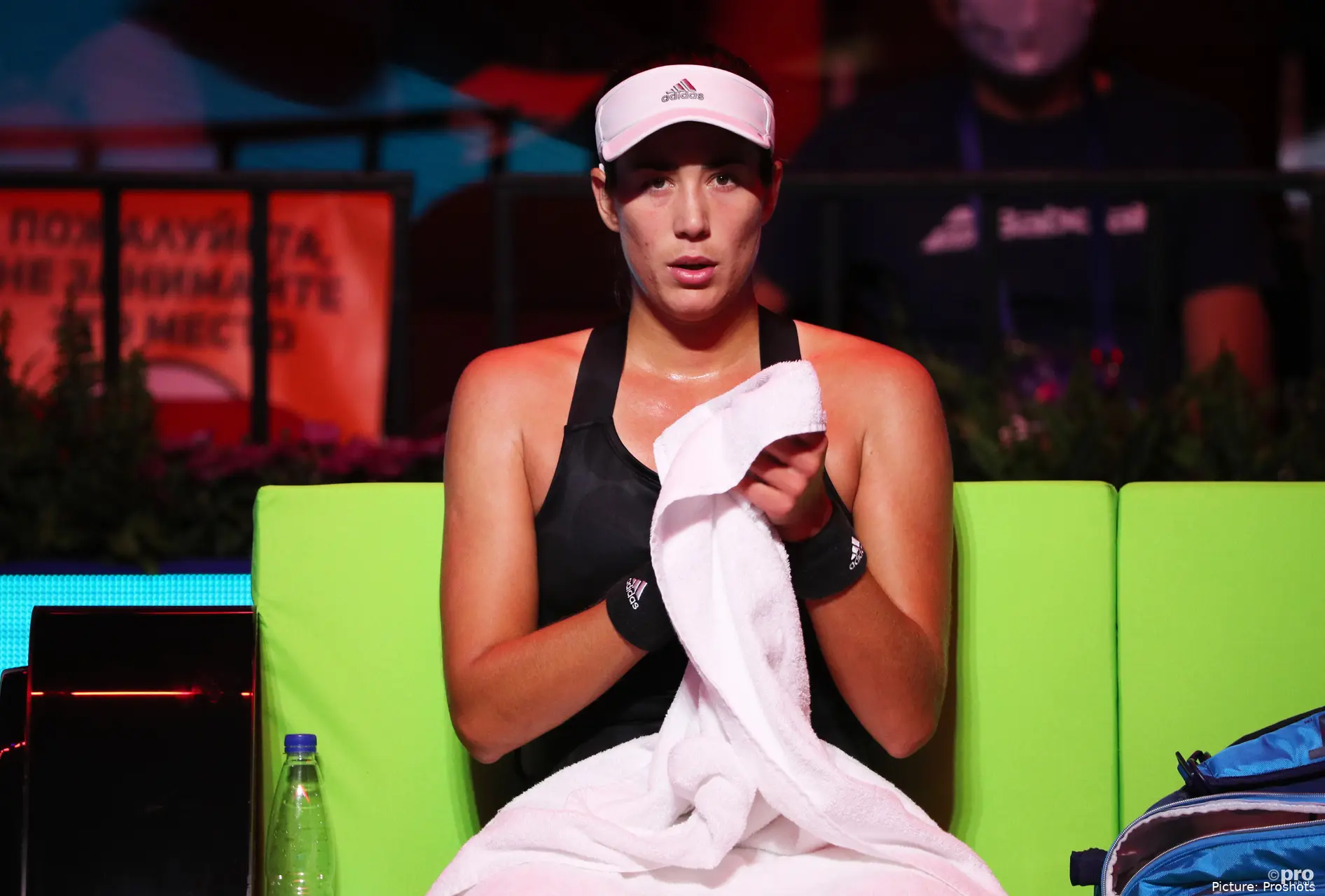
Few careers end as quietly as Garbiñe Muguruza's did. There was no farewell tour, no final match circled on a calendar, not even a proper goodbye on a tennis court. She simply stopped playing in January 2023, took what she called a break, and fourteen months later confirmed at a press conference in Madrid that the break was permanent. She was 30 years old, and had not lost a step so much as she had quietly walked away from the sport altogether.
That ending sits strangely next to what came before it. Muguruza beat both Williams sisters in Grand Slam finals, something no other player in tennis history can claim. She reached world No. 1 and established herself as one of the biggest names of her generation. She won a pair of WTA 1000 titles, but after the COVID-19 break in 2020, she struggled to consistently rediscover her best level.
Yet she was still young. In 2021, Muguruza won her third WTA 1000 title and qualified for the WTA Finals. Despite entering the final months of the year without much confidence, she was crowned champion in Guadalajara at 28, suggesting she still had plenty left to prove on Tour.
And then, across the back half of her career, she produced one of the more dramatic disappearing acts the WTA has seen — not through injury or scandal, but through a slow, steady fade that eventually stopped being a slump and became a retirement.
Garbiñe Muguruza's career snapshot
| Achievement | Record |
| Career-high ranking | No. 1 (11 September 2017) |
| Grand Slam titles | 2 (French Open 2016, Wimbledon 2017) |
| Grand Slam finals | 4 (2 titles, 2 runner-ups) |
| WTA singles titles | 10, including 3 at 1000/Premier Mandatory level |
| Other honours | 2021 WTA Finals champion; two-time Olympian |
| Career win-loss | 449–238 |
| Retired | April 2024, aged 30 (last played January 2023) |
The rise: from a Wimbledon final at 21 to beating both Williams sisters
Muguruza's breakthrough came earlier than most people remember. In 2015, at just 21, she reached the Wimbledon final in only her sixth major appearance, losing to Serena Williams in straight sets. It looked, at the time, like an impressive but perhaps one-off run for a talented young Spaniard still finding her level.
A year later, she got her revenge in the biggest possible way. At the 2016 French Open, Muguruza beat Serena Williams in the final, 7-5, 6-4, to become the first Spanish woman to win Roland Garros since Arantxa Sánchez Vicario in 1998. Twelve months on from that, she went to Wimbledon and beat Venus Williams in the final, 7-5, 6-0 — the first Spanish woman to win there since Conchita Martínez in 1994, and, in the process, the only player ever to defeat both Williams sisters in Grand Slam finals.

Garbine Muguruza at Rome Open 2017
Muguruza's Grand Slam finals
| Year | Tournament | Result | Opponent |
| 2015 | Wimbledon | Runner-up | Serena Williams |
| 2016 | French Open | Champion | Serena Williams |
| 2017 | Wimbledon | Champion | Venus Williams |
| 2020 | Australian Open | Runner-up | Sofia Kenin |
Reaching No. 1 — and losing her level almost as fast
The Wimbledon title, backed up by a Cincinnati Masters win over Simona Halep weeks later, carried Muguruza to world No. 1 on September 11, 2017 — only the second Spanish woman in history to top the rankings, after Sánchez Vicario. She was 24, held two majors, and looked set up for a long stay near the top of the sport.
Instead, the very next season unravelled quickly. Muguruza finished 2018 ranked No. 18, her lowest year-end position since 2014, opening the year with a withdrawal in Sydney and a retirement in Brisbane before losing in the second round of the Australian Open to a player ranked outside the top 80.
The player who had been untouchable at Wimbledon a few months earlier suddenly looked like she was searching for her game from scratch, and 2019 brought more of the same: only a pair of WTA 250 titles in Monterrey to show for two full seasons.

The 2021 twist: one last run to the top
Just as it looked like Muguruza's career had settled into permanent inconsistency, she produced one genuine late peak. She reached the 2020 Australian Open final as the favorite, only to lose to an in-form Sofia Kenin — a defeat that, oddly, the WTA itself later described as the start of a resurgence rather than another setback.
That resurgence arrived in full in 2021. Muguruza won the Dubai Duty Free Championships, a WTA 1000-level title, then added a further title in Chicago, and closed the season by winning the WTA Finals in Guadalajara, beating Anett Kontaveit in a tense three-set final. It was her tenth and final tour-level title, and remains, to this day, her last significant result on a tennis court.
The long goodbye: a hiatus that became permanent
What followed the 2021 high was not a slow decline so much as a sudden stop. Her level fell away through 2022, and by January 2023, after a first-round exit at the Lyon Open, she simply stepped away. Months later she confirmed she was extending the break indefinitely, saying the time at home with family and friends had felt healthy in a way tour life rarely had.
By April 2024, the break had become permanent. At a press conference in Madrid, a 30-year-old Muguruza announced her retirement, reflecting that if someone had told her as a child she'd one day win Roland Garros and Wimbledon and reach world No. 1, she would have thought they were crazy.

She left the sport with nearly $25 million in career prize money, two Grand Slam titles, and a level of unpredictability that meant nobody — including, it seems, Muguruza herself — ever quite knew which version of her would show up on a given week.
That unpredictability is, in the end, the whole story. Few players have looked as complete as Muguruza did beating Venus Williams at Wimbledon in 2017, and few careers illustrate more clearly how little that guarantees about what comes after. Two Grand Slams and a No. 1 ranking were real. So, eventually, was the silence that followed them.

Cristhián AvilaTennis Journalist
Cristhián Ávila is a tennis journalist based in Santiago, Chile, and has been part of the TennisUpToDate team since early 2023. He covers the ATP and WTA Tours as well as all four Grand Slams, producing breaking news, match reports, analysis, and regular liveblogs from major tournaments.
His reporting combines statistical analysis with clear explanation, helping readers understand tactical developments, player form, and broader storylines across the tour. Working fluently in both Spanish and English, Cristhián collaborates with an international editorial team and contributes to comprehensive global coverage. As part of his work, he has conducted interviews and media interactions with leading figures in the sport, including Caroline Wozniacki and John McEnroe.
In his journalism, Cristhián places strong emphasis on careful sourcing, editorial accuracy, and updating articles promptly when new, verified information becomes available. His coverage is grounded in research, context, and direct engagement with professional tennis.
claps 0visitors 0
Just In


Popular News
Latest Comments
- great articlestennisseserver07-10-2026
- Medvedev was leading Djokovic 7-5, 3-5 when an attempted return..' NO you ignorants, Djokovic was leading .weiss05-10-2026
- No more bullshit "Wildcards" to these two. Qualify like everyone else -- there will be cameras there, too. Time to scream... WTF ????!!!!
 mandoist29-09-2026
 - Let's not BS the general public -- Sabalenka started showing cracks in her game last season. Her losses and near-losses started at about the same time she began being distracted by Fame (constant Selfies, making TV commercials, magazine shoots, endless Social Media nonsense, etc., etc.) One would think even Saba could recognize the parallels with others who failed before her -- Raducanu, Giorgi, Bouchard to name a few.mandoist25-09-2026
- Gross!! Hey Raducanu, Giorgi, and Bouchard -- reserve a seat at your Social Media Selfie table for Saba + Naomi. They're heading in your direction soon enough.mandoist24-09-2026
- And then these same players will complain about how lengthy their season’s were and need more time-off. I’m all for more tennis but the amount of tennis we get now is actually kind of crazy! We all need a break, especially the players.DaveyWavey23-09-2026
- You should do a comparison article for "different kinds of justice" the courts decide for tennis players. I can think of at least three players who received very small bans of a few months, however Tara Moore has been fighting for her literal survival the past few years. It seems odd considering she is not a "name" player, unlike the other cases.DaveyWavey22-09-2026
- PRIZE MONEY & POINTS Winner - $185,500 Finalist - $114,500 Semi-Finalist - $66,003 Quarter-Finalist - $35,000 Round of 16 - $18,045 Round of 32 - $13,005 Winner - 500 Finalist - 325 Semi-Finalist - 195 Quarter-Finalist - 108 Round of 16 - 60 Round of 32 - 1DaveyWavey20-09-2026
- Pegula withdrew from this Singapore event
 tennishappens19-09-2026
 - Serena Williams chose her tournaments. It's not such a bad idea.MuswellHillbilly17-09-2026

Loading