“You feel like everybody has a target on your back”: Iga Swiatek responds to Sabalenka’s ranking motivation
WTA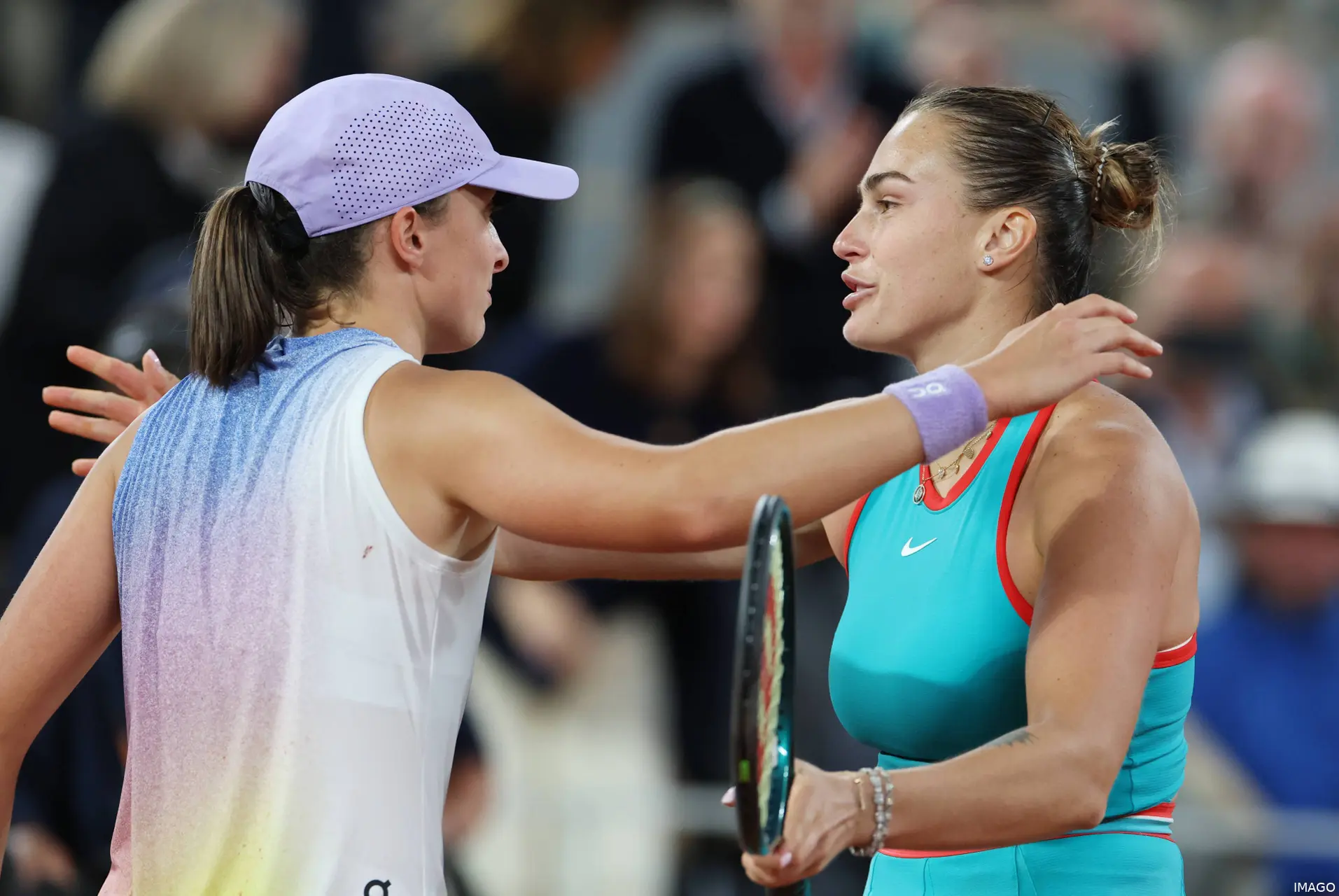
Iga Swiatek has offered her perspective on Aryna Sabalenka’s renewed motivation to reclaim the world No. 1 ranking, admitting she understands what it means to be on the other side of the chase. Their situations have changed dramatically this season, with Elena Rybakina taking over at the top after winning the US Open.
Rybakina’s reign has already suffered an unexpected setback in Beijing. The Kazakh arrived at the China Open as the newly crowned No. 1 but was eliminated by Alina Charaeva in her opening match, losing 3-6, 6-4, 6-3. It was her first match since beating Sabalenka in the US Open final and her first as the top-ranked player.
Sabalenka, meanwhile, has made no secret of her desire to reclaim the ranking. After spending 99 consecutive weeks at No. 1, she lost the position to Rybakina following the US Open, where she reached the final. She has since qualified for the WTA Finals for a sixth consecutive season, leaving the ranking battle among her main remaining objectives.
Swiatek is approaching the end of the season from a very different position. The Pole is now outside the top eight in the WTA Race, despite spending an extended period at No. 1. After beating Gao Xinyu 6-2, 6-3 in Beijing, she explained why she understands Sabalenka’s renewed motivation at this stage of the season.
Swiatek understands Sabalenka's view from the top
Swiatek has spent much of the past four years occupying the position Sabalenka is now trying to regain. She first became world No. 1 in April 2022 and held the ranking for extended periods, including a 75-week run between November 2023 and October 2024. Her current position represents a very different competitive reality, making her perspective on Sabalenka’s comments particularly relevant.
Asked about Sabalenka’s motivation to chase the top ranking again, Swiatek pointed to the psychological difference between defending No. 1 and trying to take it back. Rather than dismissing Sabalenka’s approach, she said she could understand it from her own experience of spending years as the player everyone else was trying to catch.
“I understand Aryna because when you’re number one, yeah, you feel like everybody has a target on your back," Swiatek said at press conference. "You just run away. You’re being chased instead of chasing. I totally understand what she feels. But obviously everybody has a different story. Doesn’t make sense to compare.”

Aryna Sabalenka and Iga Swiatek embracing after their 2025 Roland Garros semi-final clash
The current standings make that contrast particularly clear. Rybakina leads the rankings, with Sabalenka second, while Swiatek is down in 10th. Rybakina had already secured her place at the WTA Finals before becoming world No. 1, while Sabalenka joined her in qualifying shortly before the China Open.
Most weeks as WTA No. 1
| Rank | Player | Weeks at No. 1 |
| 1 | Steffi Graf | 377 |
| 2 | Martina Navratilova | 332 |
| 3 | Serena Williams | 319 |
| 4 | Chris Evert | 260 |
| 5 | Martina Hingis | 209 |
| 6 | Monica Seles | 178 |
| 7 | Iga Swiatek | 125 |
| 8 | Ashleigh Barty | 121 |
| 9 | Justine Henin | 117 |
| 10 | Aryna Sabalenka | 107 |
Three players, three different targets in Beijing
Rybakina’s early exit has added another unexpected element to the end-of-season ranking picture. The 27-year-old had built her rise to No. 1 over several months, culminating in her US Open triumph over Sabalenka, but her first match in Beijing ended with a defeat against world No. 118 Charaeva.
Sabalenka therefore has another opportunity to reduce the distance at the top as the Asian swing continues. She has already secured her WTA Finals qualification, but Swiatek is fighting a separate battle. The former No. 1 entered the China Open in 10th place in the live Race and needs a strong finish to keep her six-year run of appearances at the season-ending tournament alive.
Swiatek’s opening win over Gao was her ninth victory from her first 10 matches at the China Open, where she won the title in 2023. She will next face Donna Vekic, whom she leads 4-0 in their head-to-head record. A deep run would provide valuable points in a race that has become one of the defining objectives of her final weeks of 2026.
Read also
For Swiatek, the immediate target is therefore not another battle for No. 1 but qualification for the WTA Finals. She acknowledged that ranking recovery remains a longer-term possibility, but said her focus has shifted toward individual matches rather than the position at the top.
“That’s the goal. I’m going to be fighting for that. Obviously, I’m aware. But it doesn’t change the fact that it still feels pretty far, as there are many tournaments where you can gain many points.”
Her comments leave the three-way picture at the top of the women’s game unusually fragmented. Rybakina is defending the No. 1 position after her US Open breakthrough, Sabalenka is trying to take it back, and Swiatek is concentrating on rebuilding her position and securing another appearance at the WTA Finals. The ranking chase has changed, but the final weeks of the season still give all three plenty to play for.

Cristhián AvilaTennis Journalist
Cristhián Ávila is a tennis journalist based in Santiago, Chile, and has been part of the TennisUpToDate team since early 2023. He covers the ATP and WTA Tours as well as all four Grand Slams, producing breaking news, match reports, analysis, and regular liveblogs from major tournaments.
His reporting combines statistical analysis with clear explanation, helping readers understand tactical developments, player form, and broader storylines across the tour. Working fluently in both Spanish and English, Cristhián collaborates with an international editorial team and contributes to comprehensive global coverage. As part of his work, he has conducted interviews and media interactions with leading figures in the sport, including Caroline Wozniacki and John McEnroe.
In his journalism, Cristhián places strong emphasis on careful sourcing, editorial accuracy, and updating articles promptly when new, verified information becomes available. His coverage is grounded in research, context, and direct engagement with professional tennis.
claps 0visitors 0
Just In


Popular News

Latest Comments
- Lena... Takin' care of business
 mandoist25-10-2026
 - Can you please stop publishing this nonsense? Stick to Tennis.mandoist25-10-2026
- Does Sinner need that 4.5 mil? I doubt it. He can make that with three modelling gigs!😅🤣Rapunzel21-10-2026
- Did "People Magazine" purchase this website? This nonstop storyline is bullshit.mandoist21-10-2026
- Listen... this is of no concern to anyone but these two. Deal with your own issues -- most of us have our own. Thanks, media, for these insignificant follow-ups which are meaningless.mandoist21-10-2026
- This is so very very sad, for all three of them. I truly thought they had an unbreakable bond, but life throws up so many differing challenges. Having your homeland suffering in such a terrible way, makes happiness lose out to guilt as well. Our thoughts are with them. X💔bjsexton20-10-2026
- I have lost all respect for Svitolina! Could she not have waited until he had played at the Paris Masters!!! She is selfish and don't give a damn about Gael. That is NOT how love is demonstrated Elina!!Rapunzel19-10-2026
- Perhaps convenient tennis tour sex is not a strong enough experience in which to base a marriage?mandoist19-10-2026
- Fight the Good Fight... Tennis (sports in general) need more Humans such as yourself.mandoist18-10-2026
- When is WTA going to mandate Genetic Testing (DNA) ???mandoist18-10-2026

Loading