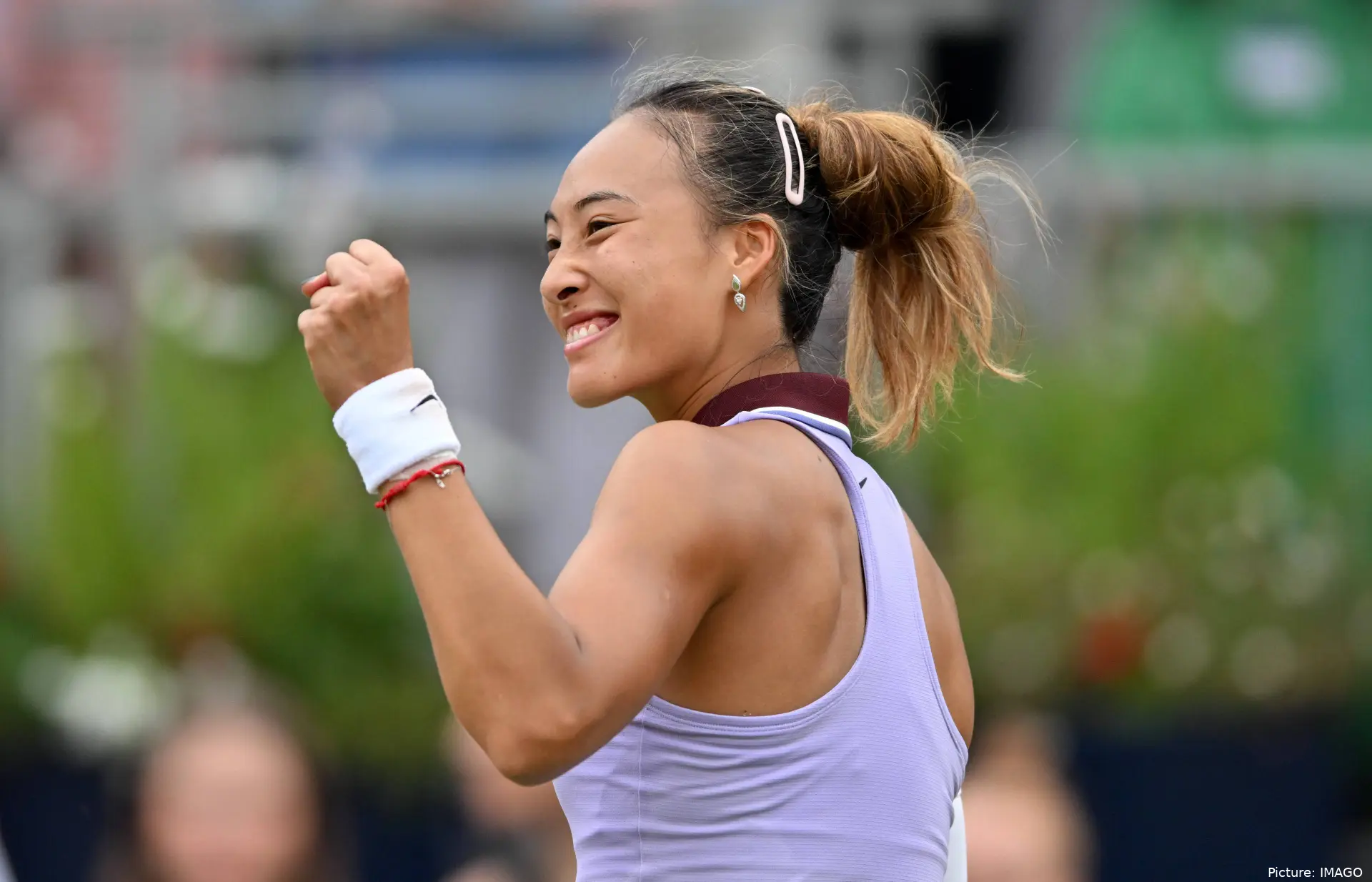
There were stretches of Zheng Qinwen’s semifinal against Elise Mertens in Beijing today when I wondered what, exactly, an opponent was supposed to do. Get the racket back earlier? Stand farther behind the baseline? Guess? Good luck with any of that.
During her 7-5, 6-2 win, Zheng hit some of the most overwhelming tennis I’ve watched on the WTA Tour this year. I know how much ground that statement covers. I’ve watched Aryna Sabalenka and Elena Rybakina. I’ve seen plenty of matches in which a very good player was made to look decidedly ordinary. But at several junctures today, the combination of pace, flatness and conviction coming off Zheng’s racket was something else altogether.
Queen-wen, indeed. Because “wen” she plays like that, the nickname feels less like a clever bit of marketing and more like a reasonable description of who’s running the court.
I’m talking about her highest level within the match. Every player has stretches when the timing slips or a decision goes wrong. What caught my attention was how little room Mertens had to work with when Zheng found hers. A ball would leave the racket, arrive somewhere deeply inconvenient and force a response that already looked like the beginning of the end of the point. Sometimes, watching on television, I could barely follow the shot before it was past her.
There’s power, and then there’s the feeling that someone has taken away your time to play tennis. Zheng was doing the latter.
Her movement made the whole thing even more impressive. At her best today, she seemed to arrive where she needed to be without wasting a step. She was balanced, ready and able to put her body behind the ball. The violence of the shot came out of preparation that looked almost unremarkable. Then, suddenly, Mertens was scrambling.
Final bound ⭐️ Zheng Qinwen makes history defeating Mertens 7-5, 6-2 and advancing to the Beijing final! #ChinaOpen https://t.co/KQmilZAmkw
— wta (@WTA) October 10, 2026
A welcoming return to home soil
Watching all of this in Beijing also got me thinking about something we probably don’t give enough consideration: how little of Zheng’s tennis year takes place at home.
She trains in Europe and has built an unmistakably international career. To my eye, she’s as comfortable moving through the wider tennis world as any Chinese player, woman or man. That matters in a sport that asks its athletes to spend much of their lives somewhere else, adjusting to different conditions, different languages and another hotel room.
But being comfortable abroad isn’t quite the same as walking onto a court in China’s capital and hearing that crowd.
For most of the season, Zheng brings her own energy to the match. In Beijing, there’s an entire stadium willing to contribute. You could feel the connection today, even through a television screen. Every thunderous winner seemed to come back to her as noise, and there were moments when she looked completely at ease being the person everyone had come to see.
That isn’t automatic. A home crowd can tighten a player’s arm as easily as it can lift her spirits. Expectations follow you onto the court, too. Everybody wants a win; everybody has an opinion about what you should be doing. Yet today, Zheng appeared to draw strength from the occasion.
One of my favorite moments had very little to do with a winner. Late in the first set, with the Beijing crowd getting too vocal during one of Mertens’s service games, Zheng took the time to shush them. She wanted their support, clearly. She also wanted them to let her opponent serve.
It was a small gesture, but an assured one. Here was a player feeding off the crowd while still being willing to tell it to settle down. There’s something appealing about that kind of command, especially when the tennis itself is already making quite enough noise. Which brings me to 2027.

Zheng Qinwen is in a first WTA final since the 2024 WTA Finals
Onwards and upwards
A healthy Zheng Qinwen, able to train properly and compete consistently, looks to me like a player headed back toward the territory of her career-high No. 4 ranking. I don’t mean she’ll get there simply because she produced some spectacular shots in October. A ranking is built over months, including the afternoons when nothing feels particularly spectacular and you still have to find a way through.
But the tennis required is there. We’ve seen it before, and today offered another very persuasive look.
Yes, the top of the women’s game is crowded. There are outstanding players who would have every reason to object to what I’m about to say. Still, when Zheng is playing her very best tennis, I see only three women as the most convincing obstacles: Rybakina, Sabalenka and Mirra Andreeva, the player she faces in tomorrow’s Beijing final.
That’s my judgment about the matchup at her peak, rather than a prediction that nobody else can beat her. Of course they can. Sustaining this level is the challenge, and opponents get a vote. But Rybakina and Sabalenka can bring the kind of serving and first-strike power that prevents Zheng from taking control in the first place. Andreeva presents a different problem, with her reading of the game, her movement and her ability to make an opponent hit one more ball from a less comfortable position.
Tomorrow should give us a fascinating look at that last test. How much time can Zheng take away? How much can Andreeva find for herself? Those are questions I’m very happy to spend a final watching.
Read also

For now, though, I keep coming back to the sheer pleasure of seeing Zheng hit a tennis ball this well. We spend so much time discussing rankings, draws and what a result means that we can hurry past the reason we switched on the match. Today, there were shots worth watching again simply because they were magnificent.
She only gets a small portion of the season in front of a home crowd. If she can take this freedom, this efficient movement and this extraordinary ball-striking with her into a healthy 2027, the rest of the tour will have plenty to think about. And considerably less time to think about it.

Aron SolomonGuest Author
A Pulitzer Prize-nominated journalist for his groundbreaking op-ed in The Independent exposing the NFL’s “race-norming” policies, Aron Solomon, JD, is a globally recognized thought leader in law, media, and strategy.
As Chief Strategy Officer for AMPLIFY, he leverages his deep expertise to shape the future of legal marketing. Aron has taught entrepreneurship at McGill University and the University of Pennsylvania and was honored as a Fastcase 50 recipient, recognizing him among the world’s top legal innovators. A prolific commentator on law, business, and culture, his insights regularly appear in Newsweek, The Hill, Crunchbase News, and Literary Hub.
He has also been featured in The New York Times, Fast Company, Fortune, Forbes, CBS News, CNBC, USA Today, ESPN, TechCrunch, BuzzFeed, Venture Beat and countless other leading global media outlets. We are proud to have Aron on board at TennisUpToDate, where his deep tennis expertise enriches the site with sharp, original columns that connect the sport to wider cultural debates.
claps 0visitors 0
Just In


Popular News
Latest Comments
- great articlestennisseserver07-10-2026
- Medvedev was leading Djokovic 7-5, 3-5 when an attempted return..' NO you ignorants, Djokovic was leading .weiss05-10-2026
- No more bullshit "Wildcards" to these two. Qualify like everyone else -- there will be cameras there, too. Time to scream... WTF ????!!!!
 mandoist29-09-2026
 - Let's not BS the general public -- Sabalenka started showing cracks in her game last season. Her losses and near-losses started at about the same time she began being distracted by Fame (constant Selfies, making TV commercials, magazine shoots, endless Social Media nonsense, etc., etc.) One would think even Saba could recognize the parallels with others who failed before her -- Raducanu, Giorgi, Bouchard to name a few.mandoist25-09-2026
- Gross!! Hey Raducanu, Giorgi, and Bouchard -- reserve a seat at your Social Media Selfie table for Saba + Naomi. They're heading in your direction soon enough.mandoist24-09-2026
- And then these same players will complain about how lengthy their season’s were and need more time-off. I’m all for more tennis but the amount of tennis we get now is actually kind of crazy! We all need a break, especially the players.DaveyWavey23-09-2026
- You should do a comparison article for "different kinds of justice" the courts decide for tennis players. I can think of at least three players who received very small bans of a few months, however Tara Moore has been fighting for her literal survival the past few years. It seems odd considering she is not a "name" player, unlike the other cases.DaveyWavey22-09-2026
- PRIZE MONEY & POINTS Winner - $185,500 Finalist - $114,500 Semi-Finalist - $66,003 Quarter-Finalist - $35,000 Round of 16 - $18,045 Round of 32 - $13,005 Winner - 500 Finalist - 325 Semi-Finalist - 195 Quarter-Finalist - 108 Round of 16 - 60 Round of 32 - 1DaveyWavey20-09-2026
- Pegula withdrew from this Singapore event
 tennishappens19-09-2026
 - Serena Williams chose her tournaments. It's not such a bad idea.MuswellHillbilly17-09-2026

Loading