Ten for ten: Iga Swiatek reaches a semifinal at every WTA 1000 event, and she is the only active player to do it
WTA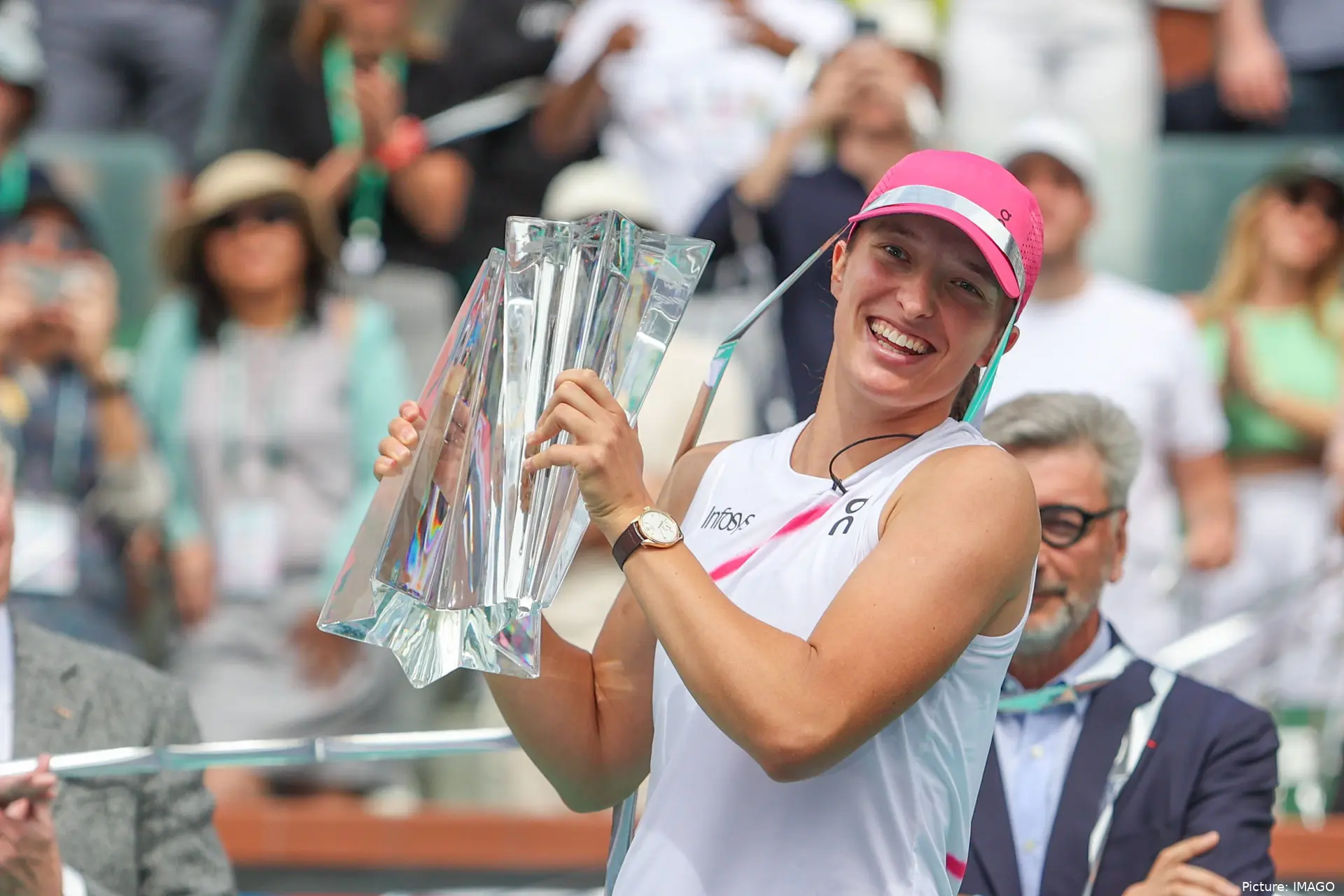
The strongest argument for Iga Swiatek's place in WTA 1000 history is not one number. It is the combination of three: how often she wins the titles, how rarely she loses the finals, and how consistently she reaches the last four at every event on the calendar. Her semifinal in Wuhan this week added a fourth point, because it completed a list that only three other women have completed since the current format began in 2009.
The context matters. Swiatek arrived in Wuhan as the seventh seed, ranked No. 9 with 3,999 points, in a season that started slowly by her standards. She had not reached a final until Toronto in August, when she beat Elena Rybakina 6-2, 6-3 for her first title in a year.
On Friday she beat Ann Li 6-4, 6-1 in the quarterfinals without dropping a set in the tournament, and she faces fellow Pole Maja Chwalińska, ranked 22nd, in the semifinals on Saturday.
The list that only four women have completed
Swiatek is the fourth player since 2009 to reach at least the semifinals at all ten current WTA 1000 events, after Caroline Wozniacki, Svetlana Kuznetsova and Simona Halep. She is the only one of the four who is still active. Wuhan was the one that completed her set, and it is also an event she has never won.
The feat has a particular meaning in the WTA calendar. The ten events are played on hard courts, clay, outdoors and indoors, across a season that goes from Doha in February to Wuhan in October. A player who only wins on clay, or only wins on fast hard courts, cannot do it. For Wozniacki, Kuznetsova and Halep, it was a measure of longevity. For Swiatek, who is 25, it comes much earlier in a career.

Poland's Iga Swiatek celebrates her 6-2, 6-3 win over Kazakhstan's Elena Rybakina to clinch the National Bank Open final
Her title in Toronto was her 12th at WTA 1000 level, which moved her past Aryna Sabalenka (11) for second place since the format debuted in 2009. Only Serena Williams, with 13, has more. She has won eight of the ten events, with Dubai and Wuhan the exceptions.
| Player | WTA 1000 titles since 2009 |
| Serena Williams | 13 |
| Iga Swiatek | 12 |
| Aryna Sabalenka | 11 |
| Victoria Azarenka | 10 |
| Simona Halep | 9 |
| Petra Kvitova | 9 |
The finals record is what separates her from almost everyone. She is 12-2 in WTA 1000 finals, a win rate of 86%, and both losses came in 2023, in Dubai and Madrid. With the Toronto title she also broke a record she had shared with Serena Williams: she has now won seven WTA 1000 finals in a row, against Williams' six.
In all WTA finals she is 26-5, the best win rate among players with 20 or more finals since 1990, and she is 6-0 in Grand Slam finals.
Fewer appearances than most, but not the fastest
Swiatek's 25th WTA 1000 semifinal came in her 50th main-draw appearance at that level. Since the Tier I format began in 1990, only three players have reached 25 semifinals in fewer appearances: Steffi Graf, Martina Hingis and Monica Seles. That puts her fourth in speed, and the three players ahead of her belong to a different era, with different tournament formats and fewer events.
| Player | Main-draw appearances needed to reach 25 Tier I/WTA 1000 semifinals |
| Steffi Graf | 28 |
| Martina Hingis | 36 |
| Monica Seles | 37 |
| Iga Swiatek | 50 |
The comparison is useful because it shows what her place in the history is built on: volume and consistency, not just peaks. She reached 25 semifinals while also collecting 150 WTA 1000 wins, a total she reached in Wuhan with her win over Ashlyn Krueger. Simona Halep (29 semifinals) and Serena Williams (26) are the other players with 25 or more.
A down year that still looks like her
The most revealing data point of her 2026 is a statistic from the WTA. Swiatek is the first player since 1990 to reach her first four semifinals of a season at Tier I or WTA 1000 events: Rome, Toronto, Cincinnati and Wuhan. In a year without a final until August, the top events were still where she performed best.
The results show the pattern. She lost the Rome semifinal to Elina Svitolina and the Cincinnati semifinal to Jessica Pegula, then won the title in Toronto in between. She is 42-15 this season, a long way from the dominant years but still a player whose results remain tied to the biggest tournaments.
| Swiatek at WTA 1000 level | Number |
| Titles | 12 |
| Finals record | 12-2 (86%) |
| Consecutive finals won | 7 (a WTA 1000 record) |
| Semifinals | 25 |
| Match wins | 150 |
| Events won | 8 of 10 (not Dubai or Wuhan) |
| Events with at least a semifinal | 10 of 10 |
What the numbers say about her place in history
Taken together, the numbers support a clear argument. Since 2009, only Serena Williams has more WTA 1000 titles. Her finals record, 12-2 at this level and 26-5 overall, is the best win rate among players with 20 or more finals since 1990. Her breadth is rarer still: only Wozniacki, Kuznetsova and Halep have also reached a semifinal at all ten events.
Compared with Sabalenka, the closest active rival with 11 titles, Swiatek has one more title and a seven-final winning streak that no woman has matched.

The comparison with the historical Tier I names is less clear, and it should be. Graf, Hingis and Seles reached 25 semifinals in fewer appearances, and they played in a very different era of the tour.
The data cannot say that Swiatek is the best WTA 1000 player ever. It does say that she belongs in the group that includes Serena Williams, Halep, Wozniacki and Kuznetsova.
What remains is the work still to do. Wuhan and Dubai are the two events she has not won, and a title in Wuhan would complete the set in the same city where her semifinal run was completed. She also needs the title to have a chance of qualifying for the WTA Finals in Indian Wells.
Whatever happens on Saturday, her WTA 1000 record already supports the argument: Swiatek is no longer only a Grand Slam champion who wins on clay. She is one of the defining players of the category.

Cristhián AvilaTennis Journalist
Cristhián Ávila is a tennis journalist based in Santiago, Chile, and has been part of the TennisUpToDate team since early 2023. He covers the ATP and WTA Tours as well as all four Grand Slams, producing breaking news, match reports, analysis, and regular liveblogs from major tournaments.
His reporting combines statistical analysis with clear explanation, helping readers understand tactical developments, player form, and broader storylines across the tour. Working fluently in both Spanish and English, Cristhián collaborates with an international editorial team and contributes to comprehensive global coverage. As part of his work, he has conducted interviews and media interactions with leading figures in the sport, including Caroline Wozniacki and John McEnroe.
In his journalism, Cristhián places strong emphasis on careful sourcing, editorial accuracy, and updating articles promptly when new, verified information becomes available. His coverage is grounded in research, context, and direct engagement with professional tennis.
claps 0visitors 0
Just In


Popular News

Latest Comments
- Two Things: 1. Stop allowing these Spoiled Trust-Fund Elitists to behave badly. Your little hand-slaps do not deter them. 2. STOP the incessantly annoying "towel wiping" nonsense!!!!
 mandoist15-10-2026
 - A healthy Qinwen may be hard to stop next season. She was already scaring her opponents before her medical leave(s). Unfortunately, Zheng insisted on singing again. On the positive side -- Mirra did not sing!! ;~}mandoist11-10-2026
- Where is it written that athletes, entertainers... People in general... are mandated to keep looking at -- or even using [anti]Social Media? Public & private figures consistently complain and reveal their concerns about negativity and violence thrown at them -- yet they insist on participating. Avoid it, don't use it, don't read it. It's okay to occasionally look up at the World instead beating your eyes & thumbs to death on The Inventions out there.mandoist11-10-2026
- great articlestennisseserver07-10-2026
- Medvedev was leading Djokovic 7-5, 3-5 when an attempted return..' NO you ignorants, Djokovic was leading .weiss05-10-2026
- No more bullshit "Wildcards" to these two. Qualify like everyone else -- there will be cameras there, too. Time to scream... WTF ????!!!!mandoist29-09-2026
- Let's not BS the general public -- Sabalenka started showing cracks in her game last season. Her losses and near-losses started at about the same time she began being distracted by Fame (constant Selfies, making TV commercials, magazine shoots, endless Social Media nonsense, etc., etc.) One would think even Saba could recognize the parallels with others who failed before her -- Raducanu, Giorgi, Bouchard to name a few.mandoist25-09-2026
- Gross!! Hey Raducanu, Giorgi, and Bouchard -- reserve a seat at your Social Media Selfie table for Saba + Naomi. They're heading in your direction soon enough.mandoist24-09-2026
- And then these same players will complain about how lengthy their season’s were and need more time-off. I’m all for more tennis but the amount of tennis we get now is actually kind of crazy! We all need a break, especially the players.DaveyWavey23-09-2026
- You should do a comparison article for "different kinds of justice" the courts decide for tennis players. I can think of at least three players who received very small bans of a few months, however Tara Moore has been fighting for her literal survival the past few years. It seems odd considering she is not a "name" player, unlike the other cases.DaveyWavey22-09-2026

Loading