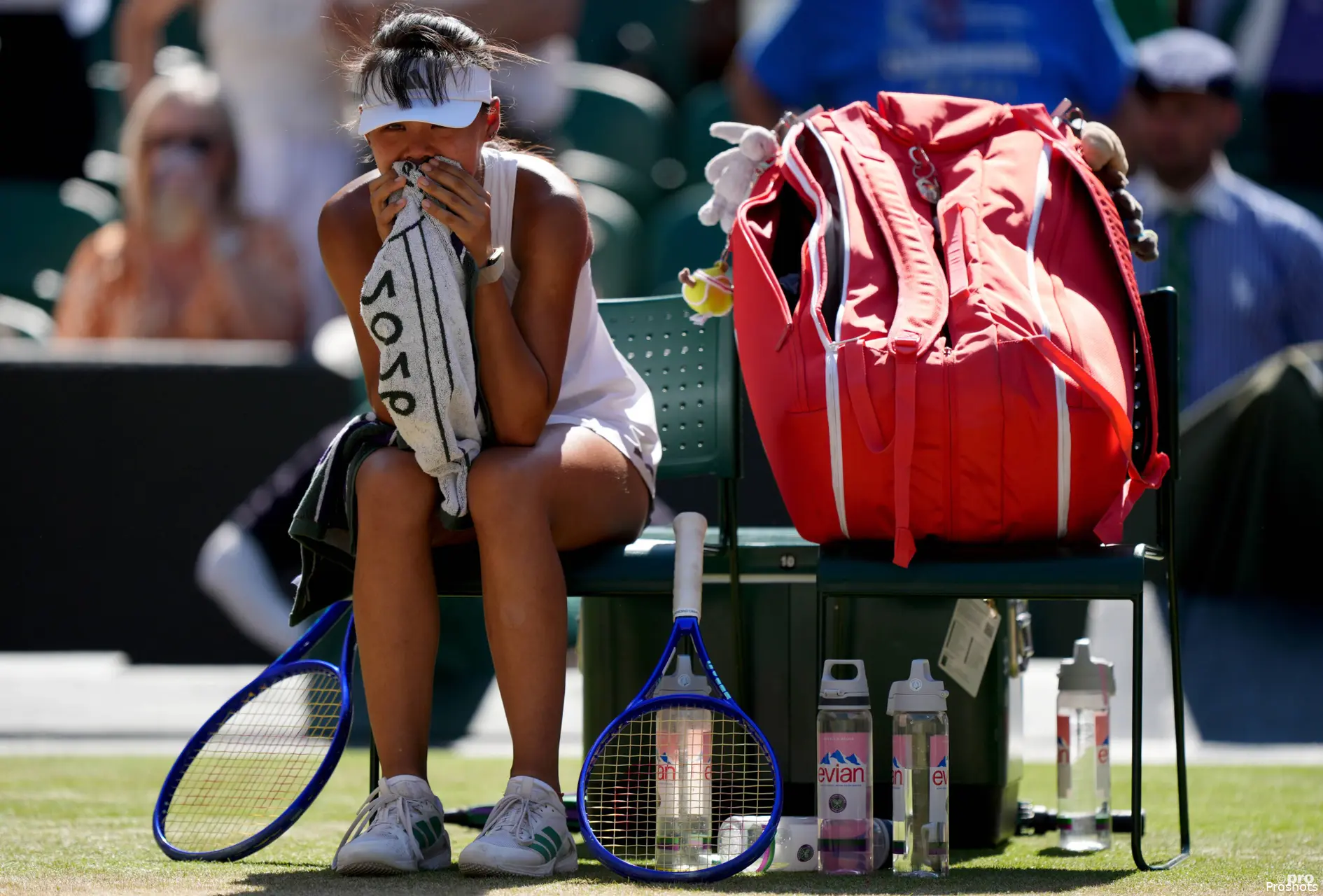
Sun Xinran had already experienced just about everything a 16-year-old could possibly want from a summer of Grand Slam tennis. Except winning one. She reached the girls’ singles final at Roland Garros in June and finished runner-up.
She reached another at Wimbledon in July and lost again, this time to Anna Pushkareva in a 2-hour, 23-minute battle that became the longest girls’ singles final in Wimbledon history. Then came New York.
Same stage. Same opponent she had faced at Wimbledon. One more opportunity. And this time, when the match reached a deciding set, Sun left absolutely nothing undecided.
The top-ranked junior in the world won the US Open girls’ singles championship Saturday, beating Pushkareva 6-4, 4-6, 6-0 in 1 hour, 47 minutes to capture the first Grand Slam singles title of her career. That last number is the one that jumps off the page. 6-0.
After two consecutive Grand Slam final defeats, after splitting the first two sets with the player who had denied her at Wimbledon just two months earlier, Sun didn’t merely win the third set. She erased it.
And maybe that is the most interesting thing about her first major title. It wasn’t simply a breakthrough. It was a response.

Xinran Sun has already lost multiple finals.
Three finals in three slams
Junior tennis is inherently dangerous territory for predictions. Every year we watch teenagers win enormous matches and immediately start trying to map out the next 15 years of their lives. Junior Grand Slam champions become future professional Grand Slam champions in our imaginations before they have played enough professional matches to pay for a decent hotel room with their career earnings.
Sun is a wonderful example of why we should resist that temptation. Her professional numbers remain remarkably modest. Her career-high singles ranking is No. 599, achieved on August 31. She has earned $5,947 in singles prize money this year and $12,110 across her professional career.
But those numbers now coexist with something far more revealing. Sun has reached the girls’ singles final at three consecutive Grand Slams.
Roland Garros. Wimbledon. US Open. Runner-up. Runner-up. Champion.
That isn’t one spectacular week from a teenager who caught fire at the right moment. That’s a pattern. And at 16, it makes Sun one of the most interesting young players in tennis.
The Wimbledon rematch
The circumstances Saturday made the victory even better. Sun wasn’t facing an unfamiliar opponent. Across the net was the person responsible for one of the most painful losses of her young career.
At Wimbledon, Pushkareva had beaten her in that marathon final. Sun had been close enough to her first Grand Slam title to touch it and walked away without it. New York offered the rematch. Sun took the opening set 6-4. Pushkareva answered by taking the second by exactly the same score.
So there they were again. Sun and Pushkareva. One set for a Grand Slam title.
What a moment for Xinran Sun! 🏆
— US Open Tennis (@usopen) September 12, 2026
The 16-year-old seals her first junior Grand Slam title in New York. pic.twitter.com/B4G76L5vV1
This time there would be no marathon. Sun won six consecutive games and finished it. There is a tendency in tennis to talk about resilience in almost mystical terms, particularly with young players. But sometimes resilience is much easier to identify.
Lose a Grand Slam final. Lose another Grand Slam final. Meet the woman who beat you in the second one. Get dragged into a deciding set. Win it 6-0. That’ll do.
The numbers tell the story
Pushkareva actually produced considerably more outright offense Saturday, hitting 28 winners to Sun’s 10. She also committed 48 unforced errors. Sun committed 26. That difference mattered. So did the break points.
Sun converted six of eight opportunities. Pushkareva managed only two of 10. Those statistics suggest something more interesting than a player simply overwhelming an opponent with spectacular shotmaking. Sun managed the match.
She made Pushkareva play. She took her opportunities. And when the championship became a six-game sprint in the final set, she didn’t blink.
For a 16-year-old playing for her first Grand Slam title after twice finishing one match short, that’s impressive. Very impressive.
What happens now is the fascinating part
The temptation will be to look at the world No. 1 junior ranking and three consecutive Grand Slam finals and immediately ask how quickly Sun can become a force on the WTA Tour. Maybe she will. But there is an enormous gulf between junior dominance and professional success.
Sun’s No. 599 ranking actually helps put that gulf into perspective. She has spent this season proving she can beat the best juniors in the world. Now comes the slow, often unglamorous business of proving she can beat professionals.
There will be ITF tournaments. Qualifying draws. Players ranked 300th who have been traveling the circuit for years and have absolutely no interest in becoming a paragraph in somebody else’s teenage breakthrough story. The serves get bigger. The points get heavier. The margins get smaller. And the expectations change. Sun won’t sneak up on anyone anymore. That may be the biggest thing Saturday changed.
Remember Sun Xinran
We should be careful with what comes next. Don’t call her a future Grand Slam champion. She already is one.
Don’t declare her China’s next great professional star. She hasn’t earned that yet, and she shouldn’t have to. Let her career tell us what she becomes.
But there is something worth recognizing right now. Three consecutive junior Grand Slam finals at 16 is extraordinary consistency. Losing the first two and returning to reach another says something about a young player’s ability to absorb disappointment. Facing the woman who beat you at Wimbledon and handing her a 6-0 deciding set says a little more.
Read also

Sun Xinran came to New York as the No. 1 junior in the world. She leaves with something the ranking couldn’t give her. The trophy. A few weeks ago, her résumé said No. 599 in the professional rankings and $12,110 in career prize money. Now it says US Open champion. And the really interesting part starts here.

Aron SolomonGuest Author
A Pulitzer Prize-nominated journalist for his groundbreaking op-ed in The Independent exposing the NFL’s “race-norming” policies, Aron Solomon, JD, is a globally recognized thought leader in law, media, and strategy.
As Chief Strategy Officer for AMPLIFY, he leverages his deep expertise to shape the future of legal marketing. Aron has taught entrepreneurship at McGill University and the University of Pennsylvania and was honored as a Fastcase 50 recipient, recognizing him among the world’s top legal innovators. A prolific commentator on law, business, and culture, his insights regularly appear in Newsweek, The Hill, Crunchbase News, and Literary Hub.
He has also been featured in The New York Times, Fast Company, Fortune, Forbes, CBS News, CNBC, USA Today, ESPN, TechCrunch, BuzzFeed, Venture Beat and countless other leading global media outlets. We are proud to have Aron on board at TennisUpToDate, where his deep tennis expertise enriches the site with sharp, original columns that connect the sport to wider cultural debates.
claps 0visitors 0
Just In




Popular News
Latest Comments
- Big Babe Tennis! Hoping for a good final.DaveyWavey12-09-2026
- Director needs to return to his old "job" at the Australia Open. He's clueless in NYC.
 mandoist12-09-2026
 - You keep writing ridiculous crap... why are you even watching tennis?mandoist12-09-2026
- They probably have a very good reason for this. I do not get it. Annoying that it finishes so late
 AceOfBase12-09-2026
 - I hope he wins. Would be great to have a USA winner again with the men.AceOfBase12-09-2026
- I love WTA matches. Seek them out as much as possible on youtube and other platforms I already subscribe to. With that in mind, I do not wish to pay $$$ to a notoriously slippery subscription conglomerate sports broadcaster (like SkySports) just for the privilege to watch it and the tnt/eurosport/discovery subscription went from $$ to $$$+ annually in a blink of an eye. With ATP I have been begrudgingly paying xyz tennis only channel and try to catch up on slams elsewhere (pubs, youtube with USO later on games are just as enjoyable to watch and a smart move to upload on their official channel) but they don't cover WTA. I tried another Tennis dedicated channel that advertised originally as broadcasting where I live, but turned out, they took the money, but didn't cover the matches (only fluff/filler value documentaries). I don't understand why it is so hard to not lock the live matches to one broadcaster only refusing so many people who are happy to pay for the privilege just not through that one entry point. WTA is so exciting for the last few years and they really should capitalise on it as much as possible. And I know it is somewhat naive talking without knowing the inner works, but not being able to find any WTA other than youtube (and then only highlights mostly) is just so frustrating.JayJay11-09-2026
- Clearly not AI :-)AceOfBase11-09-2026
- Oh my God!! Does anyone proofread these pages??? Case in point: However, the question mark over the 32-years-old head......???? No! No! No! However, the question mark over the 32-year-old's head...good grief man, hire a proofreader. This article is rife with errors making some sentences very difficult to read. I had to stop. I am a proofreader hence my disgust.Rapunzel10-09-2026
- Iga needs to make a decision whether she wants to continue the sport of tennis or pursue whatever she has going on in her personal life. One can tell that tennis is no longer an interest of hers. She should retire while she is on top, not when she slides to the bottom of the rankings. She has too much talent to look how she does on the court these days. She looks more like a wild card than a champion.crissy09-09-2026
- Looks like tennis has become a part of the American Oligarchy. As usual, Pegula is given a cupcake draw. With all her money, they have to fixed the draws in her favor in order to raised the trophy.crissy09-09-2026

Loading