What happened to Maria Sakkari? How the former world No. 3 fell from the top and fought her way back
WTA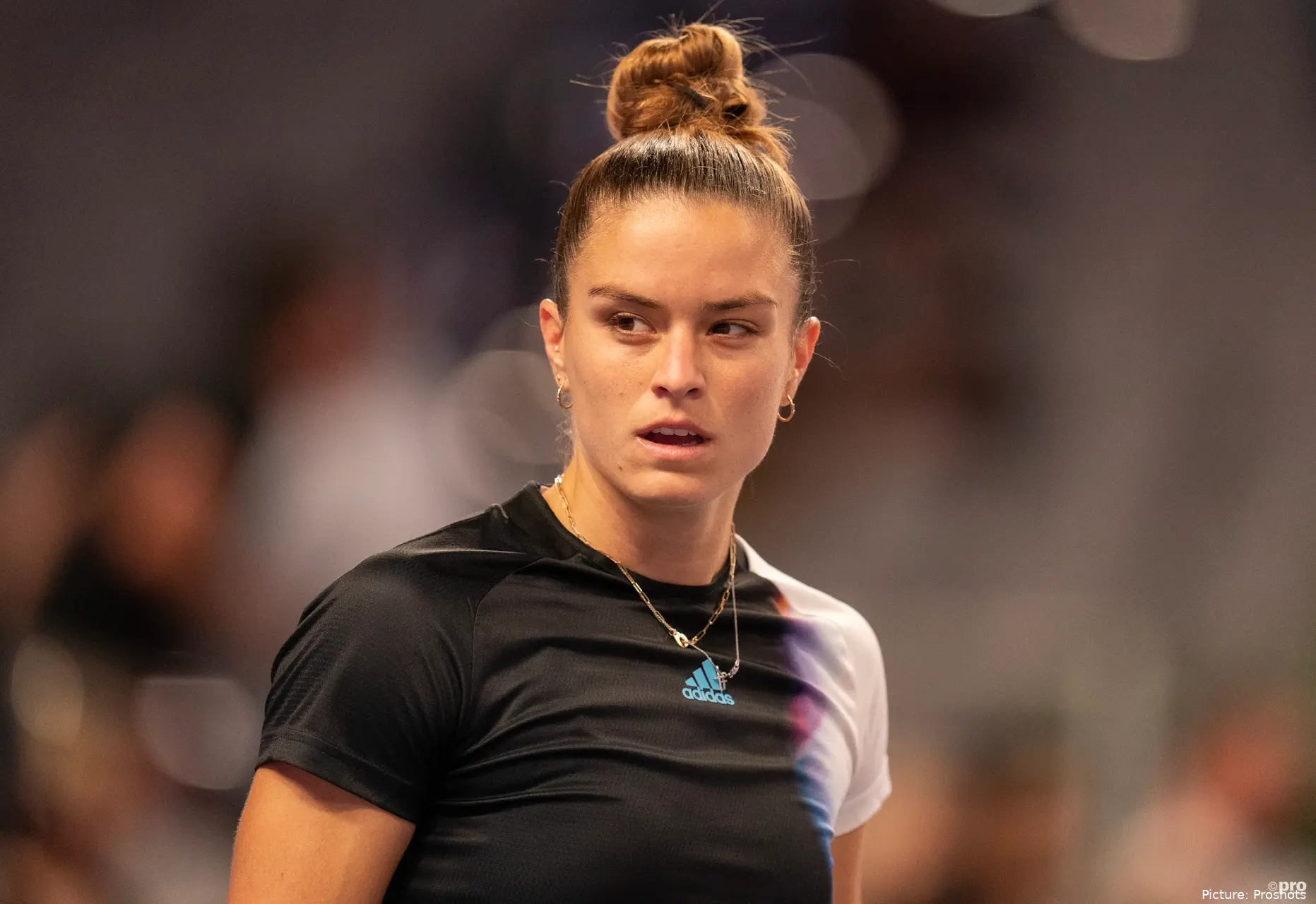
Maria Sakkari once looked like one of the safest bets in women's tennis. She reached world No. 3, made two Grand Slam semifinals and became the first Greek woman to establish herself as a genuine title contender at the biggest tournaments.
Then, remarkably, she came close to falling outside the world's top 100. Four years after reaching her career-high ranking, Sakkari's career looks very different — and her decline cannot be explained by one bad season or one injury. Her decline has been anything but straightforward. Coaching changes, a serious shoulder injury and prolonged struggles on court have contributed to a dramatic ranking slide, with Sakkari even coming close to falling outside the top 100.
Missed opportunities have also defined her career. She has twice reached a Grand Slam semifinal but never made a major final, while several painful defeats have prevented her from turning strong runs into major titles. Still, Sakkari has shown flashes in 2026 of the aggressive, physical player who once beat the world's best and climbed into the top three. The question now is whether she can rediscover that level and make another push up the WTA rankings.
Rise of fall of Maria Sakkari
| Year | What happened | Why it mattered |
| 2017 | First WTA breakthrough | Established herself at tour level |
| 2019 | First WTA title | First sign she could contend for trophies |
| 2021 | Two Grand Slam semifinals | Became a genuine elite player |
| 2022 | Reached No. 3 | Career peak |
| 2023 | Won Guadalajara | Finally broke six-final losing streak |
| 2024 | Coaching split + shoulder injury | Beginning of major decline |
| 2025 | Ranking collapsed | Fell close to Top 100 |
| 2026 | Doha semifinal | First major evidence of a comeback |

The rise: Why Sakkari became a Top 3 player
Sakkari's rise to the top was gradual rather than explosive. She did not arrive with the junior résumé of an obvious future superstar, instead spending years moving through qualifying draws and ITF events before establishing herself inside the top 100 in 2017. That season became her breakthrough, as she reached the third round at three of the four Grand Slams and made her first WTA semifinal in Wuhan, defeating Caroline Wozniacki along the way.
From there, Sakkari continued to climb without ever making a sudden leap. She won her first WTA title in Rabat in 2019 and established herself as a consistent top-20 player by the early 2020s. Then came 2021, the season that changed the trajectory of her career — but also introduced the pattern of painful defeats that would become increasingly familiar.

Sakkari reached the second week of a Grand Slam for first time in Australian Open 2020. She defeated the 10th seed Madison Keys before losing against 7th seed Petra Kvitova.
Two Grand Slam semifinals in the same season, two defeats to players who ultimately became champions. For Sakkari, it was the beginning of a recurring theme: she was consistently close to the biggest breakthrough, but rarely the player left standing when it mattered most.
Sakkari's career progression
| Year | Milestone |
| 2017 | Breakthrough season; first WTA semi-final (Wuhan) |
| 2019 | First WTA title (Rabat) |
| 2021 | Grand Slam semi-finals at Roland Garros and the US Open — both lost to the eventual champion |
| 2022 | Reaches world No. 3; three runner-up finishes, including the Indian Wells final |
| 2023 | First WTA 1000 title (Guadalajara), snapping a six-final losing streak |
| 2024 | Coaching changes, another Indian Wells final defeat, season-ending shoulder injury |
| 2025 | Ranking nearly falls out of the top 100 |
| 2026 | Reunited with Tom Hill; run to the Doha semi-final beating two top-10 players |
The problem: Why she couldn't turn deep runs into titles
Everything clicked in the first half of 2022, at least on the results sheet. Sakkari reached the final of Indian Wells, one of the biggest events outside the Grand Slams, only to run into a rampant Iga Swiatek, who beat her 6-4, 6-1 in the middle of the hot streak that would define Swiatek's own career. By March 2022, that run had carried Sakkari to No. 3 in the world — still the highest ranking any Greek player, man or woman, has ever reached — but the finals kept going the same way.
She lost at St. Petersburg, at Parma, and then, in October, in Guadalajara itself, where Jessica Pegula beat her 6-2, 6-3 for the WTA 1000 title. It was her sixth runner-up finish in a row, a streak that stretched back to 2018 and had become one of the more uncomfortable storylines on tour: a top-3 player who could get to a final but not win one.
The breakthrough, when it finally came, arrived at the exact same venue that had just broken her heart. A year later, in September 2023, Sakkari returned to Guadalajara as the No. 2 seed and did not drop a single set.
Sakkari's Guadalajara 2023 title run
| Round | Opponent | Result |
| Second round | Storm Hunter | 6–2, 6–4 |
| Third round | Camila Giorgi | 6–2, 6–2 |
| Quarter-final | Emiliana Arango | 6–3, 6–4 |
| Semi-final | Caroline Garcia (3) | 6–3, 6–0 |
| Final | Caroline Dolehide | 7–5, 6–3 |
It was her first WTA 1000 title, her second tour-level title overall, and the moment that finally ended the six-final losing streak. It should have been the platform for a run at a maiden Grand Slam final. Instead, it turned out to be close to the last unqualified high point of her career for some time.
The breaking point: Coaching changes and injury
The 2023 season that brought Sakkari her Guadalajara title also exposed growing inconsistency, with first-round exits at three of the four Grand Slams. In February 2024, as her ranking slipped toward the edge of the top 10, she split with Tom Hill after six years together — a partnership that produced her two Grand Slam semifinals, WTA 1000 title and career-high No. 3 ranking.
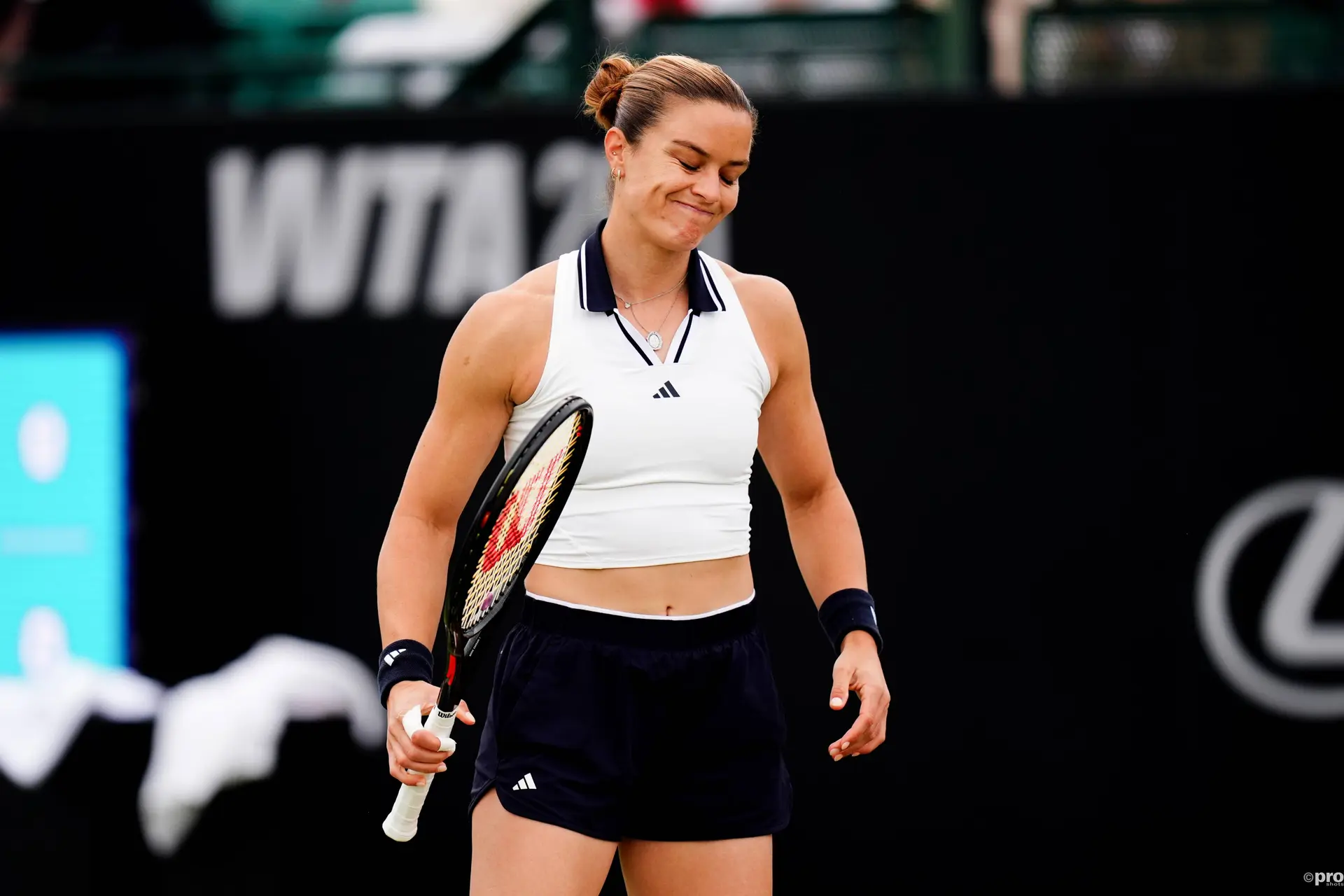
David Witt took over and immediately guided Sakkari to the Indian Wells final, but she again lost to Iga Swiatek, this time 6-4, 6-3. The partnership ended after just a few months, and Sergi Bruguera then joined her team. However, a persistent shoulder injury limited their work together and eventually forced Sakkari to retire from her first-round match at the 2024 US Open, bringing her season to an early end.
The injury was a major turning point. Sakkari had never dealt with a physical setback of that magnitude, and her recovery cost her the remainder of 2024. She returned in 2025 without the same rhythm and with another coaching change, as Raemon Sluiter replaced Bruguera. The results reflected the damage: Sakkari needed qualifying to enter Adelaide, then lost in the first round of the Australian Open to Camila Osorio — her sixth first-round Grand Slam exit in eight appearances. By spring, a return to the top 10 already looked like a distant prospect.

Sakkari has already reached 11 WTA 1000 semifinals, but has 'only' advanced to the final three times, with Guadalajara 2023 remaining his only title in the category.
The comeback: Why Doha changed the conversation
The turnaround began quietly. In April 2025, roughly 14 months after their split, Sakkari brought Tom Hill back into her team. “I've been in a better place. But I'm happy that I'm healthy; that's the most important thing,” she said at the time, reflecting on a period that had cost her far more than ranking points.
Results improved gradually through the rest of 2025, lifting her back toward No. 50 by the end of the year. Then came Doha in February 2026, her first real statement since the shoulder injury. Ranked No. 52, Sakkari beat No. 8 Jasmine Paolini and No. 2 Iga Swiatek in successive rounds before losing to eventual champion Karolina Muchova in the semi-finals. It was another reminder of what remained possible when her body and confidence aligned.
The question now: Can Sakkari become a Grand Slam contender again?
The Doha run lifted Sakkari to No. 33, her highest ranking in almost two years, but consistency has remained the biggest obstacle. She briefly slipped into the high 40s during the clay swing before recovering into the low 40s by mid-summer, with results still fluctuating from week to week. A straight-sets loss to Paula Badosa in Charleston, just weeks after her Doha breakthrough, illustrated the problem.

Her latest outing came at the Canadian Open in Toronto, where she lost in straight sets to Coco Gauff. Now heading into Cincinnati, Sakkari is still more than 30 places outside the top 10 and, at 31, is no longer working with the same timeline she had when she first emerged as a Grand Slam contender.
But Doha showed that the player who reached No. 3 has not disappeared. Sakkari can still beat the best in the world when her game and body are aligned. The question now is whether she can string enough of those performances together to finally turn the near-misses, semifinals and lost finals into the breakthrough that has eluded her throughout her career.
Sakkari didn't suddenly become a bad player. Her decline was the result of several things happening at once: the end of her long coaching partnership, a significant shoulder injury, disrupted preparation and a loss of consistency that became increasingly difficult to reverse. The more interesting question is whether the Doha run represents a genuine second peak or simply a reminder of the player she used to be.

Cristhián AvilaTennis Journalist
Cristhián Ávila is a tennis journalist based in Santiago, Chile, and has been part of the TennisUpToDate team since early 2023. He covers the ATP and WTA Tours as well as all four Grand Slams, producing breaking news, match reports, analysis, and regular liveblogs from major tournaments.
His reporting combines statistical analysis with clear explanation, helping readers understand tactical developments, player form, and broader storylines across the tour. Working fluently in both Spanish and English, Cristhián collaborates with an international editorial team and contributes to comprehensive global coverage. As part of his work, he has conducted interviews and media interactions with leading figures in the sport, including Caroline Wozniacki and John McEnroe.
In his journalism, Cristhián places strong emphasis on careful sourcing, editorial accuracy, and updating articles promptly when new, verified information becomes available. His coverage is grounded in research, context, and direct engagement with professional tennis.
claps 0visitors 0
Just In



Popular News
Latest Comments
- A healthy Qinwen may be hard to stop next season. She was already scaring her opponents before her medical leave(s). Unfortunately, Zheng insisted on singing again. On the positive side -- Mirra did not sing!! ;~}
 mandoist11-10-2026
 - Where is it written that athletes, entertainers... People in general... are mandated to keep looking at -- or even using [anti]Social Media? Public & private figures consistently complain and reveal their concerns about negativity and violence thrown at them -- yet they insist on participating. Avoid it, don't use it, don't read it. It's okay to occasionally look up at the World instead beating your eyes & thumbs to death on The Inventions out there.mandoist11-10-2026
- great articlestennisseserver07-10-2026
- Medvedev was leading Djokovic 7-5, 3-5 when an attempted return..' NO you ignorants, Djokovic was leading .weiss05-10-2026
- No more bullshit "Wildcards" to these two. Qualify like everyone else -- there will be cameras there, too. Time to scream... WTF ????!!!!mandoist29-09-2026
- Let's not BS the general public -- Sabalenka started showing cracks in her game last season. Her losses and near-losses started at about the same time she began being distracted by Fame (constant Selfies, making TV commercials, magazine shoots, endless Social Media nonsense, etc., etc.) One would think even Saba could recognize the parallels with others who failed before her -- Raducanu, Giorgi, Bouchard to name a few.mandoist25-09-2026
- Gross!! Hey Raducanu, Giorgi, and Bouchard -- reserve a seat at your Social Media Selfie table for Saba + Naomi. They're heading in your direction soon enough.mandoist24-09-2026
- And then these same players will complain about how lengthy their season’s were and need more time-off. I’m all for more tennis but the amount of tennis we get now is actually kind of crazy! We all need a break, especially the players.DaveyWavey23-09-2026
- You should do a comparison article for "different kinds of justice" the courts decide for tennis players. I can think of at least three players who received very small bans of a few months, however Tara Moore has been fighting for her literal survival the past few years. It seems odd considering she is not a "name" player, unlike the other cases.DaveyWavey22-09-2026
- PRIZE MONEY & POINTS Winner - $185,500 Finalist - $114,500 Semi-Finalist - $66,003 Quarter-Finalist - $35,000 Round of 16 - $18,045 Round of 32 - $13,005 Winner - 500 Finalist - 325 Semi-Finalist - 195 Quarter-Finalist - 108 Round of 16 - 60 Round of 32 - 1DaveyWavey20-09-2026

Loading