ATP Madrid Open Day Two Round-Up | Stefanos Tsitsipas escapes in decider, Gael Monfils exits in farewell as Reilly Opelka retires injured
ATP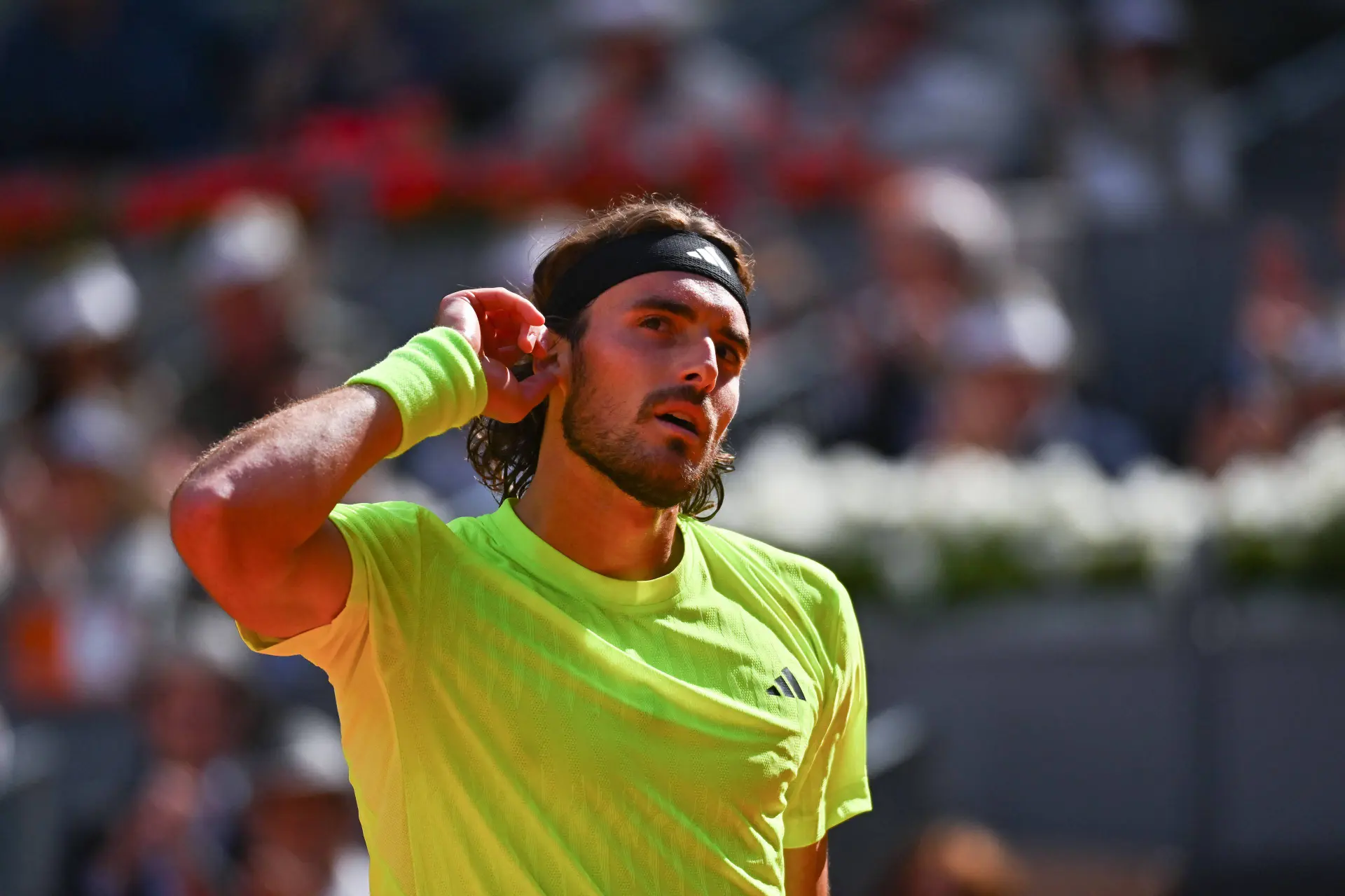
The opening round of the Madrid Open concluded with several defining results, as Stefanos Tsitsipas progressed under pressure, Gaël Monfils exited early, and Reilly Opelka was forced to retire mid-match. Elsewhere, Pablo Carreño Busta and Vilius Gaubas shaped the draw with contrasting results across tightly contested encounters.
Across the draw, early-round dynamics reflected both current form and surface adaptation, with players such as Camilo Ugo Carabelli, Daniel Mérida and Pablo Carreño Busta capitalising on key moments to secure second-round positions. The opening stage clarified potential pathways, with altitude conditions in Madrid continuing to favour first-strike tennis and efficient serving patterns.
Carreño Busta overturns deficit with third-set surge
Score: Pablo Carreño Busta def. Márton Fucsovics 4-6, 7-6, 6-2
Carreño Busta recovered from a set down, stabilising the match through a second-set tiebreak before accelerating in the decider. Fucsovics had initial control, winning key baseline exchanges and capitalising on early break opportunities.
The turning point came in the tiebreak, where Carreño Busta increased return depth and reduced unforced errors, forcing Fucsovics into lower-percentage patterns. That shift carried into the third set, where momentum translated into a sequence of consecutive games.
Carreño Busta’s improved second-serve performance and higher break-point conversion rate in the final set explained the decisive margin. He advances with momentum into the second round, strengthening Spanish presence in the draw.
Tsitsipas survives deciding-set tiebreak after early deficit
Stefanos Tsitsipas def. Patrick Kypson 3-6, 7-6, 7-6
Tsitsipas advanced to the second round after recovering from a slow start against Kypson, who imposed early scoreboard pressure by taking the opening set. The match developed around serve stability, with both players holding consistently through the second and third sets.
The shift came in the second-set tiebreak, where Tsitsipas improved his first-strike patterns and reduced rally exposure. From that point, he managed scoreboard pressure more effectively, particularly in the final-set breaker where he established an early lead.
Tsitsipas finished with a high first-serve points won percentage and limited Kypson’s return impact in key moments, converting the only decisive mini-breaks of the match. He now moves on to face Alexander Bublik, with the result preserving his position in a section that had early upset potential.
Gaubas produces upset with sustained pressure on Báez
Vilius Gaubas def. Sebastián Báez 7-5, 6-1
Gaubas delivered one of the day’s upsets, closing out a straight-sets win after a competitive opening set. Báez initially matched him from the baseline, but struggled to maintain consistency in longer exchanges.
The match shifted after the first set, where Gaubas increased return aggression and shortened points, exposing Báez’s second serve. The Lithuanian began stepping inside the baseline, forcing quicker decision-making.
Gaubas’ superior break-point conversion and stronger second-serve points won percentage in the second set created separation. He now faces Felix Auger-Aliassime, with the upset opening a section previously anchored by Báez.
Carabelli exploits Monfils’ reduced baseline resistance
Camilo Ugo Carabelli def. Gaël Monfils 6-3, 6-4
Carabelli progressed in straight sets, taking control early through a break in the opening set and maintaining scoreboard advantage throughout. Monfils struggled to impose variation from the baseline, allowing Carabelli to dictate patterns with consistent depth.
The Argentine adjusted by targeting shorter rallies and avoiding extended exchanges where Monfils typically builds rhythm. This limited the Frenchman’s ability to reset points and forced him into reactive positions.
Carabelli’s efficiency on break points and solid first-serve numbers underpinned the result, while Monfils’ lower second-serve success rate restricted his ability to recover in service games. Carabelli advances to face Flavio Cobolli, reinforcing his position in a section opened by the Frenchman’s exit.
Mérida closes tight contest after missed match points
Daniel Mérida def. Marco Trungelliti 6-4, 1-6, 7-6
Mérida advanced after a fluctuating three-set match that featured multiple momentum shifts. He took the opening set with a late break, before Trungelliti responded by dominating the second with more aggressive court positioning.
The decisive moment came late in the third set, where Mérida broke back after Trungelliti served for the match. In the tiebreak, he remained composed despite failing to convert four match points before closing on his fifth opportunity.
Mérida’s resilience on return in critical moments and ability to stabilise his second serve under pressure were decisive. He moves into the second round with confidence after managing high-leverage situations.
Kjær benefits from Opelka retirement after service battle
Nicolai Budkov Kjær def Reilly Opelka 5-3 (ret.)
The match was interrupted by Opelka’s retirement due to a right shoulder issue shortly after Kjær secured a break to move ahead 5-3. Prior to the stoppage, both players had held serve comfortably, with minimal return opportunities created.
The encounter was defined by short points and first-strike tennis, with both players winning around 80% of points behind serve in the early stages. Kjær’s breakthrough came through marginal gains in return depth rather than sustained pressure.
With Opelka unable to continue, Kjær advances without completing the set, benefiting from the only break of the match. The retirement alters the section’s dynamic, removing one of the draw’s primary serve-dominant threats.

Lucas MichaelTennis Journalist
Lucas Michael is a tennis journalist based in Cambridge, UK, specializing in comprehensive coverage of the ATP and WTA tours. For the past 1.5 years, he has been a core contributor to TennisUpToDate, where he has authored more than 3,000 data-driven match reports, deep-dive analysis pieces, and engaging liveblogs.
Lucas pairs real-time statistical analysis with on-the-ground reporting, frequently traveling to tournaments to cover the action firsthand from the press box and player press conferences. This blend of advanced metrics and direct access allows him to provide sharp context regarding player form, tactical trends, and breaking tour developments.
He holds a BA (Hons) in Sports Journalism. Grounded in core journalistic ethics, Lucas places a strict emphasis on meticulous sourcing, editorial accuracy, and a commitment to updating live content swiftly as verified information emerges.
claps 0visitors 0
Just In


Popular News

Latest Comments
- Lena... Takin' care of business
 mandoist25-10-2026
 - Can you please stop publishing this nonsense? Stick to Tennis.mandoist25-10-2026
- Does Sinner need that 4.5 mil? I doubt it. He can make that with three modelling gigs!😅🤣Rapunzel21-10-2026
- Did "People Magazine" purchase this website? This nonstop storyline is bullshit.mandoist21-10-2026
- Listen... this is of no concern to anyone but these two. Deal with your own issues -- most of us have our own. Thanks, media, for these insignificant follow-ups which are meaningless.mandoist21-10-2026
- This is so very very sad, for all three of them. I truly thought they had an unbreakable bond, but life throws up so many differing challenges. Having your homeland suffering in such a terrible way, makes happiness lose out to guilt as well. Our thoughts are with them. X💔bjsexton20-10-2026
- I have lost all respect for Svitolina! Could she not have waited until he had played at the Paris Masters!!! She is selfish and don't give a damn about Gael. That is NOT how love is demonstrated Elina!!Rapunzel19-10-2026
- Perhaps convenient tennis tour sex is not a strong enough experience in which to base a marriage?mandoist19-10-2026
- Fight the Good Fight... Tennis (sports in general) need more Humans such as yourself.mandoist18-10-2026
- When is WTA going to mandate Genetic Testing (DNA) ???mandoist18-10-2026

Loading