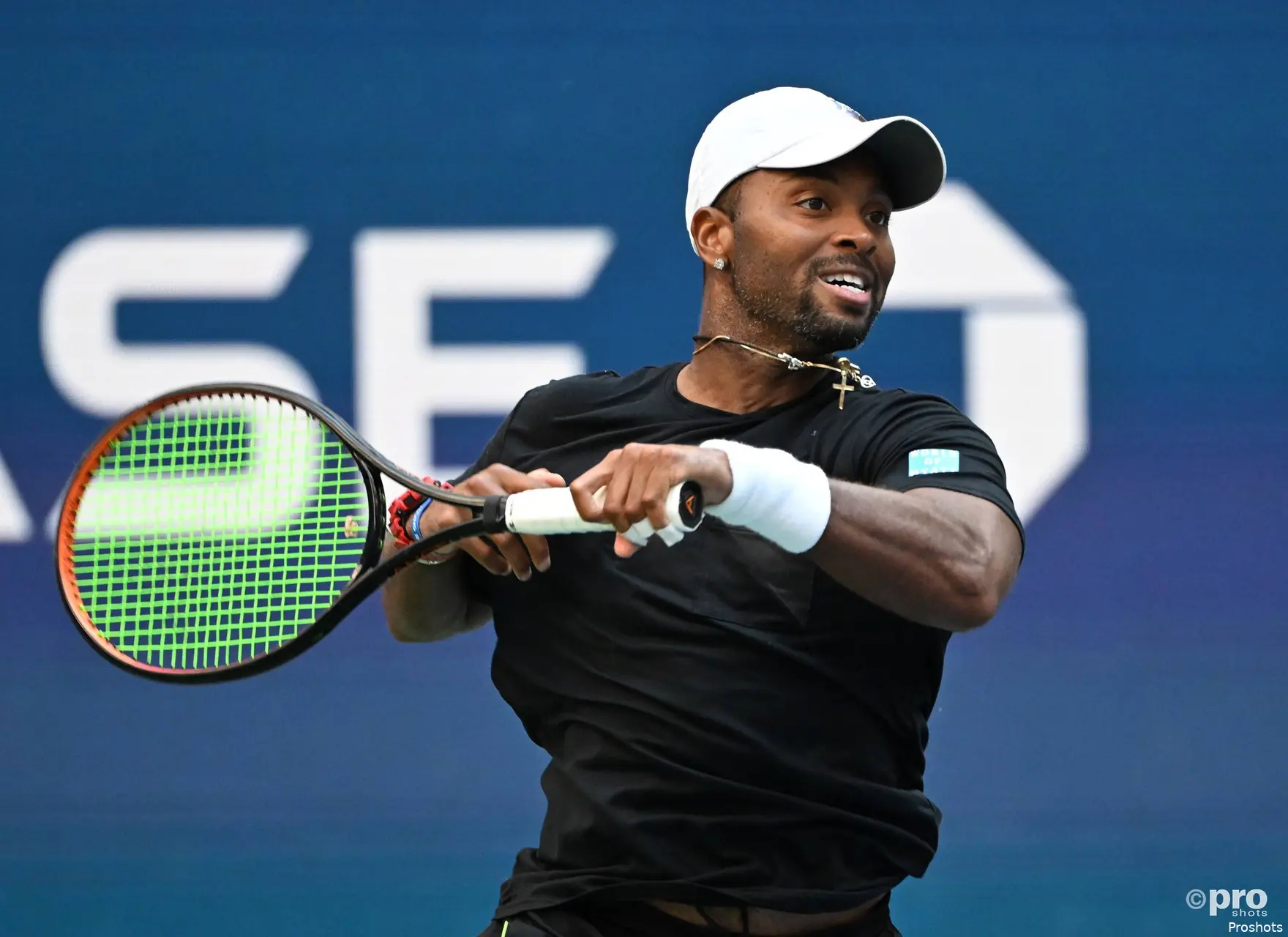
Donald Young was once supposed to be the future of American men's tennis. He was the world's No. 1 junior, had won a Grand Slam boys' title by 15 and turned professional at an age when most players were still dreaming about reaching the tour.
Twenty years later, Young retired without winning an ATP singles title. His career-high ranking was No. 38, his Grand Slam best was the fourth round and he finished with 124 wins against 190 losses. So what happened?
Donald Young — career snapshot
| Junior ranking | No. 1 in the world (2005) |
| Junior Grand Slam titles | 3 [2 singles, 1 doubles] - (Australian Open 2005, Wimbledon 2007); doubles (US Open 2005) |
| Turned pro | 2004, aged 15 |
| Career-high singles ranking | No. 38 (February 2012) |
| Best Grand Slam singles result | Fourth round, US Open (2011, 2015) |
| ATP singles titles | 0 (2 runner-ups: Bangkok 2011, Delray Beach 2015) |
| Career singles record | 124–190 |
| Career-high doubles ranking | No. 43 (2017) |
| Retired | September 2024, aged 35 |
A junior phenom unlike any other
Young's rise through the junior ranks was among the most dominant American tennis had seen in years. He won both the Easter Bowl 14s and 18s titles as a teenager, captured the 2005 Australian Open boys' singles title and finished that season as the world's top-ranked junior.
He became the youngest year-end junior world No. 1 in history at 16 years and five months, one month younger than Richard Gasquet had been when he achieved the same distinction in 2002. Young later added the 2007 Wimbledon boys' singles title and broke into the ATP top 100 at just 18 years old, in November 2007.
His emergence came at an important moment for American men's tennis. In the early 2000s, Andre Agassi and Andy Roddick remained the leading figures of the American contingent, but there were relatively few younger names establishing themselves near the top of the rankings. Meanwhile, Roger Federer had emerged as the dominant force in men's tennis between 2003 and 2004.
The rest of the ATP elite was populated by established international contenders including Juan Carlos Ferrero, Lleyton Hewitt, Marat Safin, Carlos Moya, Fernando Gonzalez and Nikolay Davydenko. American tennis was looking for a player capable of leading the next generation, and Young appeared to be one of the most promising junior prospects the country had produced in years.
The professional ceiling that never rose higher than No. 38
The senior career, by contrast, plateaued early and never developed as many expected. Young played in the US Open main draw for 14 consecutive years, from 2005 to 2018, but his best result in New York — and at any Grand Slam during his entire career — was the fourth round, which he reached twice in 2011 and 2015.
His career-high ranking of No. 38 arrived in February 2012, but the breakthrough proved difficult to sustain. Soon afterwards, Young endured a 17-match losing streak, rapidly undoing much of the progress that had taken him to the highest ranking of his career.
He reached two ATP singles finals, in Bangkok in 2011 and Delray Beach in 2015, losing both, and never managed to lift a tour-level singles trophy. By the time of his retirement, his career record stood at 124 wins and 190 losses — a remarkable contrast for someone who had once been regarded as one of the brightest junior prospects in world tennis.
There were nevertheless occasional reminders of the talent that had generated such enormous expectations. In 2011, at the age of 22, Young earned his first victories over top-10 opponents, defeating World No. 5 Andy Murray at Indian Wells and World No. 9 Gael Monfils at the Thailand Open.
It would take another four years before he recorded his third and final victory over a top-10 player. At the 2015 Canadian Open, Young defeated World No. 6 Tomas Berdych in the second round. Those victories demonstrated that he could compete with the very best on isolated occasions, but he was never able to turn those moments into the consistency required to establish himself among the ATP's elite.
Young career finals (0-2)
| Event | Result |
| 2011 Bangkok final | Runner-up (lost against Andy Murray) |
| 2015 Delray Beach final | Runner-up (lost against Ivo Karlovic) |
Better in doubles, and a bigger legacy off the court
If singles never quite worked out, doubles came closer. Young reached the 2017 French Open final alongside Santiago Gonzalez, losing in three sets, and climbed to a career-high doubles ranking of No. 43 later that year.
Arguably Young's most lasting contribution to the sport came away from his own results entirely. He served as a role model and mentor figure for a generation of American players who came up behind him, including Christopher Eubanks, who worked as Young's hitting partner before playing college tennis at Georgia Tech, and Taylor Townsend, who trained under Young's father as a child and has repeatedly credited Young himself with proving to her that a career like his — junior No. 1, aiming for the pros — was actually possible.
Better in doubles, and a bigger legacy off the court
If singles never quite worked out, doubles brought Young closer to the success many had expected from him. He reached his first ATP doubles final at the 2015 Memphis Open alongside Artem Sitak, although the pair lost to Mariusz Fyrstenberg and Santiago Gonzalez. Two years later, Gonzalez became his partner again for an epic run to the 2017 French Open final, where they fell in three sets. Young later climbed to a career-high doubles ranking of No. 43.
Arguably, Young's most lasting contribution to tennis came away from his own results. He became a role model and mentor figure for a generation of American players who followed him, including Christopher Eubanks, who worked as Young's hitting partner before playing college tennis at Georgia Tech, and Taylor Townsend.
Townsend trained under Young's father as a child and has repeatedly credited Young himself with showing her that a path from junior success to professional tennis was genuinely possible.
Young's last tour-level singles victory came in 2021. He spent most of 2022 and 2023 competing on the Challenger circuit and did not play a single professional match in 2024 before the US Open. His career appeared to have quietly come to an end, as so many professional careers do. Instead, Young decided he wanted a proper farewell and asked longtime friend Taylor Townsend, then the reigning Wimbledon doubles champion, to partner him in mixed doubles at that year's US Open. She immediately agreed.
What followed was the storybook ending that two decades of singles tennis had never delivered. Young and Townsend reached the mixed doubles final, the best Grand Slam result of his career in any discipline, before losing to third seeds Sara Errani and Andrea Vavassori.
Young and Townsend's run to the US Open mixed doubles final
| Round | Opponents | Result | Score |
| First Round | Asia Muhammad / Andres Molteni | W | 6-7(3), 6-3, [10-8] |
| Second Round | Nadiia Kichenok / Hugo Nys | W | 7-5, 6-0 |
| Quarterfinal | Anna Danilina / Harri Heliovaara | W | 3-6, 7-6(3), [10-8] |
| Semifinal | Aldila Sutjiadi / Rohan Bopanna [8] | W | 6-3, 6-4 |
| Final | Sara Errani / Andrea Vavassori [3] | L | 6-7(0), 5-7 |
He left the court to a standing ovation, bringing his professional tennis career to an unexpectedly emotional conclusion. Young has since moved into professional pickleball, competing on the PPA Tour and in Major League Pickleball.
Read also

There is a genuine irony at the centre of Donald Young's career. A player whose professional identity was largely shaped by unfulfilled expectations found, in his literal final match, the kind of major-stage moment that had eluded him for two decades. It did not rewrite the record: the zero ATP singles titles and losing career record remain. But Young still managed to leave the sport on his own terms, with a Grand Slam final and a standing ovation.
Cristhián AvilaTennis Journalist
Cristhián Ávila is a tennis journalist based in Santiago, Chile, and has been part of the TennisUpToDate team since early 2023. He covers the ATP and WTA Tours as well as all four Grand Slams, producing breaking news, match reports, analysis, and regular liveblogs from major tournaments.
His reporting combines statistical analysis with clear explanation, helping readers understand tactical developments, player form, and broader storylines across the tour. Working fluently in both Spanish and English, Cristhián collaborates with an international editorial team and contributes to comprehensive global coverage. As part of his work, he has conducted interviews and media interactions with leading figures in the sport, including Caroline Wozniacki and John McEnroe.
In his journalism, Cristhián places strong emphasis on careful sourcing, editorial accuracy, and updating articles promptly when new, verified information becomes available. His coverage is grounded in research, context, and direct engagement with professional tennis.
claps 0visitors 0
Just In

Popular News
Latest Comments
- Two Things: 1. Stop allowing these Spoiled Trust-Fund Elitists to behave badly. Your little hand-slaps do not deter them. 2. STOP the incessantly annoying "towel wiping" nonsense!!!!
 mandoist15-10-2026
 - A healthy Qinwen may be hard to stop next season. She was already scaring her opponents before her medical leave(s). Unfortunately, Zheng insisted on singing again. On the positive side -- Mirra did not sing!! ;~}mandoist11-10-2026
- Where is it written that athletes, entertainers... People in general... are mandated to keep looking at -- or even using [anti]Social Media? Public & private figures consistently complain and reveal their concerns about negativity and violence thrown at them -- yet they insist on participating. Avoid it, don't use it, don't read it. It's okay to occasionally look up at the World instead beating your eyes & thumbs to death on The Inventions out there.mandoist11-10-2026
- great articlestennisseserver07-10-2026
- Medvedev was leading Djokovic 7-5, 3-5 when an attempted return..' NO you ignorants, Djokovic was leading .weiss05-10-2026
- No more bullshit "Wildcards" to these two. Qualify like everyone else -- there will be cameras there, too. Time to scream... WTF ????!!!!mandoist29-09-2026
- Let's not BS the general public -- Sabalenka started showing cracks in her game last season. Her losses and near-losses started at about the same time she began being distracted by Fame (constant Selfies, making TV commercials, magazine shoots, endless Social Media nonsense, etc., etc.) One would think even Saba could recognize the parallels with others who failed before her -- Raducanu, Giorgi, Bouchard to name a few.mandoist25-09-2026
- Gross!! Hey Raducanu, Giorgi, and Bouchard -- reserve a seat at your Social Media Selfie table for Saba + Naomi. They're heading in your direction soon enough.mandoist24-09-2026
- And then these same players will complain about how lengthy their season’s were and need more time-off. I’m all for more tennis but the amount of tennis we get now is actually kind of crazy! We all need a break, especially the players.DaveyWavey23-09-2026
- You should do a comparison article for "different kinds of justice" the courts decide for tennis players. I can think of at least three players who received very small bans of a few months, however Tara Moore has been fighting for her literal survival the past few years. It seems odd considering she is not a "name" player, unlike the other cases.DaveyWavey22-09-2026

Loading