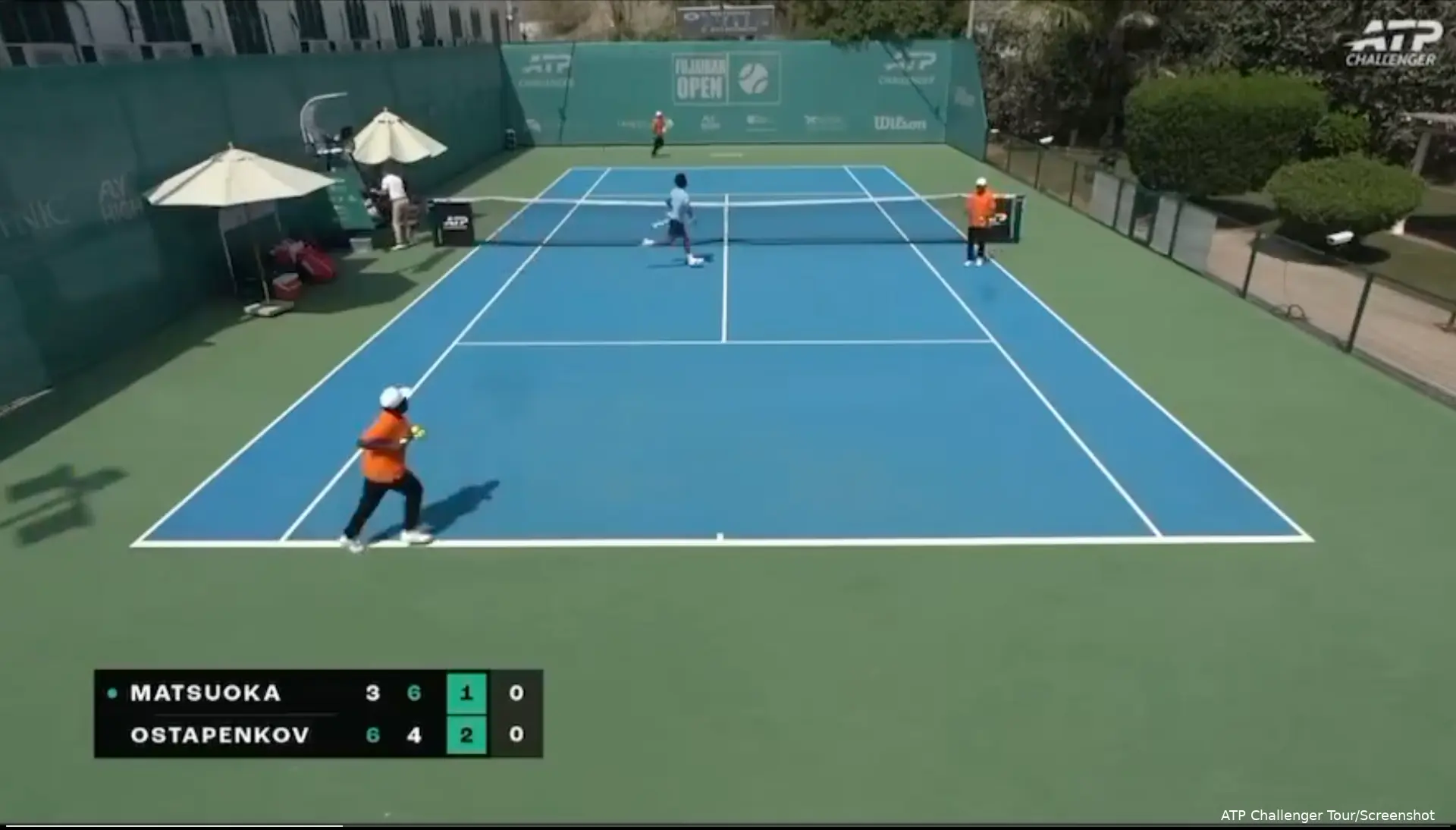
The Fujairah Challenger was brought to an abrupt halt after escalating regional conflict created security concerns in the Middle East, forcing organisers to cancel both scheduled ATP Challenger 50 tournaments. Players were informed via email that Fujairah 1 and Fujairah 2 were “officially cancelled,” ending what was intended to be a two-week swing in the United Arab Emirates.
The timing of the decision followed heightened instability in the region, including reported security alerts and airspace disruption affecting travel routes. While the email did not elaborate on the broader geopolitical context, the link to escalating regional tensions was evident. The shutdown was understood to be a safety-driven decision rather than a sporting or operational matter.
In professional tennis, such circumstances remain rare but not unprecedented. Governing bodies prioritise player welfare when external risks escalate beyond acceptable limits. In this case, the immediate focus shifted from match schedules and ranking points to ensuring safe departure options for players and staff already on site.
However, the second half of the email quickly redirected attention to logistics — and cost. “The ATP is potentially organizing a charter flight on Thursday 5th March from Muscat. Departure at 3.00 pm, going to Milan, stopping on the way in Egypt,” the message stated. The price was outlined clearly: “5.000,- Euro per person.”
The entry list underlined that this was not an anonymous field. Former Top 20 player Hyeon Chung, former world No. 31 Lloyd Harris, and Australian Jason Kubler, who previously reached a career-high of No. 62, were among those competing. Young prospects Cruz Hewitt and Ivan Ivanov were also in the draw, while former Top 40 player Ilya Ivashka featured in qualifying — a mix of established names and rising talents affected by the abrupt cancellation.
Read also

Safety concerns collide with Challenger-level economics
At Challenger 50 level, financial margins are narrow. The Fujairah event carried a total purse of approximately $63,000, consistent with 2026 standards. The singles champion was set to receive $9,500 and 50 ATP ranking points, while the finalist would earn $5,500.
The distribution further down the draw illustrates the financial reality of this tier. A semifinalist would collect $3,145, a quarter-finalist $1,800, and a round-of-16 player $1,010. First-round losers were scheduled to receive $630. In qualifying, payouts ranged from $195 to $335 in early stages, with some rounds offering ranking points but no prize money.
Against that backdrop, a €5,000 charter flight — roughly equivalent to $5,400 — represents a substantial expense. For many players ranked between 100 and 500, that figure approaches or exceeds a typical week’s potential earnings. Even for the eventual champion, the departure cost would represent a significant proportion of gross prize money before taxes and expenses are accounted for.
The email did not indicate that the charter was mandatory, but in a context of disrupted commercial flights and uncertain airspace access, alternatives may have been limited. The financial calculation therefore became immediate and personal for each competitor.
Fujirah Prize Money
| Round | Prize Money | Points |
| Winner | $9,500 | 50 |
| Runner-up | $5,500 | 25 |
| SF | $3,145 | 14 |
| Quarter Finals | $1,800 | 8 |
| Round 16 | $1,010 | 4 |
| Round 32 | $630 | 0 |
| Qualifier | $0 | 3 |
| Qualifier 3 | $0 | 0 |
| Qualifier 2 | $335 | 1 |
| Qualifier 1 | $195 | 0 |
A structural tension exposed
The Fujairah episode underscores a structural imbalance within professional tennis. At the top tier, Masters 1000 events and Grand Slams distribute millions in prize money and provide logistical security. At Challenger level, players operate with tighter budgets, often funding travel and coaching largely from weekly winnings.
When external crises intervene — whether conflict, airspace closures or broader instability — the economic vulnerability of lower-tier professionals becomes visible. A cancelled event removes not only ranking opportunities but also expected income. An expensive exit option compounds that disruption.
From a governance standpoint, prioritising safety is non-negotiable. No ranking points or prize purse outweigh personal security in a volatile situation. Yet the optics of a €5,000 departure linked to a tournament whose champion earns $9,500 inevitably raise broader questions about cost distribution and financial protections at this level.
In the space of a short email, the focus of the week shifted dramatically. What began as a routine Challenger stop offering 50 ATP points ended with geopolitical tension, cancelled draws, and a premium-priced escape route — a reminder that on the lower rungs of the sport, margins remain thin, even when the risks are not.

Cristhián AvilaTennis Journalist
Cristhián Ávila is a tennis journalist based in Santiago, Chile, and has been part of the TennisUpToDate team since early 2023. He covers the ATP and WTA Tours as well as all four Grand Slams, producing breaking news, match reports, analysis, and regular liveblogs from major tournaments.
His reporting combines statistical analysis with clear explanation, helping readers understand tactical developments, player form, and broader storylines across the tour. Working fluently in both Spanish and English, Cristhián collaborates with an international editorial team and contributes to comprehensive global coverage. As part of his work, he has conducted interviews and media interactions with leading figures in the sport, including Caroline Wozniacki and John McEnroe.
In his journalism, Cristhián places strong emphasis on careful sourcing, editorial accuracy, and updating articles promptly when new, verified information becomes available. His coverage is grounded in research, context, and direct engagement with professional tennis.
claps 0visitors 0
Just In


Popular News
Latest Comments
- A healthy Qinwen may be hard to stop next season. She was already scaring her opponents before her medical leave(s). Unfortunately, Zheng insisted on singing again. On the positive side -- Mirra did not sing!! ;~}
 mandoist11-10-2026
 - Where is it written that athletes, entertainers... People in general... are mandated to keep looking at -- or even using [anti]Social Media? Public & private figures consistently complain and reveal their concerns about negativity and violence thrown at them -- yet they insist on participating. Avoid it, don't use it, don't read it. It's okay to occasionally look up at the World instead beating your eyes & thumbs to death on The Inventions out there.mandoist11-10-2026
- great articlestennisseserver07-10-2026
- Medvedev was leading Djokovic 7-5, 3-5 when an attempted return..' NO you ignorants, Djokovic was leading .weiss05-10-2026
- No more bullshit "Wildcards" to these two. Qualify like everyone else -- there will be cameras there, too. Time to scream... WTF ????!!!!mandoist29-09-2026
- Let's not BS the general public -- Sabalenka started showing cracks in her game last season. Her losses and near-losses started at about the same time she began being distracted by Fame (constant Selfies, making TV commercials, magazine shoots, endless Social Media nonsense, etc., etc.) One would think even Saba could recognize the parallels with others who failed before her -- Raducanu, Giorgi, Bouchard to name a few.mandoist25-09-2026
- Gross!! Hey Raducanu, Giorgi, and Bouchard -- reserve a seat at your Social Media Selfie table for Saba + Naomi. They're heading in your direction soon enough.mandoist24-09-2026
- And then these same players will complain about how lengthy their season’s were and need more time-off. I’m all for more tennis but the amount of tennis we get now is actually kind of crazy! We all need a break, especially the players.DaveyWavey23-09-2026
- You should do a comparison article for "different kinds of justice" the courts decide for tennis players. I can think of at least three players who received very small bans of a few months, however Tara Moore has been fighting for her literal survival the past few years. It seems odd considering she is not a "name" player, unlike the other cases.DaveyWavey22-09-2026
- PRIZE MONEY & POINTS Winner - $185,500 Finalist - $114,500 Semi-Finalist - $66,003 Quarter-Finalist - $35,000 Round of 16 - $18,045 Round of 32 - $13,005 Winner - 500 Finalist - 325 Semi-Finalist - 195 Quarter-Finalist - 108 Round of 16 - 60 Round of 32 - 1DaveyWavey20-09-2026

Loading

