“He definitely deserved it”: Andrey Rublev reflects after defeat to Arthur Fils in Barcelona final
ATP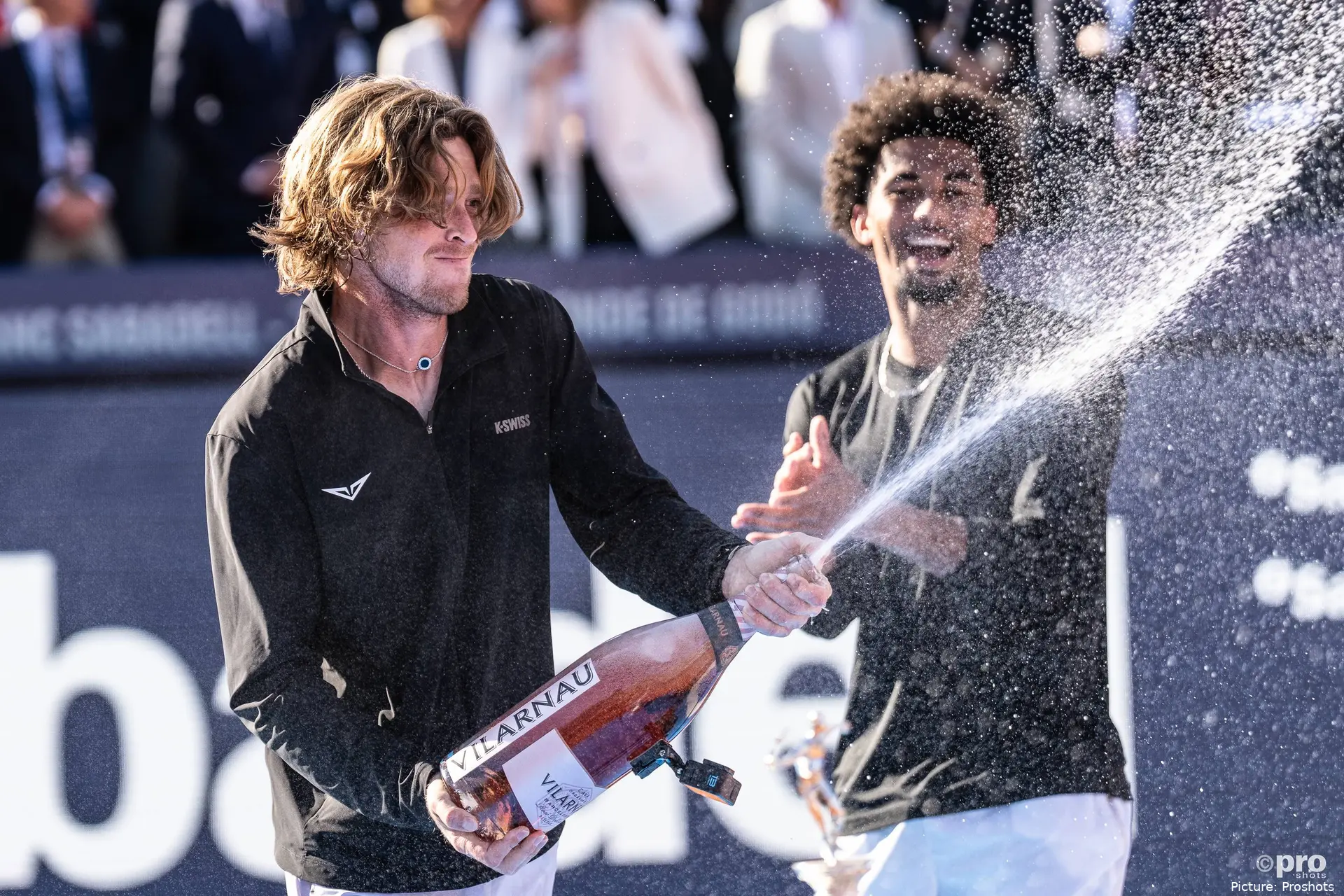
Andrey Rublev framed his Barcelona Open final defeat as part of a broader process, emphasising effort and clarity over the result after losing to Arthur Fils. The Russian, who fell 6–2, 7–6(2), pointed to improvements across the week while acknowledging the level required to close out matches at this stage.
Rublev reached his first final in Barcelona after a sequence of wins over Mariano Navone, Lorenzo Sonego, Tomas Machac and Hamad Medjedovic. The run marked one of his most consistent performances of the 2026 season, reinforcing his position inside the top 15 and providing momentum heading into the clay-court swing.
Rublev’s run to the Barcelona final ended an 11-month wait for a title match, a relatively long gap for the former world No. 5, who had not gone that long without reaching a final since his early years on tour between 2018 and 2019.
He now turns his focus to the Mutua Madrid Open, where he returns as the 2024 champion and ninth seed, awaiting his opening opponent after a first-round bye, with Zhizhen Zhang or Vit Kopriva set to face him.

Rublev prioritises process over result
Rublev described his level across the week as progressively improving, noting that the final represented his best performance of the tournament despite the defeat. He acknowledged that Fils was the better player in key moments, particularly in the closing stages.
“My tennis has been good, I’ve been playing better and better,” the former world No. 5 said in press conference. “I reached the final and played better than in the previous matches, but he played better than me — he definitely deserved it. I know what I need to work on and I will keep going in that direction.”
That assessment reflects a shift in focus toward long-term development rather than isolated results. Rublev indicated that he now approaches matches with a reduced emphasis on expectations, instead concentrating on execution and consistency. “I’ve stopped having expectations and setting goals. I live day by day, and that’s it.”
Key moments highlight competitive margin
Rublev identified the second set as the defining phase of the match, particularly the sequence where he trailed 5–3 and 0–40 before recovering. Rather than adjusting tactically, he focused on maintaining intensity and avoiding unforced concessions.
“I only thought about keep fighting. I didn’t want to give away easy points; if I had to lose, I wanted him to earn the points. I wasn’t thinking about the score, just about giving my best.”
He went on to save multiple break points and later three championship points, extending the match beyond its initial trajectory. The turnaround briefly shifted momentum, even allowing Rublev to approach a potential set recovery. “He played some incredible points and had three match points, then the match turned around and I came back. I almost thought I could win the set, but it wasn’t possible.”
Fils ultimately reasserted control in the tie-break, closing the match with a sequence of points that underlined the narrow margins between the two players.

Lessons from Barcelona final
Rublev also reflected on the significance of reaching the final at a venue where he regularly trains, describing the experience as personally meaningful despite the result. “First of all, I’m very grateful to have reached the final for the first time here, where I usually train. Playing a final here is a very nice moment. This match taught me many things that I need to improve.”
The Russian now turns his attention to the next phase of the clay season, including the Madrid Open, where he returns as defending champion. The level shown in Barcelona, combined with his stated focus on process, provides a framework for the upcoming stretch.
Read also

Cristhián AvilaTennis Journalist
Cristhián Ávila is a tennis journalist based in Santiago, Chile, and has been part of the TennisUpToDate team since early 2023. He covers the ATP and WTA Tours as well as all four Grand Slams, producing breaking news, match reports, analysis, and regular liveblogs from major tournaments.
His reporting combines statistical analysis with clear explanation, helping readers understand tactical developments, player form, and broader storylines across the tour. Working fluently in both Spanish and English, Cristhián collaborates with an international editorial team and contributes to comprehensive global coverage. As part of his work, he has conducted interviews and media interactions with leading figures in the sport, including Caroline Wozniacki and John McEnroe.
In his journalism, Cristhián places strong emphasis on careful sourcing, editorial accuracy, and updating articles promptly when new, verified information becomes available. His coverage is grounded in research, context, and direct engagement with professional tennis.
claps 0visitors 0
Just In

Popular News


Latest Comments
- Does Sinner need that 4.5 mil? I doubt it. He can make that with three modelling gigs!😅🤣Rapunzel21-10-2026
- Did "People Magazine" purchase this website? This nonstop storyline is bullshit.
 mandoist21-10-2026
 - Listen... this is of no concern to anyone but these two. Deal with your own issues -- most of us have our own. Thanks, media, for these insignificant follow-ups which are meaningless.mandoist21-10-2026
- This is so very very sad, for all three of them. I truly thought they had an unbreakable bond, but life throws up so many differing challenges. Having your homeland suffering in such a terrible way, makes happiness lose out to guilt as well. Our thoughts are with them. X💔bjsexton20-10-2026
- I have lost all respect for Svitolina! Could she not have waited until he had played at the Paris Masters!!! She is selfish and don't give a damn about Gael. That is NOT how love is demonstrated Elina!!Rapunzel19-10-2026
- Perhaps convenient tennis tour sex is not a strong enough experience in which to base a marriage?mandoist19-10-2026
- Fight the Good Fight... Tennis (sports in general) need more Humans such as yourself.mandoist18-10-2026
- When is WTA going to mandate Genetic Testing (DNA) ???mandoist18-10-2026
- Hey, Dan... you just wake up from a coma? Regardless -- Thanks for the comedy this morning!mandoist18-10-2026
- Two Things: 1. Stop allowing these Spoiled Trust-Fund Elitists to behave badly. Your little hand-slaps do not deter them. 2. STOP the incessantly annoying "towel wiping" nonsense!!!!mandoist15-10-2026

Loading