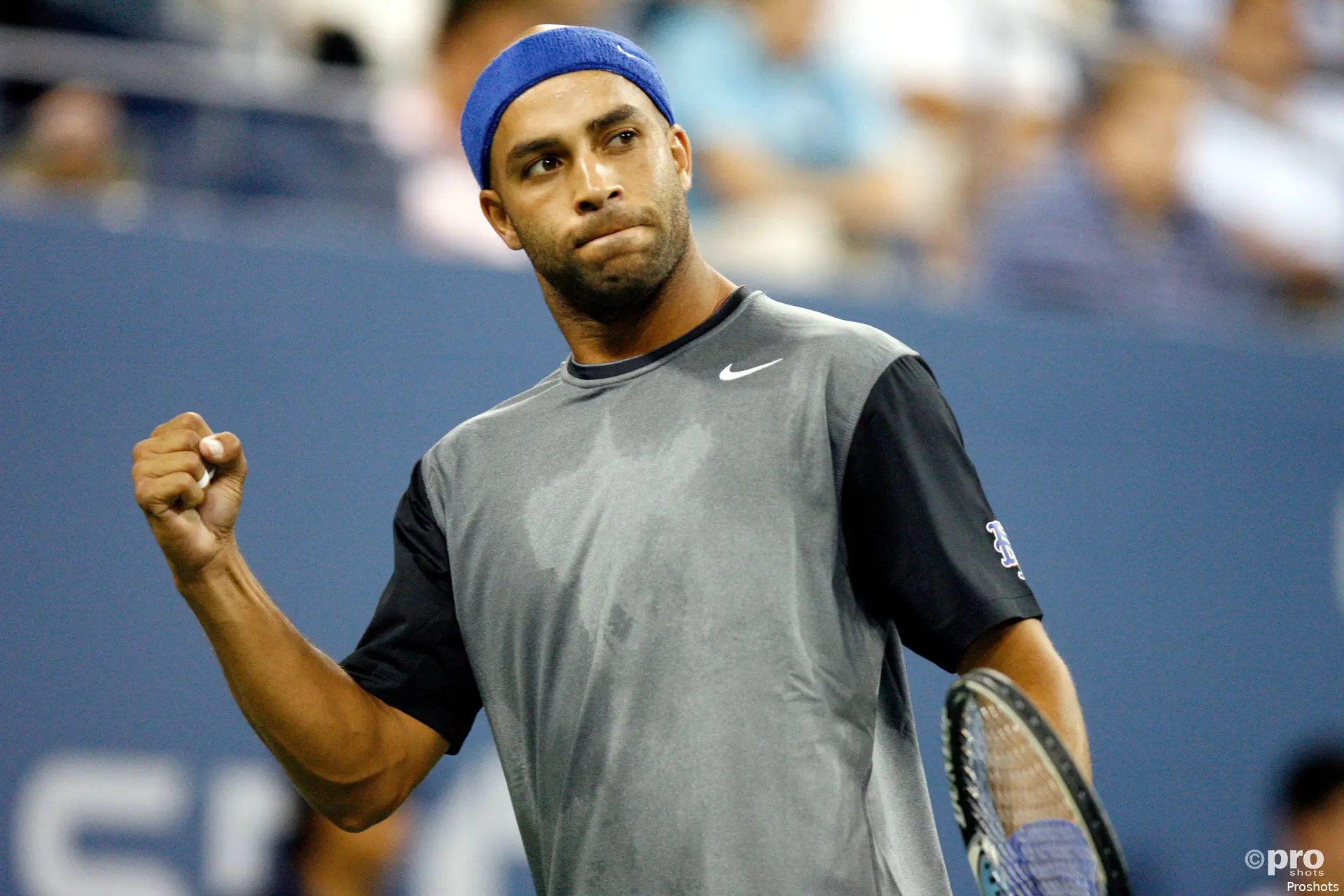
James Blake's tennis story was almost cut short in a tragic accident. However, his comeback to the sport following a broken neck has been well documented, with his peak years showcasing a very special player. He was not on top for many years and failed to capitalise in that time with his title catalogue missing that big reward.
His accident in 2004 was in a period of his life where nothing was going right. Illness and personal losses would destroy most, but Blake was not going to be deterred. After a sharp ranking drop, he rose to World No.4 in two years and was a serious contender until 2008.
Injuries and burnout marked a rapid decline to his career as he languished in the depths of the ATP Tour. Retiring in 2013, the American's pomp was timed at a poor time with the emergence of the 'Big Three' as well as that injury which ruptured his progress to that point, delaying and slashing his time competing for big titles.
10 ATP titles, two Masters 1000 and a year-end championship final is not a bad return. However, Blake was ranked as high as fourth. To have reached only three Grand Slam quarter-finals is a hugely disappointing return, leaving many to wonder what could have been.
James Blake – career at a glance
| Period | Career stage | Key events |
| 1999–2003 | Building his career | Gradually climbed the rankings and established himself on the ATP Tour. |
| 2004 | Major setback | Broke his neck in a practice accident in Rome after hitting a net post. Later battled shingles. His ranking collapsed. (ESPN Press Room) |
| 2005 | Breakthrough comeback | Returned strongly, won New Haven, defeated Rafael Nadal at the US Open and finished the year No. 22. Named ATP Comeback Player of the Year. (ESPN Press Room) |
| 2006 | Career breakthrough | Won five ATP titles, reached the Indian Wells final and reached the final of the Tennis Masters Cup. Finished No. 4 in the world, his career high. (ESPN Press Room) |
| 2007 | Established elite player | Helped the USA win the Davis Cup, going 2–0 in the final against Russia. Continued to compete near the top of the rankings. (ESPN Press Room) |
| 2008 | Olympic highlight | Defeated world No. 1 Roger Federer at the Beijing Olympics and finished fourth. (ESPN Press Room) |
| 2009–12 | Veteran contender | Remained a significant ATP player, although he never reached another career-high ranking. Continued winning ATP titles and representing the USA. |
| 2013 | Final season | Played his final professional season and ended a career spanning 14 years. (ATP Tour) |
Early career hindered by untimely injury
There was not loads of hype being centred around Blake in his youth, but he was still a very solid talent. He attended Harvard and became the No. 1-ranked college player in the US, making the 1999 NCAA singles final before leaving college to turn professional.
This was a crucial step. He trusted in himself and his own ability that he could make his own way on the ATP Tour. A place that can be very testing and ruthless. He was making big strides, finishing 2022 28th in the world before a slight decline in 2003, still seeing him very much in the top 40 in the world.
A fourth-round run at the 2003 Australian Open and three quarter-finals at Masters 1000 level between 2002 and 2004 were good steps of progression. He also reached five ATP finals, albeit only managing to win one of them. The 2002 DC Open marked a huge progression in his development and got many fans excited about him.
However, there would be a huge obstacle in the way. While practising ahead of the Rome Open, Blake suffered an unusual yet detrimental injury. He collided with a net post in the Italian capital and broke his neck, later contracting shingles. Added to all of that, in July of that year his dad died of stomach cancer, rubbing salt into the wound of what was a dreadful time in his life.
This caused him to miss a significant amount of time in his tennis career, wrecking his development and participation on the ATP Tour as his ranking suffered dearly.

James Blake's career took a bitter twist - but he reacted incredibly
The heroic comeback
A number of players would not be able to come back from these brutal setbacks. However, Blake proved his true mental strength with a marvellous return.
He won his second title at the DC Open final to Andy Roddick before winning the Connecticut Open. His best Grand Slam result came right after, defeating Rafael Nadal at the US Open en route to the quarter-finals, a huge breakthrough in his tennis career. After all he had been through in his tennis career and personal life, these results deserved and got a lot of recognition.
He added another title at the Stockholm Open, finishing the year as the World No.22 and earning the ATP Comeback Player of the Year. He would only go from strength to strength.
He reached eight ATP finals in 2006, winning five of them. This included a first-ever Masters 1000 final in which he was outclassed by Roger Federer. He culminated the year with another last-eight run at the US Open while reaching the final of the Tennis Masters Cup, again faltering against Federer.
These results saw him finish the year as the World No.4, the first American since Andre Agassi in 2003 to finish inside the top four.
Never capitalising on his best years
That was his best season on tour, but 2007 and 2008 were also strong campaigns, but he would not live up to those heights. He lost to Federer in the 2007 Cincinnati Open final while reaching a third and final Grand Slam quarter-final at the Australian Open. Later that year at the Olympics in Beijing, he finally got one over Federer following six previous defeats in big matches. He could not add an Olympic medal to his accolades, finishing fourth.
In 2008, he appeared in five Masters 1000 quarter-finals, making the Paris Masters semi-final in the process. He made eight finals in these two years, only triumphing in two of them. His 10th and final ATP title came in the Connecticut Open in August 2007. Four more final appearances between 2008 and 2009 all ended in defeat.
He would start slowly declining from this point as he reached the latter stages of his career. His ranking slowly dwindled down, and he was not the competitive force he once was.
A loss of form and injuries also had a huge impact. From 2011 - 2013, just one semi-final appearance at the Stockholm Open translated to a disappointing return and the end of his tennis career, retiring at the 2013 US Open at 33.

James Blake can put his names among the top Americans in the sport, but unlike Andre Agassi, he never tested major success
An immense recovery, but unable to reach those treasured heights
There are two ways to look at Blake's career. On the one hand, he came back from a possible career-ending injury after slipping on those courts in Rome and instantly strode up the rankings to cement his name among some of the best players in the world.
The argument against that is the fact that he never officially broke into the elite or even stayed there long. His title haul has the gaping void of any Grand Slam or even Masters 1000 titles, not even reaching a major semi-final, let alone a final. To have failed this task while being ranked as high as fourth in the world will bug Blake.
Read also
It would have been interesting to see the career trajectory if that injury never occurred. Would he have stormed his way into the top four or even further up it to major stardom? No one will ever know. His pomp was in the midst of the start of the 'Big Three' era, playing second fiddle to Federer and Nadal while Novak Djokovic also entered the fray later in his career. That would have hampered his career. A decline from 2008 was also due to a poor busy scheduling plan which saw him burnout and fatigued, leading to those injury woes late in his time in tennis.
You cannot say Blake's career was an outright failure. From one perspective you could single out his lack of success on the big stage, but the fact that he came back from the brink for a flourishing period among the best is very commendable. The problem is that when he was at the top, he never fully capitalised.
Lucas MichaelTennis Journalist
Lucas Michael is a tennis journalist based in Cambridge, UK, specializing in comprehensive coverage of the ATP and WTA tours. For the past 1.5 years, he has been a core contributor to TennisUpToDate, where he has authored more than 3,000 data-driven match reports, deep-dive analysis pieces, and engaging liveblogs.
Lucas pairs real-time statistical analysis with on-the-ground reporting, frequently traveling to tournaments to cover the action firsthand from the press box and player press conferences. This blend of advanced metrics and direct access allows him to provide sharp context regarding player form, tactical trends, and breaking tour developments.
He holds a BA (Hons) in Sports Journalism. Grounded in core journalistic ethics, Lucas places a strict emphasis on meticulous sourcing, editorial accuracy, and a commitment to updating live content swiftly as verified information emerges.
claps 0visitors 0
Just In

Popular News

Latest Comments
- A healthy Qinwen may be hard to stop next season. She was already scaring her opponents before her medical leave(s). Unfortunately, Zheng insisted on singing again. On the positive side -- Mirra did not sing!! ;~}
 mandoist11-10-2026
 - Where is it written that athletes, entertainers... People in general... are mandated to keep looking at -- or even using [anti]Social Media? Public & private figures consistently complain and reveal their concerns about negativity and violence thrown at them -- yet they insist on participating. Avoid it, don't use it, don't read it. It's okay to occasionally look up at the World instead beating your eyes & thumbs to death on The Inventions out there.mandoist11-10-2026
- great articlestennisseserver07-10-2026
- Medvedev was leading Djokovic 7-5, 3-5 when an attempted return..' NO you ignorants, Djokovic was leading .weiss05-10-2026
- No more bullshit "Wildcards" to these two. Qualify like everyone else -- there will be cameras there, too. Time to scream... WTF ????!!!!mandoist29-09-2026
- Let's not BS the general public -- Sabalenka started showing cracks in her game last season. Her losses and near-losses started at about the same time she began being distracted by Fame (constant Selfies, making TV commercials, magazine shoots, endless Social Media nonsense, etc., etc.) One would think even Saba could recognize the parallels with others who failed before her -- Raducanu, Giorgi, Bouchard to name a few.mandoist25-09-2026
- Gross!! Hey Raducanu, Giorgi, and Bouchard -- reserve a seat at your Social Media Selfie table for Saba + Naomi. They're heading in your direction soon enough.mandoist24-09-2026
- And then these same players will complain about how lengthy their season’s were and need more time-off. I’m all for more tennis but the amount of tennis we get now is actually kind of crazy! We all need a break, especially the players.DaveyWavey23-09-2026
- You should do a comparison article for "different kinds of justice" the courts decide for tennis players. I can think of at least three players who received very small bans of a few months, however Tara Moore has been fighting for her literal survival the past few years. It seems odd considering she is not a "name" player, unlike the other cases.DaveyWavey22-09-2026
- PRIZE MONEY & POINTS Winner - $185,500 Finalist - $114,500 Semi-Finalist - $66,003 Quarter-Finalist - $35,000 Round of 16 - $18,045 Round of 32 - $13,005 Winner - 500 Finalist - 325 Semi-Finalist - 195 Quarter-Finalist - 108 Round of 16 - 60 Round of 32 - 1DaveyWavey20-09-2026

Loading