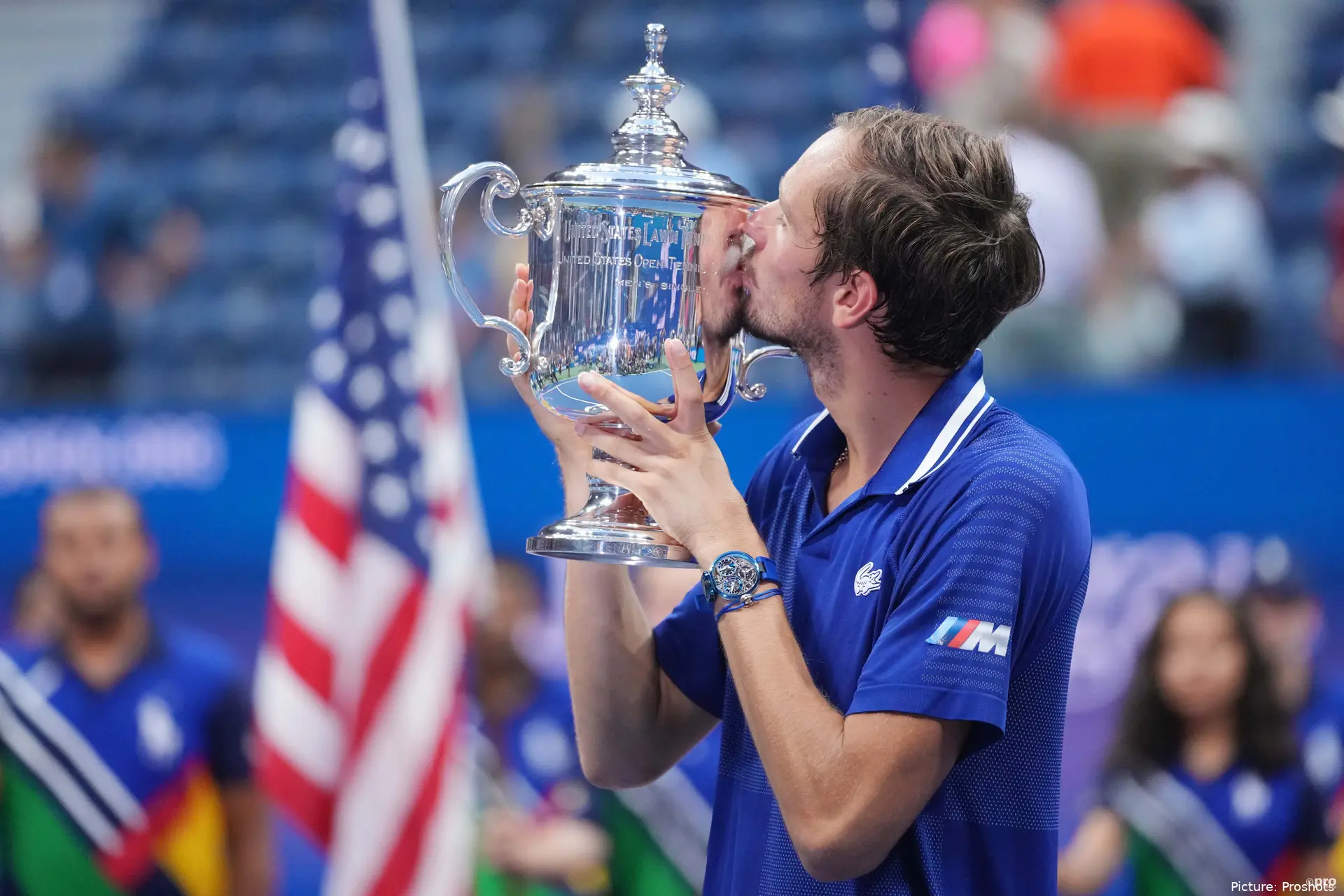
Gilles Cervara’s reset in 2026 has taken him away from the spotlight of Grand Slam finals and into the development phase of a 20-year-old American. Months after parting ways with Daniil Medvedev following the US Open, the French coach has aligned himself with Nishesh Basavareddy, currently ranked No. 192 in the ATP standings.
The decision was not driven by lack of offers. After eight years guiding Medvedev to a US Open title, seven Masters 1000 trophies and the world No. 1 ranking, Cervara could have attached himself to another established contender. Instead, he opted for what he described as a return to fundamentals. “I wanted to go back to basics,” he said in a recent interview with Eurosport.
Basavareddy’s profile explains part of the appeal. The American reached a career-high ranking inside the Top 100 last season after a semi-final run in Auckland, and he has already gained exposure at Grand Slam level. At the 2025 Australian Open, he took a set off Novak Djokovic in the first round, drawing attention for his composure on a major stage.
For Cervara, the attraction lies less in isolated results and more in long-term projection. “Clearly, it takes me out of my comfort zone,” he admitted, framing the partnership as a competitive risk rather than a safe continuation of past success.
A developmental project with upside
Basavareddy’s trajectory has not been linear. After briefly entering the Top 100, he slipped outside the Top 150 and spent much of the following months rebuilding through Challenger events. Yet his underlying metrics — serve efficiency and baseline tolerance — have remained competitive against higher-ranked opposition.
Cervara sees in him a familiar internal mechanism, one that he once identified in Medvedev before the Russian became a Grand Slam champion and world No. 1.
"I would say there are similarities with Daniil, not in style, but in the fact that Nishesh has something in his personality that can take his game to another level. Even without playing well, he is capable of producing good tennis and winning. And that something, a bit invisible, cannot be learned. You either have it or you don’t. The great champions have it. The work is to discover it, to know how to switch it on to make it even more powerful."
Basavareddy’s ability to compete in tight scorelines has been evident in his early tour appearances, including ATP-level wins and his showing in Auckland. Cervara’s focus now is structural growth rather than short-term ranking jumps.
"I wanted to go back to basics with a young player who certainly has experience, but in whom there is still a lot to build, technically, physically, mentally and in his personal development. At that age, the work is very rewarding. This idea of starting from scratch to reach the top is what I experienced with Daniil, and I really want to relive it."
The Frenchman acknowledges the uncertainty that comes with mentoring a player outside the established elite. The challenge is not merely tactical but existential for a coach whose résumé includes the sport’s highest achievements.
"Every day I ask myself whether I will be good enough to help a player of that age improve again, and I have no certainty about it. But feeling threatened is also what I enjoy. When Nadal believed he could lose even against the world No. 300, that resonates with me. It was that sense of threat that allowed him to play at his best level. That’s a bit what I feel too. It’s part of my personality and my energy."
Perspective after Medvedev
Cervara’s partnership with Medvedev was marked by visible tension and sustained excellence. Together they navigated volatile exchanges and built one of the most successful coach-player relationships of the past decade. Now, he speaks of that era without regret.
"In a way, yes, Nishesh is more relaxing. With him, I don’t have to look for subterfuges or counter-arguments to contain a player who tries to contradict me or frustrate me. In the end, no player is relaxing. This job is not. The question is not whether it’s better or worse than before. It’s simply different. And when I think about Daniil’s excesses, today I smile."
The competitive environment may have shifted from Grand Slam finals to Challenger qualifying rounds, but Cervara rejects any suggestion of hierarchy in coaching relevance. "I love being here! Whether it’s a Grand Slam final or Challenger qualifying, the coach’s job remains the same,” commented the 45-year-old coach With Daniil, it’s over. We get along well, we greet each other when we meet, but that’s it.”
“I would say quite well. The emotions come back, a kind of nostalgia. But it’s not nostalgia for the relationship itself. It’s more nostalgia for the passage of time. Because all that represented ten years of my life."

Cristhián AvilaTennis Journalist
Cristhián Ávila is a tennis journalist based in Santiago, Chile, and has been part of the TennisUpToDate team since early 2023. He covers the ATP and WTA Tours as well as all four Grand Slams, producing breaking news, match reports, analysis, and regular liveblogs from major tournaments.
His reporting combines statistical analysis with clear explanation, helping readers understand tactical developments, player form, and broader storylines across the tour. Working fluently in both Spanish and English, Cristhián collaborates with an international editorial team and contributes to comprehensive global coverage. As part of his work, he has conducted interviews and media interactions with leading figures in the sport, including Caroline Wozniacki and John McEnroe.
In his journalism, Cristhián places strong emphasis on careful sourcing, editorial accuracy, and updating articles promptly when new, verified information becomes available. His coverage is grounded in research, context, and direct engagement with professional tennis.
claps 0visitors 0
Just In

Popular News
Latest Comments
- A healthy Qinwen may be hard to stop next season. She was already scaring her opponents before her medical leave(s). Unfortunately, Zheng insisted on singing again. On the positive side -- Mirra did not sing!! ;~}
 mandoist11-10-2026
 - Where is it written that athletes, entertainers... People in general... are mandated to keep looking at -- or even using [anti]Social Media? Public & private figures consistently complain and reveal their concerns about negativity and violence thrown at them -- yet they insist on participating. Avoid it, don't use it, don't read it. It's okay to occasionally look up at the World instead beating your eyes & thumbs to death on The Inventions out there.mandoist11-10-2026
- great articlestennisseserver07-10-2026
- Medvedev was leading Djokovic 7-5, 3-5 when an attempted return..' NO you ignorants, Djokovic was leading .weiss05-10-2026
- No more bullshit "Wildcards" to these two. Qualify like everyone else -- there will be cameras there, too. Time to scream... WTF ????!!!!mandoist29-09-2026
- Let's not BS the general public -- Sabalenka started showing cracks in her game last season. Her losses and near-losses started at about the same time she began being distracted by Fame (constant Selfies, making TV commercials, magazine shoots, endless Social Media nonsense, etc., etc.) One would think even Saba could recognize the parallels with others who failed before her -- Raducanu, Giorgi, Bouchard to name a few.mandoist25-09-2026
- Gross!! Hey Raducanu, Giorgi, and Bouchard -- reserve a seat at your Social Media Selfie table for Saba + Naomi. They're heading in your direction soon enough.mandoist24-09-2026
- And then these same players will complain about how lengthy their season’s were and need more time-off. I’m all for more tennis but the amount of tennis we get now is actually kind of crazy! We all need a break, especially the players.DaveyWavey23-09-2026
- You should do a comparison article for "different kinds of justice" the courts decide for tennis players. I can think of at least three players who received very small bans of a few months, however Tara Moore has been fighting for her literal survival the past few years. It seems odd considering she is not a "name" player, unlike the other cases.DaveyWavey22-09-2026
- PRIZE MONEY & POINTS Winner - $185,500 Finalist - $114,500 Semi-Finalist - $66,003 Quarter-Finalist - $35,000 Round of 16 - $18,045 Round of 32 - $13,005 Winner - 500 Finalist - 325 Semi-Finalist - 195 Quarter-Finalist - 108 Round of 16 - 60 Round of 32 - 1DaveyWavey20-09-2026

Loading