Tennis Legends - Gustavo Kuerten: Triple French Open champion who is the only Brazilian to be world number one
ATP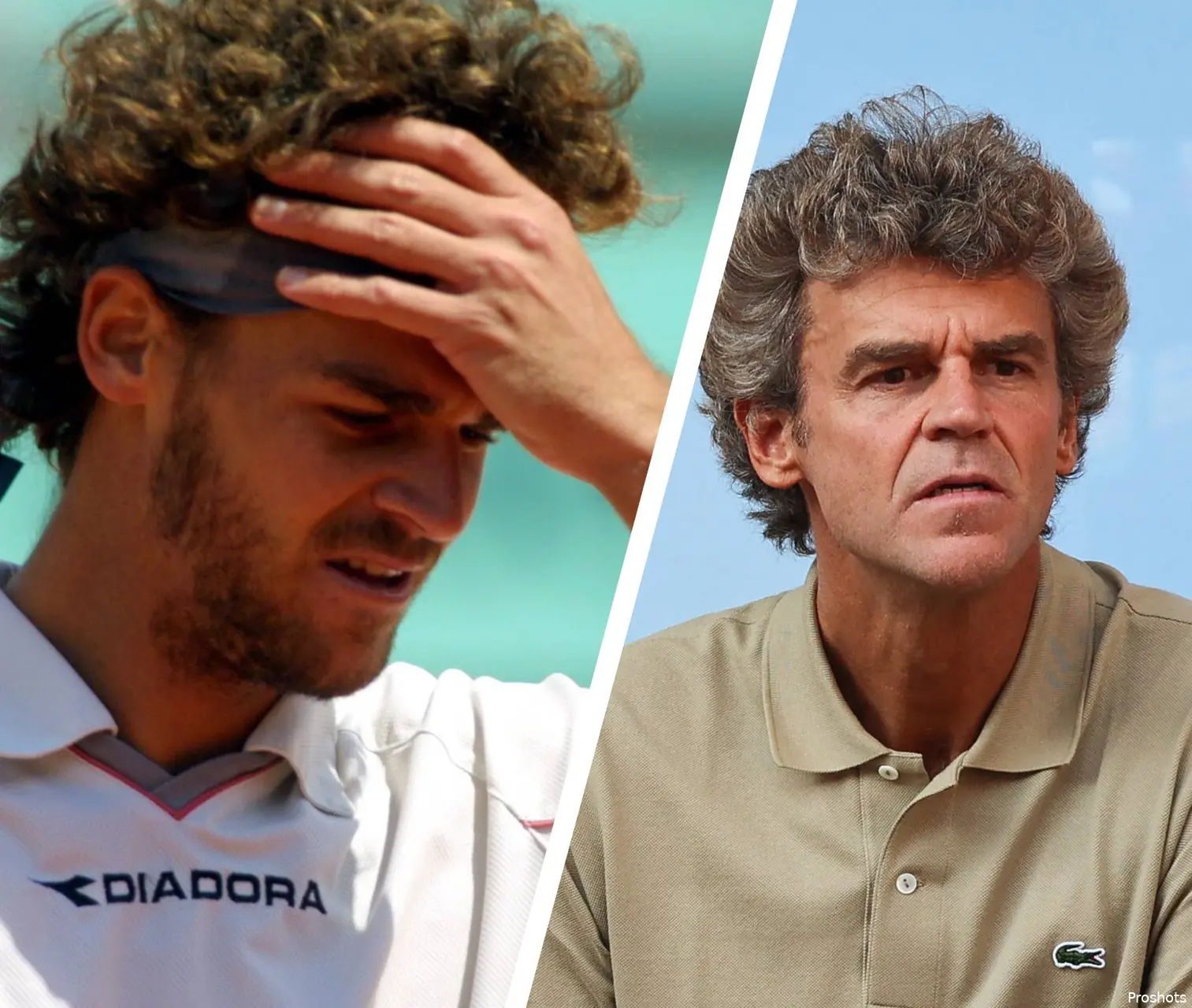
Argentina has produced more leading tennis players than their great South American rivals Brazil, but it's the Samba nation that has provided the only man to reach the world ranking summit. Gustavo Kuerten is the only Brazilian, male or female, to be ranked world number one. A treble of French Open victories underpinned Kuerten's ascent to the top.
His record is heavily slanted towards the clay courts, but the occasional triumph on hard surfaces added a little depth to a CV of a competitor who was popular for his flair.
Born in Florianopolis, Brazil on 10th September 1976. His early life was struck by tragedy when his father Aldo suffered a heart attack when umpiring an amateur match in 1985. On top of this huge loss, Kuerten's youngest brother Guilherme suffered irreparable brain damage at birth and lived with cerebral palsy until his death in 2007. Older brother Raphael would later act as his manager.
Kuerten, known affectionately as Guga, began playing tennis at the age of six. His initial tennis education came through Carlos Alves. They'd work together for the next eight years before he met Larri Passos, a relationship that lasted 15 years, enduring the entirety of Kuerten's professional career.
Turns professional and within two years achieves a huge upset victory at the French Open
Kuerten turned professional in 1995. He treaded water for the first couple of seasons, making into the main draw of only one Grand Slam. He went into the 1997 French Open having achieved a solitary victory from two Grand Slam appearances.
He went into the Paris major ranked 66 in the world. Little was expected even after shocking 1995 winner Thomas Muster. It was when he followed that match with successive five set victories over Andrei Medvedev, one of the best on clay at this stage, and then defending champion Yevgeny Kalfenikov, that many thought he could go all the way. Come the semi-finals and he was now favourite to beat fellow unseeded player Filip Dewulf. Kuerten duly did so and faced off with the past two-time winner Sergi Bruguera. A new star was born as Kuerten took the Spaniard apart in straight sets.
Kuerten rocketed up the rankings to 15, becoming the first Brazilian man to win a Grand Slam. He was the second lowest ranked player to win a major in the men's game.
Struggles with the expectation now placed upon him as a major champion before double Masters glory in 1999
The 1998 season was an anti-climax regarding the Grand Slams, with Kuerten failing to progress beyond the second round of any Grand Slam. His campaign was redeemed a little with clay court successes in Stuttgart and Majorca.
Kuerten reasserted himself during the 1999 season. A first Masters 1000 title came in Monte Carlo, albeit via Chilean opponent Marcelo Rios retiring hurt, a set down, in the title match. The following month, Kuerten doubled his Masters tally when besting Pat Rafter in the Italian Open final at Rome's Foro Italico.
He also reached the quarter-final stages of all majors in 1999 outside the Australian Open. These were his best Grand Slam runs since his French Open win in 1997. He finished the season in the world's top ten for the first time, positioned at number five.
Read also
First two years of Millennium prove to be the peak of Guga's career
Kuerten picked up a sixth ATP title in Santiago in March 2000. It was the first of five titles in a season that ranks arguably as his finest. It was a campaign where he managed to shake off the perception he could only win big events on clay.
He made finals of the Masters events in Miami and Rome before going to the French Open as one of the favourites. In echoes of his 1997 triumph at Roland Garros, Kuerten emerged from five set thrillers with Kalfenikov in the quarters and Juan Carlos Ferrero at the semi-final stage.
The final pitted him against the Swede Magnus Norman. Kuerten required a tenth match point in an epic fourth set to become a two-time French Open champion.
The Brazilian star added a hard court title for the first time in the summer this year. Victory in Indianapolis giving Kuerten a first title away from his favoured clay.
A golden year was topped off with glory at the season-ending Masters Cup (now the Tour Finals) after Andre Agassi was swept aside in straight sets. These successes away from clay gave Kuerten's CV a more rounded feel. It validated the fact he ended the term as world number one.

The 2001 season yielded six titles, a career high. This haul began with a trio of titles on clay, including a second Monte Carlo Masters crown, heading into defending his French Open title.
At Roland Garros, Kuerten retained his title with a dominant final victory over Spaniard Alex Corretja. Only Rafael Nadal and Bjorn Borg have won more French Opens in the Open Era.
Kuerten won two additional titles in 2001, including a Masters triumph on the hard courts of Cincinnati ahead of the US Open. He then made the quarter-finals in New York.
Decline sets in as Kuerten struggles with injuries
One title, coming in his native Brazil, represented a notable drop-off for the 2002 season. He also failed to progress beyond the last 16 of any Grand Slam. After finishing 2001 at world number two, Kuerten had slumped to 37 by the end of the 2002 campaign.
Kuerten experienced a modest revival in fortunes the following season. He amassed titles in Auckland and St Petersburg. Another fourth round showing at the French Open proved to be his Grand Slam best in 2003. The stylish Brazilian finished the year ranked at 16.
The 2004 season saw him regain his Costa Do Sauipe title. This would turn out to be the last of Kuerten's twenty singles titles from 29 finals. It was a term where he reached a last Grand Slam quarter-final, going down in four sets at Roland Garros to Argentine David Nalbandian. During the French Open, he was the only player to beat Roger Federer in a major all season.
2005 would ultimately see diminishing returns and he announced time away from the sport to have surgery on his hip.
The 2006 and 2007 seasons witnessed intermittent appearances from Kuerten, not playing in any of the Grand Slams. He made one final major appearance at the French Open in 2008, losing in round one. Kuerten retired later that season. His final singles win/loss record was 358/195
Davis Cup and doubles highlights
Kuerten represented Brazil in Davis Cup on several occasions. He was committed to a greater extent than many other leading players at the time. He finished with a 34/15 win/loss record across singles and doubles.
In the 2000 edition, Kuerten led a Brazilian challenge that saw them progress to the semi-final stage. This matched Brazil’s best showing in the venerable team competition from 1992.
Kuerten accrued a total of eight doubles titles in his career. Five of these were won in tandem alongside compatriot Fernando Meligeni. His highest doubles ranking was 38.
Personal life including surfing passion
Kuerten founded the Gustavo Kuerten Institute, in 2000, to assist children and disabled people in Florianopolis. The organisation provides opportunities for sports and education. It’s an advocate for social inclusion across Brazil. He won the Arthur Ashe Humanitarian of the Year Award in 2003.
Since his retirement, Kuerten has resided in the city of his birth. He's continued to coach youngsters. Kuerten also takes advantage of the great surfing conditions. In 2009 he embarked on a drama studies course at the Center of Arts of Santa Catarina State University.
In November 2010, on his late brother Guilherme's birthday, he married Mariana Soncini. The couple have two children, a daughter and a son.
Kuerten was found guilty of tax evasion in October 2016. The evasion related to income earned from copyright and image rights earned between 1995 and 2002. He was ordered to repay millions back.
Legacy of only South American man to be world number one
Gustavo remains the only Brazilian man to win a Grand Slam singles title. He's one of the country's greatest sporting figures. In 1999, Kuerten received Brazil’s top athletic honour, the Premio Brasil Olimpico. Kuerten was a torch bearer for Brazil at the 2016 Rio Olympics.
He remains the only South American man to be world number one despite several leading players from Argentina. Kuerten enjoyed 43 weeks in the top slot.
Some would opine Kuerten was just a world class clay courter but not a genuine all-rounder. It’s fair to say that Kuerten's record is heavily slanted towards the red stuff. However, triumphs in showpiece events on hard courts such as the Cincinnati and the Masters Cup tempered these criticisms.
Kuerten was inducted into the International Tennis Hall of Fame in 2012. Maria Bueno, who won seven Grand Slams in the amateur era, placed Brazilian and South American tennis on the map. Kuerten revived the sport in Brazil with his French Open dynasty.

Jay Brannon is a sports journalist from Sutton Coldfield, England, with a lifelong passion for athletic competition and storytelling. For the past 1.5 years, he has been a prominent voice at TennisUpToDate.com, where he has authored more than 3,000 articles, specializing in deep-dive columns, tactical analyses, liveblogs, and comprehensive match reports for the ATP and WTA tours.
Jay’s tennis reporting blends rigorous, real-time statistical analysis with on-the-ground coverage. He frequently travels to tournaments to cover the action firsthand from the press box and player press conferences. This direct access allows him to deliver sharp insight into player form and tour developments—a dedication sparked by his earliest sporting memory of the iconic 1991 Wimbledon final between Michael Stich and Boris Becker.
Beyond the court, Jay brings a versatile background in live broadcasting and media. His professional experience includes serving as a sports reporter for BHBN Hospital Radio—where he delivered live updates and analysis for West Bromwich Albion and Wolverhampton Wanderers matches—as well as working as a match reporter for Sutton Coldfield Town.
Jay holds a degree in Music Journalism and Broadcasting from Staffordshire University, a foundational training that shaped his voice as a thoughtful, authentic storyteller. Grounded in core journalistic ethics, he places a strict emphasis on careful sourcing, editorial accuracy, and swift, verified updates.
claps 0visitors 0
Just In

Popular News

Latest Comments
- Does Sinner need that 4.5 mil? I doubt it. He can make that with three modelling gigs!😅🤣Rapunzel21-10-2026
- Did "People Magazine" purchase this website? This nonstop storyline is bullshit.
 mandoist21-10-2026
 - Listen... this is of no concern to anyone but these two. Deal with your own issues -- most of us have our own. Thanks, media, for these insignificant follow-ups which are meaningless.mandoist21-10-2026
- This is so very very sad, for all three of them. I truly thought they had an unbreakable bond, but life throws up so many differing challenges. Having your homeland suffering in such a terrible way, makes happiness lose out to guilt as well. Our thoughts are with them. X💔bjsexton20-10-2026
- I have lost all respect for Svitolina! Could she not have waited until he had played at the Paris Masters!!! She is selfish and don't give a damn about Gael. That is NOT how love is demonstrated Elina!!Rapunzel19-10-2026
- Perhaps convenient tennis tour sex is not a strong enough experience in which to base a marriage?mandoist19-10-2026
- Fight the Good Fight... Tennis (sports in general) need more Humans such as yourself.mandoist18-10-2026
- When is WTA going to mandate Genetic Testing (DNA) ???mandoist18-10-2026
- Hey, Dan... you just wake up from a coma? Regardless -- Thanks for the comedy this morning!mandoist18-10-2026
- Two Things: 1. Stop allowing these Spoiled Trust-Fund Elitists to behave badly. Your little hand-slaps do not deter them. 2. STOP the incessantly annoying "towel wiping" nonsense!!!!mandoist15-10-2026

Loading