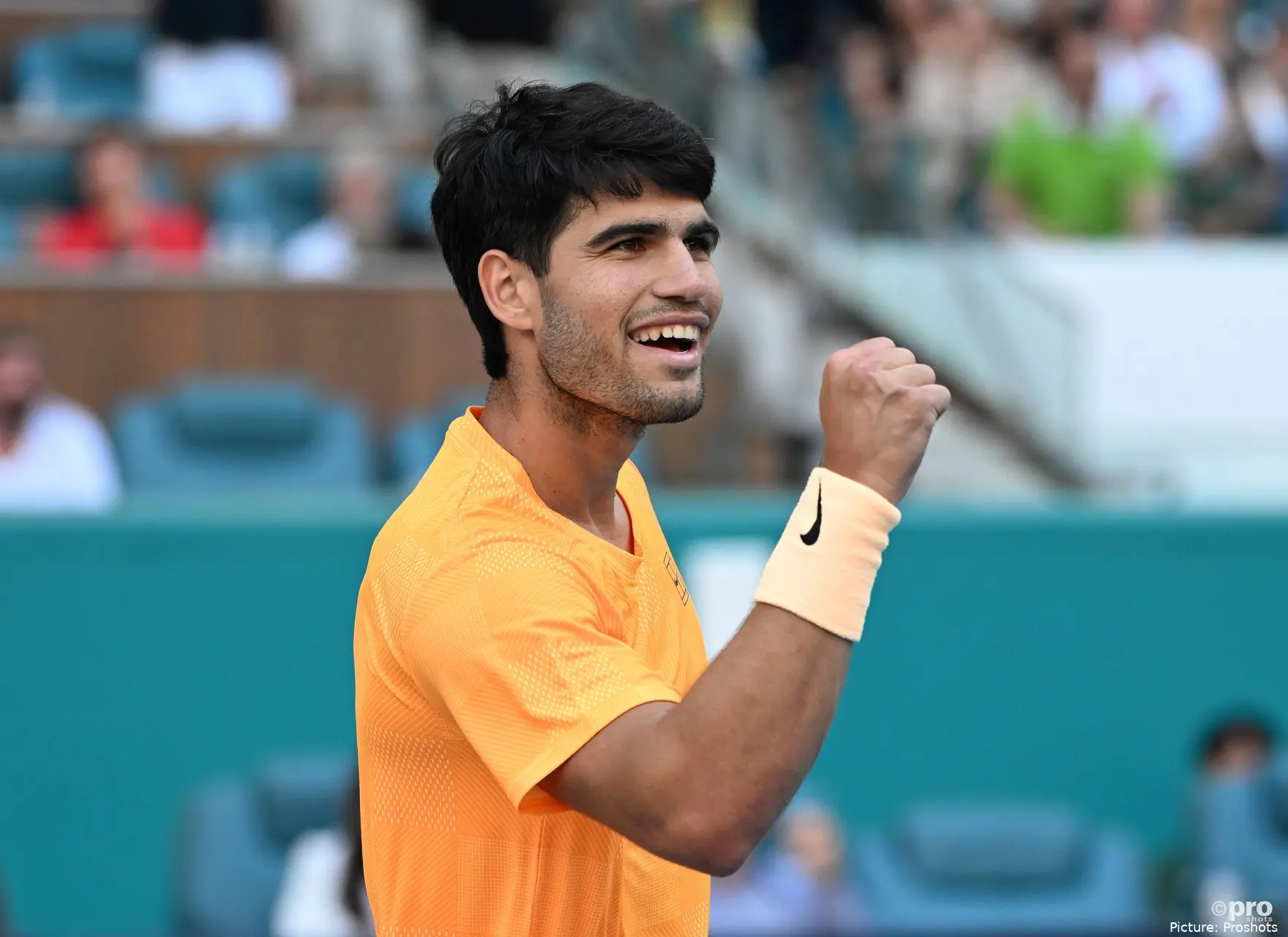
Carlos Alcaraz delivered one of his most emphatic performances of the week at the Monte-Carlo Masters, defeating Alexander Bublik 6-3, 6-0 to reach the semi-finals. Yet the defining moment came not during the match, but immediately after, when the Spaniard apologised to his opponent at the net following a one-sided contest.
The encounter marked the first meeting between the two players on the ATP Tour and carried some anticipation given Bublik’s unpredictable style. However, that expectation dissolved quickly as Alcaraz imposed control from the outset, ultimately winning the final 10 games in succession to close the match in just over an hour.
For Bublik, ranked World No. 11, the match became an exercise in damage limitation rather than competition. His ability to disrupt rhythm—often a defining feature of his game—was neutralised by Alcaraz’s consistency and depth. Despite the scoreline, the post-match exchange reflected mutual respect rather than frustration.
Alcaraz’s victory also carried broader significance, marking his 300th career win at tour level. The milestone comes during a period of sustained success, with the Spaniard now two victories away from defending his Monte-Carlo title and continuing his strong transition into the clay season. The world No. 1 now advances to the semi-finals, where he will face either Alex de Minaur or Valentin Vacherot.
A one-sided contest shaped by control
The match initially hinted at greater balance. Alcaraz broke early to lead 2-0 and had opportunities to extend his advantage further, but Bublik responded with a brief surge, winning three consecutive games to level the set. That phase proved temporary, as the Spaniard quickly reasserted control through sustained baseline pressure and improved shot tolerance.
From that point forward, the dynamic shifted decisively. Alcaraz dictated rallies with consistent depth, limiting Bublik’s ability to improvise. The Kazakh’s unorthodox shot selection, typically a source of disruption, instead produced errors under pressure. As Alcaraz extended his run, the match effectively moved beyond competitive balance.
The tone of the contest was captured in the exchange at the net, where Alcaraz acknowledged the nature of the result. Bublik, smiling, responded in kind, framing the conditions with a degree of irony that reflected both the difficulty of the matchup and his own style of play.
“Sorry, man,” said Alcaraz.
“It’s OK, good luck,” replied Bublik.
“Thank you so much,” Alcaraz answered.
“We played in my worst conditions possible, bro,” added Bublik with a smile.
Execution, adaptation and milestone context
In his post-match assessment, Alcaraz highlighted the early fluctuations in rhythm before settling into a more stable pattern. He noted that after failing to convert additional break opportunities, he briefly “lost the feeling of the ball,” allowing Bublik to dictate short phases of play before regaining control.
“First of all, I started pretty well the match. I had points to be two breaks up in the first set, I didn’t make it, and then all of a sudden, I think I lost a little bit the feeling of the ball.”

The Spaniard also acknowledged the unique challenge posed by Bublik, describing him as “an anarchic player” whose unpredictability demands constant adjustment. That assessment aligned with the brief momentum shifts early in the match, though Alcaraz ultimately resolved them through consistency rather than tactical risk.
“After that, I think he just pull off great shots, great games, that I had to run side to side a lot, try to defend my best. I save few games, which gave me a lot of confidence coming into the match again and playing aggressive and all of that stuff.”
As the match progressed, Alcaraz’s execution became increasingly efficient. He closed points with authority and reduced unforced errors, turning the contest into a controlled display. That progression underlined his ability to adjust mid-match, particularly against opponents whose patterns are difficult to anticipate.
“I would say I played a great and a solid match against him, that is probably an anarchic player, you don’t know what’s going to be next. Just happy to get through and be playing another semi-final here. Obviously, I’m really happy about my 300th win in the ATP Tour, and hopefully many more to come.”

Cristhián AvilaTennis Journalist
Cristhián Ávila is a tennis journalist based in Santiago, Chile, and has been part of the TennisUpToDate team since early 2023. He covers the ATP and WTA Tours as well as all four Grand Slams, producing breaking news, match reports, analysis, and regular liveblogs from major tournaments.
His reporting combines statistical analysis with clear explanation, helping readers understand tactical developments, player form, and broader storylines across the tour. Working fluently in both Spanish and English, Cristhián collaborates with an international editorial team and contributes to comprehensive global coverage. As part of his work, he has conducted interviews and media interactions with leading figures in the sport, including Caroline Wozniacki and John McEnroe.
In his journalism, Cristhián places strong emphasis on careful sourcing, editorial accuracy, and updating articles promptly when new, verified information becomes available. His coverage is grounded in research, context, and direct engagement with professional tennis.
claps 1visitors 1
Just In

Popular News
Latest Comments
- A healthy Qinwen may be hard to stop next season. She was already scaring her opponents before her medical leave(s). Unfortunately, Zheng insisted on singing again. On the positive side -- Mirra did not sing!! ;~}
 mandoist11-10-2026
 - Where is it written that athletes, entertainers... People in general... are mandated to keep looking at -- or even using [anti]Social Media? Public & private figures consistently complain and reveal their concerns about negativity and violence thrown at them -- yet they insist on participating. Avoid it, don't use it, don't read it. It's okay to occasionally look up at the World instead beating your eyes & thumbs to death on The Inventions out there.mandoist11-10-2026
- great articlestennisseserver07-10-2026
- Medvedev was leading Djokovic 7-5, 3-5 when an attempted return..' NO you ignorants, Djokovic was leading .weiss05-10-2026
- No more bullshit "Wildcards" to these two. Qualify like everyone else -- there will be cameras there, too. Time to scream... WTF ????!!!!mandoist29-09-2026
- Let's not BS the general public -- Sabalenka started showing cracks in her game last season. Her losses and near-losses started at about the same time she began being distracted by Fame (constant Selfies, making TV commercials, magazine shoots, endless Social Media nonsense, etc., etc.) One would think even Saba could recognize the parallels with others who failed before her -- Raducanu, Giorgi, Bouchard to name a few.mandoist25-09-2026
- Gross!! Hey Raducanu, Giorgi, and Bouchard -- reserve a seat at your Social Media Selfie table for Saba + Naomi. They're heading in your direction soon enough.mandoist24-09-2026
- And then these same players will complain about how lengthy their season’s were and need more time-off. I’m all for more tennis but the amount of tennis we get now is actually kind of crazy! We all need a break, especially the players.DaveyWavey23-09-2026
- You should do a comparison article for "different kinds of justice" the courts decide for tennis players. I can think of at least three players who received very small bans of a few months, however Tara Moore has been fighting for her literal survival the past few years. It seems odd considering she is not a "name" player, unlike the other cases.DaveyWavey22-09-2026
- PRIZE MONEY & POINTS Winner - $185,500 Finalist - $114,500 Semi-Finalist - $66,003 Quarter-Finalist - $35,000 Round of 16 - $18,045 Round of 32 - $13,005 Winner - 500 Finalist - 325 Semi-Finalist - 195 Quarter-Finalist - 108 Round of 16 - 60 Round of 32 - 1DaveyWavey20-09-2026

Loading
