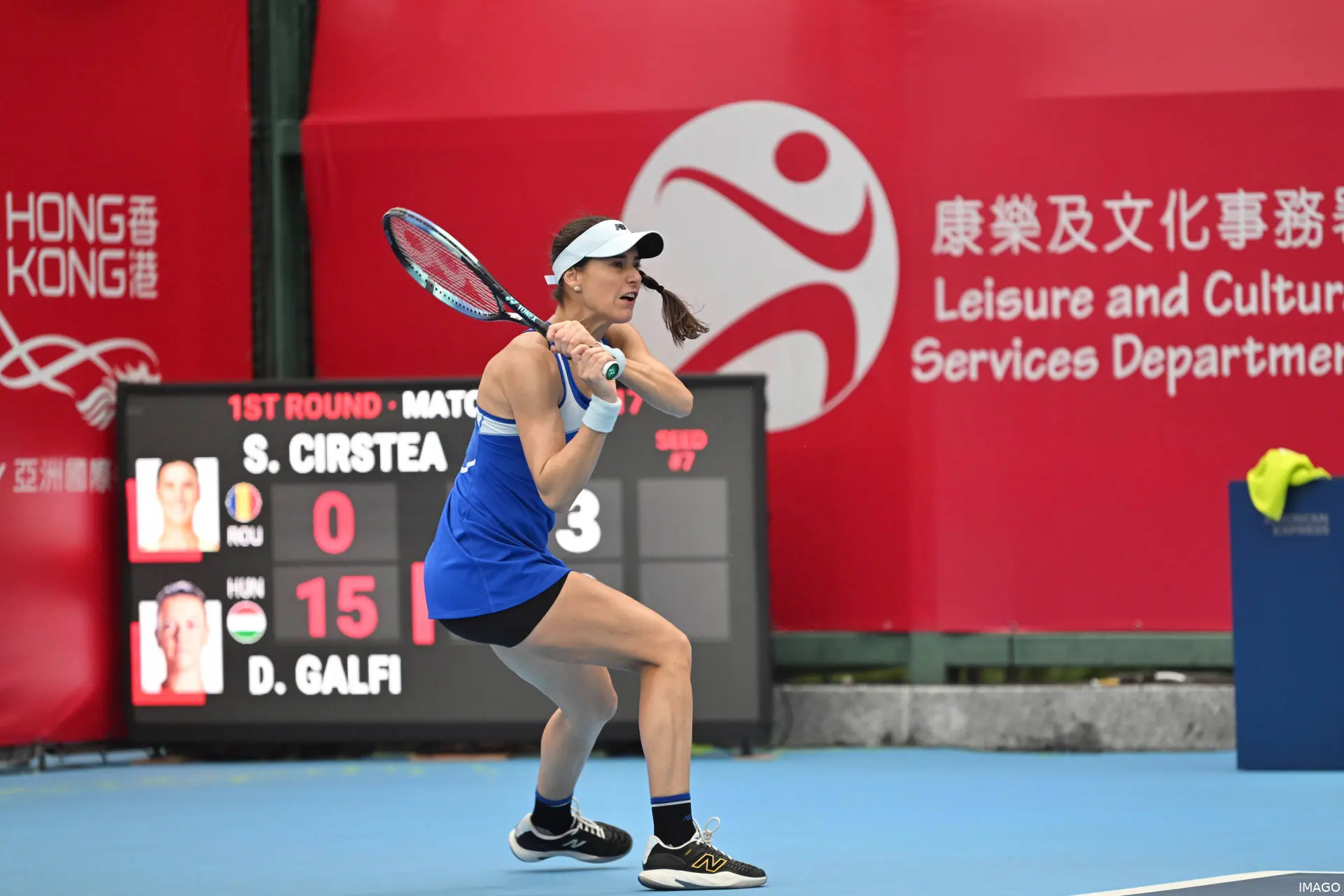
It’s October in Hong Kong, and Sorana Cîrstea is still here. Still swinging. Still winning. And, somehow, at 35, she might be playing the best tennis of her life.
At the time of writing, Cîrstea is into the round of 32 in Hong Kong. That’s not headline-grabbing stuff on its own—but what makes it remarkable is the broader arc of her year. She started 2025 flirting with the 200-spot mark in the rankings. Today, her live ranking is 44. That’s not a typo. Forty-four. A ninety-plus-spot climb in less than a year. For most pros, that kind of resurgence belongs in a Netflix doc, not the official WTA site.
The comeback nobody ordered —but everybody should appreciate
What makes this comeback so interesting is that no one was really asking for it. Cîrstea has been around forever. She turned pro before most of today’s top 10 had smartphones. She’s been a teen phenom, a journey-woman, a dark-horse seed, and occasionally the player who knocks out a star and then quietly exits the next round.
But the latter half of 2025 has been markedly different.
Her run in Cleveland—at the affectionately titled Tennis in the Land—was something special. It wasn’t just that she won the title; it was how she did it. Gritty baseline rallies, laser-sharp returns, and an aura of composure that felt brand new. Cîrstea didn’t look like someone hanging on for one last hurrah. She looked like someone finally freed (or who freed herself, more accurately) from expectation.
The economics of persistence
On-court earnings can tell their own story. This year, Cîrstea has earned just over a million dollars in prize money. That’s not Sinner-level cash (parenthetically, Sinner is currently at a few dollars under $14 million for the year, with the Paris Masters underway and the ATP Finals still to come), but it’s a massive figure for someone written off as a “veteran.” Tennis economics favor youth and ranking points—two things that had started to slip from her grasp. Yet she’s flipped that equation, earning like a top-tier player by playing with the looseness of someone who has nothing left to prove.
That combination—calm and confidence—is lethal in this sport.
What changed?
It’s tempting to point to some external factor. A new coach. A new racket. A new diet or dog or mindfulness app. But watch her courtside and you realize the transformation is mostly internal. I’ve seen her practice in person. She’s not big—maybe 170 centimeters on paper, and even that might be generous—but she carries herself like she’s much bigger. There’s a density to her energy, a quiet defiance in the way she resets between points.
What really comes through is her strength of character. It’s in how she handles bad calls. How she refuses to sag after a lost set. How she can look over at her box, take one quick breath, and start again like nothing happened.
In a sport that worships perfection, Cîrstea radiates humanity.
Age and the modern game
There’s another layer here: age. At 35, she’s supposed to be winding down. Everyone around her is getting younger, faster, more analytics-driven. But tennis in 2025 is a different animal. The lines between physical prime and competitive relevance have blurred. Venus and Serena redefined longevity. Wozniacki came back from motherhood swinging like she never left. And now here’s Cîrstea, showing that a decade of experience can outwit the algorithmic precision of twenty-something opponents.
The truth is, players like Cîrstea age differently because they’ve learned how to care selectively. She doesn’t chase every tournament or every point. She’s playing smarter, not harder—strategic in her scheduling, patient in her shot selection. She’s no longer fighting the game; she’s collaborating with it.
The psychology of still believing
Comebacks in tennis are never just physical. They’re psychological high-wire acts. The hardest part isn’t beating opponents—it’s convincing yourself that it’s still worth trying.
That’s why what she’s doing feels quietly revolutionary. While many players her age have turned to commentary booths or coaching gigs, Cîrstea is still grinding it out on hard courts and clay, often far from the spotlight. She’s not here for nostalgia. She’s here because she still thinks she can win. And this year, she’s proved it.
The numbers behind the narrative
Let’s zoom out. In March, her ranking hovered near 200. That’s the tennis equivalent of purgatory—good enough to qualify for some really low-level events and qualifying at some others, not good enough for direct entry to others. From there, she’s strung together wins against higher-ranked players, adapted across surfaces, and built a stat line that’s hard to ignore.
Her Cleveland title wasn’t a fluke—it was the confirmation. And now, at number 44 in the world in the live rankings, it’s not unrealistic to imagine her making a run early next year toward her career-high ranking of 21. That number suddenly feels within reach again.
Lessons from a late bloom
There’s something wonderfully un-Instagram about Cîrstea’s resurgence. It’s not flashy. She’s not breaking the internet with trick shots or viral celebrations. She’s just showing up, competing, and trusting the long arc of her own career.
Maybe that’s what’s most refreshing about her story—it’s not about reinvention so much as rediscovery. She’s rediscovered why she plays, what she loves about the game, and how to block out everything that doesn’t serve that mission.
Her post-match interviews are calm and candid, often laced with gratitude. You get the sense she’s savoring the moments she used to rush through. And when you’ve been on tour for nearly two decades, that kind of peace isn’t a small thing—it’s the thing.
Why we should all be paying attention
Every tennis season has its headliners—the Sabalenkas, the Gauffs, the Swiateks. But lurking beneath that top tier are players like Cîrstea who remind us what longevity looks like when it’s fueled by love of the game rather than fear of its end.
She’s an underdog who refuses to fade quietly, a veteran who somehow keeps finding new gears. Watching her in 2025 feels like witnessing a private renaissance, one match at a time.
And here’s the beautiful irony: when she finally cracked the top 25 a decade ago, the narrative was about promise and potential. Now, with less hairpin speed but more mental torque, she’s proving that promise doesn’t expire—it just evolves.
One more run
Maybe she won’t hit 21 again. Maybe she’ll stop short. Or maybe—just maybe—she’ll climb even higher. Either way, this late-career surge is a reminder that sport doesn’t always reward youth—it rewards belief.
Sorana Cîrstea has spent most of her career on the margins of the tennis conversation. But this season, with her mix of endurance, intelligence, and sheer willpower, she’s forced her way back into the spotlight. She’s not done. Not even close. And that’s the point.

Aron SolomonGuest Author
A Pulitzer Prize-nominated journalist for his groundbreaking op-ed in The Independent exposing the NFL’s “race-norming” policies, Aron Solomon, JD, is a globally recognized thought leader in law, media, and strategy.
As Chief Strategy Officer for AMPLIFY, he leverages his deep expertise to shape the future of legal marketing. Aron has taught entrepreneurship at McGill University and the University of Pennsylvania and was honored as a Fastcase 50 recipient, recognizing him among the world’s top legal innovators. A prolific commentator on law, business, and culture, his insights regularly appear in Newsweek, The Hill, Crunchbase News, and Literary Hub.
He has also been featured in The New York Times, Fast Company, Fortune, Forbes, CBS News, CNBC, USA Today, ESPN, TechCrunch, BuzzFeed, Venture Beat and countless other leading global media outlets. We are proud to have Aron on board at TennisUpToDate, where his deep tennis expertise enriches the site with sharp, original columns that connect the sport to wider cultural debates.
claps 2visitors 2
Just In


Popular News
Latest Comments
- A healthy Qinwen may be hard to stop next season. She was already scaring her opponents before her medical leave(s). Unfortunately, Zheng insisted on singing again. On the positive side -- Mirra did not sing!! ;~}
 mandoist11-10-2026
 - Where is it written that athletes, entertainers... People in general... are mandated to keep looking at -- or even using [anti]Social Media? Public & private figures consistently complain and reveal their concerns about negativity and violence thrown at them -- yet they insist on participating. Avoid it, don't use it, don't read it. It's okay to occasionally look up at the World instead beating your eyes & thumbs to death on The Inventions out there.mandoist11-10-2026
- great articlestennisseserver07-10-2026
- Medvedev was leading Djokovic 7-5, 3-5 when an attempted return..' NO you ignorants, Djokovic was leading .weiss05-10-2026
- No more bullshit "Wildcards" to these two. Qualify like everyone else -- there will be cameras there, too. Time to scream... WTF ????!!!!mandoist29-09-2026
- Let's not BS the general public -- Sabalenka started showing cracks in her game last season. Her losses and near-losses started at about the same time she began being distracted by Fame (constant Selfies, making TV commercials, magazine shoots, endless Social Media nonsense, etc., etc.) One would think even Saba could recognize the parallels with others who failed before her -- Raducanu, Giorgi, Bouchard to name a few.mandoist25-09-2026
- Gross!! Hey Raducanu, Giorgi, and Bouchard -- reserve a seat at your Social Media Selfie table for Saba + Naomi. They're heading in your direction soon enough.mandoist24-09-2026
- And then these same players will complain about how lengthy their season’s were and need more time-off. I’m all for more tennis but the amount of tennis we get now is actually kind of crazy! We all need a break, especially the players.DaveyWavey23-09-2026
- You should do a comparison article for "different kinds of justice" the courts decide for tennis players. I can think of at least three players who received very small bans of a few months, however Tara Moore has been fighting for her literal survival the past few years. It seems odd considering she is not a "name" player, unlike the other cases.DaveyWavey22-09-2026
- PRIZE MONEY & POINTS Winner - $185,500 Finalist - $114,500 Semi-Finalist - $66,003 Quarter-Finalist - $35,000 Round of 16 - $18,045 Round of 32 - $13,005 Winner - 500 Finalist - 325 Semi-Finalist - 195 Quarter-Finalist - 108 Round of 16 - 60 Round of 32 - 1DaveyWavey20-09-2026

Loading