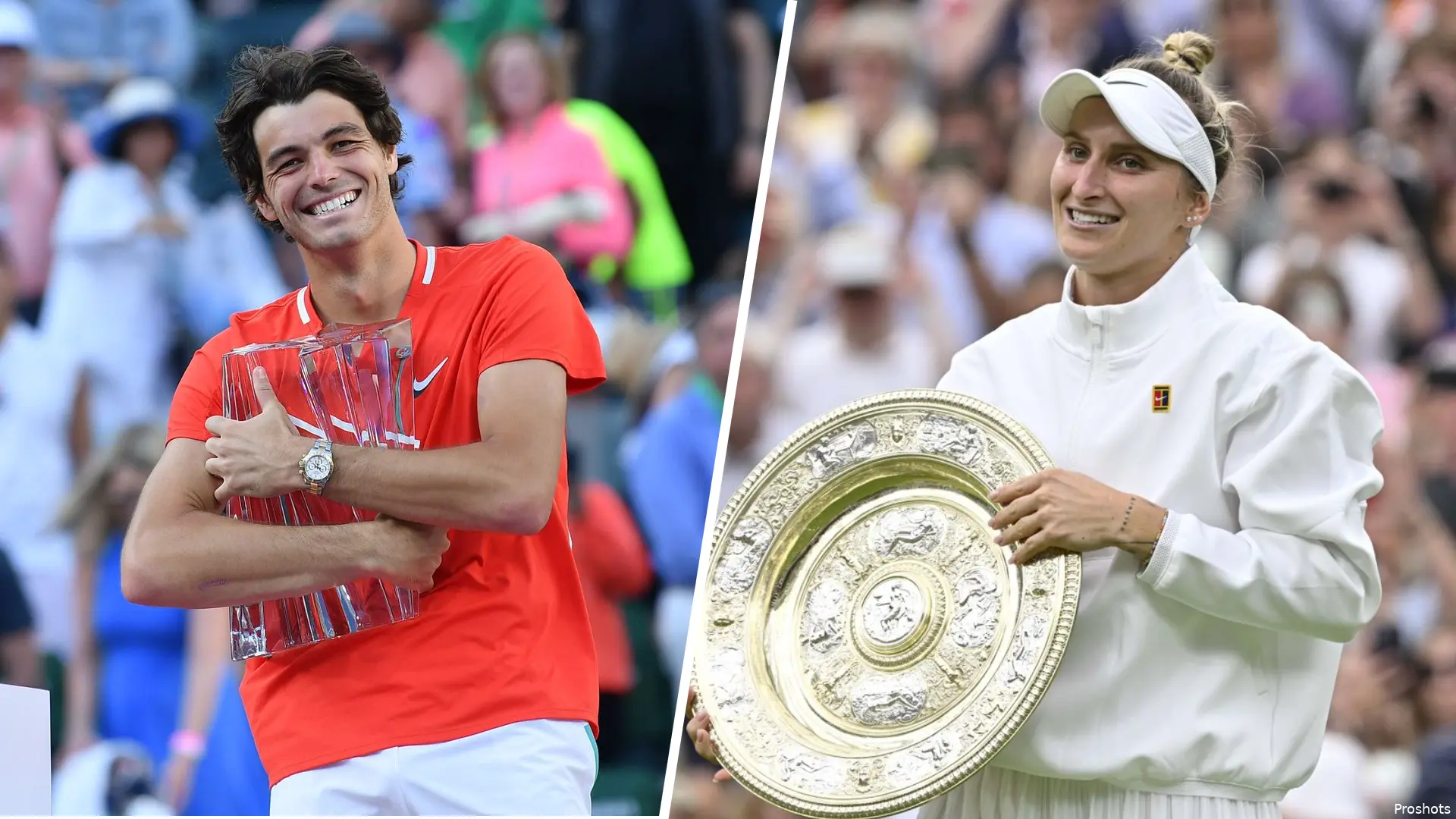
Every season produces at least one player nobody saw coming — a qualifier who reaches a semifinal, an unseeded name who lifts a trophy, or a journeyman who suddenly looks like a contender. The tennis world reacts to all of them the same way in the moment: as evidence that something has genuinely changed. Only afterward does it become clear which of those runs were the start of something real and which were simply a great two weeks that never repeated.
That gap is worth examining properly, because the signs are usually there before the breakthrough even happens — in a player's age, their prior results, their injury history, or the specific shape of the game that got them there. Using seven of the clearest recent cases, here's what actually separates a genuine breakthrough from a one-off.
1. Marketa Vondrousova: the breakthrough that was real all along
Vondrousova's Wimbledon title in 2023 gets remembered as a shock — an unseeded, 42nd-ranked player becoming the first unseeded woman ever to win the title. But her breakthrough hadn't actually happened at Wimbledon at all. It happened four years earlier, at 19, when she reached the French Open final in 2019, a result with real junior pedigree behind it rather than a surprise.
What followed wasn't a decline so much as an interruption. Wrist injuries required surgery and derailed her ranking for several seasons, the kind of setback that makes a promising young player look, from the outside, like their one big result might have been a ceiling rather than a floor. By the time she arrived at Wimbledon in 2023, most of the sport had stopped thinking of her as a future Grand Slam champion.
The title itself was really just delayed confirmation of what her 2019 run had already suggested. Vondrousova's case shows that a young player reaching a major final on real merit remains a strong indicator of future success, even if injuries push that success years further down the road than anyone expected.
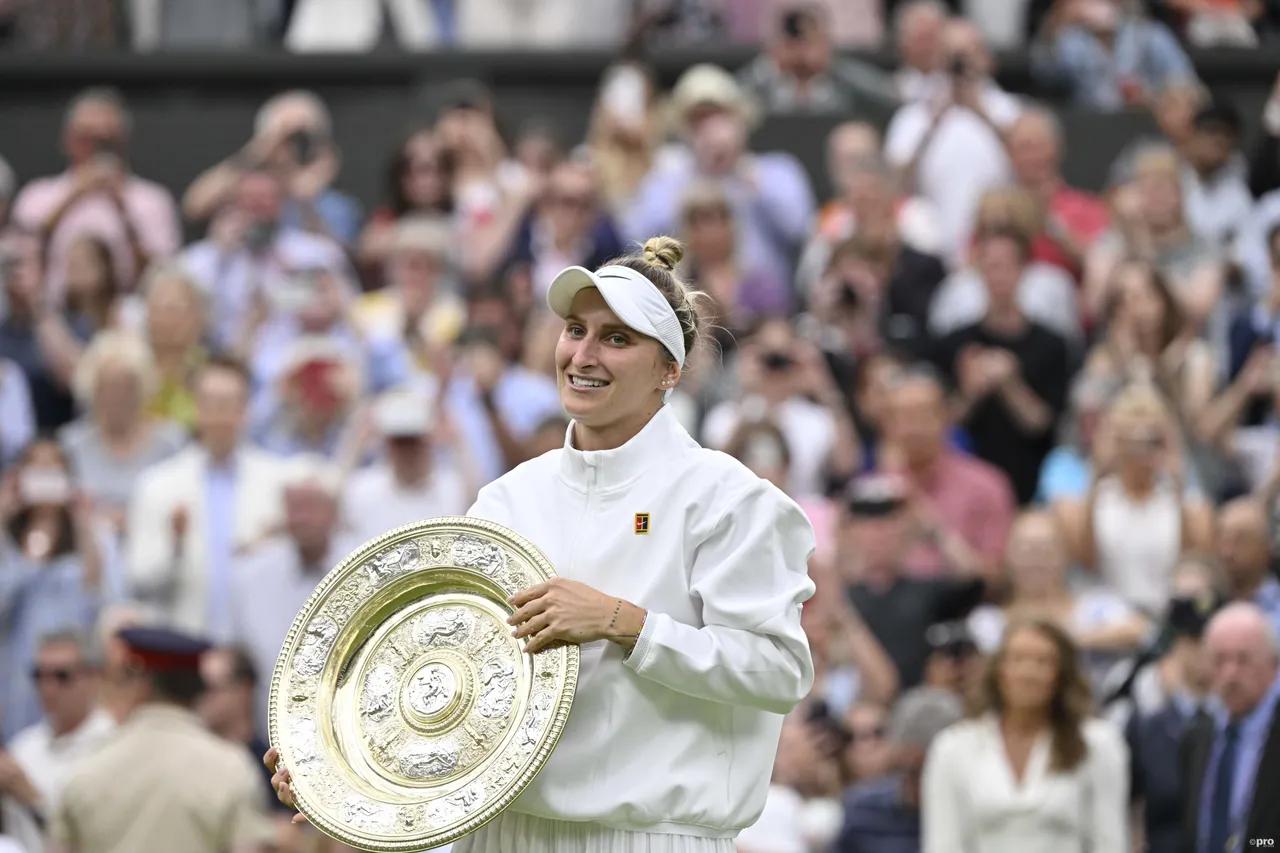
Marketa Vondrousova won the 2023 Wimbledon ladies title.
2. Aslan Karatsev: the purest one-off on record
Karatsev's 2021 Australian Open remains one of the strangest runs in Grand Slam history. Ranked No. 114 and playing in his first-ever major main draw, he beat three seeded opponents to reach the semifinal—the first man in the Open Era to reach a Slam semifinal on his tournament debut and the lowest-ranked man to reach one since Goran Ivanišević in 2001. He backed it up by winning the ATP's Most Improved Player award that year and briefly climbing to a career-high No. 14.
None of it had any real precedent, and none of it was ever repeated. Karatsev had no history of deep runs at smaller events, no junior pedigree suggesting elite upside, and no obvious technical or physical trait that explained the run beyond a red-hot two weeks. His career record sits below .500 today, and he's added just three tour titles since, none of them remotely close to that Melbourne fortnight.
Karatsev is the control case for this whole exercise — the version of a breakthrough with genuinely no statistical indicators behind it. When a run like his happens, it is tempting to treat it as the start of a new level. In Karatsev's case, however, he never reached the second week of a Grand Slam again, failed to produce deep runs at Masters 1000 events and, after winning his third title in Sydney in January 2022 — less than a year after his breakthrough — the Russian never managed another deep run at a major tournament or lifted another trophy.

Karatsev reached the semifinals in his Grand Slam debut, but after that, he never made it past the third round.
3. Amanda Anisimova: talent confirmed early, validated late
Anisimova's first big signal came even earlier than Vondrousova's. At just 17, she beat defending champion Simona Halep to reach the 2019 French Open semifinal, already showing the flat, aggressive ball-striking that separates a genuinely dangerous young player from a lucky qualifier. There was no ambiguity about whether the talent was real.
What complicated her case wasn't injury but a mental health break in 2023, a step away from the sport that left her career trajectory genuinely uncertain for a period. Plenty of players who step away at that stage never fully return to their previous level, and for a while, Anisimova's file looked like it might close on "promising teenager who never got back there".
Instead, 2025 brought two Grand Slam finals in the same season, a Wimbledon final and a US Open final, along with two WTA 1000 titles and a career-high ranking of world No. 3. While she was unable to remain at the very top of the WTA Tour in 2026, she has stayed inside the Top 20, and having only turned 25 a month ago, there is still plenty to expect from a player who has already shown that, when she plays with confidence, she has the talent to be a genuine Grand Slam contender.

Amanda Anisimova lifting the China Open trophy after clinching the title in 2025
4. Kevin Anderson: real, gradual, and cut short by his body
Anderson's story looks nothing like Karatsev's, even though both reached major finals. His 2017 US Open final, lost to Rafael Nadal as the lowest-ranked finalist in tournament history at world No. 32, arrived after years of visible incremental progress — multiple fourth-round finishes at the Australian Open and French Open throughout his late 20s, a college All-American career at Illinois, and a serve-based game built to age well rather than peak early.
That run wasn't a fluke, and Anderson proved it by reaching a second major final less than a year later, at the 2018 Wimbledon Championships, climbing to a career-high No. 5 in the process — a run that included a match-point save against Roger Federer and a 26-24 fifth-set win over John Isner in the longest Grand Slam semifinal ever played. This was a genuine, sustained two-year peak from a player whose gradual rise had been visible for years beforehand.
What ended it wasn't a decline in level — it was his body. Elbow injuries limited him to just 15 matches in 2019, and by 2022, at 35, he retired, having played only a handful of matches over the previous three seasons.

5. Donna Vekic: the verdict is still being written
Vekic's case is the one still genuinely open. She reached the quarterfinals of the 2023 US Open in her late 20s, then backed it up with a Wimbledon semifinal in 2024 — the longest women's semifinal in the tournament's history, lost to Paolini — and an Olympic silver medal that same year, climbing to a career-high No. 17 in January 2025. Unlike Karatsev, this wasn't an isolated fluke; it was sustained across two different seasons and surfaces.
But unlike Paolini, it hasn't held. By September 2026, Vekic had slipped to No. 37, without another signature run to add to the 2023-24 stretch. That leaves her case somewhere between the extremes — clearly more real than Karatsev's single fortnight, but not yet proven durable enough to sit alongside Paolini's sustained top-10 residency.
Vekic's file is a reminder that this test doesn't always resolve neatly or quickly. Some breakthroughs take years to reveal whether they were the beginning of a real level or simply the best two-season stretch of an otherwise good, unspectacular career.

Croatia's Donna Vekic with the trophy following her victory over Great Britain's Emma Raducanu after the Women's singles final match on day seven of the HSBC Championships at The Queen's Club
6. Taylor Fritz: a slow, earned validation
Fritz's route to the 2024 US Open final, where he became the first American man to reach a major final since Andy Roddick in 2003, had almost none of the surprise attached to Karatsev's run or Vondrousova's title. He'd already spent years as a fixture just outside the game's top tier, won a Masters 1000 title at Indian Wells in 2022, and built a career defined by steady, visible improvement to his serve and return rather than a single leap in form.
That groundwork is exactly why the final loss to Jannik Sinner didn't read as a fluke exposed — it read as a very good player finally cashing in years of incremental progress on the sport's biggest stage. Fritz has remained a top-10 mainstay in the two years since, even through a quieter 2026 season at the majors specifically, reinforcing that the US Open final was a genuine level rather than a ceiling.
His case sits close to Anderson's and Paolini's: a breakthrough that looked, in hindsight, entirely predictable from the shape of the seasons that preceded it. The only real drama in Fritz's story was whether he'd ever get the signature result his level had been suggesting for years — not whether the level itself was real.
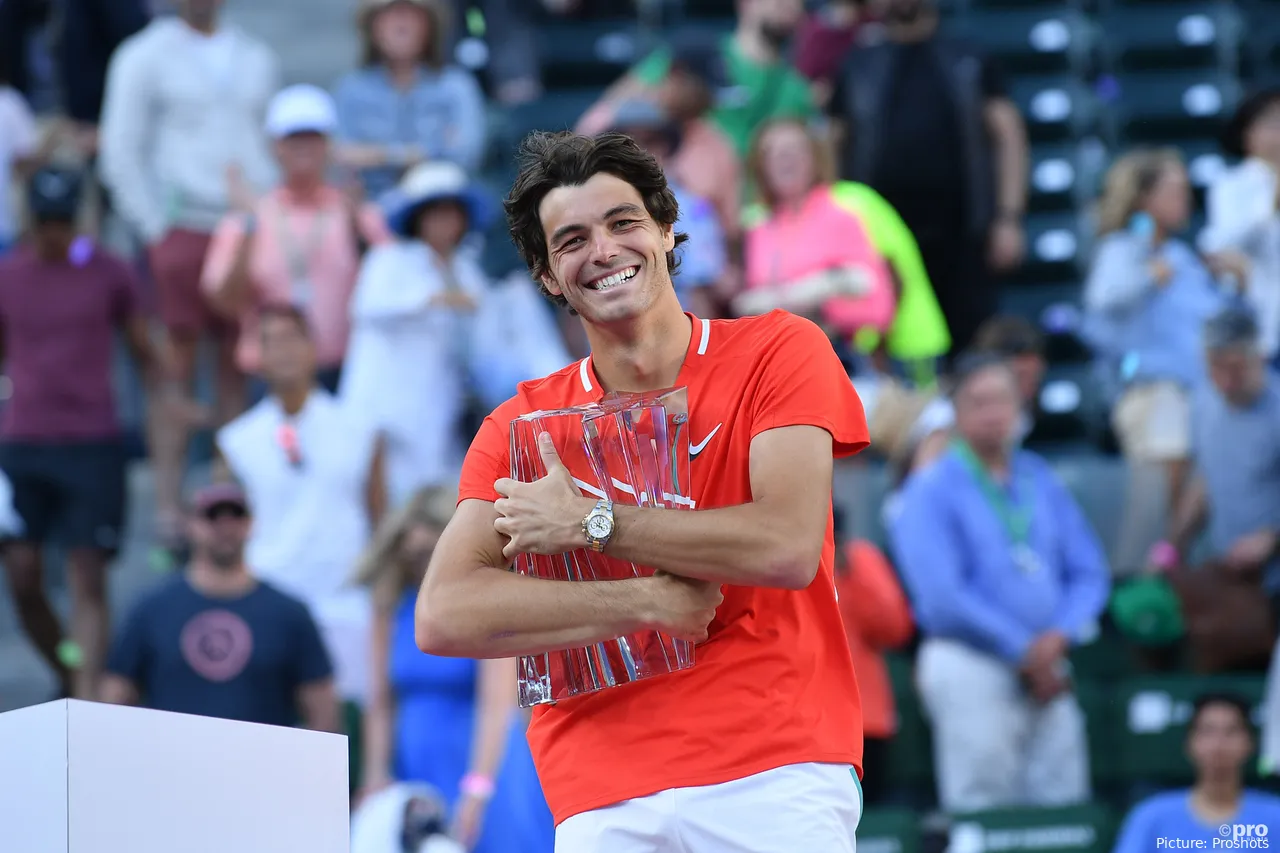
Fritz in 2022.
7. Jasmine Paolini: proof a breakthrough doesn't need to be sudden
Paolini's route to the top looked nothing like the other cases here. There was no teenage Grand Slam run, no injury layoff, and no viral fortnight from outside the top 100. She spent years as a steady, unspectacular tour pro, gradually climbing from the sport's middle tier while also building one of the more effective doubles games on tour — the kind of slow, visible improvement that tends to predict a real breakthrough rather than rule one out.
That breakthrough arrived at almost 28, an unusually late age for a first major final, when she reached both the French Open and Wimbledon finals in 2024 — becoming the first woman to reach both finals in the same season since Serena Williams in 2016 and the first Italian woman ever to do it. It wasn't a single shocking result. It was the visible endpoint of years of incremental gains finally compounding at once.
Two years on, Paolini remains a fixture near the top of the rankings rather than a one-off name, which is exactly what her gradual pre-breakthrough trajectory would have predicted. Hers is the clearest case here of a breakthrough with almost no surprise attached to it at all, once you look at the years that preceded it.
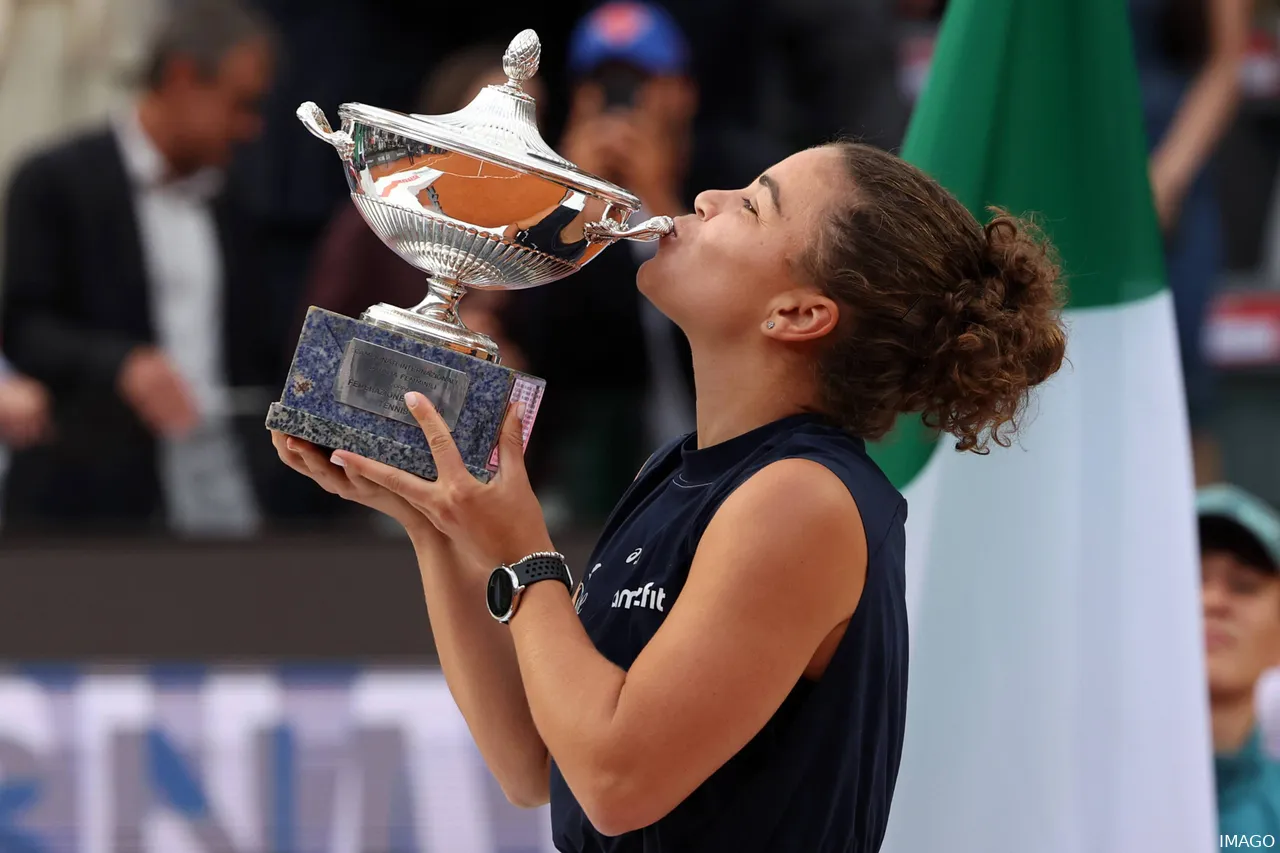
Paolini holds the Rome title.
The indicators that actually matter
| Player | Breakthrough | Prior indicators | Verdict |
| Marketa Vondrousova | 2023 Wimbledon champion (unseeded) | 2019 French Open final at 19 | Real, delayed by injury |
| Aslan Karatsev | 2021 Australian Open SF (ranked No. 114) | None — no prior deep runs, no junior pedigree | One-off |
| Amanda Anisimova | 2025 Wimbledon and US Open finals | 2019 French Open SF at 17 | Real, delayed by mental health break |
| Kevin Anderson | 2017 US Open final, 2018 Wimbledon final | Years of steady major fourth-round finishes | Real, ended by injury |
| Donna Vekic | 2023 US Open QF, 2024 Wimbledon SF | Modest career results in her teens and 20s | Verdict still pending |
| Taylor Fritz | 2024 US Open final | Masters 1000 title, years as a top-20 fixture | Real, immediately sustained |
| Jasmine Paolini | 2024 French Open and Wimbledon finals | Years of gradual ranking improvement | Real, immediately sustained |
Line them up together, and a pattern emerges that has very little to do with how dramatic the breakthrough itself looked on television. The players with real prior indicators — a junior pedigree, a visible multi-year climb, an established technical foundation — tend to validate their moment eventually, even when injury or personal circumstance delays it by years.
Read also
The player with none of that behind him produced the most spectacular single run of the group and never came close to repeating it. The test was never really about the two weeks that made the headlines. It was about everything that did, or didn't, come before them.

Cristhián AvilaTennis Journalist
Cristhián Ávila is a tennis journalist based in Santiago, Chile, and has been part of the TennisUpToDate team since early 2023. He covers the ATP and WTA Tours as well as all four Grand Slams, producing breaking news, match reports, analysis, and regular liveblogs from major tournaments.
His reporting combines statistical analysis with clear explanation, helping readers understand tactical developments, player form, and broader storylines across the tour. Working fluently in both Spanish and English, Cristhián collaborates with an international editorial team and contributes to comprehensive global coverage. As part of his work, he has conducted interviews and media interactions with leading figures in the sport, including Caroline Wozniacki and John McEnroe.
In his journalism, Cristhián places strong emphasis on careful sourcing, editorial accuracy, and updating articles promptly when new, verified information becomes available. His coverage is grounded in research, context, and direct engagement with professional tennis.
claps 0visitors 0
Just In

Popular News
Latest Comments
- Two Things: 1. Stop allowing these Spoiled Trust-Fund Elitists to behave badly. Your little hand-slaps do not deter them. 2. STOP the incessantly annoying "towel wiping" nonsense!!!!
 mandoist15-10-2026
 - A healthy Qinwen may be hard to stop next season. She was already scaring her opponents before her medical leave(s). Unfortunately, Zheng insisted on singing again. On the positive side -- Mirra did not sing!! ;~}mandoist11-10-2026
- Where is it written that athletes, entertainers... People in general... are mandated to keep looking at -- or even using [anti]Social Media? Public & private figures consistently complain and reveal their concerns about negativity and violence thrown at them -- yet they insist on participating. Avoid it, don't use it, don't read it. It's okay to occasionally look up at the World instead beating your eyes & thumbs to death on The Inventions out there.mandoist11-10-2026
- great articlestennisseserver07-10-2026
- Medvedev was leading Djokovic 7-5, 3-5 when an attempted return..' NO you ignorants, Djokovic was leading .weiss05-10-2026
- No more bullshit "Wildcards" to these two. Qualify like everyone else -- there will be cameras there, too. Time to scream... WTF ????!!!!mandoist29-09-2026
- Let's not BS the general public -- Sabalenka started showing cracks in her game last season. Her losses and near-losses started at about the same time she began being distracted by Fame (constant Selfies, making TV commercials, magazine shoots, endless Social Media nonsense, etc., etc.) One would think even Saba could recognize the parallels with others who failed before her -- Raducanu, Giorgi, Bouchard to name a few.mandoist25-09-2026
- Gross!! Hey Raducanu, Giorgi, and Bouchard -- reserve a seat at your Social Media Selfie table for Saba + Naomi. They're heading in your direction soon enough.mandoist24-09-2026
- And then these same players will complain about how lengthy their season’s were and need more time-off. I’m all for more tennis but the amount of tennis we get now is actually kind of crazy! We all need a break, especially the players.DaveyWavey23-09-2026
- You should do a comparison article for "different kinds of justice" the courts decide for tennis players. I can think of at least three players who received very small bans of a few months, however Tara Moore has been fighting for her literal survival the past few years. It seems odd considering she is not a "name" player, unlike the other cases.DaveyWavey22-09-2026

Loading