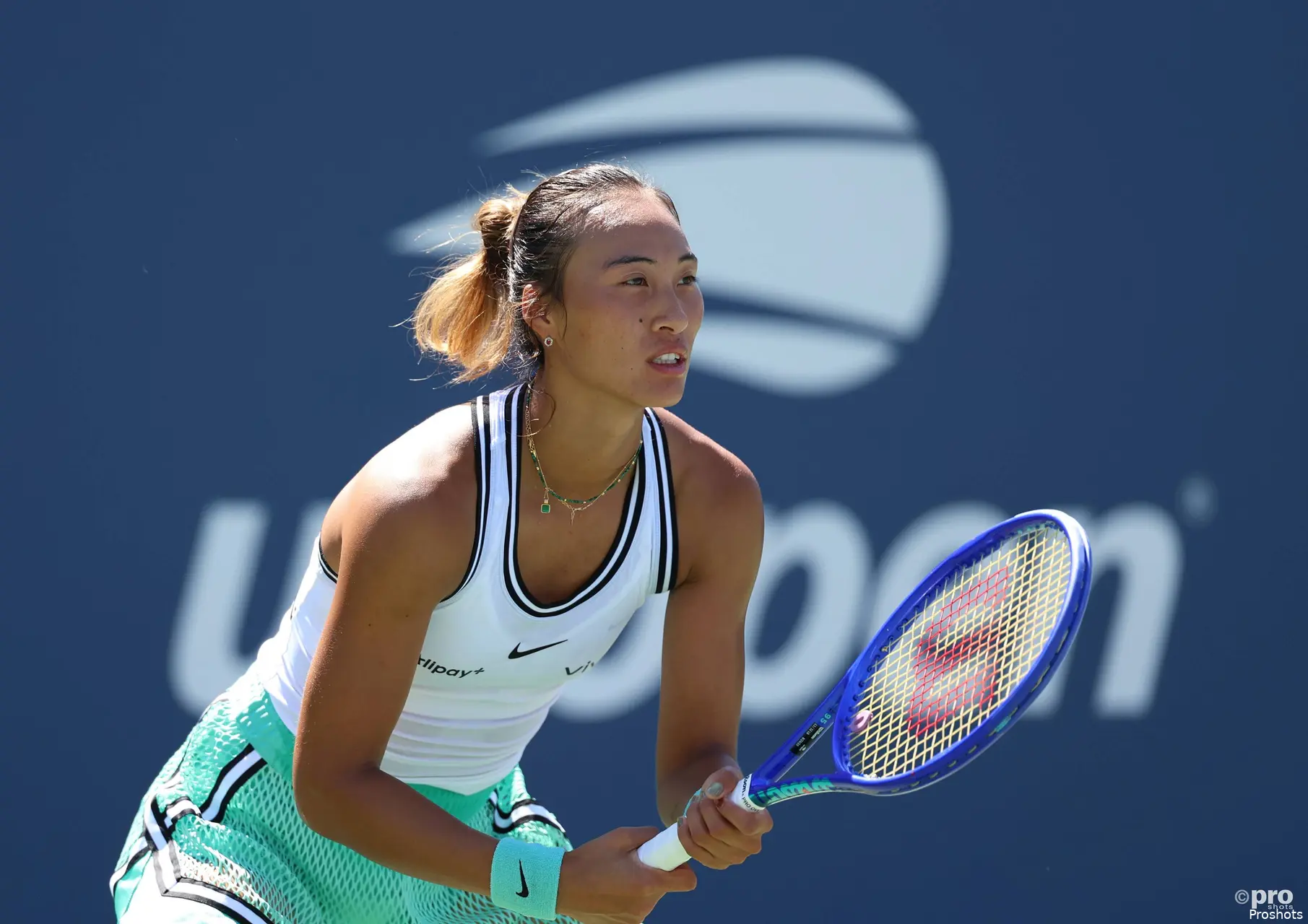
Today at the U.S. Open, Zheng Qinwen was down 0-5 in the third and deciding set against Madison Keys. She won the match.
A lot of people who don’t know a lot about tennis will look at that scoreline and reach for the easiest explanation: Keys imploded. I watched the match. This isn’t the story. It’s an easy and bad hot take.
There were certainly points Keys will want back. There always are. But reducing what happened today to a collapse misses something far more interesting about Zheng Qinwen and, I think, about tennis itself.
At her best, which she absolutely was by the end of that third set, Zheng is one of the five most talented players in the world.
A product of the famously rigid Chinese tennis machine, Zheng increasingly defies rather than defines it. And I believe she will ultimately become the greatest player in Chinese tennis history precisely because of the quality that seems least associated with the system that produced her.
Creativity. You can see it away from the court, too.
Zheng has become a partnership machine, representing some of the most relevant and stylish brands in the world. That isn’t incidental. She has an unusually developed sense of presentation and identity. There is creativity in the way she dresses, the way she presents herself and the way she has built a global brand that feels distinctly hers.
I raise this because I think the same instinct was visible on the court today. Coming back from 0-5 in a deciding set at this level almost never happens.
And the reason isn’t simply mathematical.
By the time an elite player gets to 0-5 in a third set, she has usually exhausted her creativity. Think about it.
You have already spent two sets trying to solve one of the best tennis players in the world. You have changed tactics. Changed patterns. Changed return positions. Tried attacking. Tried defending. Tried taking time away. Tried giving yourself more time.

Zheng does it again.
You are physically tired, mentally drained and now five games behind. At some point, the problem isn’t that you’re losing.
It’s that you’re out of ideas. Zheng wasn’t.
At 0-5, she did not simply start hitting the ball harder or wait for Keys to fall apart.
She started finding things. A different shape on the ball. A different return position. A little more height here. More aggression there. Different geometry within the points.
She kept asking Keys different questions, and somehow, after several hours of tennis, she kept finding new ones.
Most importantly, she didn’t appear to be trying to erase five games at once.
She played the point in front of her, focused only at the point
Then she found something for the next one. And the next.
And eventually, something that almost never happens in professional tennis started happening.
The impossible scoreline began to actually look possible. Some of us (raises hand) put down the bowl of popcorn tofu and sat in front of the big screen and really watched.
That distinction matters because it changes how we should talk about Madison Keys.
Keys did not suddenly forget how to play tennis. She did not gift Zheng the match through some spectacular act of self-destruction. She found herself across the net from an extraordinary player who, with virtually no margin for error remaining, discovered another version of herself. And she did so admirably, far less frustrated and far more professional than any of us would have been
There is a tendency in sports coverage to describe every remarkable comeback as somebody else’s collapse. Sometimes it is.
This wasn’t. This was creation under pressure.
And if you have followed Zheng closely, maybe it shouldn’t be quite as surprising as it felt.
Chinese tennis has produced extraordinarily disciplined players. Its development system has traditionally been associated with structure, repetition and technical rigor. Zheng possesses all of that. You can see it in her preparation, her serve, her physicality and her willingness to suffer.
But she also improvises. She has imagination.
She can play tennis that looks authored rather than manufactured. That is what separates her.
And it is why I think the connection between Zheng the tennis player and Zheng the global brand is more than superficial. Creativity is a habit.
It is the instinct to look at something everyone else considers settled and wonder whether there is another way through it.
The best athletes have always possessed some version of this. Their greatness isn’t merely that they execute familiar solutions better than everybody else. Sometimes they see solutions that aren’t obvious to anybody else. That becomes particularly important when everything is going wrong.
It is relatively easy to be creative at 2-2 in the first set. There is time. There is room to experiment. A bad decision costs you a point and perhaps a game. At 0-5 in the third, experimentation becomes terrifying.
One wrong idea and you’re shaking hands. And yet that was precisely when Zheng became most inventive.
That, more than the comeback itself, is what stayed with me. Because 0-5 is where creativity is supposed to disappear.
The scoreboard is screaming at you to panic. Your body is telling you the match has already taken too much. Your opponent can see the finish line. Every conventional solution you brought onto the court has apparently failed.
Most players start searching for a miracle. Zheng kept searching for answers. There is an enormous difference.
At 0-5 today, the story had already been written. Keys was going to win. Zheng had made her run. The match was effectively over.
Zheng refused the premise. And that is much more interesting than saying Madison Keys choked.
Li Na will forever remain one of the most important players in the history of tennis. She broke barriers Zheng never had to break and created possibilities for an entire generation of Chinese players who followed her. Saying Zheng can surpass her is not a small claim.
I think she will. Not simply because of her serve, her movement or her power. Not because of her ranking, endorsements or marketability. And certainly not because she won one extraordinary match at the U.S. Open.
All the machinery of an elite tennis player
I think she will because Zheng possesses something exceedingly rare. She has all the machinery of an elite tennis player without playing like a machine.
Today, down 0-5 in the deciding set against Madison Keys, almost everyone watching could see how the match was supposed to end.
Read also

Zheng Qinwen could still imagine another ending. And then she created it.

Aron SolomonGuest Author
A Pulitzer Prize-nominated journalist for his groundbreaking op-ed in The Independent exposing the NFL’s “race-norming” policies, Aron Solomon, JD, is a globally recognized thought leader in law, media, and strategy.
As Chief Strategy Officer for AMPLIFY, he leverages his deep expertise to shape the future of legal marketing. Aron has taught entrepreneurship at McGill University and the University of Pennsylvania and was honored as a Fastcase 50 recipient, recognizing him among the world’s top legal innovators. A prolific commentator on law, business, and culture, his insights regularly appear in Newsweek, The Hill, Crunchbase News, and Literary Hub.
He has also been featured in The New York Times, Fast Company, Fortune, Forbes, CBS News, CNBC, USA Today, ESPN, TechCrunch, BuzzFeed, Venture Beat and countless other leading global media outlets. We are proud to have Aron on board at TennisUpToDate, where his deep tennis expertise enriches the site with sharp, original columns that connect the sport to wider cultural debates.
claps 15visitors 4
Just In

Popular News
Latest Comments
- Two Things: 1. Stop allowing these Spoiled Trust-Fund Elitists to behave badly. Your little hand-slaps do not deter them. 2. STOP the incessantly annoying "towel wiping" nonsense!!!!
 mandoist15-10-2026
 - A healthy Qinwen may be hard to stop next season. She was already scaring her opponents before her medical leave(s). Unfortunately, Zheng insisted on singing again. On the positive side -- Mirra did not sing!! ;~}mandoist11-10-2026
- Where is it written that athletes, entertainers... People in general... are mandated to keep looking at -- or even using [anti]Social Media? Public & private figures consistently complain and reveal their concerns about negativity and violence thrown at them -- yet they insist on participating. Avoid it, don't use it, don't read it. It's okay to occasionally look up at the World instead beating your eyes & thumbs to death on The Inventions out there.mandoist11-10-2026
- great articlestennisseserver07-10-2026
- Medvedev was leading Djokovic 7-5, 3-5 when an attempted return..' NO you ignorants, Djokovic was leading .weiss05-10-2026
- No more bullshit "Wildcards" to these two. Qualify like everyone else -- there will be cameras there, too. Time to scream... WTF ????!!!!mandoist29-09-2026
- Let's not BS the general public -- Sabalenka started showing cracks in her game last season. Her losses and near-losses started at about the same time she began being distracted by Fame (constant Selfies, making TV commercials, magazine shoots, endless Social Media nonsense, etc., etc.) One would think even Saba could recognize the parallels with others who failed before her -- Raducanu, Giorgi, Bouchard to name a few.mandoist25-09-2026
- Gross!! Hey Raducanu, Giorgi, and Bouchard -- reserve a seat at your Social Media Selfie table for Saba + Naomi. They're heading in your direction soon enough.mandoist24-09-2026
- And then these same players will complain about how lengthy their season’s were and need more time-off. I’m all for more tennis but the amount of tennis we get now is actually kind of crazy! We all need a break, especially the players.DaveyWavey23-09-2026
- You should do a comparison article for "different kinds of justice" the courts decide for tennis players. I can think of at least three players who received very small bans of a few months, however Tara Moore has been fighting for her literal survival the past few years. It seems odd considering she is not a "name" player, unlike the other cases.DaveyWavey22-09-2026

Loading