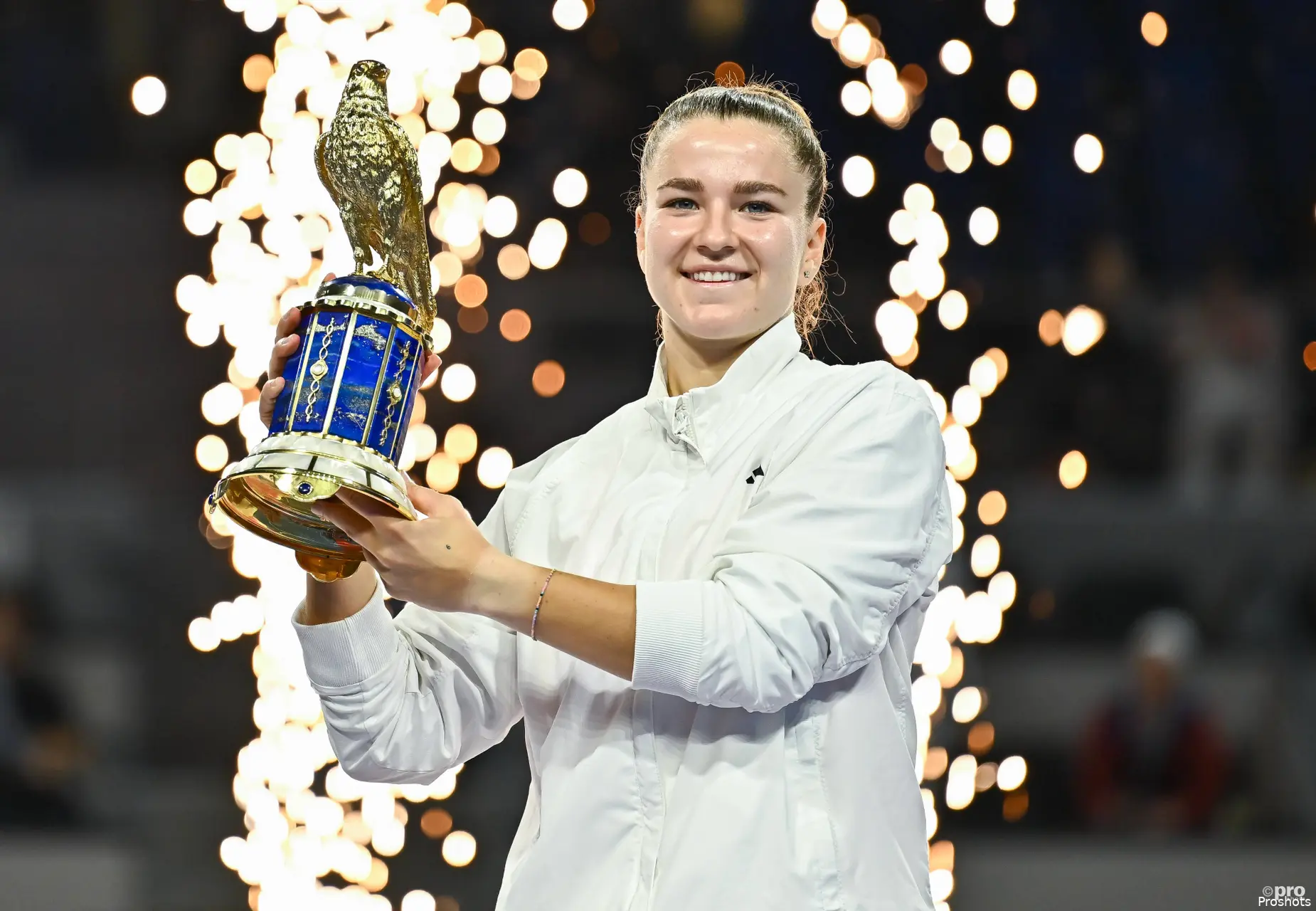
We find ourselves in that peculiar stretch of the calendar. Back-to-back WTA 1000 events in Doha and Dubai. Mandatory. Important for ranking points. And yet, if we are being honest, not exactly the tournaments fans circle in red ink. Unless, of course, you live in Dubai.
The Middle East swing always feels transitional. Useful. Necessary. But transitional. And yet, in just fifteen days, we arrive at something entirely different.
Indian Wells. Tennis Paradise. The unofficial but for reals fifth Grand Slam. Whatever you want to call it, the BNP Paribas Open in the California desert remains, for many players and fans, the best non-major tournament of the year. Slower courts. Full fields. Sunshine. Prestige. It is where seasons begin to take shape.
Read also

And if you want to understand where the WTA stands heading into Indian Wells, forget the names for a moment.
Look at the ages. The current Top 10 spans from 18 to 31. Eighteen. Thirty-one. That is not a transition period. That is not a youth wave. That is not a veteran last stand. It is something much more interesting.
It is a two-speed tour. The average age of the Top 10 sits just over 25. That sounds ordinary enough. But the distribution tells a different story. Three players are 21 or younger. Three players are 30 or older. And right in the middle sits a traditional prime cluster in the 24 to 27 range. What we are watching is generational compression.
The Teenagers are no longer “next”
For years, we talked about teenage breakthroughs as rare events. Special cases. The kind of run that required a once-in-a-generation talent.
Now, they are structural. The modern pathway to the top is faster and more professionalized than ever. Elite juniors travel with full teams. Data analysis is standard. Sports psychology is embedded early. Physical preparation is tailored and aggressive. The developmental curve has shortened.
Teenagers are not surviving in the Top 10 on adrenaline. They are arriving fully formed. And perhaps most importantly, they are not replacing veterans. They are competing alongside them.

Victoria Mboko raises arm in victory.
Thirty is not the end
At the same time, three players aged 30 or 31 sit comfortably inside the Top 10.
That would have been unusual fifteen years ago. The old narrative suggested volatility in women’s tennis. Early peaks. Burnout. Physical decline by the late twenties.
That narrative is outdated. Longevity has been redefined. Scheduling is smarter. Recovery protocols are advanced. Players build stable teams and careers that are not defined by constant overplaying. Financial security reduces pressure. Experience matters more in a tour where margins are razor thin. Thirty is no longer a warning label. It is a competitive advantage.
The middle still matters
Between those extremes sits the familiar prime window of 24 to 27. Four of the Top 10 fall right there. So this is not a youth revolution. It is not a veteran renaissance. It is a compressed competitive spectrum where multiple development timelines can thrive at once.
The WTA is no longer tilted toward one archetype. It does not exclusively reward early bloomers. It does not exclusively reward late bloomers. It rewards completeness.
Power remains essential. But so does movement. So does tactical discipline. So does emotional control.
And those traits are no longer age-bound.
Heading into Indian Wells
Which brings us back to Tennis Paradise. Indian Wells rewards physical endurance and tactical patience. The slower surface stretches rallies. It exposes incomplete games. It rewards depth and maturity.
That is precisely why this generational overlap makes the desert so intriguing this year. An 18-year-old does not represent the future. She represents the present.
A 31-year-old does not represent the past. She represents the standard. The WTA has become two-speed tennis at the highest level. And as the tour moves from Doha and Dubai into the California desert, both speeds are accelerating.

Aron SolomonGuest Author
A Pulitzer Prize-nominated journalist for his groundbreaking op-ed in The Independent exposing the NFL’s “race-norming” policies, Aron Solomon, JD, is a globally recognized thought leader in law, media, and strategy.
As Chief Strategy Officer for AMPLIFY, he leverages his deep expertise to shape the future of legal marketing. Aron has taught entrepreneurship at McGill University and the University of Pennsylvania and was honored as a Fastcase 50 recipient, recognizing him among the world’s top legal innovators. A prolific commentator on law, business, and culture, his insights regularly appear in Newsweek, The Hill, Crunchbase News, and Literary Hub.
He has also been featured in The New York Times, Fast Company, Fortune, Forbes, CBS News, CNBC, USA Today, ESPN, TechCrunch, BuzzFeed, Venture Beat and countless other leading global media outlets. We are proud to have Aron on board at TennisUpToDate, where his deep tennis expertise enriches the site with sharp, original columns that connect the sport to wider cultural debates.
claps 0visitors 0
Just In




Popular News

Latest Comments
- Fight the Good Fight... Tennis (sports in general) need more Humans such as yourself.
 mandoist18-10-2026
 - When is WTA going to mandate Genetic Testing (DNA) ???mandoist18-10-2026
- Hey, Dan... you just wake up from a coma? Regardless -- Thanks for the comedy this morning!mandoist18-10-2026
- Two Things: 1. Stop allowing these Spoiled Trust-Fund Elitists to behave badly. Your little hand-slaps do not deter them. 2. STOP the incessantly annoying "towel wiping" nonsense!!!!mandoist15-10-2026
- A healthy Qinwen may be hard to stop next season. She was already scaring her opponents before her medical leave(s). Unfortunately, Zheng insisted on singing again. On the positive side -- Mirra did not sing!! ;~}mandoist11-10-2026
- Where is it written that athletes, entertainers... People in general... are mandated to keep looking at -- or even using [anti]Social Media? Public & private figures consistently complain and reveal their concerns about negativity and violence thrown at them -- yet they insist on participating. Avoid it, don't use it, don't read it. It's okay to occasionally look up at the World instead beating your eyes & thumbs to death on The Inventions out there.mandoist11-10-2026
- great articlestennisseserver07-10-2026
- Medvedev was leading Djokovic 7-5, 3-5 when an attempted return..' NO you ignorants, Djokovic was leading .weiss05-10-2026
- No more bullshit "Wildcards" to these two. Qualify like everyone else -- there will be cameras there, too. Time to scream... WTF ????!!!!mandoist29-09-2026
- Let's not BS the general public -- Sabalenka started showing cracks in her game last season. Her losses and near-losses started at about the same time she began being distracted by Fame (constant Selfies, making TV commercials, magazine shoots, endless Social Media nonsense, etc., etc.) One would think even Saba could recognize the parallels with others who failed before her -- Raducanu, Giorgi, Bouchard to name a few.mandoist25-09-2026

Loading

