There are days in tennis when you finish watching the matches and feel as though you’ve witnessed something special. There are others when you feel you’ve learned something important about the players, the tournament, or the direction of the sport.
And then there are days like Monday at the WTA Finals in Indian Wells. The tennis was good. The better players won. Nobody embarrassed themselves, and nobody really surprised us. We got two matches that went more or less according to the script, and by the end of the afternoon, there wasn’t much to argue about.
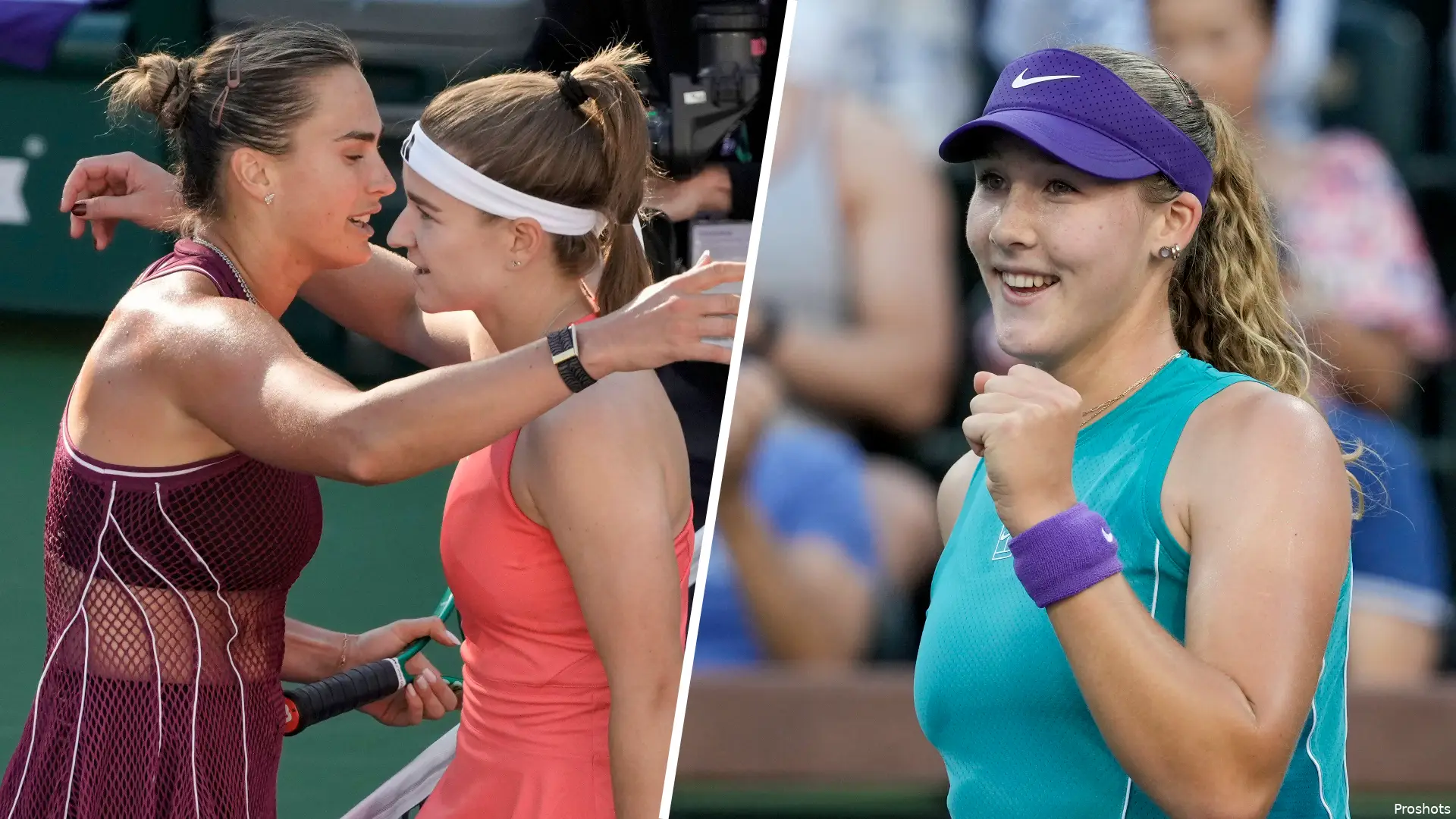
Aryna Sabalenka beat Karolína Muchová 7-6(2), 7-5. Mirra Andreeva beat Elina Svitolina 6-4, 6-0. Predictable. Not particularly in doubt. Safe.
I don’t mean any of those words as an insult to the players. Winning matches against the best women in the world is an extraordinary accomplishment, even when you’re expected to win. But the WTA Finals should feel like something more than a collection of results that could have been reasonably predicted over breakfast. Monday never quite got there.
A Wonderful Moment for Karolína Muchová
Before getting into what Monday lacked, I want to spend some time on something it got absolutely right.
Karolína Muchová is playing in her first WTA Finals, and I couldn’t be happier for her.

Karolina Muchova made her debut at the WTA Finals.
I’ve been a fan of Muchová for years. There are few players on the women’s tour whose tennis I enjoy watching more. She has a creativity and variety that sometimes seem to belong to a different era of the sport. She can slice, change pace, move forward, and construct points in ways that make you appreciate how much thought goes into playing tennis at this level.
She’s also had to deal with more than her share of injuries. There have been stretches when it seemed that every time she was beginning to establish herself among the very best players in the world, something physical would interrupt her progress.
That’s why seeing her at the year-end championships matters. Muchová has earned close to $5 million in prize money this season, an extraordinary achievement for someone whose career has so often been interrupted by circumstances beyond her control. More importantly, she’s finally getting the opportunity to compete on one of the sport’s biggest stages at the end of the year.
Against Sabalenka, she showed plenty of the tennis that makes her so enjoyable to watch. She also showed the problem with playing Sabalenka.
You can do a great many things right against the Belarusian and still lose. Sabalenka won the first-set tiebreak comfortably and took the second set 7-5. Muchová made her work for the victory, and the match lasted nearly two hours, but I never really felt that Sabalenka was losing control of the occasion.
That’s an important distinction. A close score doesn’t always mean a match feels close. Sabalenka has become exceptionally good at finding another level when a set reaches its decisive moments. There was a time when her tennis could become increasingly unpredictable as the pressure mounted. These days, she’s much more likely to impose herself on those moments.
For Muchová, it was a disappointing result but hardly a disappointing occasion. She belongs in this tournament, and I hope she gets the opportunity to show even more of what makes her special as the week progresses.
Andreeva made it look almost too easy
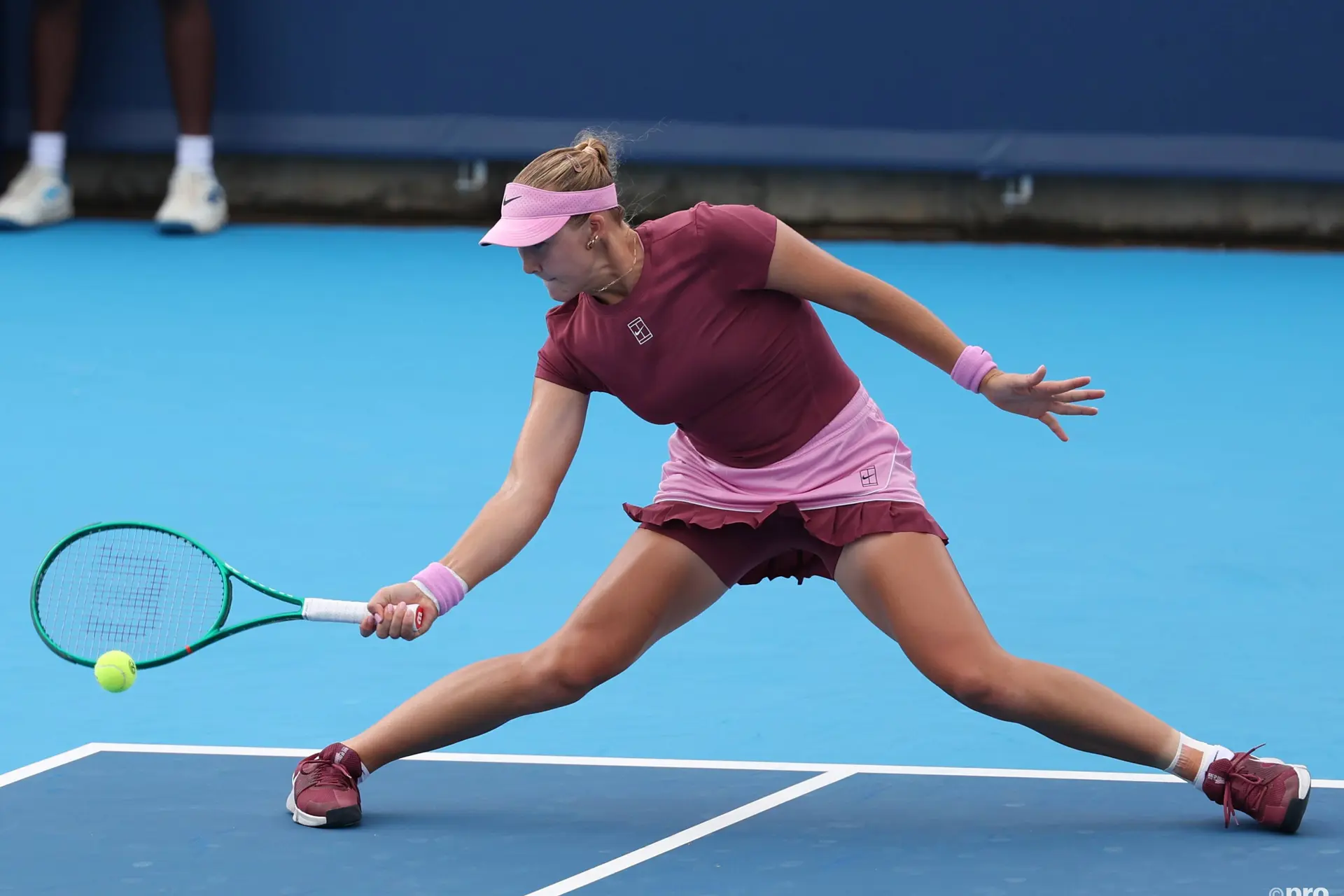
The second match was considerably less complicated. Mirra Andreeva defeated Elina Svitolina 6-4, 6-0 in just 70 minutes, and the score tells a pretty accurate story.
The first set was competitive enough. The second was not. Andreeva is one of those players who can make the game look almost suspiciously simple when she’s playing well. She moves beautifully, sees the court exceptionally well, and rarely seems to be in a hurry to do something spectacular when something sensible will do.
That last quality is especially impressive in someone so young. Against Svitolina, she didn’t need to manufacture drama. She simply played the tennis required to win, and once she established control, the match moved very quickly toward its conclusion.

Mirra Andreeva easily saw off Elina Svitolina.
For Svitolina, it was a difficult afternoon. She’s a player whose competitiveness and determination have earned her enormous respect, particularly given everything she’s navigated away from the court over the past several years. But Monday wasn’t her day.
What interested me most was how little resistance Andreeva encountered once she had the match where she wanted it. At an event featuring eight of the world’s best players, a 6-0 set should feel like a startling development.
Instead, it felt like the natural conclusion of what we’d been watching. Andreeva was simply that much better.
Indian Wells is doing its part
One of my strongest impressions from the opening two days has nothing to do with a forehand, a backhand, or a break point.
It’s the crowd. Even for Monday’s opening match, the attendance was excellent, and the energy inside the stadium was terrific. People were engaged, enthusiastic, and clearly delighted to be watching this level of women’s tennis.
I wrote after Sunday’s opening day that Indian Wells might be the best place in the world to host the WTA Finals, and nothing I saw Monday changed my mind. Quite the opposite.
We’re told that Indian Wells is a one-year stopgap before the tournament moves to Charlotte. I understand that hosting decisions involve commercial relationships, scheduling, facilities, and considerations that extend well beyond what happens on the court.
But if we’re evaluating a location by the experience it creates for players and spectators, Indian Wells is making a remarkably persuasive case.
The facilities are outstanding. The setting is beautiful. The crowds understand tennis, and they show up. That last point shouldn’t be underestimated.
Women’s tennis has spent years trying to figure out how to present its biggest events in ways that reflect the quality of the athletes competing in them. There have been some very questionable decisions along the way, including several surrounding this very tournament. Indian Wells offers something wonderfully straightforward.
Put the best women in the world on a beautiful court, fill the stands with people who genuinely love tennis, and let them play. It’s not a particularly complicated formula. Apparently, that doesn’t make it an easy one for the WTA to follow consistently.
Is predictable tennis enough?
This is where Monday leaves me with a question.
How much should we expect from a tournament like the WTA Finals? I don’t believe every match needs to be a three-hour epic. I don’t need a shocking upset every afternoon, and I certainly don’t want players manufacturing excitement when the tennis itself doesn’t justify it.
Sometimes the better player is simply better. That’s sport. But the WTA Finals occupy a special place on the calendar. This isn’t an ordinary tournament where a top seed might encounter a player ranked 80th in the world during the opening round. Every match is supposed to be an encounter between players who have spent an entire season proving they belong among the elite.
That should create a certain tension. On Sunday, we saw some excellent tennis mixed with what looked like the unmistakable fatigue of a season that has stretched on for far too long. The players were trying, but there were moments when their bodies seemed less enthusiastic about the assignment.
Monday was different. It wasn’t so much a question of exhaustion as a lack of uncertainty. Sabalenka did what Sabalenka was expected to do. Andreeva did what Andreeva was expected to do, only more emphatically.
There is something impressive about that level of professional efficiency. There is also something a little unsatisfying about watching two matches without ever really believing that the eventual winners might lose.
Perhaps that’s unfair. But when you’re watching the season-ending championship, I think you’re allowed to hope for a little more.
Two days in, the tournament still has something to prove
After two days, I’m left with a curious mixture of admiration and anticipation.
I admire the players for reaching this point after an extraordinarily demanding season. I admire Muchová for finally getting here, Sabalenka for the consistency and authority she’s developed, and Andreeva for playing with a maturity that continues to make her one of the most fascinating young athletes in tennis.
I also admire the people at Indian Wells who have managed to make this event feel important from the moment the first ball was struck.
But I’m still waiting for the tennis to give us a moment that we’ll be talking about long after the tournament ends.
A comeback that seems impossible until it happens. A match in which both players reach a level neither can sustain for very long. An underdog who refuses to accept the role she’s been assigned.
Something that reminds us why the best sporting events are the ones nobody can script. Maybe that’s coming later this week. I certainly hope so.
Read also

For now, Monday gave us two deserving winners, a terrific crowd, and another reminder that Indian Wells knows how to host a major tennis event.
It was a perfectly respectable day of tennis. And perhaps that’s the problem. At the WTA Finals, perfectly respectable shouldn’t be the ceiling.

Aron SolomonGuest Author
A Pulitzer Prize-nominated journalist for his groundbreaking op-ed in The Independent exposing the NFL’s “race-norming” policies, Aron Solomon, JD, is a globally recognized thought leader in law, media, and strategy.
As Chief Strategy Officer for AMPLIFY, he leverages his deep expertise to shape the future of legal marketing. Aron has taught entrepreneurship at McGill University and the University of Pennsylvania and was honored as a Fastcase 50 recipient, recognizing him among the world’s top legal innovators. A prolific commentator on law, business, and culture, his insights regularly appear in Newsweek, The Hill, Crunchbase News, and Literary Hub.
He has also been featured in The New York Times, Fast Company, Fortune, Forbes, CBS News, CNBC, USA Today, ESPN, TechCrunch, BuzzFeed, Venture Beat and countless other leading global media outlets. We are proud to have Aron on board at TennisUpToDate, where his deep tennis expertise enriches the site with sharp, original columns that connect the sport to wider cultural debates.
claps 0visitors 0
Just In

Popular News
Latest Comments
- Either Lena has a chronic internal ailment (i.e., colitis, enteritis, Crohn's, or some type of lower abdomen issue) -- or she is once again dealing with 'Vukovitis'. Mental stress can indeed cause lower body pains. No matter... whatever is truly going on sucks. "Virus" excuse is getting a bit old -- and often -- at this point.
 mandoist09-11-2026
- Ironically, Martina became a U.S. Citizen about the same time as the Orange Convicted Felon & Abuser was just beginning on his road to losing all Daddy's Millions!!mandoist09-11-2026
- "Another fresh start is in the cards." Thanks for the Humor!! I'm guessing this is the minimum one can do to keep all your sponsors hanging-on in perpetuity?mandoist09-11-2026
- Vukov is doing this to Lena... AGAIN!!!!! WTA's autonomous collective should be dismantled for allowing Vukov to re-emerge from his hand-slapping suspension. Just ask WTA employees how that's been going lately as they witness his continued verbal abuses. Women's Pro Tennis should start over.mandoist08-11-2026
- Can't help but suspect Vukov is back to his old self again. Thank you, WTA. Perhaps you can give them a "Battling Couple of the Year Award 2026" ??mandoist08-11-2026
- Wtf? Why is there no reason? And what about the men's?Bel08-11-2026
- One step by another step -- WTA continues to 'lose the plot'. Too many hi-tech microphones being installed at most venues!!! Remove them (especially those along the hallways, sidewalks, and pathways throughout the venues. Not to mention (most of all) remove the mic's from the Players/Coaches Box.mandoist06-11-2026
- Enough of her bullshit. Go marry someone.mandoist06-11-2026
- Don't you just love this young lady!? We fans often expect athletes to be supermen and superwomen, often forgetting that they WILL GET TIRED! I love Alex's perspective. Tiredness for an athlete should never be viewed as a negative, especially if you are healthy, taking care of your body and mental health and putting in the work. What a mature perspective. Good for you, Alex!Rapunzel05-11-2026
- Jess is absolutely correct! But the disrespect is a trait I have noticed in most of the Russian players. Mirra is good but very immature and lacks humility. Conceivable needs to get a handle on that!Rapunzel05-11-2026
