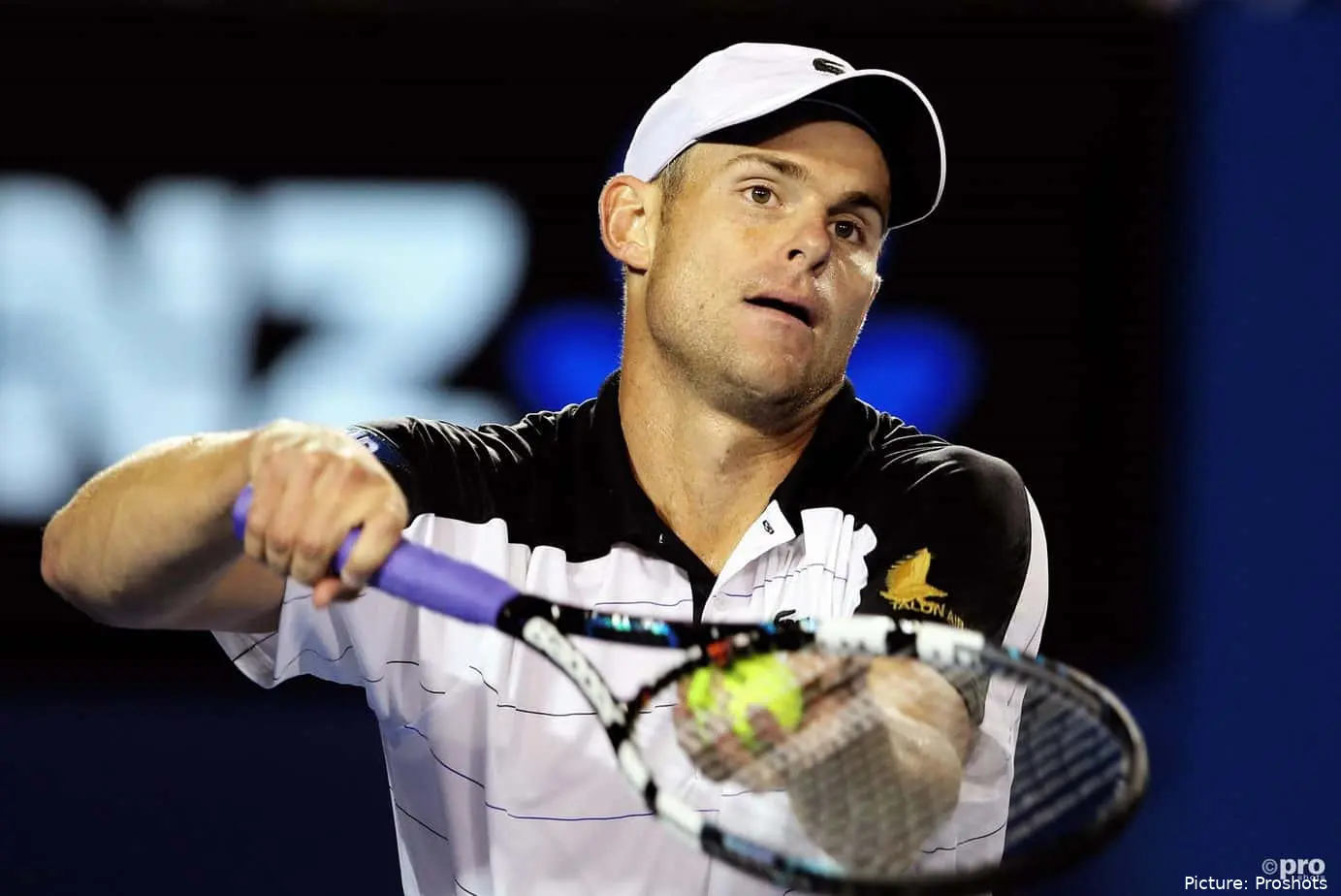
Andy Roddick won one Grand Slam title. That much is impossible to change. But reduce his career to those two words — “one Slam” — and you miss almost everything that made him one of the best American tennis players of his generation.
Roddick was a former world No. 1, a five-time Masters 1000 champion, a Davis Cup winner and a player who finished inside the ATP top 10 for nine consecutive years. He reached five Grand Slam finals and played in three Wimbledon finals.
The single Grand Slam is real. It is also the least interesting part of the case for how good Roddick actually was. The reason his résumé is so often flattened into that of a “one-Slam wonder” is simple: he had the misfortune of peaking at almost exactly the moment Roger Federer did. Three times Roddick reached the Wimbledon final, and three times Federer was waiting on the other side of the net. That timing shaped Roddick's legacy more than almost anything else about the level he actually reached.
Career snapshot
| Career-high ranking | No. 1 (3 November 2003) |
| Weeks at No. 1 | 13 |
| Grand Slam titles | 1 (US Open, 2003) |
| Grand Slam finals | 5 (Wimbledon 2004, 2005, 2009; US Open 2003, 2006) |
| ATP titles | 32, including 5 Masters 1000s |
| Consecutive years in the top 10 | 9 (2002–2010) |
| Team honours | 2007 Davis Cup champion (USA) |
| Status | Retired 2012; inducted into the International Tennis Hall of Fame in 2017 |
More than a one-Slam wonder
Roddick reached No. 1 at 21, becoming the fifth-youngest man ever to do so at that point and the first American to finish a year on top since Andre Agassi in 1999. His reign lasted only 13 weeks before Federer took over in February 2004 — but getting there at all put him in the same company as Sampras, Agassi, and, for the next two decades, almost no other American man.
The rest of the résumé holds up just as well. Thirty-two tour titles, five of them Masters 1000 events, spread across nine consecutive seasons inside the top 10. He was a key piece of the United States' 2007 Davis Cup-winning team. Very few "one-Slam" careers include a stretch of consistency that long; most of the players remembered that way had one great fortnight and years of irrelevance around it. Roddick's irrelevance never really arrived.
The summer of 2003
The Grand Slam itself came at the end of one of the best hard-court stretches anyone had put together that decade. Roddick won back-to-back Masters titles in Montreal and Cincinnati, then arrived at the US Open having barely lost. His run to the title included a scare that has become part of tennis lore: in the semi-final against David Nalbandian, he fell two sets down, saved a match point, and rallied to win 6-7, 3-6, 7-6, 6-1, 6-3.
Two days later he beat Juan Carlos Ferrero in the final, 6-3, 7-6(2), 6-3, to become the first American man to win the US Open since Pete Sampras. It capped a stretch that also included his first career win over Federer that same summer, in Montreal — a small detail that makes what happened at Wimbledon over the next six years even more frustrating in hindsight.
Andy Roddick — 2003 US Open title run
| Round | Opponent | Score |
| R1 | Tim Henman | 6-3, 7-6(5), 6-3 |
| R2 | Ivan Ljubičić | 6-3, 6-7(4), 6-3, 7-6(5) |
| R3 | Flavio Saretta | 6-1, 6-3, 6-2 |
| R4 | Xavier Malisse | 6-3, 6-4, 6-4 |
| QF | David Nalbandian | 6-7(4), 3-6, 7-6(7), 6-1, 6-3 |
| SF | Juan Carlos Ferrero | 6-3, 6-4, 6-2 |
| F | Juan Martín del Potro | 6-4, 6-3, 6-2 |
Right era, wrong opponent
What follows is the part of Roddick's career that actually explains the "one-Slam" reputation, and it has almost nothing to do with his own level dropping. He reached three Wimbledon finals — 2004, 2005 and 2009 — and lost all three to Federer, plus a fourth major final at the 2006 US Open, also to Federer.
The 2009 Wimbledon final is the one people still talk about. Roddick pushed Federer to 77 games, a men's Grand Slam final record at the time, and a fifth set that went 16-14 before Federer finally broke through — the longest final set in a major singles final in history up to that point. Roddick played close to the best tennis of his life that day. It simply wasn't enough against a version of Federer playing some of the best tennis anyone has ever produced.
The numbers that complicate the "one-hit wonder" label
A few other details tend to get lost. Roddick's serve, once clocked at 155 mph at a 2004 Davis Cup tie, stood as the fastest ever officially recorded for years. In 2010, well past the point most players who peak young start fading, he came within one match of the "Sunshine Double," losing a tight final at Indian Wells before beating Rafael Nadal on the way to the Miami title days later.
He finished his career with a win rate above 74 percent, a number that sits comfortably alongside players remembered as far more decorated. When he retired at the 2012 US Open, in an emotional four-set loss to Juan Martin del Potro on his 30th birthday tournament, he did so as the last American man to have reached a Grand Slam final for another 15 years, until Taylor Fritz in 2024 — a gap that says more about the state of American men's tennis after Roddick than about Roddick himself.
None of this rewrites the record book. Roddick will always have one Grand Slam title next to his name. But stack his ranking history, five Masters 1000 titles, Davis Cup success, five Grand Slam finals and nine consecutive years inside the top 10 against the players usually filed under “one-Slam wonder”, and the label stops making much sense.
Roddick didn't have one great fortnight followed by years of decline. He built one of the most consistent careers of his generation. His problem was that, at the biggest tournament on the biggest stage, he kept running into Roger Federer. Roddick's one Grand Slam title tells you what he won. It doesn't tell you how good he was.

Cristhián AvilaTennis Journalist
Cristhián Ávila is a tennis journalist based in Santiago, Chile, and has been part of the TennisUpToDate team since early 2023. He covers the ATP and WTA Tours as well as all four Grand Slams, producing breaking news, match reports, analysis, and regular liveblogs from major tournaments.
His reporting combines statistical analysis with clear explanation, helping readers understand tactical developments, player form, and broader storylines across the tour. Working fluently in both Spanish and English, Cristhián collaborates with an international editorial team and contributes to comprehensive global coverage. As part of his work, he has conducted interviews and media interactions with leading figures in the sport, including Caroline Wozniacki and John McEnroe.
In his journalism, Cristhián places strong emphasis on careful sourcing, editorial accuracy, and updating articles promptly when new, verified information becomes available. His coverage is grounded in research, context, and direct engagement with professional tennis.
claps 0visitors 0
Just In



Popular News
Latest Comments
- Apparently still refusing to seek 'help' ...and still playing Dress-Up like a 10 year-old.
 mandoist27-10-2026
 - Lena... Takin' care of businessmandoist25-10-2026
- Can you please stop publishing this nonsense? Stick to Tennis.mandoist25-10-2026
- Does Sinner need that 4.5 mil? I doubt it. He can make that with three modelling gigs!😅🤣Rapunzel21-10-2026
- Did "People Magazine" purchase this website? This nonstop storyline is bullshit.mandoist21-10-2026
- Listen... this is of no concern to anyone but these two. Deal with your own issues -- most of us have our own. Thanks, media, for these insignificant follow-ups which are meaningless.mandoist21-10-2026
- This is so very very sad, for all three of them. I truly thought they had an unbreakable bond, but life throws up so many differing challenges. Having your homeland suffering in such a terrible way, makes happiness lose out to guilt as well. Our thoughts are with them. X💔bjsexton20-10-2026
- I have lost all respect for Svitolina! Could she not have waited until he had played at the Paris Masters!!! She is selfish and don't give a damn about Gael. That is NOT how love is demonstrated Elina!!Rapunzel19-10-2026
- Perhaps convenient tennis tour sex is not a strong enough experience in which to base a marriage?mandoist19-10-2026
- Fight the Good Fight... Tennis (sports in general) need more Humans such as yourself.mandoist18-10-2026

Loading