Henry Patten’s speech on Sunday in Turin was the latest reminder of why I’ve increasingly lost interest in the ATP. I’ve been following professional tennis for a very long time. I love the sport, understand its peculiarities, appreciate its history, and can happily spend an entire afternoon watching two players ranked outside the top 100 battle through a qualifying match that almost nobody else is paying attention to.
It is a sport that has given me countless hours of entertainment, and I have always enjoyed following the different stories, rivalries and personalities that make up the professional game.
But I’ve reached a conclusion that would have surprised me a few years ago. I’m pretty much done with men’s tennis. Not tennis. Certainly not tennis.
I follow the WTA obsessively, from the biggest tournaments to the lower levels of the professional game. I watch players most casual fans have never heard of, follow rankings, results, injuries and scheduling decisions, and keep an eye on the seemingly endless parade of extraordinarily talented young women coming through the sport. I find the women’s game fascinating, unpredictable, maddening, and frequently brilliant. It’s also, in my opinion, a considerably better entertainment product than what the ATP is offering.
In 2026, I still followed men’s tennis. I knew who was winning, who was losing, and what was happening at the major tournaments. But the enthusiasm has been disappearing for a while, and I’m no longer particularly interested in pretending otherwise. There are plenty of reasons for that, ranging from the way the sport is governed to the attitudes surrounding certain players and the continued financial imbalance between the men's and women's games. And then came Henry Patten in Turin at the start of the ATP Finals.
A Speech That Said Quite a Lot
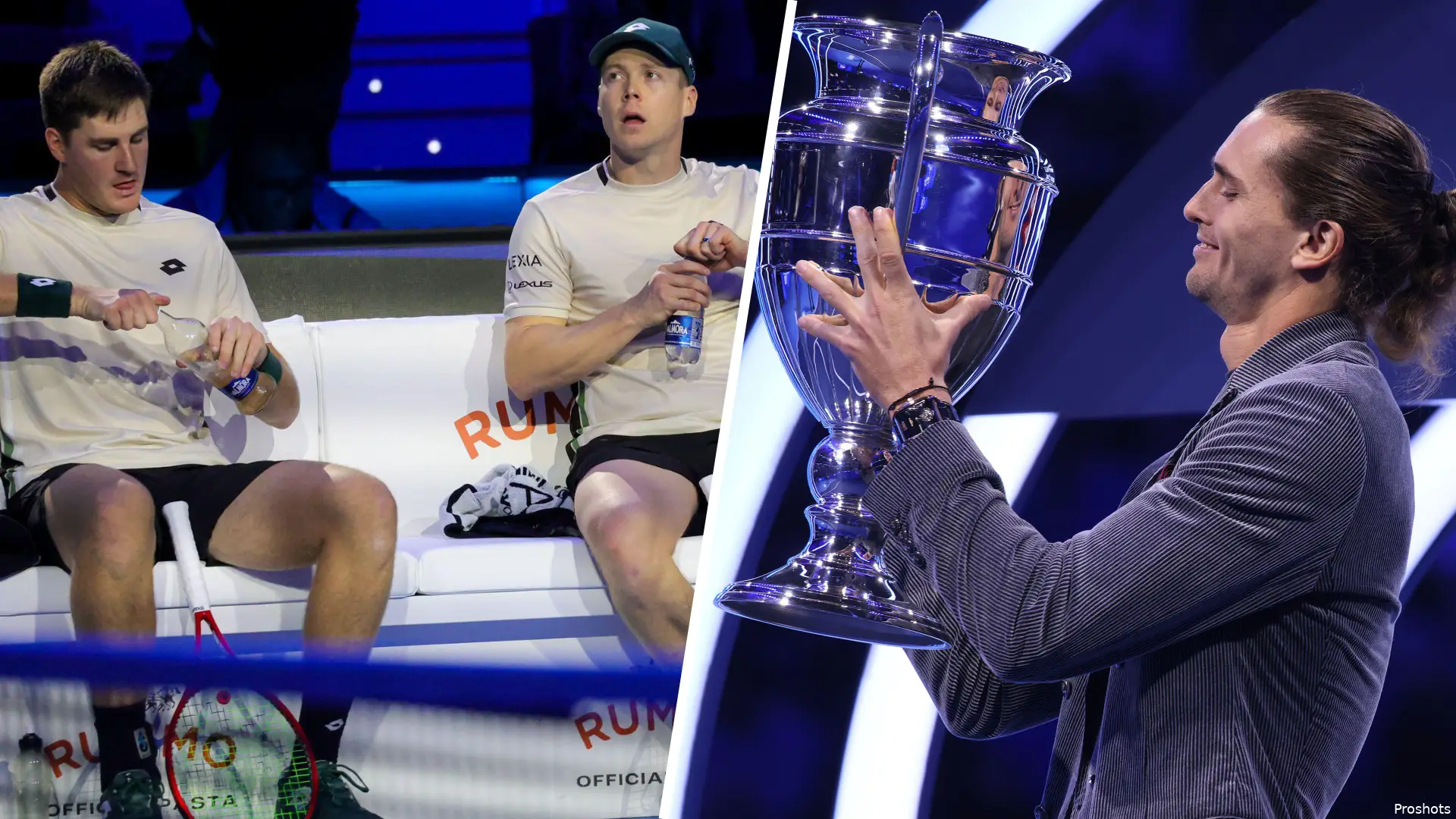
At the ATP Finals, Patten and his doubles partner, Harri Heliovaara, were recognised as the year-end No. 1 doubles team. It’s an extraordinary accomplishment. Years of work, travel, uncertainty, and professional sacrifice culminated in reaching the very top of their discipline. You might imagine that the people running the ATP would consider that an occasion worth attending. Apparently not.

Henry Patten and Harri Heliovaara sat on bench.
During the ceremony, Patten publicly criticised ATP Chairman Andrea Gaudenzi and CEO Eno Polo for failing to join the players on court. He made it clear that their absence was disappointing, particularly given what the achievement meant to him and his partner. Good for him. Very good.
There was something refreshingly direct about a player standing in front of the tennis establishment and telling it that its priorities were wrong. And this wasn’t happening in a vacuum. Patten and Heliovaara have been vocal critics of proposals to reduce doubles opportunities and redirect money toward singles, so there was an additional significance to his decision to speak out during what should have been one of the proudest moments of their careers.
The message from the ATP, whether intended or not, is difficult to miss. Congratulations on becoming the best doubles team in the world. Just don’t expect us to act as though it matters very much.
It’s a terrible look for an organisation that should be celebrating every part of its sport. Doubles is an important part of professional tennis, has its own dedicated audience and produces some wonderful matches. Yet the treatment of doubles players increasingly suggests that those running the sport view it as something of an inconvenience rather than an integral part of the product. And for me, it was another reminder of how little affection I have left for the men’s professional game.
Then there's Alexander Zverev
I know this is going to annoy some people, and I welcome the troll comments.
One of the things that has increasingly alienated me from men’s tennis is the way Alexander Zverev has been embraced, celebrated, and normalised by WAY too much of the tennis establishment. Zverev has faced serious domestic abuse allegations, which he has denied. An ATP investigation into one set of allegations concluded that there was insufficient evidence to substantiate a rules violation. A separate German legal proceeding arising from another allegation ended without a finding of guilt after a settlement. And a new lawsuit filed just weeks ago surely still won’t hold Zverev responsible for making allegedly false statements about these cases and set of events.
But legal outcomes aren’t the only things that determine how people feel about a public figure. We are all perfectly entitled to look at the history, consider the allegations and controversies, and decide that I have absolutely no interest in cheering for this particular player.
What bothers me even more is the broader culture surrounding him. The warm embraces, the enthusiastic celebrations, and the seemingly endless willingness to move along as though none of it ever happened. I don’t expect every ATP player to become a commentator on another player’s personal life. I understand that professional athletes compete against, practice with, and develop relationships with people they might not choose as friends outside their profession.

Alexander Zverev GER with US Open Trophy after beating Ben Shelton
But I also don’t have to enjoy watching it. And increasingly, I don’t.
For me, Zverev has become a symbol of something deeply, profoundly unappealing about the men’s game. Not because every player shares responsibility for his controversies, but because the surrounding culture seems so determined to make discomfort disappear. There is a difference between allowing someone to continue competing and expecting everyone else to enthusiastically embrace them, and I find it increasingly difficult to separate the two when watching the ATP. I can’t make myself feel comfortable with that, nor do I particularly want to.
The Money Makes It Much Worse
Then there’s the issue that has bothered me for years. Money. Enormous amounts of it. Professional tennis has spent decades congratulating itself on progress toward gender equality. And, yes, there has been meaningful progress, particularly at the Grand Slams, where men and women receive equal prize money. But move beyond those four tournaments, and the financial picture becomes considerably less flattering.
Across much of the professional calendar, women still compete for substantially less prize money than men. The size of the disparity varies by tournament and category, but the larger reality is impossible to ignore. The men’s game continues to enjoy financial advantages that I find increasingly difficult to justify, especially because I think the women’s product is better.
I know that’s subjective, and I don’t particularly care. I’d rather watch an unpredictable WTA match between two players fighting for a place in the top 50 than another ATP match in which the same familiar patterns produce the same familiar result. I find the variety of playing styles more interesting, the emergence of new talent more exciting and the weekly movement in the rankings more compelling. And the personalities, rivalries, and extraordinary depth of talent on the women’s side give me far more reasons to remain invested.
The idea that the men’s game should continue to command such a financial premium simply because it’s the men’s game strikes me as increasingly absurd. There are commercial arguments about revenue, television audiences, sponsorships, and the economics of individual tournaments. Those deserve to be examined rather than dismissed, and I understand that different events have different financial circumstances.
But I reject the assumption that men’s tennis is inherently the more valuable product. For this particular tennis consumer, it isn’t even close.
I only have so much tennis in me
This is perhaps the simplest part of my argument. There are only so many hours in a day. I have business to do, a life to live, and plenty of other interests competing for my attention. Even someone who loves tennis as much as I do cannot watch everything, follow every tournament or keep up with every storyline across both tours. So I make choices.
And increasingly, those tennis choices involve only the WTA. I’d rather spend my time following the next generation of Czech players, watching a promising teenager make her first serious run at a tour-level tournament, or trying to figure out whether a talented player ranked 120th is about to become a top-30 regular. I care about those stories. I care about the women grinding through lower-level tournaments, often for prize money that barely reflects the extraordinary expense of pursuing a professional tennis career.
I care about the brutal scheduling, the injuries, the ridiculously short off-season, and the physical demands placed on players who are expected to keep competing almost continuously. There is always something happening, whether it is an established star trying to rediscover her best form, a teenager announcing herself to the wider tennis world or an under-the-radar player putting together a run that could change her career.
And I care about a tour that, despite its many flaws, continues to give me reasons to turn on the television.
I’m not suggesting the WTA is perfect. Far from it. I’ve criticised its leadership, scheduling decisions, tournament arrangements, and treatment of players plenty of times. There are plenty of things that frustrate me about the women's tour, and I certainly don't agree with every decision made by those running it.
But criticism is different when it comes from a place of genuine investment. I criticise the WTA because I want it to be better. Increasingly, when I look at the ATP, I find myself wondering whether I care enough to bother. That’s a significant difference.
Good luck to them
I don’t want to turn this into an indictment of every man who plays professional tennis. There are wonderful ATP players, compelling stories, extraordinary athletes, and plenty of people doing admirable things for the sport.
Henry Patten’s willingness to speak up in Turin is a perfect example. I admire what he did. I wish more players would challenge the people running their sport when they believe something is wrong, particularly when it comes to issues that affect their colleagues and the future of disciplines that deserve greater recognition.
And I’m sure there will be men’s matches that catch my attention in the future. I’m not taking an oath never to watch another ATP point. There will inevitably be interesting matches, unexpected results and stories that make me want to tune in, because my love of tennis hasn't suddenly disappeared.
But I’ve reached the stage where the cumulative effect of everything that bothers me about the men’s game has overwhelmed much of what I once enjoyed about it. The treatment of doubles, the enormous financial disparities, the culture surrounding certain players and the sense that the sport’s establishment is often more interested in protecting its hierarchy than questioning it have all contributed to that feeling.
None of those problems exists exclusively in men’s tennis, and the WTA certainly has its own considerable problems. But my patience isn’t unlimited. Neither is my time.
I don’t need to keep investing either in a product that increasingly leaves me cold.
So, to the ATP, I wish you well. I hope your players continue to produce great tennis, your tournaments attract enthusiastic crowds, and your leadership eventually figures out that doubles players deserve considerably more respect than they appear to be receiving. I hope the tour continues to produce wonderful champions and compelling rivalries, and that the people running it eventually recognise some of the issues that have driven fans away.
Read also

I’ll keep an eye on the results. I’ll probably watch the occasional match. But the days when I felt compelled to follow men’s tennis closely are behind me.
There are simply too many interesting things happening on the women’s side of the sport.
And frankly, I’d rather be watching them. All the best, ATP. But I’m out.

Aron SolomonGuest Author
A Pulitzer Prize-nominated journalist for his groundbreaking op-ed in The Independent exposing the NFL’s “race-norming” policies, Aron Solomon, JD, is a globally recognized thought leader in law, media, and strategy.
As Chief Strategy Officer for AMPLIFY, he leverages his deep expertise to shape the future of legal marketing. Aron has taught entrepreneurship at McGill University and the University of Pennsylvania and was honored as a Fastcase 50 recipient, recognizing him among the world’s top legal innovators. A prolific commentator on law, business, and culture, his insights regularly appear in Newsweek, The Hill, Crunchbase News, and Literary Hub.
He has also been featured in The New York Times, Fast Company, Fortune, Forbes, CBS News, CNBC, USA Today, ESPN, TechCrunch, BuzzFeed, Venture Beat and countless other leading global media outlets. We are proud to have Aron on board at TennisUpToDate, where his deep tennis expertise enriches the site with sharp, original columns that connect the sport to wider cultural debates.
claps 0visitors 0
Just In



Popular News
Latest Comments
- Great list of players to watch! Really like Lilli Tagger. Nice looking game. I’m most interested in seeing how good Victoria Mboko becomes. She and Jovic and Eala might just be the ones fighting alongside Andreeva for Grand Slam titles soon.DaveyWavey16-11-2026
- Mirra's very funny words have been in my head since yesterday. "If I win the car I have 5 people in my box that can drive me around. I will forever be a passenger princess. I have a plan..." And I will never forget how she had me rolling on the floor laughing when asked how she beat Jess Pegula so handily: "I don't know what happened; It must have been the Diva in me". CLASSIC STUFF !
 mandoist15-11-2026
- Can whomever has a microphone in the Final... PLEASE STOP YAMMERING ABOUT YOURSELVES NONSTOP THROUGHOUT THE MATCH???? Get a grip and STFU once in awhile so we can 'hear' the actual play on court.mandoist15-11-2026
- Martina is one of the most competent, knowledgeable, and 99.999% correct in her analysis. Most of all -- WHILE A COMMENTATOR IN MATCHES SHE KNOWS WHEN NOT TO TALK AND DISTRACT FROM THE ACTION !!! Someone please pass that idea on to Austin, Shriver, and whoever else has been f-ing YAPPING throughout the play. How thoughtless and elitist can these people be squawking nonstop throughout an entire game about themselves. STFU, please (I said "please"). Let us 'hear' the game play on court.mandoist15-11-2026
- Tennis "fans" have short memories. This is exactly who Saba always was... granted she found a 'new' persona when she began winning matches and tourneys. Off-court she's always been a racist potty-mouth. Her meanness also shines through when she thinks no one else is around. In short, the "person" you've witnessed in post-match on-court interviews is NOT who she is. As for her familiar "apologies, she can stick that routine in her racquet bags because I never believed her words nor phony "respect" for her opponents -- and I ain't buying that now.mandoist15-11-2026
- Was Saba not paying attention to those who sought an inordinate amount of attention outside of their sport (occupation)... and to the point they lost their focus and eventually their place in tennis? For example: Giorgi, Bouchard, Raducanu, etc. They became infatuated with endless Selfies, videos, podcasts, TV commercials, magazine shoots, and so on. Thus their tennis suffered. Priorities are important.mandoist14-11-2026
- I, like writer of this wonderful article, also picked Noskova to win this entire thing. I would love it if she and Andreeva are in the final.Rapunzel12-11-2026
- "Priorities", Saba... spend less time in front of cameras, anti-Social Media, selfies and back to Tennis.mandoist12-11-2026
- Tell this to Andreeva!mandoist12-11-2026
- Andreeva with 11 games in a row to add to Saba's downward spiral issue !!! Personal feelings aside... Jess Pegula may want to reassess her evaluation of Mirra's abilities.mandoist12-11-2026
