"From almost quitting tennis to becoming World No. 1": Rohan Bopanna bids farewell after a historic journey
ATP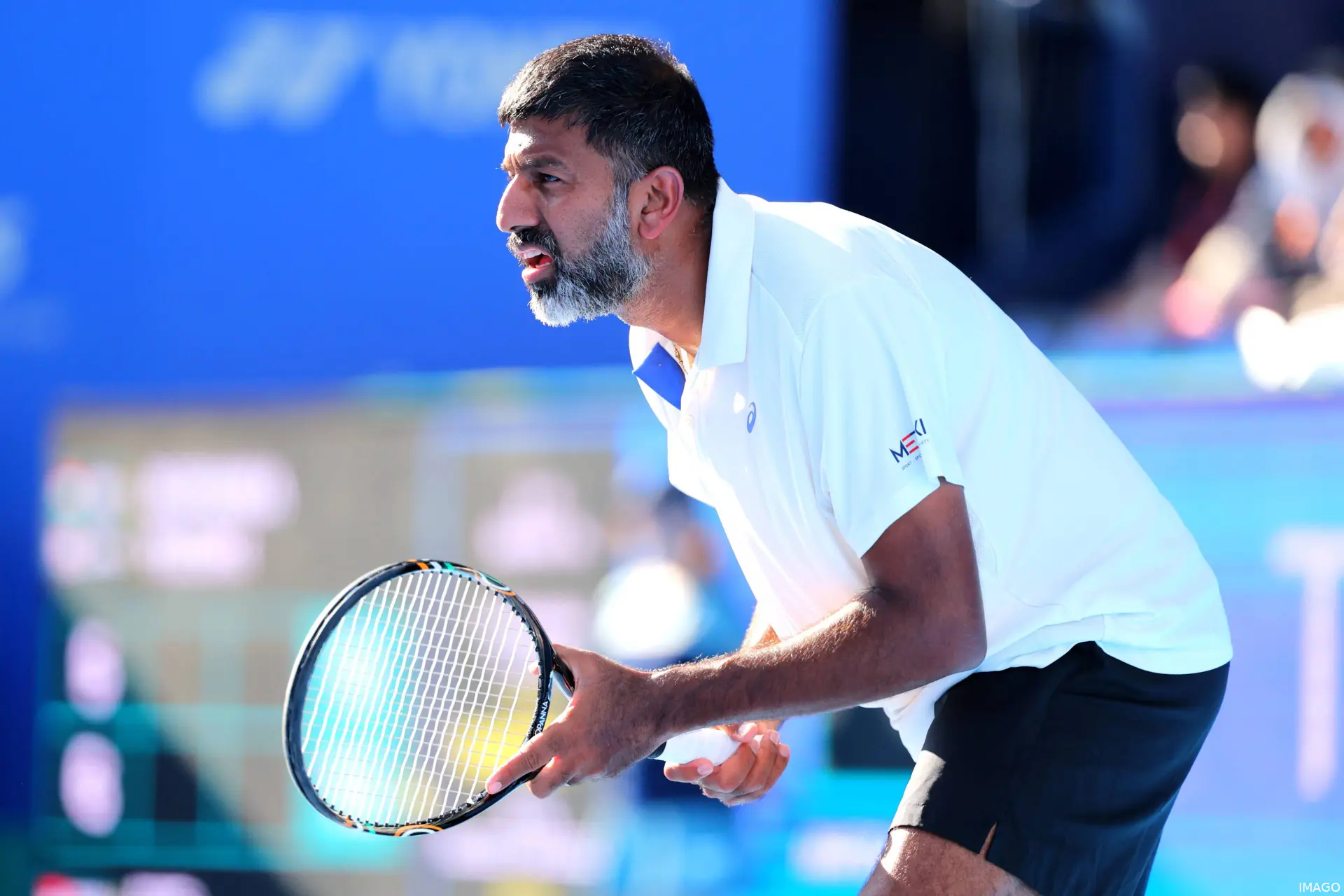
Rohan Bopanna’s final season on the ATP Tour closed a chapter unlike any other in Indian tennis — a 22-year journey that stretched from small-town beginnings in Coorg to the very top of the doubles world rankings. His retirement at the end of the 2025 season marked the conclusion of a career defined not only by trophies but by remarkable longevity, resilience, and a commitment to growth on and off the court.
As he reflected on the road behind him, Bopanna described his career as a lesson in persistence more than natural gift. “I think my career is a story of patience, discipline and self-belief,” he said to ATP Tour website, noting how close he once came to walking away from the sport entirely.
The Indian star’s legacy is etched in the record books: 26 ATP doubles titles, a 539-410 career win-loss record in doubles, and one of the most remarkable late-career ascents in modern tennis.
His partnership with Matthew Ebden delivered the 2024 Australian Open title, a triumph that sent Bopanna to World No. 1 for the first time at age 43 — making him the oldest player to reach the summit in history. But as he explained, the ranking was only one chapter in a path shaped as much by setbacks as success. “You need to have a strong mindset,” he said. “That’s where it made a massive difference, a massive switch for me going from almost quitting tennis to becoming World No. 1.”
Read also
Bopanna’s climb was inspired early on by India’s great doubles figures, whom he studied closely as he shaped his own ambitions. He spoke of reading about Mahesh Bhupathi and Leander Paes, seeing the global stages they reached and the impact they had back home. Their journey became a map for his own aspirations, and later, mentors he could consult as he learned to navigate life on Tour.
He also shared deep respect for 3-time Grand Slam champion Sania Mirza, with whom he rose through the ranks, describing the importance of having a compatriot who understood the unique pressures of representing India. “Sania Mirza was also somebody I came along the Tour with, and we shared a lot of great memories. Even though I met beautiful people from across the world, just sharing this journey from somebody from your own country, I think helps you shape your journey better as well.”
A journey far beyond expectations
Bopanna often returns to one theme: gratitude. From his first ATP title in 2008 alongside Eric Butorac to his mixed doubles triumph at Roland Garros in 2017 with Gabriela Dabrowski, each partnership played a role in shaping his story. By the time he hung up his racquets, he had won titles with 15 different partners — a testament to both his adaptability and his reputation as a teammate. “Coming from a small town like Coorg to travelling all over the world, becoming World No. 1… it’s a journey way beyond what I imagined,” he said. “I’m grateful to every partner, every match, every city.”
His path wasn’t without doubts. The 2021 season, coming out of the pandemic, pushed Bopanna to the edge of retirement — a moment he remembers vividly. After months without a win, he told his wife he was ready to stop. Her response changed everything. “She said, ‘Look at it as a new challenge, not a limitation,’” Bopanna recalled. “That is where I started playing my best tennis.” The resurgence that followed carried him through the most successful late-career stretch of his life, eventually culminating in the achievements that will define his legacy.
His career also included memorable appearances in the Nitto ATP Finals, finishing runner-up in 2012 with Bhupathi and in 2015 with Florin Mergea. These results placed him firmly among the most consistent doubles competitors of his era. Yet what Bopanna cherishes most is not the silverware but the integrity he carried. One moment often cited is his self-call on a crucial touch-violation point — a gesture that, for him, defined the values he wanted to pass on. “Being a father, you want to teach the right kind of things,” he said. “There are things so much bigger than just playing tennis.”
Fatherhood, perspective and a second wind
Becoming a parent transformed the final phase of Bopanna’s career. He credits his daughter, Tridha, with giving him renewed purpose at a time when many players would be winding down. She watched him lift trophies and compete at the highest level, believing it was normal for her father to be in finals. “When I made the final in Tokyo this year, the first thing after the prize distribution, I gave her the trophy and told her, ‘This is for you,’” he shared. “Kids… they keep you grounded at all times.”
This perspective helped him extend his playing days far longer than he once thought possible. It also prepared him for what comes next. While he may be retiring from competition, Bopanna insists he is not stepping away from tennis. His Rohan Bopanna Tennis Development Foundation currently supports 37 underprivileged children, providing education, lodging and professional training — a project he aims to expand in his post-tour life. “My next true mission is to help Indian tennis,” he said. “I would love to share my experience with young players.”

Cristhián AvilaTennis Journalist
Cristhián Ávila is a tennis journalist based in Santiago, Chile, and has been part of the TennisUpToDate team since early 2023. He covers the ATP and WTA Tours as well as all four Grand Slams, producing breaking news, match reports, analysis, and regular liveblogs from major tournaments.
His reporting combines statistical analysis with clear explanation, helping readers understand tactical developments, player form, and broader storylines across the tour. Working fluently in both Spanish and English, Cristhián collaborates with an international editorial team and contributes to comprehensive global coverage. As part of his work, he has conducted interviews and media interactions with leading figures in the sport, including Caroline Wozniacki and John McEnroe.
In his journalism, Cristhián places strong emphasis on careful sourcing, editorial accuracy, and updating articles promptly when new, verified information becomes available. His coverage is grounded in research, context, and direct engagement with professional tennis.
claps 0visitors 0
Just In

Popular News
Latest Comments
- A healthy Qinwen may be hard to stop next season. She was already scaring her opponents before her medical leave(s). Unfortunately, Zheng insisted on singing again. On the positive side -- Mirra did not sing!! ;~}
 mandoist11-10-2026
 - Where is it written that athletes, entertainers... People in general... are mandated to keep looking at -- or even using [anti]Social Media? Public & private figures consistently complain and reveal their concerns about negativity and violence thrown at them -- yet they insist on participating. Avoid it, don't use it, don't read it. It's okay to occasionally look up at the World instead beating your eyes & thumbs to death on The Inventions out there.mandoist11-10-2026
- great articlestennisseserver07-10-2026
- Medvedev was leading Djokovic 7-5, 3-5 when an attempted return..' NO you ignorants, Djokovic was leading .weiss05-10-2026
- No more bullshit "Wildcards" to these two. Qualify like everyone else -- there will be cameras there, too. Time to scream... WTF ????!!!!mandoist29-09-2026
- Let's not BS the general public -- Sabalenka started showing cracks in her game last season. Her losses and near-losses started at about the same time she began being distracted by Fame (constant Selfies, making TV commercials, magazine shoots, endless Social Media nonsense, etc., etc.) One would think even Saba could recognize the parallels with others who failed before her -- Raducanu, Giorgi, Bouchard to name a few.mandoist25-09-2026
- Gross!! Hey Raducanu, Giorgi, and Bouchard -- reserve a seat at your Social Media Selfie table for Saba + Naomi. They're heading in your direction soon enough.mandoist24-09-2026
- And then these same players will complain about how lengthy their season’s were and need more time-off. I’m all for more tennis but the amount of tennis we get now is actually kind of crazy! We all need a break, especially the players.DaveyWavey23-09-2026
- You should do a comparison article for "different kinds of justice" the courts decide for tennis players. I can think of at least three players who received very small bans of a few months, however Tara Moore has been fighting for her literal survival the past few years. It seems odd considering she is not a "name" player, unlike the other cases.DaveyWavey22-09-2026
- PRIZE MONEY & POINTS Winner - $185,500 Finalist - $114,500 Semi-Finalist - $66,003 Quarter-Finalist - $35,000 Round of 16 - $18,045 Round of 32 - $13,005 Winner - 500 Finalist - 325 Semi-Finalist - 195 Quarter-Finalist - 108 Round of 16 - 60 Round of 32 - 1DaveyWavey20-09-2026

Loading