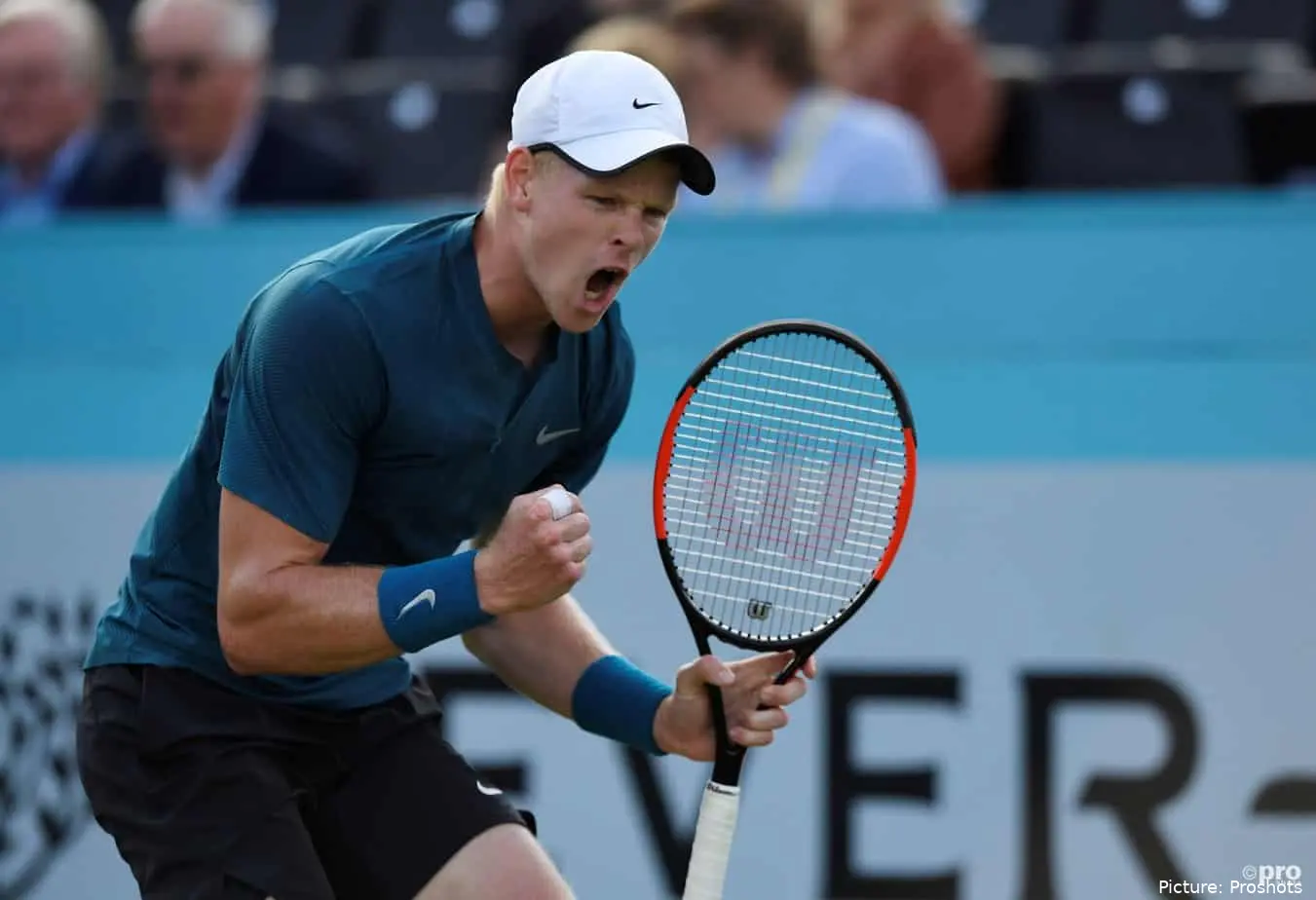
In October 2018, Kyle Edmund was the world No. 14, had just won his first ATP title, and had spent the year beating Grigor Dimitrov at a Grand Slam and Novak Djokovic at a Masters 1000. He had ended Andy Murray's 12-year hold on the British No. 1 ranking and looked, at 23, like the natural heir to Britain's golden generation of men's tennis.
Seven years later, he retired at 30 having barely played a competitive match in the previous two seasons, his body simply unable to keep pace with a career that had briefly promised so much more.
Edmund's story doesn't have the shock value of a sudden career-ending accident. It has something arguably sadder: a left knee that quietly turned from a minor concern into three separate surgeries, each one chipping away at the window he'd worked a decade to open.
By the time he finally called it a career in August 2025, the Australian Open semifinalist of 2018 had become a name tennis fans mostly remembered in the past tense already.
Kyle Edmund — Career highlights
| Career-high ranking | No. 14 (October 2018) |
| Grand Slam best | Semifinal, 2018 Australian Open |
| ATP titles | 2 (Antwerp 2018, New York 2020) |
| British No. 1 | March 2018 – October 2019 |
| Team honours | 2015 Davis Cup champion |
| Career prize money | Over $6 million |
| Retired | August 2025, aged 30 |
The rise: from qualifying rounds to British No. 1
Edmund's path to the top was gradual by design. He won junior Grand Slam doubles titles at the 2012 US Open and 2013 French Open alongside Frederico Ferreira Silva, while also helping Great Britain win the Junior Davis Cup for the first time in 2011.
He turned professional in 2013, finishing that season ranked outside the top 400, and spent the following years grinding through Challenger events and Grand Slam qualifying rounds. His breakthrough began to take shape in 2015, when he qualified for the Australian and French Opens for the first time and helped Great Britain win the Davis Cup for the first time in 79 years.
By 2017, the signs of a genuine top-level player were becoming increasingly difficult to ignore. Edmund reached the fourth round at Indian Wells, losing to Roger Federer, before retiring injured against Pablo Cuevas at Roland Garros. He later reached the semifinal in Eastbourne, beating fellow Brit Dan Evans along the way, as his results began to arrive consistently across different surfaces.
Edmund's game was built around one standout weapon: a heavy, flat forehand that opponents and commentators regularly described as one of the most powerful shots in tennis at the time. On his best days, it could look almost unplayable and gave him a puncher's chance against anyone in the draw. It would ultimately define both his biggest victories and the frustration of seeing that weapon largely disappear during his injury struggles.
2018: the year everything arrived at once
Then came the season that defined his career. Edmund reached the Australian Open semifinal, beating 12th seed Kevin Anderson and third seed Grigor Dimitrov before losing to eventual champion Marin Cilic — only the sixth British man in the Open Era to reach a major semifinal. Weeks later, on March 5, he overtook Andy Murray as British No. 1, ending a reign that had lasted 12 years.
He reached his first tour-level final in Marrakech and his first Masters 1000 quarterfinal in Madrid, beating both Djokovic and Goffin along the way, then capped the season by winning his maiden ATP title in Antwerp that October — the result that carried him to a career-high ranking of world No. 14.
For a player who'd spent his early twenties in Challenger events, it was a remarkably compressed arrival: Grand Slam semifinalist, Masters 1000 giant-killer, and national No. 1, essentially all within a single calendar year.
The knee that ended it all
The trouble began almost as soon as the peak did. A chronic problem in his left knee, first a nagging concern, progressed to the point where Edmund underwent the first of three surgeries in November 2020, keeping him off tour for close to two years.
A second operation followed in March 2021, and a third in May 2022 — each one arriving before he'd fully recovered from the last, on top of separate issues with his wrist, abdomen, hip and foot that piled up across the same stretch.
Edmund's knee surgery timeline
| Date | Event |
| October 2018 | Reaches career-high ranking, No. 14 |
| 2019–2020 | Left knee problems begin; ranking starts sliding |
| November 2020 | First knee surgery; sidelined for roughly 21 months |
| March 2021 | Second knee surgery |
| May 2022 | Third knee surgery |
| 2023–2024 | Drops to Challenger and ITF-level events |
| August 2025 | Announces retirement, aged 30 |
A comeback that never took hold
What followed the surgeries was less a comeback than a long, difficult search for a level that kept receding. Edmund won his return match in Washington but then lost nine ATP-level matches in a row, a run bad enough that he shifted his focus to Challenger and ITF events for the 2023 and 2024 seasons, chasing ranking points wherever he could find real matches rather than first-round exits against the game's elite.
He did make one more appearance in the Wimbledon main draw, in 2024, via a wildcard granted largely out of respect for what he'd once been rather than what he currently was — a first-round exit that felt more like a farewell than a genuine title bid.
Read also
Through it all, Edmund kept returning to the Davis Cup as a source of pride separate from his singles ranking. Across eight ties for Great Britain, he compiled a 6-5 record, with standout wins over Janko Tipsarevic in the 2016 quarterfinal, Denis Shapovalov in 2017, and Feliciano Lopez in the decisive 2019 semifinal — the team format offering him moments of relevance even as his individual ranking kept sliding away from him.
By August 2025, Edmund had reached his own conclusion. "The last five years have taken a toll with three surgeries and other injuries, and my body is telling me it's finally reached the end point," he said in a video announcing his retirement, adding that he had no regrets and had tried his absolute hardest to get back to where he'd been.
That's the note Edmund's career ends on: not bitterness, but simple acknowledgment that the body had stopped cooperating long before the will to compete had. He leaves the sport as a two-time ATP champion, a Davis Cup winner, a Grand Slam semifinalist, and, for a year and a half, the best player his country had.

Cristhián AvilaTennis Journalist
Cristhián Ávila is a tennis journalist based in Santiago, Chile, and has been part of the TennisUpToDate team since early 2023. He covers the ATP and WTA Tours as well as all four Grand Slams, producing breaking news, match reports, analysis, and regular liveblogs from major tournaments.
His reporting combines statistical analysis with clear explanation, helping readers understand tactical developments, player form, and broader storylines across the tour. Working fluently in both Spanish and English, Cristhián collaborates with an international editorial team and contributes to comprehensive global coverage. As part of his work, he has conducted interviews and media interactions with leading figures in the sport, including Caroline Wozniacki and John McEnroe.
In his journalism, Cristhián places strong emphasis on careful sourcing, editorial accuracy, and updating articles promptly when new, verified information becomes available. His coverage is grounded in research, context, and direct engagement with professional tennis.
claps 0visitors 0
Just In

Popular News
Latest Comments
- Two Things: 1. Stop allowing these Spoiled Trust-Fund Elitists to behave badly. Your little hand-slaps do not deter them. 2. STOP the incessantly annoying "towel wiping" nonsense!!!!
 mandoist15-10-2026
 - A healthy Qinwen may be hard to stop next season. She was already scaring her opponents before her medical leave(s). Unfortunately, Zheng insisted on singing again. On the positive side -- Mirra did not sing!! ;~}mandoist11-10-2026
- Where is it written that athletes, entertainers... People in general... are mandated to keep looking at -- or even using [anti]Social Media? Public & private figures consistently complain and reveal their concerns about negativity and violence thrown at them -- yet they insist on participating. Avoid it, don't use it, don't read it. It's okay to occasionally look up at the World instead beating your eyes & thumbs to death on The Inventions out there.mandoist11-10-2026
- great articlestennisseserver07-10-2026
- Medvedev was leading Djokovic 7-5, 3-5 when an attempted return..' NO you ignorants, Djokovic was leading .weiss05-10-2026
- No more bullshit "Wildcards" to these two. Qualify like everyone else -- there will be cameras there, too. Time to scream... WTF ????!!!!mandoist29-09-2026
- Let's not BS the general public -- Sabalenka started showing cracks in her game last season. Her losses and near-losses started at about the same time she began being distracted by Fame (constant Selfies, making TV commercials, magazine shoots, endless Social Media nonsense, etc., etc.) One would think even Saba could recognize the parallels with others who failed before her -- Raducanu, Giorgi, Bouchard to name a few.mandoist25-09-2026
- Gross!! Hey Raducanu, Giorgi, and Bouchard -- reserve a seat at your Social Media Selfie table for Saba + Naomi. They're heading in your direction soon enough.mandoist24-09-2026
- And then these same players will complain about how lengthy their season’s were and need more time-off. I’m all for more tennis but the amount of tennis we get now is actually kind of crazy! We all need a break, especially the players.DaveyWavey23-09-2026
- You should do a comparison article for "different kinds of justice" the courts decide for tennis players. I can think of at least three players who received very small bans of a few months, however Tara Moore has been fighting for her literal survival the past few years. It seems odd considering she is not a "name" player, unlike the other cases.DaveyWavey22-09-2026

Loading