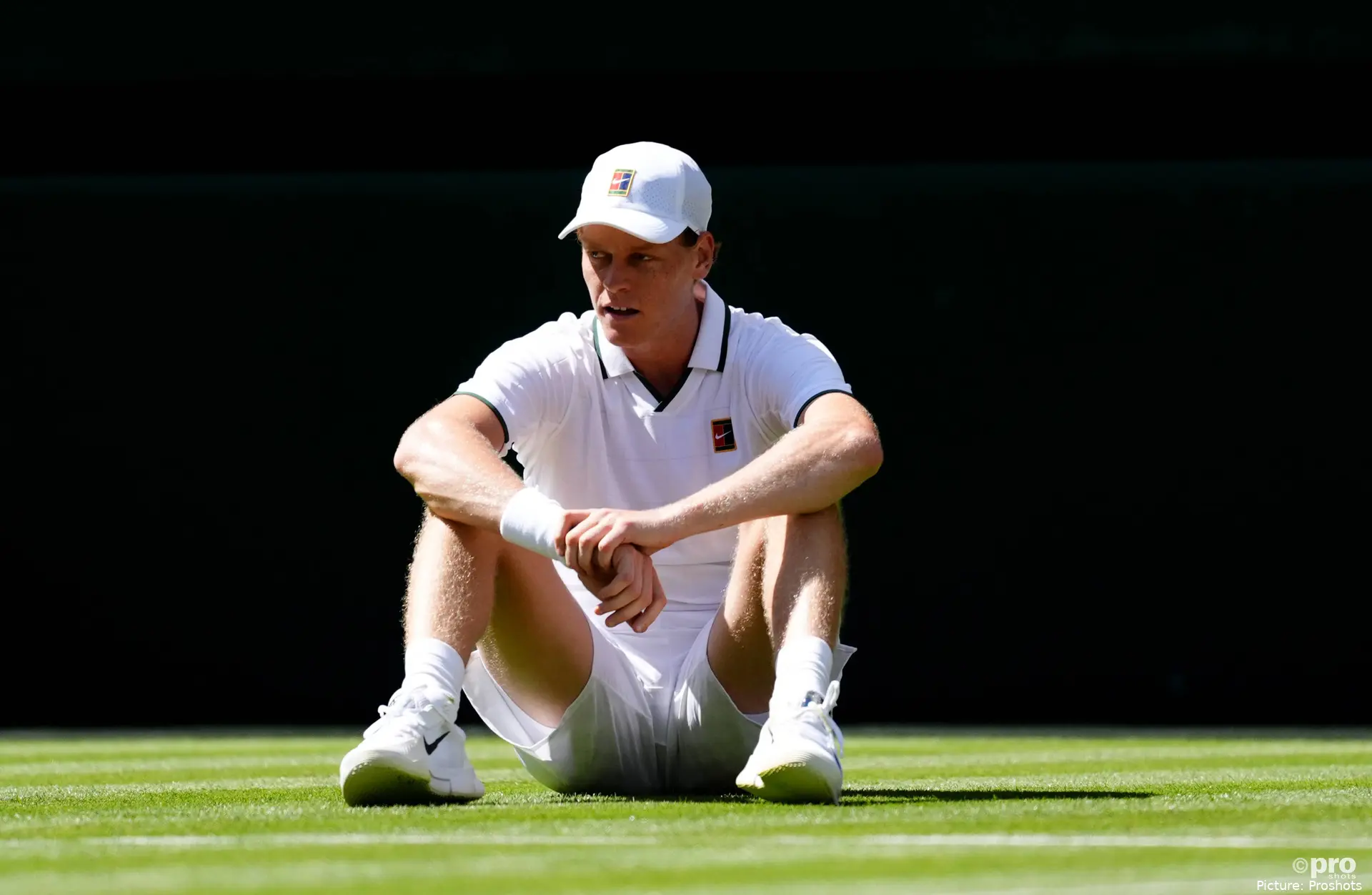
Jannik Sinner’s ongoing knee problems may have roots stretching back to an incident in his early childhood, according to chiropractor Alfio Caronti, who worked with the Italian during his development.
In an interview with La Gazzetta dello Sport, Caronti described how a fall at around five years old may have left the five-time Grand Slam champion with a subconscious fear of certain movements, offering his own theory about the physical difficulties that have disrupted Sinner’s season.
Sinner is continuing treatment for inflammation of the iliotibial band, as the problem has prevented him from returning to competitive action during the 2026 season. Caronti believes that understanding the way Sinner’s body responds to certain movements could be important to addressing the issue.
The chiropractor first assessed Sinner when he was 13 and training at Riccardo Piatti’s academy. Their work focused on balance, coordination and movement patterns, with Caronti arguing that the Italian’s physical efficiency is more significant than his muscle mass.
His explanation remains a personal theory rather than a confirmed medical account of Sinner’s injury. However, Caronti also revisited Sinner’s fall during his Wimbledon debut this year, suggesting that the way the Italian responded to that incident may have aggravated an existing difficulty with support on his right leg.
Sinner’s chiropractor traces movement concerns back to childhood fall
Caronti recalled that Sinner was around five when he was pushed and fell backwards, hitting his head. Years later, while working with the young tennis player, he noticed a pattern that led him to believe the experience had left a lasting psychological response.
“When he was in primary school, or perhaps still in kindergarten, at around five years old, Jannik was pushed and fell backwards, hitting his head," Caronti told La Gazzetta dello Sport. "Years later, when I worked with him, I noticed that during certain movements he would not tilt his head backwards. I believe that fall left him with a subconscious fear."

In his interpretation, the incident may also have influenced the way Sinner approaches rallies. “In tennis, opponents try to push you out of the court and force you backwards. Jannik, on the other hand, doesn't want to move backwards; he wants to stay ahead," Caronti said. "He has developed an incredible ability to anticipate. What could have been a difficulty has also become one of his characteristics.”
The chiropractor said their work involved gradually exposing Sinner to movements that made him uncomfortable, rather than allowing him to remain rigid when losing balance.
“You have to get the athlete to perform precisely the movements they fear, gradually getting them used to doing them without becoming stiff," he added. "With Jannik, we worked on falls, pushes and foot placements. There are images showing how his balance changed. You have to restore the body’s confidence in movement.”
Caronti offers theory linking Wimbledon fall to Sinner’s knee problems
The chiropractor’s most direct comments about Sinner’s current condition concerned the relationship between muscle coordination and the inflammation affecting the iliotibial band. Caronti described movement as a balance between contraction and relaxation, arguing that opposing muscles can sometimes work against one another rather than coordinating efficiently.
The chiropractor also revisited Sinner’s fall on grass during his Wimbledon first-round match against Miomir Kecmanovic. “I watched that match again. Jannik plants his foot, pushes towards the left, slips on the grass and his legs spread apart."
"In my opinion, as he was falling, he tried to resist rather than letting himself fall backwards," he added. "That is a behaviour I connect with the fear he developed as a child. That incident may have aggravated a difficulty that was already present when supporting himself on his right leg.”
Read also

Caronti argued that recovery should involve more than addressing the inflammation itself. He said he would focus on rebuilding Sinner’s confidence in movements involving the right leg, including changes of direction, pushing off and falling safely.
“If you limit yourself to treating the inflammation with anti-inflammatory medication or injections, you risk treating only the symptom," he added. "It is like switching off the oil warning light on a dashboard without checking why it came on. The tissues can repair themselves, but if you don't correct what is causing the problem, you risk it returning.”

Cristhián AvilaTennis Journalist
Cristhián Ávila is a tennis journalist based in Santiago, Chile, and has been part of the TennisUpToDate team since early 2023. He covers the ATP and WTA Tours as well as all four Grand Slams, producing breaking news, match reports, analysis, and regular liveblogs from major tournaments.
His reporting combines statistical analysis with clear explanation, helping readers understand tactical developments, player form, and broader storylines across the tour. Working fluently in both Spanish and English, Cristhián collaborates with an international editorial team and contributes to comprehensive global coverage. As part of his work, he has conducted interviews and media interactions with leading figures in the sport, including Caroline Wozniacki and John McEnroe.
In his journalism, Cristhián places strong emphasis on careful sourcing, editorial accuracy, and updating articles promptly when new, verified information becomes available. His coverage is grounded in research, context, and direct engagement with professional tennis.
claps 0visitors 0
Just In




Popular News
Latest Comments
- Osaka's mental state apparently does not allow her to reach any more Quarter Finals? I mean, she doesn't really have the time for tennis with all the pre-planning that must go into her 12 year-old "fashion" goals.
 mandoist29-10-2026
- With her money one would think she could afford a better team of Psychiatrists?mandoist29-10-2026
- Boss move, Sinner !Rapunzel27-10-2026
- Apparently still refusing to seek 'help' ...and still playing Dress-Up like a 10 year-old.mandoist27-10-2026
- Lena... Takin' care of businessmandoist25-10-2026
- Can you please stop publishing this nonsense? Stick to Tennis.mandoist25-10-2026
- Does Sinner need that 4.5 mil? I doubt it. He can make that with three modelling gigs!😅🤣Rapunzel21-10-2026
- Did "People Magazine" purchase this website? This nonstop storyline is bullshit.mandoist21-10-2026
- Listen... this is of no concern to anyone but these two. Deal with your own issues -- most of us have our own. Thanks, media, for these insignificant follow-ups which are meaningless.mandoist21-10-2026
- This is so very very sad, for all three of them. I truly thought they had an unbreakable bond, but life throws up so many differing challenges. Having your homeland suffering in such a terrible way, makes happiness lose out to guilt as well. Our thoughts are with them. X💔bjsexton20-10-2026

Loading