“How hard is it to test the meat?”: Kim Clijsters questions contamination evidence in Tara Moore case
ATP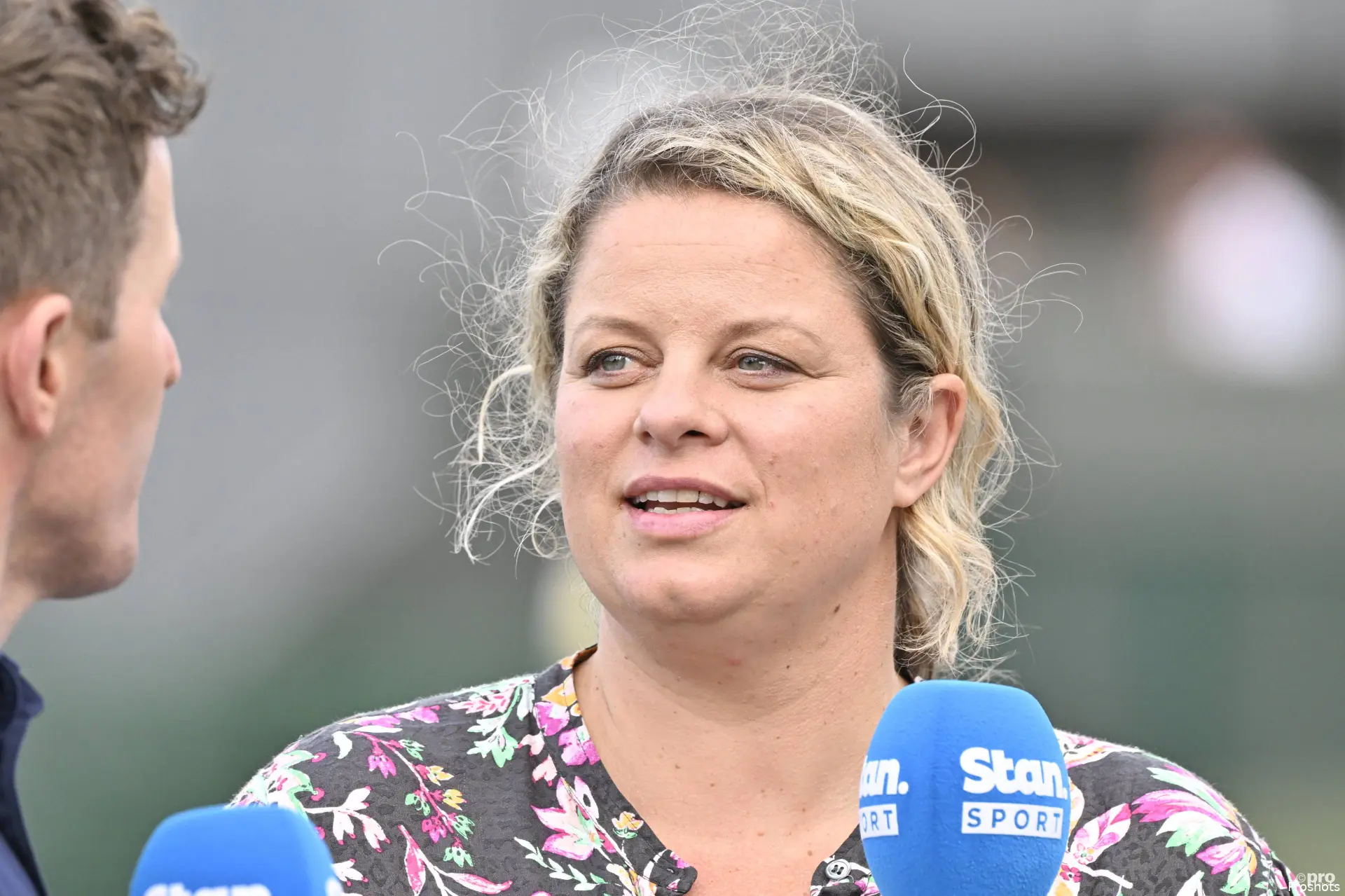
Former world No. 1 and seven-time Grand Slam champion Kim Clijsters has described the Tara Moore case as a “very, very disappointing situation,” offering a measured assessment of the British player’s $20 million lawsuit against the WTA following her four-year suspension.
Moore, 33, who reached a career-high ranking of No. 145 in singles and No. 77 in doubles, tested positive in 2022 for the anabolic steroids boldenone and nandrolone. Although she was initially cleared of “fault and negligence” by an independent tribunal in December 2023, the International Tennis Integrity Agency (ITIA) appealed to the Court of Arbitration for Sport (CAS), which imposed a four-year ban last July.
Moore is now suing the WTA, arguing the tour failed to protect her from the risk of contaminated meat at events, particularly in South America. Clijsters, speaking on the issue, focused less on legal tactics and more on the broader implications for players navigating a global schedule under strict anti-doping liability.
While careful not to speculate on the merits of the lawsuit itself, Clijsters framed the matter as one that exposes structural tensions between athlete responsibility, tour oversight and scientific thresholds in doping adjudication.
“They said the levels were too high”
At the centre of the dispute is CAS’s conclusion that the concentration of nandrolone detected in Moore’s system could not plausibly be explained by contaminated meat. Clijsters pointed directly to that finding as pivotal.
“One of the things that I did find online when I was trying to get my timeline… I do think the ITIA, they based their conclusion or their decision on the fact that they said that the levels were too high to be contaminated through meat. Specifically of the nandrolone.”
In anti-doping cases, concentration levels often determine whether a contaminated-food defence is viable. Clijsters acknowledged that if scientific panels conclude that the amount detected exceeds what is consistent with accidental ingestion, the room for mitigation narrows considerably.
At the same time, she questioned how contamination claims are assessed in practice, particularly once an event has passed and food sources are no longer available for independent verification. “If she is innocent, then how hard is it to test the meat and how hard is it to, you know, go for like a check, how much that has an impact on the body? It’s just a very frustrating situation.”
That frustration, Clijsters suggested, lies in the gap between suspicion and proof. Athletes bear strict liability under the anti-doping code, meaning intent is not required for a violation. But once CAS has accepted the ITIA’s argument on concentration levels, reversing that narrative becomes extremely difficult.
“I don’t think there’s a lot that the WTA can do”
Moore’s lawsuit shifts attention from anti-doping authorities to the WTA itself, alleging insufficient protection against contaminated food risks at tournaments. Clijsters, who served on the WTA board earlier in her career, emphasised the limits of what a governing body can realistically control.
“I know that the WTA, they try their absolute best when it comes to providing, you know, making sure that all the tournaments and the tournament directors are aware of the risks and of the catering services that work for the tournaments.”
She added that tour officials are typically “very, very involved in making sure what’s important for the players, what’s healthy, what should be available and whatnot,” but stopped short of suggesting that oversight guarantees safety in every jurisdiction.
Clijsters pointed to the recurring reality that players sometimes fall ill at events due to food quality issues, underscoring how difficult it is to eliminate all risk across a global calendar. “When it comes to the quality of certain meats… we’ve heard it over and over again that a few players get sick. I don’t think there’s a lot that the WTA can do about those kinds of things, but we’ll see how this turns out.”
The broader question raised by Moore’s case is whether tournament catering protocols must now evolve further to shield tours from legal exposure. Some events on the ATP side have reportedly removed red meat from menus in specific regions as a precautionary measure, a development that reflects growing awareness of contamination concerns.
“Very unfortunate… for every party”
For Clijsters, the human dimension remains central. A four-year ban at age 33 is effectively career-defining. Regardless of legal outcomes, the competitive window narrows. “It’s such a very, very unfortunate and disappointing situation for every party… If it is because of that contaminated meat, it is a very, very sad situation and that she gets punished for it is just very, very unfortunate.”
Clijsters did not predict whether Moore’s $20 million claim will succeed, noting simply, “Will it be 20 million? I don’t think so.” Instead, she characterised the case as one that highlights systemic tension rather than simple fault. “We’ll see how this turns out… it’ll be interesting to see where this will go and what measurements the WTA will take.”
As the legal process unfolds, the Moore case stands at the intersection of science, governance and athlete accountability. For tours operating across continents and regulatory environments, the debate is no longer theoretical. It now carries financial, reputational and career-altering consequences.

Cristhián AvilaTennis Journalist
Cristhián Ávila is a tennis journalist based in Santiago, Chile, and has been part of the TennisUpToDate team since early 2023. He covers the ATP and WTA Tours as well as all four Grand Slams, producing breaking news, match reports, analysis, and regular liveblogs from major tournaments.
His reporting combines statistical analysis with clear explanation, helping readers understand tactical developments, player form, and broader storylines across the tour. Working fluently in both Spanish and English, Cristhián collaborates with an international editorial team and contributes to comprehensive global coverage. As part of his work, he has conducted interviews and media interactions with leading figures in the sport, including Caroline Wozniacki and John McEnroe.
In his journalism, Cristhián places strong emphasis on careful sourcing, editorial accuracy, and updating articles promptly when new, verified information becomes available. His coverage is grounded in research, context, and direct engagement with professional tennis.
claps 0visitors 0
Just In

Popular News
Latest Comments
- A healthy Qinwen may be hard to stop next season. She was already scaring her opponents before her medical leave(s). Unfortunately, Zheng insisted on singing again. On the positive side -- Mirra did not sing!! ;~}
 mandoist11-10-2026
 - Where is it written that athletes, entertainers... People in general... are mandated to keep looking at -- or even using [anti]Social Media? Public & private figures consistently complain and reveal their concerns about negativity and violence thrown at them -- yet they insist on participating. Avoid it, don't use it, don't read it. It's okay to occasionally look up at the World instead beating your eyes & thumbs to death on The Inventions out there.mandoist11-10-2026
- great articlestennisseserver07-10-2026
- Medvedev was leading Djokovic 7-5, 3-5 when an attempted return..' NO you ignorants, Djokovic was leading .weiss05-10-2026
- No more bullshit "Wildcards" to these two. Qualify like everyone else -- there will be cameras there, too. Time to scream... WTF ????!!!!mandoist29-09-2026
- Let's not BS the general public -- Sabalenka started showing cracks in her game last season. Her losses and near-losses started at about the same time she began being distracted by Fame (constant Selfies, making TV commercials, magazine shoots, endless Social Media nonsense, etc., etc.) One would think even Saba could recognize the parallels with others who failed before her -- Raducanu, Giorgi, Bouchard to name a few.mandoist25-09-2026
- Gross!! Hey Raducanu, Giorgi, and Bouchard -- reserve a seat at your Social Media Selfie table for Saba + Naomi. They're heading in your direction soon enough.mandoist24-09-2026
- And then these same players will complain about how lengthy their season’s were and need more time-off. I’m all for more tennis but the amount of tennis we get now is actually kind of crazy! We all need a break, especially the players.DaveyWavey23-09-2026
- You should do a comparison article for "different kinds of justice" the courts decide for tennis players. I can think of at least three players who received very small bans of a few months, however Tara Moore has been fighting for her literal survival the past few years. It seems odd considering she is not a "name" player, unlike the other cases.DaveyWavey22-09-2026
- PRIZE MONEY & POINTS Winner - $185,500 Finalist - $114,500 Semi-Finalist - $66,003 Quarter-Finalist - $35,000 Round of 16 - $18,045 Round of 32 - $13,005 Winner - 500 Finalist - 325 Semi-Finalist - 195 Quarter-Finalist - 108 Round of 16 - 60 Round of 32 - 1DaveyWavey20-09-2026

Loading