"Sometimes you have to be a warrior" - Pain not getting in the way of Carlos Alcaraz's career Grand Slam aspirations
ATP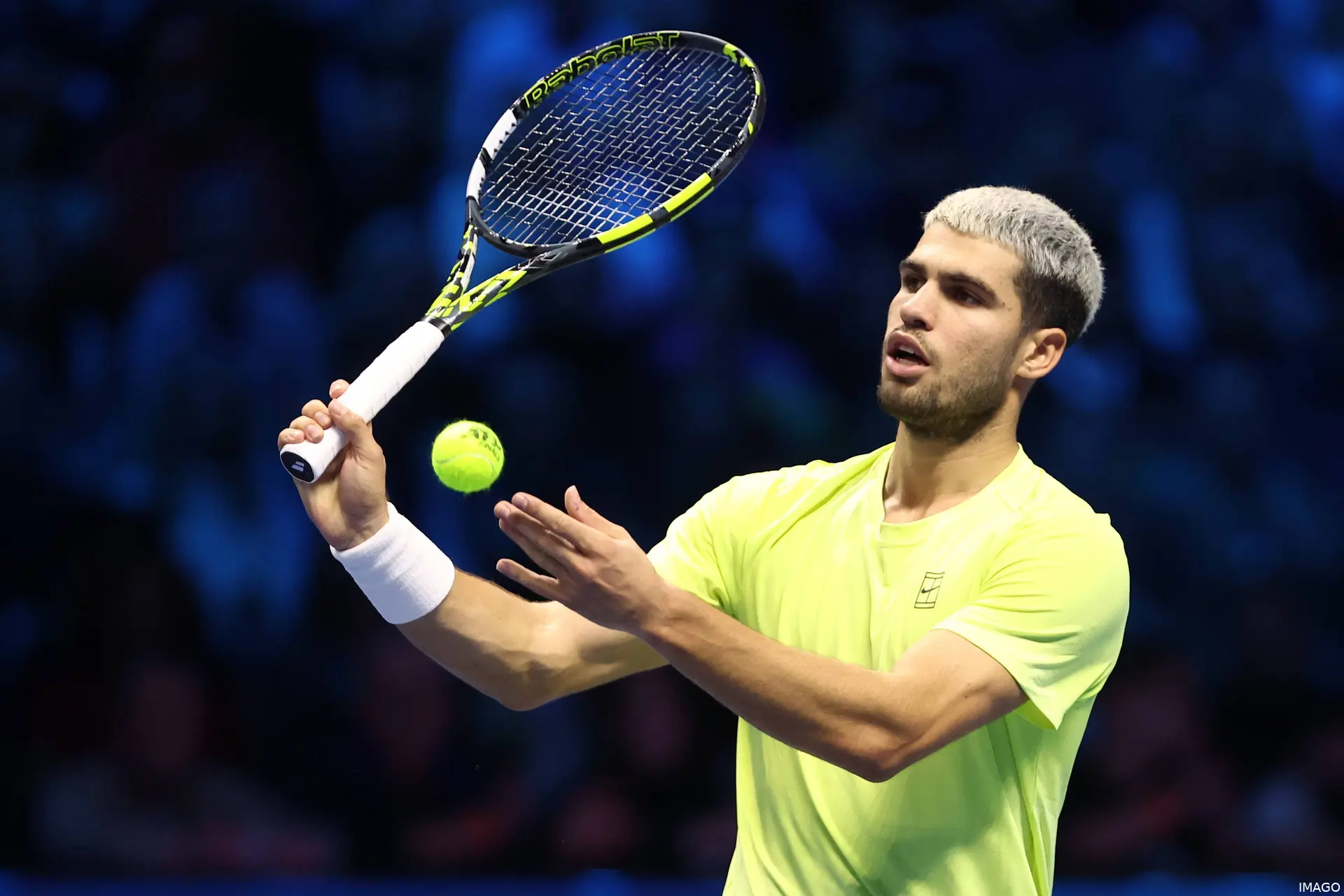
Another day, another Carlos Alcaraz victory, The six-time Grand Slam champion continues to progress through the early stages of the Australian Open with a commendable 7-6(4), 6-3, 6-2 win over Yannick Hanfmann.
The first set would take 80 minutes, with Hanfmann the first one to get his nose in front. He was instantly pegged back, and a tiebreak would eventually reveal itself. Alcaraz up his level late on to secure the set before he started to settle in the match. A break in the second set to go 4-1 up gave him more than enough of an advantage, with a double break in the following set leaving Hanfmann with no chance of completing the seemingly impossible task of defeating Alcaraz.
Having his team to tell him he played well
Whilst his performance was at a very respectable level, he did not feel like that on court and had to wait for confirmation by his team. "Well, I didn’t see myself playing that well. But then, talking to my team, I realised that I played better than I thought, which I think is great," he admitted after the victory.
"When you’re on court, you can’t always see things clearly. Sometimes you get stuck in negative thoughts or focus on negative things, and you don’t see the bigger picture. When you watch the match from the outside, everything is much clearer. The way I felt on court is why I said I didn’t feel that good. But obviously, that was also because of Yannick—he played great shots and didn’t let me feel comfortable on court."
It is a huge positive to hear these thoughts from his team, which in turn would give him a much needed confidence boost and the feeling that things are on track. "In general, those conversations with my team after the match help me a lot for the next round, to see things more clearly," he confirmed.
Technical adjustments
One of the reasons Alcaraz has motored away from the chasing pack is due to his continuous motivation to improve every technical aspect of his game, as he keeps pushing to get better and extend his lead at the top.
One of these focuses have been in the serve, something that is not always considered his strongest weapon. "The serve is something where I’ve seen that there have been a lot of changes over the last year. I’m not sure I’ve been changing anything specific or putting too much attention on it."
Not all the shots are in need of constant technical tweaks, with his mentality coming into the picture as a key factor in how he gets the best out of himself. "But outside of shots, I’ve adjusted how I behave, how I talk to myself, and how I approach every match and every tournament. In really difficult moments during matches, it’s about how I deal with them. Those are the adjustments I’ve tried to make in the best way possible over the last year, and that’s something I’ve been really focused on."
World number one not feeling like ambassador
Being the world number one comes with a lot of responsibilities to represent the sport to a high level, not just on the court. Or that is what many people think, with Alcaraz solely focusing on what he does with a racket in his hand.
"I don’t think about being a good ambassador for tennis, he said. "But at the same time, the way I play is sometimes about trying to entertain people and engage them to watch more tennis. Still, I’m not thinking that I have to be the best ambassador possible."
He looks to use his influence on court, doing the thing he loves. "For me, stepping on court is just doing what I love to do—playing tennis. I think that, in a way, is the best way I can be a good ambassador: loving what you do and enjoying every single second you step on court. That’s really all that’s in my mind."
Overcoming painful blisters
After mentioning about adjusting things, a reporter questioned whether the Spaniard is dealing with blisters on the court, specifically on his hands which would cause a very painful experience and not a nice sensation.
Read also
Fortunately, this was not the case. "Luckily, I don’t have any blisters on my hands right now, so that’s good for me," he said, although he is not totally out of the woods. "I have had blisters on my feet, though, and it’s not a comfortable situation, to be honest."
At the end of the day, it is only pain. "But sometimes you have to be a warrior," he bravely stated. "If you feel pain in some part of your body—blisters or whatever it is—you have to go through it and try to be the best player possible on court. Obviously, having blisters on your hands, where you hold the racket, is not a great thing. But I haven’t felt that yet, and hopefully I never will."
Lucas MichaelTennis Journalist
Lucas Michael is a tennis journalist based in Cambridge, UK, specializing in comprehensive coverage of the ATP and WTA tours. For the past 1.5 years, he has been a core contributor to TennisUpToDate, where he has authored more than 3,000 data-driven match reports, deep-dive analysis pieces, and engaging liveblogs.
Lucas pairs real-time statistical analysis with on-the-ground reporting, frequently traveling to tournaments to cover the action firsthand from the press box and player press conferences. This blend of advanced metrics and direct access allows him to provide sharp context regarding player form, tactical trends, and breaking tour developments.
He holds a BA (Hons) in Sports Journalism. Grounded in core journalistic ethics, Lucas places a strict emphasis on meticulous sourcing, editorial accuracy, and a commitment to updating live content swiftly as verified information emerges.
claps 0visitors 0
Just In



Popular News

Latest Comments
- Lena... Takin' care of business
 mandoist25-10-2026
 - Can you please stop publishing this nonsense? Stick to Tennis.mandoist25-10-2026
- Does Sinner need that 4.5 mil? I doubt it. He can make that with three modelling gigs!😅🤣Rapunzel21-10-2026
- Did "People Magazine" purchase this website? This nonstop storyline is bullshit.mandoist21-10-2026
- Listen... this is of no concern to anyone but these two. Deal with your own issues -- most of us have our own. Thanks, media, for these insignificant follow-ups which are meaningless.mandoist21-10-2026
- This is so very very sad, for all three of them. I truly thought they had an unbreakable bond, but life throws up so many differing challenges. Having your homeland suffering in such a terrible way, makes happiness lose out to guilt as well. Our thoughts are with them. X💔bjsexton20-10-2026
- I have lost all respect for Svitolina! Could she not have waited until he had played at the Paris Masters!!! She is selfish and don't give a damn about Gael. That is NOT how love is demonstrated Elina!!Rapunzel19-10-2026
- Perhaps convenient tennis tour sex is not a strong enough experience in which to base a marriage?mandoist19-10-2026
- Fight the Good Fight... Tennis (sports in general) need more Humans such as yourself.mandoist18-10-2026
- When is WTA going to mandate Genetic Testing (DNA) ???mandoist18-10-2026

Loading