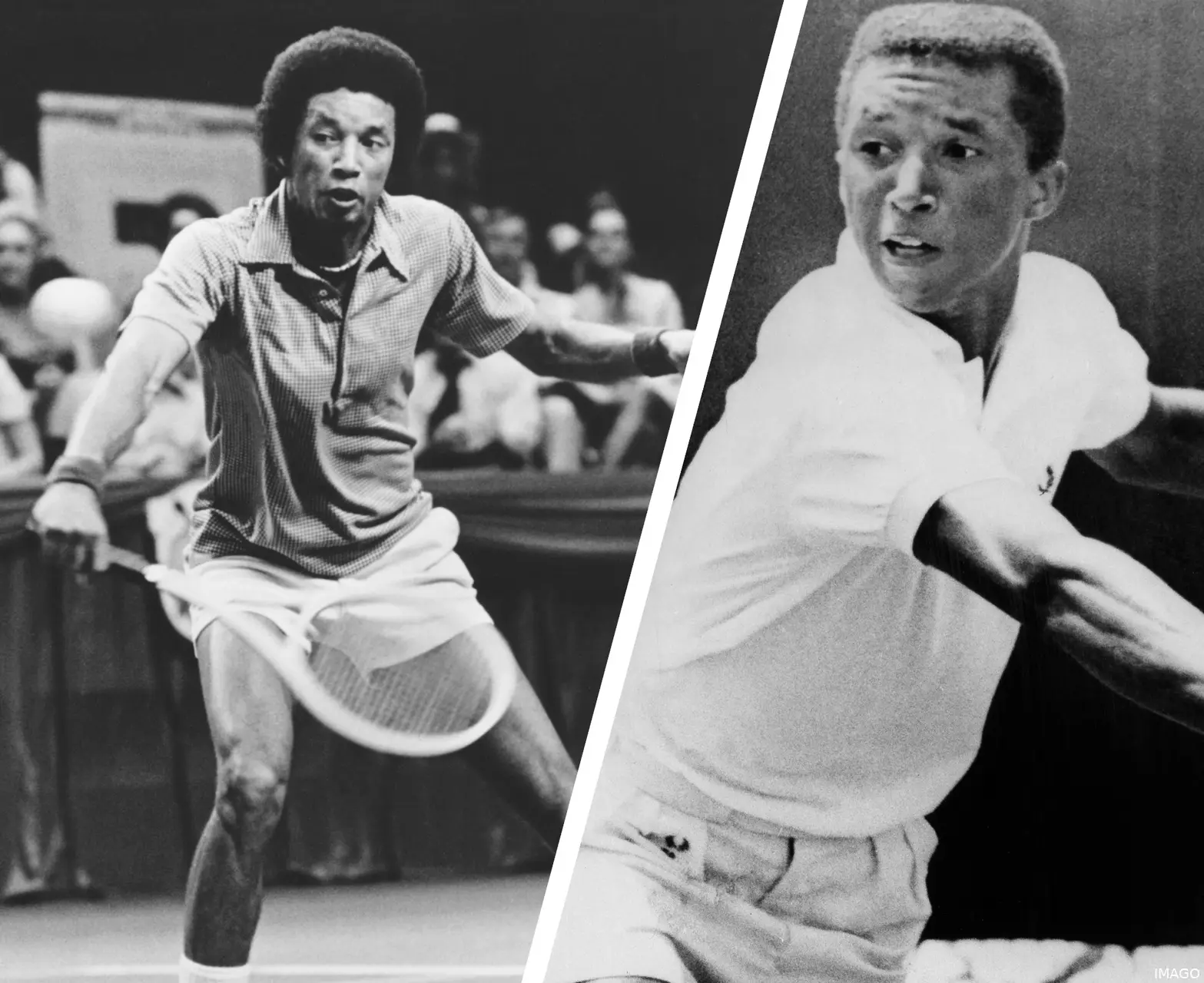
Arthur Ashe is a true pioneer in the history of tennis. He was the first black player to achieve a number of milestones. The American remains the only black player to win Wimbledon, the US Open, and the Australian Open. His activism off the court ranks him alongside Billie Jean King for using his platform to accelerate change in society. Throughout his rich career, Arthur Ashe compiled an 818–260 match record and won 51 titles.
Arthur Ashe: Early Life and Successes
Born on the 10th of July, 1943, in Richmond, Virginia, to parents Arthur Ashe Snr. and Mattie Ashe. His mother, through complications in pregnancy, passed away at the age of only 27. Arthur was just six years old. He also had a brother, Johnnie.
Ashe initially played in the amateur era, winning the first of 76 singles titles at the 1961 Eastern Clay Court Championships in Hackensack, USA. The American continued to win regular titles in the 1960s and then reached his first Grand Slam final at the 1966 Australian Open, losing to Roy Emerson. He lost in the final to the same opponent the following year.
Ashe's Grand Slam brilliance
His maiden Grand Slam triumph would come on home soil at the 1968 US Open. In an epic final, against Tom Okker of the Netherlands, Ashe prevailed in five sets. In a seismic landmark for tennis, Ashe became the first black man to win a Grand Slam singles title. It would be the catalyst for a sustained rise in the upper echelons of elite tennis.
A second Grand Slam success would materialise in 1970, at the Australian Open, defeating compatriot Dick Crealy in straight sets. This was in the days when the season's opening major was still played on grass. Ashe made just six appearances in Melbourne, reaching the final on four occasions.
Read also
The year 1975 proved to be Ashe's greatest year as he accumulated a total of nine titles. The undoubted zenith came in the summer at Wimbledon. Ashe reached the men's singles final against the defending champion, Jimmy Connors. At the time, Ashe and Connors were embroiled in litigation action against each other. Relations between the pair were considerably fractious. Connors was suing the ATP, which had Ashe serve as president, over restraint of trade after the pugnacious Connors was refused entry to the 1974 French Open owing to Connors's involvement with World Team Tennis. The legal action expanded when Connor began a case against Ashe over comments Ashe'd made about him being unpatriotic for his lack of commitment to the US Davis Cup team.
Going into the final, Ashe had yet to record a victory over Connors. In an effort to provoke him further, Ashe wore the USA Davis Cup team when walking onto Centre Court. Ashe went against his natural game and produced a tactical masterclass against Connors. His four-set victory was underpinned by nullifying Connors and leaving him flustered through the surprise elements of his gameplan.
The haul of titles Ashe collected in 1975 featured the prestigious WCT Finals (now ATP Tour Finals) after he defeated Bjorn Borg in the finals, held in Dallas. This ranks as his finest individual success outside the three majors he won. He would go on to finish 1975 as ATP Player of the Year.
Representing the United States of America, Ashe was part of four Davis Cup-winning teams. Triumphs in 1963, 1968, 1969 and 1970 established him as an American tennis superstar. Ashe was the first black man to feature for the US team.
A feeling of patriotic service was further instilled in Ashe when he enlisted in the United States Army in 1966. He was stationed at the US Military Academy at West Point, where he operated as a data processor. Ashe eventually ascended to 1st Lieutenant and was honorably discharged from the Army in February 1969. He would go on to receive a National Defense Service Medal for his service.
The one that got away
The one Grand Slam that eluded Ashe was the French Open. He made eight appearances at Roland Garros. His best showing were quarter-final appearances in 1970 and 1971. Following his annus mirabilis of 1975, Ashe never managed to sustain such a prolific rate of success. However, he added eight further titles in the next three years. The last title of his singles career, in 1978, came at a tournament in Los Angeles on the now-defunct carpet surface.
In addition, Ashe has won two Grand Slam doubles titles. The first of these was clinched at the 1971 French Open alongside compatriot Marty Reissen. They defeated another all-American pairing of Stan Smith and Tom Gorman. The Ashe/Reissen combination prevailed in an epic fifth set, 11-9. Six years had elapsed before Ashe became a multiple Grand Slam doubles champion. At the 1977 Australian Open, playing alongside Aussie favourite Tony Roche, they bested Charlie Pasarell and Erik van Dillen in straight sets.
He also lost in three Grand Slam doubles finals: 1968 Wimbledon (with Andres Gimeno), 1970 French Open (with Pasarell) and 1971 Wimbledon (with Ralston). Ashe embellished his doubles CV with an additional 16 doubles titles at the tour level, finishing with a 323/176 win/loss record. His highest doubles ranking was 15.
Ashe retired in 1980. He led a varied and substantive post-tennis life until his tragic early passing. The erudite Statesider used those skills to foster a career in print and broadcast journalism. A role with the Washington Post and Time Magazine soon followed his tennis career. He also worked as a tennis summariser for both ABC and HBO on American television, a role that lasted until a few months before he passed.
Retirement and civil rights activism
A stint as US Davis Cup Captain was an inevitable transition for a player so dedicated to the venerable team competition. A five-year stint as captain started with consecutive triumphs in 1981 and 1982. He stepped down after the 1985 edition.
Ashe was a passionate civil rights activist. In conjunction with actor and singer Harry Belafonte, they established the group Artists and Athletes against Apartheid. The group called for a cultural boycott of South Africa. On the 11th of January 1985, Ashe was arrested outside the South African Embassy, Washington D.C during an anti-apartheid rally. He would later travel to South Africa to see for himself the dissolution of Apartheid and the reintegration of black people into South African society following the release of Nelson Mandela. A year later, Ashe was arrested for a second time while protesting outside the White House for their clampdown on refugees from Haiti.

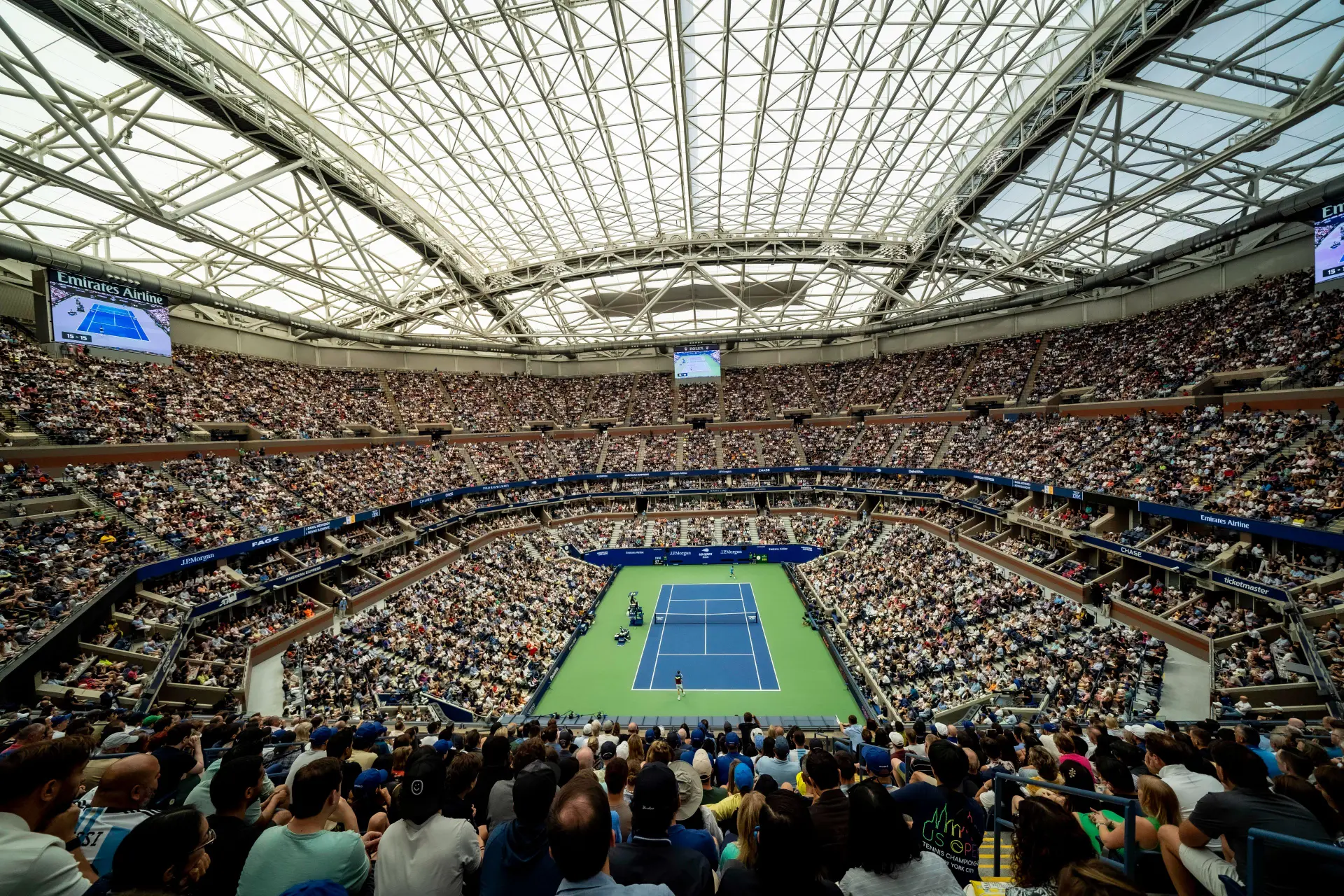
The stadium at the US Open named after the legendary American.
HIV and AIDS activism, and the unfortunate passing
Ashe eventually revealed to the public he'd been diagnosed as HIV Positive. He quickly founded the Arthur Ashe Foundation for the defeat of AIDS. He wanted to raise awareness of the illness and debunk myths surrounding it. Two months prior to his death, Ashe also established the Arthur Ashe Institute for Urban Health. It was introduced to improve defective healthcare delivery. He went on to be named Sports Illustrated's Sportsman of the Year.
Ashe married photographer and graphic artist Jeanne Moutoussammy in 1977. Their ceremony was officiated by Andrew Young, then the US Ambassador to the United Nations. The couple would go on to adopt a daughter in 1986, whom they named Camera.
Ashe survived a heart attack at the age of 39. His family had a history of heart issues. His mother died at 27 when already experiencing cardiovascular issues. Ashe's father suffered two heart attacks. While the family kept the diagnosis private for several years, Ashe went public with his HIV condition in 1992, triggered by pre-empting USA Today revealing it without his consent, with much criticism of Ashe being forced to reveal his condition.
On the 6th of February 1993, Ashe died from AIDS-related pneumonia, aged just 49. His funeral would see over 6,000 mourners attend. A memorial service was held six days later. On his own request, he was buried in the same cemetery as his mother in Woodland Cemetery, Richmond, Virginia.
Rightfully, Ashe has been honoured in several ways. Sporting awards included the 1975 BBC Sports Personality of the Year and a number of ATP awards. He was inducted into the ITF Hall of Fame in 1985. A sports Emmy came his way for his documentary A Hard Road To Glory. An honorary doctorate was bestowed upon him in 1991 from the College of William and Mary in Virginia. In 1993, the ATP recognised his passing by creating the Arthur Ashe Humanitarian Award. Three years later, a statue of Ashe was erected on Monument Avenue. Later that year, the USTA renamed the main centre court at the US Open after Ashe - the Arthur Ashe Stadium. More recently, in 2019, Arthur Ashe had a boulevard named after him in Virginia. A vast number of honours underlining the impact of a man, like Billie Jean King, left a legacy that transcended tennis.
Arthur Ashe: Career Titles and Major Achievements
| Category | Achievement | Details |
| Singles Grand Slams | 3 | US Open (1968), Australian Open (1970), Wimbledon (1975) |
| Doubles Grand Slams | 2 | French Open (1971), Australian Open (1977) |
| Total Career Titles | 76 | 44-51 Singles titles (Open Era records vary), 18+ Doubles |
| Career-High Ranking | No. 2 | Peaked in May 1976 (World No. 1 in 1968/1975 pre-computer) |
| Davis Cup (Player) | 5 Titles | Winner: 1963, 1968, 1969, 1970, 1978 |
| Davis Cup (Captain) | 2 Titles | Led USA to victory in 1981 and 1982 |
| NCAA Champion | Singles & Doubles | Won both for UCLA in 1965 |
| Historic Firsts | Pioneer | First Black man to win US Open, Australian Open, and Wimbledon |
Arthur Ashe: Major Finals and Milestones
| Year | Competition / Tournament | Result | Category |
| 1963 | Davis Cup | Member | 1st African-American selected for US Team |
| 1965 | NCAA Championships | Winner | Singles & Doubles Champion (UCLA) |
| 1968 | US Amateur & US Open | Winner | Only player to win both in the same year |
| 1968 | Davis Cup | Winner | Spearheaded 4-1 victory over Australia |
| 1970 | Australian Open | Winner | 2nd Grand Slam Singles Title |
| 1971 | French Open | Winner | Men's Doubles (Partner: Marty Riessen) |
| 1972 | US Open | Runner-up | Lost epic 5-set final to Ilie Năstase |
| 1975 | Wimbledon | Winner | Historic upset over #1 seed Jimmy Connors |
| 1975 | WCT Finals | Winner | Defeated Björn Borg 3–6, 6–4, 6–4, 6–0 |
| 1977 | Australian Open | Winner | Men's Doubles (Partner: Tony Roche) |
| 1981 | Davis Cup | Captain | 1st title as Non-Playing Captain |
Jay Brannon is a sports journalist from Sutton Coldfield, England, with a lifelong passion for athletic competition and storytelling. For the past 1.5 years, he has been a prominent voice at TennisUpToDate.com, where he has authored more than 3,000 articles, specializing in deep-dive columns, tactical analyses, liveblogs, and comprehensive match reports for the ATP and WTA tours.
Jay’s tennis reporting blends rigorous, real-time statistical analysis with on-the-ground coverage. He frequently travels to tournaments to cover the action firsthand from the press box and player press conferences. This direct access allows him to deliver sharp insight into player form and tour developments—a dedication sparked by his earliest sporting memory of the iconic 1991 Wimbledon final between Michael Stich and Boris Becker.
Beyond the court, Jay brings a versatile background in live broadcasting and media. His professional experience includes serving as a sports reporter for BHBN Hospital Radio—where he delivered live updates and analysis for West Bromwich Albion and Wolverhampton Wanderers matches—as well as working as a match reporter for Sutton Coldfield Town.
Jay holds a degree in Music Journalism and Broadcasting from Staffordshire University, a foundational training that shaped his voice as a thoughtful, authentic storyteller. Grounded in core journalistic ethics, he places a strict emphasis on careful sourcing, editorial accuracy, and swift, verified updates.
claps 0visitors 0
Just In

Popular News
Latest Comments
- A healthy Qinwen may be hard to stop next season. She was already scaring her opponents before her medical leave(s). Unfortunately, Zheng insisted on singing again. On the positive side -- Mirra did not sing!! ;~}
 mandoist11-10-2026
 - Where is it written that athletes, entertainers... People in general... are mandated to keep looking at -- or even using [anti]Social Media? Public & private figures consistently complain and reveal their concerns about negativity and violence thrown at them -- yet they insist on participating. Avoid it, don't use it, don't read it. It's okay to occasionally look up at the World instead beating your eyes & thumbs to death on The Inventions out there.mandoist11-10-2026
- great articlestennisseserver07-10-2026
- Medvedev was leading Djokovic 7-5, 3-5 when an attempted return..' NO you ignorants, Djokovic was leading .weiss05-10-2026
- No more bullshit "Wildcards" to these two. Qualify like everyone else -- there will be cameras there, too. Time to scream... WTF ????!!!!mandoist29-09-2026
- Let's not BS the general public -- Sabalenka started showing cracks in her game last season. Her losses and near-losses started at about the same time she began being distracted by Fame (constant Selfies, making TV commercials, magazine shoots, endless Social Media nonsense, etc., etc.) One would think even Saba could recognize the parallels with others who failed before her -- Raducanu, Giorgi, Bouchard to name a few.mandoist25-09-2026
- Gross!! Hey Raducanu, Giorgi, and Bouchard -- reserve a seat at your Social Media Selfie table for Saba + Naomi. They're heading in your direction soon enough.mandoist24-09-2026
- And then these same players will complain about how lengthy their season’s were and need more time-off. I’m all for more tennis but the amount of tennis we get now is actually kind of crazy! We all need a break, especially the players.DaveyWavey23-09-2026
- You should do a comparison article for "different kinds of justice" the courts decide for tennis players. I can think of at least three players who received very small bans of a few months, however Tara Moore has been fighting for her literal survival the past few years. It seems odd considering she is not a "name" player, unlike the other cases.DaveyWavey22-09-2026
- PRIZE MONEY & POINTS Winner - $185,500 Finalist - $114,500 Semi-Finalist - $66,003 Quarter-Finalist - $35,000 Round of 16 - $18,045 Round of 32 - $13,005 Winner - 500 Finalist - 325 Semi-Finalist - 195 Quarter-Finalist - 108 Round of 16 - 60 Round of 32 - 1DaveyWavey20-09-2026

Loading