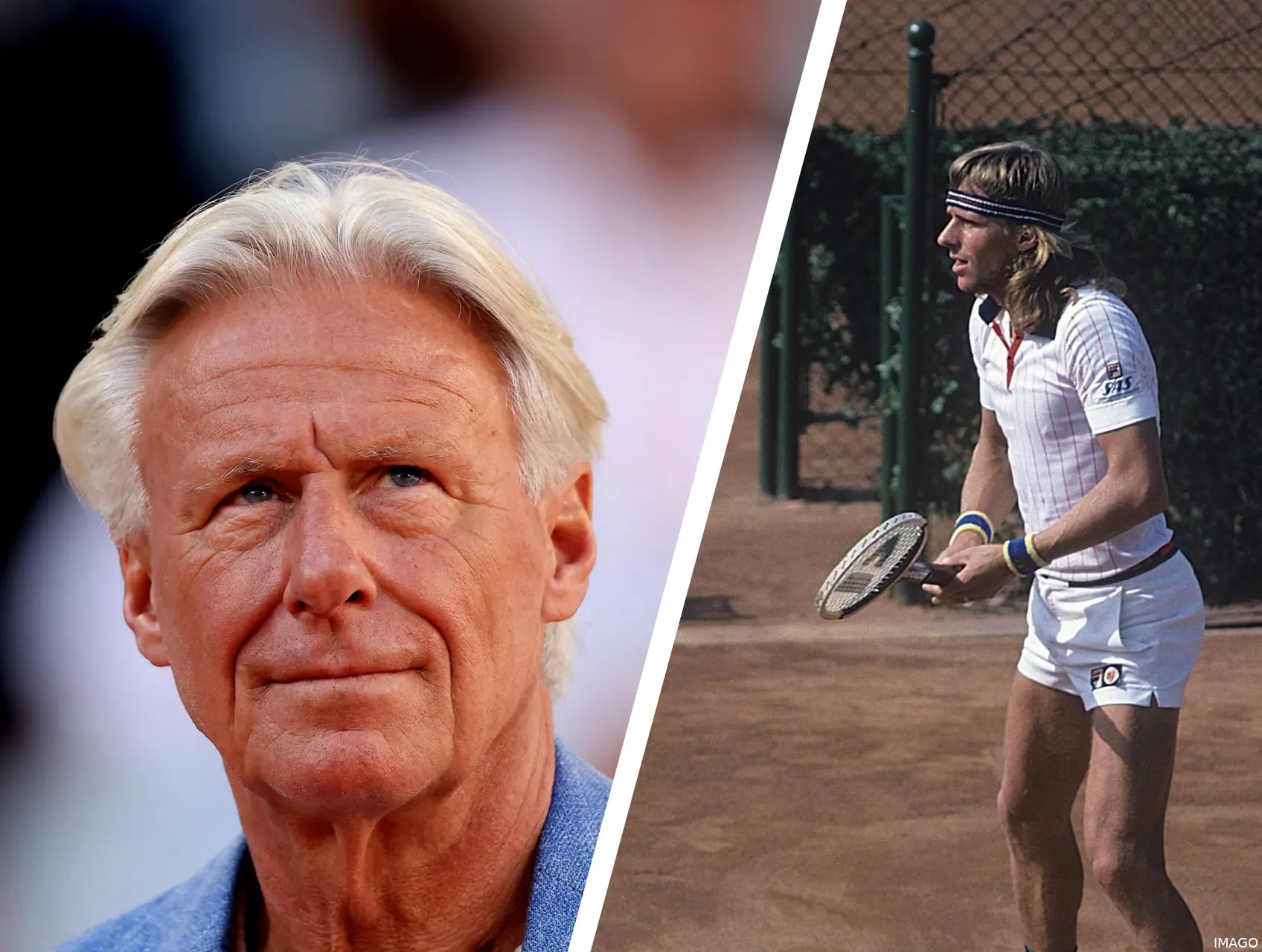
Bjorn Borg ushered in a level of fan hysteria previously unseen in tennis. He was the sport's first global superstar of the TV age and dominated the second half of the 1970s before stunning the sporting world with an immediate retirement, aged just 26, when still a major force in the game.
Bjorn Borg: Early life and successes
Born on June 6, 1956, Borg was the only child of parents Rune (died in 2008) and Margaretha. He was born in the Swedish capital Stockholm, but grew up in nearby Södertälje. Father Rune triggered Bjorn's interest in tennis by presenting him with a racket he'd won at a table tennis event. He was the junior Wimbledon champion in 1972.
Borg turned professional in 1973, at a time when Sweden had never produced a leading figure in tennis. Under the guidance of compatriot Lennart Bergelin, success came quickly with Borg winning his first title in 1974 at a tournament in Auckland. It proved to be one of eight titles he won that season, including a maiden Grand Slam success at the French Open. Borg fashioned a brutal comeback in the Roland Garros final, overturning a two-set deficit by winning the next three sets, for the loss of just two games, against Spaniard Manuel Orantes.
A further quintet of titles followed in 1975, including retention of his French Open title with a straight sets victory over Guillermo Vilas in the final.
The 1976 season saw him win four titles before he failed in his attempt to win a hat-trick of French Open titles, losing to eventual champion Adriano Panatta in the quarter-finals. This represented one of just two defeats for Borg at the clay court major. Atonement soon followed when Borg claimed his first Wimbledon title a month later, beating the gnarly Ilie Nastase in the showpiece contest.
His strike rate of success reached a new benchmark in 1977, when Borg accumulated twelve titles in a campaign highlighted by defending his Wimbledon title. The final saw him defeat Jimmy Connors in a five set thriller.
The first of his three successive French Open/Wimbledon doubles materialised in 1978. He was the first to achieve the Channel Slam in the Open Era. This feat was all the more difficult back then, as the transition from clay to grass was considered starker than the current situation, where the uniformity of playing surfaces has led to the adjustment being easier to navigate. He won both finals without dropping a set against Vilas and Connors, respectively.
In 1979, Borg matched his seasonal high of 12 titles. The Channel Slam proved tougher to win, though, with four sets required to best Victor Pecci in the French Open final, before he edged Roscoe Tanner, 6-4 in the fifth set, at the Wimbledon final. This meant he'd won each of the Slams based in Europe on four occasions. This season would mark the first time a player had passed a million dollars for prize money in a season.
The 1980s began with Borg celebrating success at the lucrative and elite Masters tournament in New York. A third title at Monte Carlo honed Borg’s clay court game heading into the French Open. He went on to win a fifth title in Paris with a comfortable victory over Vitas Gerulaitis. The following month saw Borg involved in the greatest match of his career.
Borg vs McEnroe rivalry
The Swede’s encounter with John McEnroe was the apex of a rivalry which transcended the sport, and the match is often in the conversation as the greatest match ever played. Tennis journalist Christopher Clarey still regards it as number one. The match is best recalled for a marathon tiebreak in the fourth set, where the younger McEnroe prevailed 18-16 to force a decider. Wisdom suggested McEnroe had broken the ice-cool Swedish superstar mentally. However, Borg had a different reaction than expected and held his nerve to win 8-6 in the fifth set. This was Borg's greatest hour as a fifth consecutive Wimbledon title clinched a third straight Channel Slam. No man has ever completed the French/Wimbledon double more times.
The 1981 season would prove to be Borg's last full season. A fourth consecutive French Open crown would be the standout moment of a season that numbered four titles. The last win of his career came in September 1981, in Geneva. Defeats to McEnroe in the Wimbledon and the US Open finals signalled that the baton of power had passed to the American serve and volleyer.
Borg's early retirement
The decision to retire at just 26 stunned the sporting world. He'd lost his status as the game's premier force, but his success in Paris clearly underlined his game was still in fantastic shape. Borg’s choice to exit in his pomp came down to a disillusionment with life in the spotlight. No tennis player had ever experienced the fan hysteria that greeted Borg worldwide. It drew parallels with Beatlemania. Any person would have potentially found it suffocating, but Borg was a reserved man who yearned for a life of greater bliss and anonymity.
His final tally of 11 Grand Slams, from 16 finals, places him joint sixth (with Rod Laver) for Grand Slams won. He retired with an Open Era record six French Open titles. This was eventually surpassed in 2012 by Rafael Nadal. Borg amassed 66 career titles from 93 singles finals appearances. This included 15 wins in Super Series (a forerunner of today's 1000 tournaments) events. Borg only ever played in one Australian Open and lost four finals in the US Open.
Borg holds the record for the longest winning streaks in the Open Era of the men's game. He produced a 49-match-winning streak in 1978 and then embarked on a stretch of 48 matches won in succession overlapping the 1979 and 1980 seasons. He also set the record for most 6-0 sets won on the ATP Tour, a total of 131, bettering second-placed Roger Federer by 38.
In honour of his country, Sweden, he was part of the Davis Cup winning squad in 1975, winning both of his singles rubbers during the final against Czechoslovakia. He was victorious in 33 consecutive singles rubbers at one stage. Borg first played for Sweden when he was 15.
Reaching the summit
Borg was one of the first leading players to focus almost entirely on singles competition. He did pick up four doubles titles, but none of these were Slams. Borg first reached the summit of the world rankings in 1977. He totalled 109 weeks in all at number one (8th all-time) and finished year-end number one in 1979 and 1980.
His game was centered around his baseline game, relentlessly breaking opponents down with his consistent groundstrokes. His temperament was outstanding. He never lost his cool and handled pressure moments with remarkable clarity. His physical conditioning was also regarded as the best of his generation. Something which served him well for the longer rallies on his favoured clay court surface. He finished with a 96.08 win percentage at Roland Garros.
Borg has been married three times. His first marriage was to fellow pro Mariana Simonescu. It lasted four years. He was married from 1989 to 1993 to singer Loredana Berte. His current wife has proved to be his longest. He married Patricia Ostfeld in 2002. They have a son together called Leo, who is a current pro but hasn't been ranked higher than 334 so far. Borg has a much older son, Robin, from another relationship.
Following his initial retirement in 1981, Borg stayed away from tennis and led a relaxed existence away from the celebrity world. He made a comeback for a short period in the early 1990s. Bizarrely, Borg attempted to take on a younger generation, now playing with graphite rackets, with a wooden racket. He never won a match, and after not winning a set in any matches played in 1991 and 1992, Borg did manage to win a set in each of his three losses in 1993.
Borg’s rivalry with McEnroe was immortalised in a Borg vs McEnroe film that was released in 2017. He also discussed their rivalry in a number of tennis documentaries such as Gods of Tennis.
Post tennis career, including Laver Cup captains
Sweden’s finest was inducted into the International Tennis Hall of Fame in 1987. Borg has garnered many awards, such as the 1979 BBC Overseas Sports Personality of the Year. The corporation also honoured him with their Lifetime Achievement Award at the 2006 BBC Sports Personality of the Year ceremony. Swedish newspaper Dagens Nyheter elected him Sweden's greatest sportsperson in 2014.
From its inception in 2017 to 2024, Borg was captain of Team Europe in the Laver Cup. It was an opportunity to renew his old rivalry with McEnroe, who was captain of the opposing Team World side. Borg's team were champions of the first four editions.
In early 2025, Borg released an autobiography that included a final chapter explaining he was diagnosed with an extremely aggressive form of prostate cancer. He's been in remission since 2024, but acknowledged there's a high chance of it recurring.
Borg is regularly placed in many tennis observers' top ten players of all time. Any assessment of his career needs to compute how relatively short his career was in comparison to many other greats. However, Borg’s strike rate in the Slams compares favourably with any in the pantheon of greats. He basically only played three of the four Slams and still won more than most. The first rockstar of tennis produced a body of work featuring a vast collection of greatest hits.
Björn Borg: Career Titles and Major Achievements
| Category | Achievement | Details |
| Singles Grand Slams | 11 | French Open (6), Wimbledon (5) |
| Total ATP Titles | 66 | Includes 2 Year-End Championships (1979, 1980) |
| Win Percentage | 82.7% | Second-highest career win percentage in the Open Era |
| Wimbledon Dominance | 5 Titles | Won five consecutive titles (1976–1980) |
| French Open Record | 6 Titles | Held the record for most titles until surpassed by Rafael Nadal |
| Channel Slam | 3 Consecutive | Won the French Open and Wimbledon in the same year (1978, 1979, 1980) |
| World No. 1 | 109 Weeks | First reached the top spot in August 1977 |
| Davis Cup Streak | 33 Matches | Holds the record for the longest singles winning streak in Davis Cup history |
Björn Borg: Major Finals and Milestones
| Year | Competition / Tournament | Result | Category |
| 1973 | Monte Carlo | Debut | Reached the final at age 16 |
| 1974 | Italian Open | Winner | First major professional title (Age 17) |
| 1974 | French Open | Winner | 1st Grand Slam Singles Title (Youngest winner at the time) |
| 1975 | Davis Cup | Winner | Led Sweden to its first-ever Davis Cup title |
| 1976 | Wimbledon | Winner | Won first of 5 straight titles without dropping a set |
| 1978 | French Open | Winner | 3rd Roland Garros title; started 3-year "Channel Slam" run |
| 1980 | Wimbledon | Winner | Defeated John McEnroe in the legendary 18–16 tiebreak final |
| 1981 | French Open | Winner | 11th and Final Grand Slam Singles Title |
| 1981 | US Open | Runner-up | 4th final in New York; retired shortly after at age 26 |
| 1991 | Monte Carlo | Return | Attempted a comeback with his original wooden racquet |

Jay Brannon is a sports journalist from Sutton Coldfield, England, with a lifelong passion for athletic competition and storytelling. For the past 1.5 years, he has been a prominent voice at TennisUpToDate.com, where he has authored more than 3,000 articles, specializing in deep-dive columns, tactical analyses, liveblogs, and comprehensive match reports for the ATP and WTA tours.
Jay’s tennis reporting blends rigorous, real-time statistical analysis with on-the-ground coverage. He frequently travels to tournaments to cover the action firsthand from the press box and player press conferences. This direct access allows him to deliver sharp insight into player form and tour developments—a dedication sparked by his earliest sporting memory of the iconic 1991 Wimbledon final between Michael Stich and Boris Becker.
Beyond the court, Jay brings a versatile background in live broadcasting and media. His professional experience includes serving as a sports reporter for BHBN Hospital Radio—where he delivered live updates and analysis for West Bromwich Albion and Wolverhampton Wanderers matches—as well as working as a match reporter for Sutton Coldfield Town.
Jay holds a degree in Music Journalism and Broadcasting from Staffordshire University, a foundational training that shaped his voice as a thoughtful, authentic storyteller. Grounded in core journalistic ethics, he places a strict emphasis on careful sourcing, editorial accuracy, and swift, verified updates.
claps 0visitors 0
Just In

Popular News
Latest Comments
- A healthy Qinwen may be hard to stop next season. She was already scaring her opponents before her medical leave(s). Unfortunately, Zheng insisted on singing again. On the positive side -- Mirra did not sing!! ;~}
 mandoist11-10-2026
 - Where is it written that athletes, entertainers... People in general... are mandated to keep looking at -- or even using [anti]Social Media? Public & private figures consistently complain and reveal their concerns about negativity and violence thrown at them -- yet they insist on participating. Avoid it, don't use it, don't read it. It's okay to occasionally look up at the World instead beating your eyes & thumbs to death on The Inventions out there.mandoist11-10-2026
- great articlestennisseserver07-10-2026
- Medvedev was leading Djokovic 7-5, 3-5 when an attempted return..' NO you ignorants, Djokovic was leading .weiss05-10-2026
- No more bullshit "Wildcards" to these two. Qualify like everyone else -- there will be cameras there, too. Time to scream... WTF ????!!!!mandoist29-09-2026
- Let's not BS the general public -- Sabalenka started showing cracks in her game last season. Her losses and near-losses started at about the same time she began being distracted by Fame (constant Selfies, making TV commercials, magazine shoots, endless Social Media nonsense, etc., etc.) One would think even Saba could recognize the parallels with others who failed before her -- Raducanu, Giorgi, Bouchard to name a few.mandoist25-09-2026
- Gross!! Hey Raducanu, Giorgi, and Bouchard -- reserve a seat at your Social Media Selfie table for Saba + Naomi. They're heading in your direction soon enough.mandoist24-09-2026
- And then these same players will complain about how lengthy their season’s were and need more time-off. I’m all for more tennis but the amount of tennis we get now is actually kind of crazy! We all need a break, especially the players.DaveyWavey23-09-2026
- You should do a comparison article for "different kinds of justice" the courts decide for tennis players. I can think of at least three players who received very small bans of a few months, however Tara Moore has been fighting for her literal survival the past few years. It seems odd considering she is not a "name" player, unlike the other cases.DaveyWavey22-09-2026
- PRIZE MONEY & POINTS Winner - $185,500 Finalist - $114,500 Semi-Finalist - $66,003 Quarter-Finalist - $35,000 Round of 16 - $18,045 Round of 32 - $13,005 Winner - 500 Finalist - 325 Semi-Finalist - 195 Quarter-Finalist - 108 Round of 16 - 60 Round of 32 - 1DaveyWavey20-09-2026

Loading