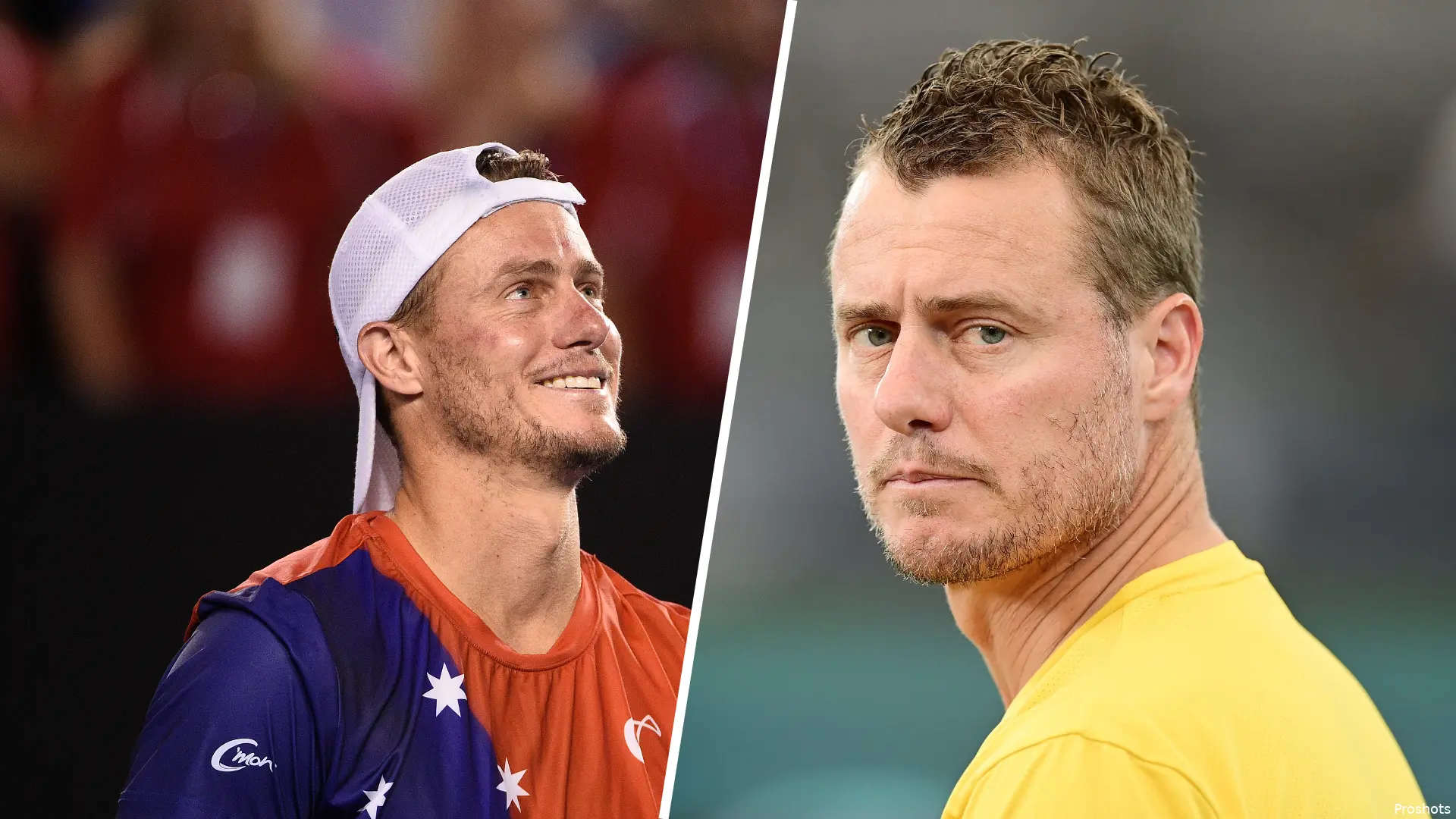
For a short period in the early 2000s, Lleyton Hewitt threatened to become a dominant force in men's tennis. Triumphs at the US Open and Wimbledon within ten months underpinned a 80-week stint as world number one. The emergence of Roger Federer dispelled that prospect but Hewitt still finished as the greatest Australian male player since the halcyon days of Rod Laver, John Newcombe and Roy Emerson.
Hewitt was born Adelaide, South Australia on February 24th 1981. His parents both had careers in sport. Father Glynn was an accomplished Aussie Rules Football player and Lleyton’s mother Cherilyn worked as a physical education teacher. Sister Jaslyn competed as a bodybuilder and worked in tennis coaching. Uncle Darryl played football, too.
Hewitt competed in Aussie rules until 13 and the abrasive nature of that sport shaped the competitive intensity Hewitt brought to a tennis court. Never has a player, other than Rafael Nadal, maintained such a high intensity point-to-point.
Hewitt's junior career was a solid one, reaching 17 in the rankings and finishing with a 44-19 win/loss record.
Read also
Qualifies for Australian Open at 15 and becomes lowest ranked winner of an ATP event
When just 15, Hewitt qualified for the main draw of the 1997 Australian Open. It made him the youngest qualifier in the event's history.
He turned professional in 1998 and quickly made an impact. Ranked 550 at the time, Hewitt stormed to victory in the Adelaide International, bagging Andre Agassi as a scalp. This remains a record for the lowest ranked player to win an ATP title. He was also the third youngest.
The 1999 campaign witnessed an upward trajectory for the teenage Hewitt. He lost in the final defending in Adelaide but later that year won a second ATP title at the Delray Beach Open. The Australian finished the season at 25 in the world rankings.
Breakthrough into the top ten and first major semi
Hewitt amassed four titles in the 2000 season. This included back-to-back titles in Australia at the outset of the year and a maiden title on grass at Queen's Club.
The year witnessed Hewitt making significant progress in the majors. He reached the last 16 for the first time in Grand Slams at the Australian Open and followed suit in Paris. He topped this by reaching the final four at the US Open, where his run came to an end when bested by Pete Sampras. Hewitt ended the year inside the top ten for the first time, and became the first teenager to qualify for the season-ending ATP Finals.
The highlight of Hewitt's year was arguably teaming up with big-serving Max Mirnyi to lift the doubles title at the US Open.
2001-2002: Hewitt takes on the mantle as world number one and wins two Grand Slams
The peak of Hewitt's career unfolded over the 2001 and 2002 seasons. It saw him, aged just 20, assume the world number one spot, becoming the youngest man to hold the position (a record since ceded to Carlos Alcaraz).
Success at the Sydney International kick-started the 2001 season in a winning fashion. Things went a little quiet until the grasscourt season where he picked up consecutive titles at Queen's and the Rosmalen Championships.
At the US Open of 2001, Hewitt produced a storming performance against Sampras in the final to lift a first Grand Slam trophy. He won the last two sets for the loss of just two games. Sampras was now a slightly diminished force, but this straight sets destruction felt like a potential changing of the guard.
Career Statistics Overview
| Category | Titles Won | Runner-up |
| Grand Slam (Singles) | 2 | 2 |
| Year-End Championships | 2 | 1 |
| ATP Masters 1000 | 2 | 5 |
| ATP Tour Titles (Singles) | 30 | 16 |
| ATP Tour Titles (Doubles) | 3 | 5 |
Hewitt finished his year with two more titles to swell his seasonal tally to six. The sixth trophy lift came at the ATP Tour Finals, a triumph that saw Hewitt clinch the world number one spot in the process.
Five titles came Hewitt's way in 2002. The first was at the Pacific Coast Championships. He then went on to the Indian Wells Open, his maiden win at a 1000 event.
Hewitt remained number one throughout the year and it was on the grass at Wimbledon where he doubled his major haul. A third straight title at Queen's was ideal preparation heading to SW19. A semi-final win over home favourite Tim Henman, a player Hewitt never lost to, put him into the title match against David Nalbandian, a surprise finalist.
The final was one-sided as Hewitt won in three sets. It's best remembered for being the final that signalled a shift in how grass court tennis was going to be played. Serve and volley was the popular way of playing on grass, but a slowing down of courts was reflected in the 2002 final by neither protagonist serve and volleying at all.
Loses the top ranking but remains a force as Federer starts to dominate
Hewitt’s reign as world number one ended in 2003 as talk of dominance quickly abated. A failure to progress beyond the last 16 at any of the majors was a big drop-off in form. Both of his titles this term materialised in March, including a successful defence of his Indian Wells crown.
Federer began to dominate men's tennis in 2004 and Hewitt was left in the chasing pack. Four titles was a good return for the season, even if none were above 500 level. A third Sydney International was the pick of the quartet.
Hewitt experienced a good year in the majors where he reached the last eight at Roland Garros and Wimbledon. Later in the year, Hewitt was beaten in the US Open final by Federer.
A fiercely patriotic Australian, Hewitt yearned for success at his home major and ending a long wait for an Aussie winner of the men's singles title in the Australian Open. His best chance came in the 2005 showpiece against Russian Marat Safin. A four-set loss was arguably the most painful of his career.
Hewitt also reached the semis of Wimbledon and the US Open in 2005. He finished the season, despite no titles, inside the top ten. This would be the last time Hewitt achieved this feat.

Lleyton Hewitt - a legendary Aussie.
Late 2000s see Hewitt struggle to remain in the upper echelon of men's tennis
Hewitt ended a near two year wait for silverware when lifting a record-equalling fourth Queen's Club title. It was the only title of a 2006 season that saw Grand Slam last-eight runs in London and New York.
A third title at the Tennis Channel Open proved to be the highlight of a 2007 season where Hewitt failed to progress beyond round four at the Grand Slams.
The Adelaide star drew a trophy blank in 2008 but returned to the winner's enclosure in 2009 when claiming the US Claycourt Championship title. A quarter-final appearance at Wimbledon represented a final last eight appearance in the majors.
Hewitt's 2010 campaign was briefly illuminated by a rare win over Federer on the grass in the Halle final. By now, Hewitt was now finding grass his best surface as he struggled to be a major factor in the Slams.
Last two titles in 2014 before retirement two years later
Hewitt was now no longer a seed at majors and was battling to maintain a top 100 ranking. A couple of titles in 2014, including success at the defunct Hall of Fame Championship on grass helped him conclude the season at 50.
He finally called time on his career in 2016. A final major appearance came at the Australian Open, losing in round two to David Ferrer.
Hewitt finished his career with 30 singles titles from 46 finals. He spent 80 weeks at world number one across two separate spells. Three doubles titles were accrued.
A dual Davis Cup winner and current Australia captain
Hewitt played in an era where commitment to playing Davis Cup was on the wane, especially amongst the leading players. The attitude of Hewitt was a welcome contrast as he'd need to be seriously injured to swerve any Davis Cup tie.
He was part of two Davis Cup winning squads. The first triumph occurred in 1999 when despite losing his solitary live singles rubber, Australia beat France 3-2 in the final.
A couple of years later and the 3-2 scoreline was reversed as France won a decisive fifth rubber, in Melbourne, after Hewitt's win over Sebastian Grosjean forced a decider.
Hewitt played a winning hand in the 2003 final victory over Spain. The first rubber saw Hewitt claim a five-set victory over Juan Carlos Ferrero. Australia went on to win 3-1.
Hewitt holds the Australian record for most years active (19), most ties played (43), most matches won (59) and most singles matches won (42).
In 2015, even before his playing retirement, Hewitt was appointed Davis Cup captain. It's a role he's held ever since. Their best run being appearances in the finals of 2022 and 2023.
The revamp to the Davis Cup, which included largely scrapping the home and away dynamic, have been much criticised by the outspoken South Australian. His words carry extra weight due to him going against the grain in his playing days by maintaining a constant presence when called up.
Personal life and legacy
A pugnacious character on the court, Hewitt became embroiled in a series of controversies. A match with African-American James Blake, in 2001, caused a racism stir when Hewitt seemingly implied the skin colour of the umpire being similar to Blake may have influenced a line called against him.
The early part of his career coincided with a high-profile relationship with top women's player Kim Clijsters. They announced their relationship in 2000 and became engaged in 2003. Their impending nuptials were called off the following year.
Not long after this split, Hewitt started a relationship with then Home and Away actress Rebecca Cartwright. They married in 2005 and remain together. They've had three children, including a son Cruz who is following in his dad's footsteps by playing tennis. He even teamed up with his dad in doubles at last year's New South Wales Open.
Hewitt’s threatened dominance never ensued but he still enjoyed a length of time at world number one only a select few have bettered this century. His Davis Cup record compares favourably in the all-time pantheon. He's a player who maximised his ability and never left anything out there. He was the ultimate competitor.

Jay Brannon is a sports journalist from Sutton Coldfield, England, with a lifelong passion for athletic competition and storytelling. For the past 1.5 years, he has been a prominent voice at TennisUpToDate.com, where he has authored more than 3,000 articles, specializing in deep-dive columns, tactical analyses, liveblogs, and comprehensive match reports for the ATP and WTA tours.
Jay’s tennis reporting blends rigorous, real-time statistical analysis with on-the-ground coverage. He frequently travels to tournaments to cover the action firsthand from the press box and player press conferences. This direct access allows him to deliver sharp insight into player form and tour developments—a dedication sparked by his earliest sporting memory of the iconic 1991 Wimbledon final between Michael Stich and Boris Becker.
Beyond the court, Jay brings a versatile background in live broadcasting and media. His professional experience includes serving as a sports reporter for BHBN Hospital Radio—where he delivered live updates and analysis for West Bromwich Albion and Wolverhampton Wanderers matches—as well as working as a match reporter for Sutton Coldfield Town.
Jay holds a degree in Music Journalism and Broadcasting from Staffordshire University, a foundational training that shaped his voice as a thoughtful, authentic storyteller. Grounded in core journalistic ethics, he places a strict emphasis on careful sourcing, editorial accuracy, and swift, verified updates.
claps 1visitors 1
Just In


Popular News

Latest Comments
- Does Sinner need that 4.5 mil? I doubt it. He can make that with three modelling gigs!😅🤣Rapunzel21-10-2026
- Did "People Magazine" purchase this website? This nonstop storyline is bullshit.
 mandoist21-10-2026
 - Listen... this is of no concern to anyone but these two. Deal with your own issues -- most of us have our own. Thanks, media, for these insignificant follow-ups which are meaningless.mandoist21-10-2026
- This is so very very sad, for all three of them. I truly thought they had an unbreakable bond, but life throws up so many differing challenges. Having your homeland suffering in such a terrible way, makes happiness lose out to guilt as well. Our thoughts are with them. X💔bjsexton20-10-2026
- I have lost all respect for Svitolina! Could she not have waited until he had played at the Paris Masters!!! She is selfish and don't give a damn about Gael. That is NOT how love is demonstrated Elina!!Rapunzel19-10-2026
- Perhaps convenient tennis tour sex is not a strong enough experience in which to base a marriage?mandoist19-10-2026
- Fight the Good Fight... Tennis (sports in general) need more Humans such as yourself.mandoist18-10-2026
- When is WTA going to mandate Genetic Testing (DNA) ???mandoist18-10-2026
- Hey, Dan... you just wake up from a coma? Regardless -- Thanks for the comedy this morning!mandoist18-10-2026
- Two Things: 1. Stop allowing these Spoiled Trust-Fund Elitists to behave badly. Your little hand-slaps do not deter them. 2. STOP the incessantly annoying "towel wiping" nonsense!!!!mandoist15-10-2026

Loading