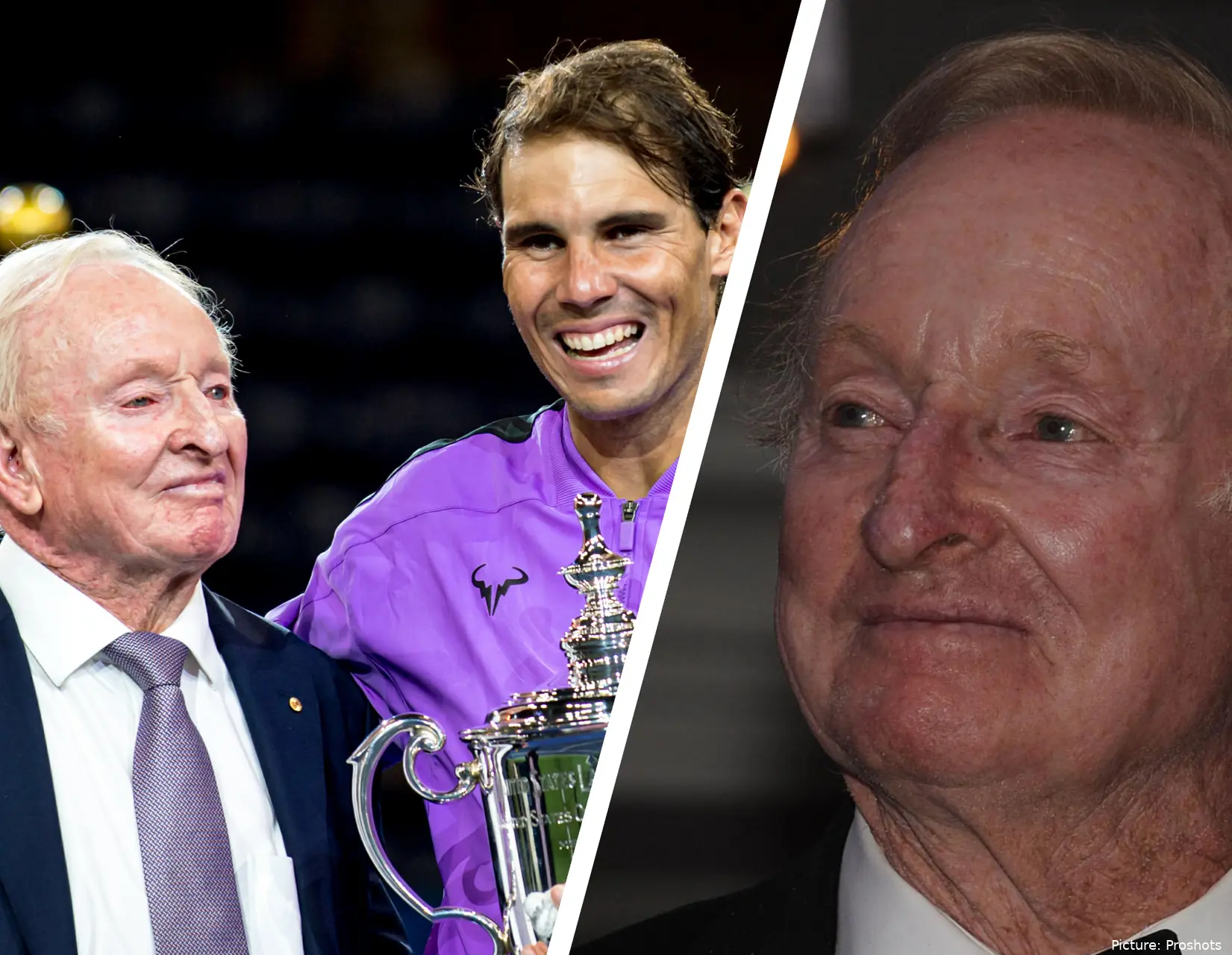
Rod Laver holds a unique place within the annals of tennis history. He’s the only man to win the calendar year Grand Slam in the Open Era, and the only man or woman to achieve this feat twice. Laver’s tally of eleven Grand Slam singles titles would almost certainly have been closer to 20 if not for a spell in the professional ranks when the Slams were open to only those of amateur status.
Rod Laver: Early life and first titles
Born Rodney George Laver on August 9, 1938, in Rockhampton, Queensland, Australia. He was the third child of Roy Laver, a cattleman and butcher, and his wife, Melba Roffey. His other relatives included cricketers Frank and Jack Laver. Laver quit school early to focus on his tennis career. He was initially coached by Charlie Hollis and later on worked with the most successful Davis Cup captain ever, Harry Hopman. It was Hopman who christened Laver with the nickname "Rocket".
In 1957, Laver pocketed both the Australian Championships and US Open junior crowns. By this stage, Laver was competing in the main draws of Grand Slams. He lost in the opening round of all four majors in 1956 and the first round of the 1957 Australian Open.
Announcing himself on the global stage
The 1959 campaign was the year Laver announced himself on the big stage. At that year's Wimbledon Championships, Laver reached the finals of all three events, singles, mixed and men's doubles, taking the mixed title alongside American Darlene Hard. Laver was beaten in an epic singles final, lasting 87 games, against Peru's Alex Olmedo.
Laver's breakthrough success at the Grand Slam level came in a marathon 1960 Australian Open final. He defeated compatriot Neale Fraser in five sets, winning the last two sets by an 8-6 scoreline. Fraser gained revenge by toppling Laver in the Wimbledon and US Championships final later in the year. Laver won a further eight titles after his Melbourne success. This was an era where the majority of tournaments were still being played on grass.
The 1961 season witnessed Laver win 17 titles, a mammoth tally which included a title success on Christmas Day in Manly. The undoubted highlight, though, was his first Wimbledon singles crown. A dominant straight sets win over the American Chuck McKinley gave Laver a second major title. Other significant trophies added this year were a quintet of clay court successes in continental Europe, including the German Championships.
Prior to 1962, the only male player to have completed a calendar year Grand Slam was the USA's Donald Budge in 1938. Laver joined this exclusive club when claiming all four Grand Slam titles in a 1962 season that yielded a gargantuan haul of 22 titles as Laver asserted total dominance.
His Grand Slam sweep began with a four-set victory over fellow Aussie Roy Emerson. His countryman would also finish runner-up to Laver at the French and US Championships. The Roland Garros final went for five sets. In between these two finals, Laver retained his Wimbledon title via a destruction of Martin Mulligan, losing just a mere five games in the final match.
The allure of earning a great living from tennis proved too difficult for Laver to resist. He opted to make a switch into the professional ranks. His absence from the Grand Slams would last five years. Given his dominance in 1962, presumptions of Laver swelling his Grand Slam tally are extremely fair.
Although Laver was now deprived of adding to his Slam tally, Queensland's finest continued to accrue titles on a frequent basis on the professional scene. His first season produced six titles.
The 1964 campaign saw Laver win his first Pro Major titles. The US Professional and London Professional titles were secured amongst eleven tournament victories. The calibre of players competing in the professional game was often superior to that at the business end of the traditional majors. Laver was competing against other Grand Slam champions such as Ken Rosewall, Lew Hoad and Alex Olmedo.
Laver accumulated 17 titles in a 1965 season highlighted by a third Pro Major success at the London Professional Championships. The silverware continued to flow in the 1966 campaign when he triumphed in 16 finals, including a pair of Pro Majors at the US and London Professional Championships.
In his final year on the breakaway Pro Tour, Laver won all three pro majors. To achieve this feat underlined that no matter the field, Laver was very much the standout player of 1960s tennis. He defended both the US and London titles and claimed his first French Professional Championships title. This triumvirate of pro majors enhanced Laver's tally to eight during a five-year stint that came to an end once the game was declared open in 1968, allowing everyone to compete in the long-established Grand Slams.
Zenith of Rod Laver's career
On his return to the Slams, Laver reached the French Open final but lost to Ken Rosewall. He went one better at Wimbledon, comfortably beating Tony Roche in three sets to win a seventh Grand Slam singles title. It was one of ten titles in the first year of the Open Era tennis.
The 1969 season would represent the zenith of Laver's already illustrious career. The Queenslander had already achieved a calendar year Grand Slam in the amateur era and then claimed all three in a season of competition on the separate pro tour. For Laver to replicate the feat in the Open Era, when all the top players were together, makes it arguably the greatest accomplishment in the history of men's tennis.
His Grand Slam year began with a home triumph at the Australian Open, beating Andres Gimeno in the final. A second French Open title materialised in the summer. He beat his great rival, Ken Rosewal,l in straight sets. A few weeks later, Laver was celebrating a fourth Wimbledon success, following a four-set victory over John Newcombe. Tennis immortality was completed at the US Open. A four-set victory over Australian Tony Roche gave Laver a second calendar-year Grand Slam, a feat unequalled across the sport.

Rod Laver, a tennis icon.
A total of 18 titles in the 1969 season underlined Laver's dominance. It was surprising in the 1970 campaign that Laver, despite 15 titles being won, the Australian failed to reach any of the Grand Slam finals. In fact, Laver never did again. He finished with 11 Grand Slam singles titles from 17 finals.
The year 1970 would prove to be the last of Laver’s campaigns to see him double figures for titles won. He secured five titles in 1971, all won Stateside. A further seven followed in 1973 and six in 1974. Five trophies were amassed in 1975 before a triumph in January 1976 at an indoor event in Detroit meant Laver finished with 200 career singles titles. This haul is unsurpassed by any man or woman, with 75 of them garnered during the Open Era. Laver officially retired in 1979.
Either side of his spell away from the Grand Slams, Laver enjoyed great success in doubles. He won six men’s Grand Slam doubles titles from 12 finals. The first three, from 1959-61, all came in Australia alongside Bob Mark. Then, later in 1961, he teamed up with Roy Emerson at the French Championships. After the Open Era had commenced, Laver reconnected with Emerson to win the doubles events at the 1969 Australian Open and the Wimbledon Championships of 1971.
Laver appeared in five Grand Slam mixed doubles finals, with all of them coming in the amateur era. He triumphed in three of them, partnered by Darlene Hard, at the Wimbledon Championships in 1959 and 1960. They also took the French Championships title in 1961.
Australia dominated the Davis Cup across the 1950s and 1960s, and Laver was part of numerous winning squads. The ‘Rocket’ featured in the glories of 1959-62 and 1973. He'd have won more if not for a switch to the pro ranks.
Laver still possesses a multitude of records in the sport. Some have already been mentioned, but other notable ones include playing a record 288 singles finals. He stands alone for indoor titles won, having claimed 55 in total. He is the only player to win at least five titles in sixteen consecutive seasons, and the sole competitor to win a minimum of ten titles in seven consecutive seasons.
Read also
Accolades - from an arena to honours further afield
In 2000 the main showcourt at the Australian Open was named in his honour. The Rod Laver Arena has now become one of the sport's great cathedrals.
The very exclusive Companion of the Order of Australia was bestowed upon him in 2016.
Laver was named BBC Overseas Sports Personality of the Year in 1969. He was inducted into the International Tennis Hall of Fame in 1981. Laver is also a member of the Australian Sports Hall of Fame, being upgraded in 2002 to a Legend of Australian Sport. He is certified as an Australian Living Treasure. The highly revered Philippe Chatrier Award was given to him in 1998.
A bronze bust was erected outside Melbourne Park (complex of the Australian Open) in 1993. In his native Rockhampton, Laver has been honoured in various ways, including having a plaza named after him.
Laver suffered a stroke in 1998 while being interviewed by ESPN for a sports series about sport in the 20th century. He made a full recovery after a month in hospital.
A tournament known as the Laver Cup is now held in his honour each year, moving location each time. It's a team event that the top players have embraced. Roger Federer, who has described Laver as the greatest, has been a vocal supporter of the competition and chose the event for his last ever match.
He married Mary Benson in 1966. She was ten years his senior and already had three children. They would have a son together, Rick. Mary passed away in 2012. He eventually found love again with Susan Johnson, and they currently reside in Carlsbad, California.
Rod’s cousin Ian was killed in the Delta Airlines Flight 191 disaster in 1985, but his son Richard survived.
Rod Laver remains very much part of the GOAT debate, even if some tend to overlook him given the number of majors racked up by Novak Djokovic, Rafael Nadal and Roger Federer. However, if you combine his majors in the amateur game, pro tour and Open Era, Laver's 19 stacks up pretty well with the 21st-century greats. While Laver has something over the other three, he won the calendar year Grand Slam twice and more overall tournaments than anyone in history.
Rod Laver: Career Titles and Major Achievements
| Category | Achievement | Details |
| Singles Grand Slams | 11 | Australian (3), French (2), Wimbledon (4), US (2) |
| The Grand Slam | 2 Times | Only player to win all 4 Majors in a year twice (1962, 1969) |
| Total Career Titles | 198 | Record for most singles titles in tennis history (Amateur/Pro/Open) |
| Open Era Titles | 72 | Official ATP-recognized singles titles |
| World No. 1 | 7 Years | Ranked No. 1 globally in 1964, 1965, 1966, 1967, 1968, 1969, 1970 |
| Davis Cup Titles | 5 | Leading Australia to victory in 1959, 1960, 1961, 1962, 1973 |
| Pro Slam Titles | 8 | Won 8 "Major" titles during his years as a professional (pre-Open Era) |
| Hall of Fame | Inductee | Inducted into the International Tennis Hall of Fame (1981) |
Rod Laver: Major Finals and Milestones
| Year | Competition / Tournament | Result | Category |
| 1959 | Australian Chp. | Runner-up | First Grand Slam Singles Final |
| 1960 | Australian Chp. | Winner | 1st Grand Slam Singles Title |
| 1961 | Wimbledon | Winner | 1st Wimbledon Singles Title |
| 1962 | The Grand Slam | Winner | Completed first Calendar Year Grand Slam |
| 1963 | Pro Debut | Professional | Left amateur tennis; banned from Majors for 5 years |
| 1967 | Pro Wimbledon | Winner | Won the "Professional" Wimbledon at SW19 |
| 1968 | Wimbledon | Winner | 1st Open Era Major Title (Defeated Tony Roche) |
| 1969 | The Grand Slam | Winner | Completed second Calendar Year Grand Slam |
| 1973 | US Open | Winner | Men's Doubles Title (w/ John Newcombe) |
| 1975 | WTA Rankings | Top 10 | At age 37, finished the season ranked World No. 10 |
Jay Brannon is a sports journalist from Sutton Coldfield, England, with a lifelong passion for athletic competition and storytelling. For the past 1.5 years, he has been a prominent voice at TennisUpToDate.com, where he has authored more than 3,000 articles, specializing in deep-dive columns, tactical analyses, liveblogs, and comprehensive match reports for the ATP and WTA tours.
Jay’s tennis reporting blends rigorous, real-time statistical analysis with on-the-ground coverage. He frequently travels to tournaments to cover the action firsthand from the press box and player press conferences. This direct access allows him to deliver sharp insight into player form and tour developments—a dedication sparked by his earliest sporting memory of the iconic 1991 Wimbledon final between Michael Stich and Boris Becker.
Beyond the court, Jay brings a versatile background in live broadcasting and media. His professional experience includes serving as a sports reporter for BHBN Hospital Radio—where he delivered live updates and analysis for West Bromwich Albion and Wolverhampton Wanderers matches—as well as working as a match reporter for Sutton Coldfield Town.
Jay holds a degree in Music Journalism and Broadcasting from Staffordshire University, a foundational training that shaped his voice as a thoughtful, authentic storyteller. Grounded in core journalistic ethics, he places a strict emphasis on careful sourcing, editorial accuracy, and swift, verified updates.
claps 0visitors 0
Just In

Popular News
Latest Comments
- Does Sinner need that 4.5 mil? I doubt it. He can make that with three modelling gigs!😅🤣Rapunzel21-10-2026
- Did "People Magazine" purchase this website? This nonstop storyline is bullshit.
 mandoist21-10-2026
 - Listen... this is of no concern to anyone but these two. Deal with your own issues -- most of us have our own. Thanks, media, for these insignificant follow-ups which are meaningless.mandoist21-10-2026
- This is so very very sad, for all three of them. I truly thought they had an unbreakable bond, but life throws up so many differing challenges. Having your homeland suffering in such a terrible way, makes happiness lose out to guilt as well. Our thoughts are with them. X💔bjsexton20-10-2026
- I have lost all respect for Svitolina! Could she not have waited until he had played at the Paris Masters!!! She is selfish and don't give a damn about Gael. That is NOT how love is demonstrated Elina!!Rapunzel19-10-2026
- Perhaps convenient tennis tour sex is not a strong enough experience in which to base a marriage?mandoist19-10-2026
- Fight the Good Fight... Tennis (sports in general) need more Humans such as yourself.mandoist18-10-2026
- When is WTA going to mandate Genetic Testing (DNA) ???mandoist18-10-2026
- Hey, Dan... you just wake up from a coma? Regardless -- Thanks for the comedy this morning!mandoist18-10-2026
- Two Things: 1. Stop allowing these Spoiled Trust-Fund Elitists to behave badly. Your little hand-slaps do not deter them. 2. STOP the incessantly annoying "towel wiping" nonsense!!!!mandoist15-10-2026

Loading