Tennis Legends: Roy Emerson - The Aussie icon with more Grand Slam titles won across all disciplines than any male player in history
ATP
Roy Emerson has won more Grand Slam titles across all disciplines than any male player in history. His combined total of 12 in singles and 16 in doubles was predominantly achieved in the amateur era of tennis. His singles tally was an outright record until Pete Sampras triumphed at Wimbledon 2000 to win a 13th Grand Slam singles title.
Roy Emerson: Early life and career
Born Roy Stanley Emerson on November 3, 1936, in Blackbutt, Queensland. His family would soon relocate to Brisbane. Emerson received a tennis education at Brisbane Grammar School and Ipswich Grammar School.
Emerson participated in his first singles tournament in 1951 at the Southwest Queensland Championships. Two years later, he clinched his first title at the Queensland Hard Court Championships. The first year of Grand Slam competition for Emerson was in 1954, with a best showing of a third-round appearance at the US Championships. It was in New York where Emerson would reach his first Grand Slam quarter-final in 1956, losing to compatriot Lew Hoad.
Emerson was still treading water in the 1957 campaign, as he couldn't advance beyond the fourth round in the trio of Grand Slams he participated in. A four-set loss to fellow Australian Neale Fraser, in four sets, at the last eight stage. This was Emerson's only appearance in the majors of 1958.
His 1959 campaign in the Grand Slam proved his best to date. He reached three quarter-finals and made a first Grand Slam semi-final at Wimbledon. In the last four at SW19, Emerson was defeated by eventual champion Alex Olmedo, of the USA, in straight sets. At the 1960 Australian Championships, Emerson was involved in an epic five-set tussle with Rod Laver. Emerson was eventually beaten 7-5 in the fifth set. He also reached the Wimbledon quarter-finals this term.
Grand Slam breakthrough in 1961
After a progression in the previous years that hinted at greater success to come, Emerson reached tennis nirvana in 1961 with a triumph at the Australian Championships. He avenged his loss a year earlier by downing Laver in four sets to win his maiden Grand Slam title. Later in the season, Emerson doubled his major tally with a straight-sets victory over Laver in the US Championships final.
The 1962 campaign saw Laver turn the tables emphatically. The Rockhampton Rocket claimed a calendar-year Grand Slam. Emerson was the losing finalist in three of the four finals, only failing to make the showpiece match at Wimbledon. The closest Emerson came to denying Laver tennis immortality was at the French Championships, where he lost a five-set classic to Laver.
Laver turns pro, leaving Emerson the chance to win more Slams
The decision of Laver to join the professional ranks left the opportunity for Emerson to potentially accumulate a greater number of major trophies. Their rivalry would now be placed on hold until the sport went Open in 1968. Emerson returned to Grand Slam winning ways in 1963, clinching both the Australian Championships and a first French Championships title.
The 1964 campaign proved to be a peak year for Emerson, who emerged with three Grand Slam triumphs to swell his overall tally to seven. Fred Stolle was the beaten opponent on all three occasions. The success included a first Wimbledon title as Emerson became the third player, following Don Budge and Rod Laver, to complete a Career Grand Slam. During this season, Emerson won 109 of the 115 singles matches he contested, including a streak of 55 matches in a row at one point.
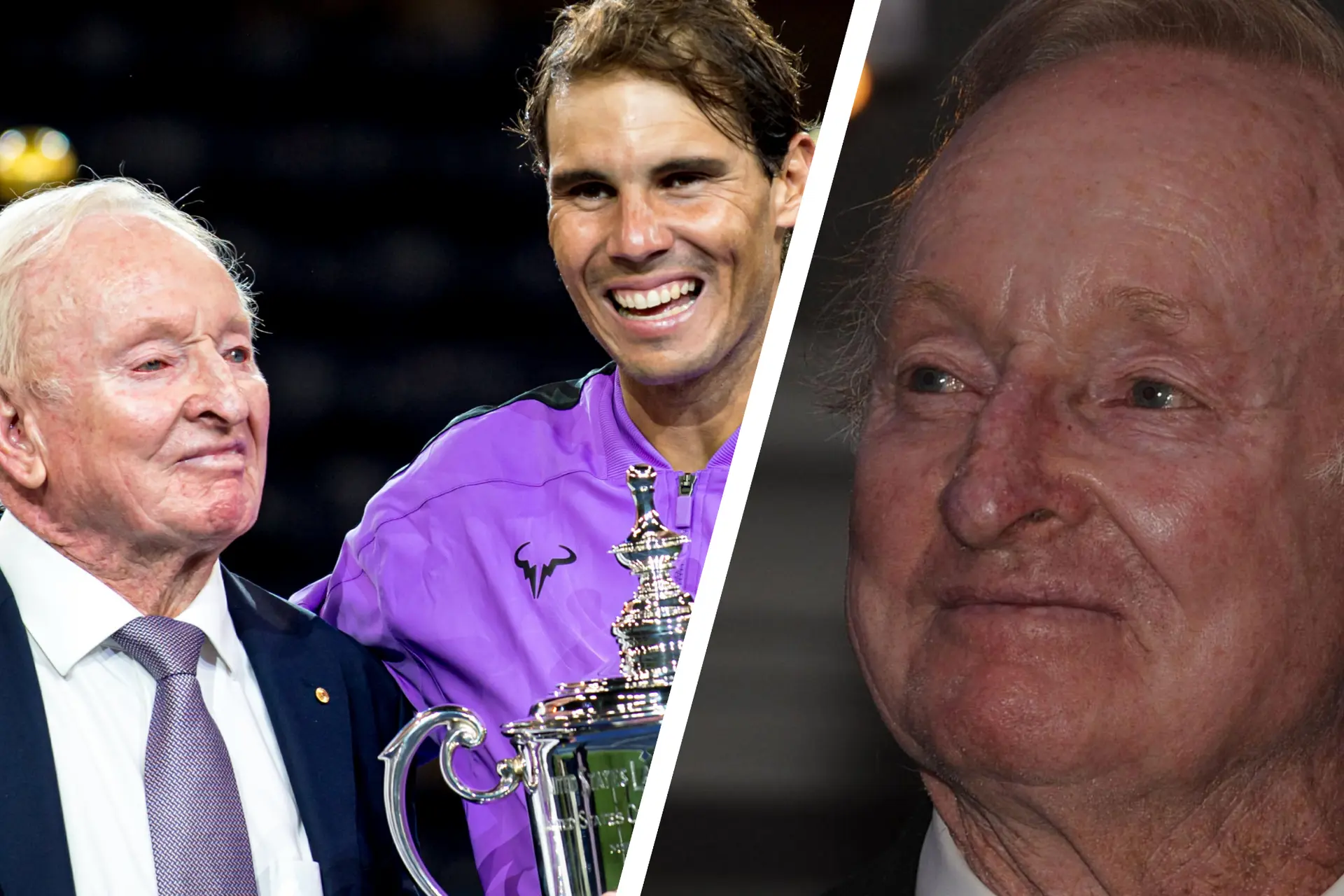
A pair of Grand Slam singles triumphs materialised in 1965 as Emerson defended his Wimbledon crown with a comprehensive victory over Stolle and won a fourth Australian Championships title.
The 1966 season witnessed Emerson go back-to-back at the Australian Championships. He beat a young Arthur Ashe in a four set final.
Emerson becomes the first man to win all Slams twice
In the 1967 season, Emerson created history when becoming the first male player to win all the singles Grand Slams at least twice. He achieved this feat by reigning supreme at the French Championships. Victory over compatriot Tony Roche meant Emerson had now won his last ten major finals. Earlier in the year, by winning a record sixth and fifth consecutive Australian Championships title, Emerson had surpassed Bill Tilden’s record haul of ten Grand Slam singles titles.
The dawn of the Open Era facilitated a great strengthening of the fields in tennis. Emerson had to now contend with professionals returning to Grand Slam competition. He struggled with this transition. Emerson never reached a Grand semi-final again. Four quarter-final appearances were the best showings for Emerson in the Open Era. This underlines that his Grand Slam success of the previous five years came with a big asterisk, given the limited fields he bested.
Emerson accumulated 119 singles titles in his career, although there's some conjecture as to whether this was a correct figure, given it was harder to define before tennis went to Open as to what merited being classed as a singles title. Only six of these are classified as ATP Tour titles. His last title was the 1973 Pacific Coast Championships in San Francisco.
Emerson at the forefront of a Davis Cup Dynasty
Australia dominated the Davis Cup throughout the 1950s and 1960s. Many of their triumphs featured Roy Emerson at the heart of it. He finished his career having been part of a record eight triumphs. The successes came in two batches of four consecutive triumphs - 1959-1962 and 1964-1967. This perpetual success for Australia was overseen by captain Harry Hopman, who played an important part in the development of Emerson as a player.
Emerson was swift and agile, due primarily to placing a great emphasis on fitness and conditioning, all characteristics of the Hopman philosophy. “Harry said get yourself in shape and do well in the majors because a win there goes in the record books,” Emerson said. “I took heed of that.” He had a deceptively big serve, especially difficult on grass, and his attacking game put pressure on his opponent to make good shots, otherwise his punctuating volleys would end points quickly. He claimed that his backhand was his strongest shot, but he was being especially modest. Emerson didn’t have any weaknesses.”
Emerson finished his Davis Cup career with a 34-4 win/loss record, breaking down as 21-2 in singles and 13-2 in doubles play.
16 Grand Slam doubles titles
Emerson managed to eclipse his tally of 12 singles Grand Slams by claiming 16 Grand Slams in men's doubles.
Seven of his major doubles titles were won in alliance with fellow Australian Neale Fraser, including a brace of Grand Slams in 1959, 1960, and 1962.
Emerson partnered with Rod Laver to win the 1961 French Championships. This partnership would later be renewed in the Open Era, where they reached five Grand Slam finals, winning the 1969 Australian Open and 1971 Wimbledon title. These latter two triumphs were the only Grand Slam titles Emerson won in the Open Era in either singles or doubles. Emerson amassed 20 doubles titles in the Open Era. The Blackbutt native reached a couple of mixed doubles Grand Slam finals but lost both of them.
Records and Awards aplenty
Emerson was inducted into the International Tennis Hall of Fame in 1982. Four years later, Emerson was included in the Australian Sports Hall of Fame. He later received, in 2000, the Australian Sports Medal, before the Centenary Medal was bestowed upon him the following year. He was later inducted into the Queensland Sports Hall of Fame.
The centre Court at the Swiss Open in Gstaad is named after him. He played his last professional match at this tournament and won the event on five occasions.
At the Brisbane International, the winner of the men's event is garlanded with the Roy Emerson Trophy.
A museum dedicated to Emerson was opened in Blackbutt at the start of 2017, complete with a statue of the great man.
Emerson is the only male player to win a Career Grand Slam in singles and doubles.
Life after stepping away from the main tour
Despite leaving the tournament circuit, Emerson did not retire. In the late 1970s, he operated as a player/coach for the Boston Lobsters in World Team Tennis (WTT). A competition with lesser intensity than mainstream tennis.
He mostly played doubles with the Lobsters and often teamed with compatriot Tony Roche. In the 1978 season, the last season under the original guise of World Team Tennis, Roy coached the Lobsters to the Eastern Division Championship and into the WTT Finals against the Los Angeles Strings.
Emerson, now 89, resides in Newport Beach, California with wife, Joy, and daughter, Heidi. His son Antony was once a high class Collegiate player in the US and briefly competed professionally.
Emerson has undertaken coaching on a sporadic basis. He has run a clinic from Gstaad and coached juniors at East Lake Woodlands in Florida.
The legacy of Roy Emerson is a complex one, as ordinarily a player with 12 singles majors would firmly be placed inside the all-time top 10. However, due to the absence of many key rivals when he won them, the weight of his success is diminished. The fact that he never won a singles Grand Slam once the sport went Open underlines that he benefited from the weaker fields of the amateur era. Although greatness can't be denied when you've won as many Grand Slams as Emerson, he is alongside Laver, Novak Djokovic, and Rafael Nadal as the only male players to win each of the majors at least twice.
Roy Emerson: Career Titles and Major Achievements
| Category | Achievement | Details |
| Singles Grand Slams | 12 | Australian (6), French (2), Wimbledon (2), US (2) |
| Total Grand Slams | 28 | All-time Men's Record: 12 Singles, 16 Men's Doubles |
| Career Grand Slam | Singles & Doubles | Only male player to complete the Career Slam in both disciplines |
| Australian Open Record | 6 Titles | Held the record for most AO titles for 52 years (1967–2019) |
| Davis Cup Titles | 8 | All-time Record: Won 8 titles with Australia (1959–1962, 1964–1967) |
| World No. 1 | 1964, 1965 | Ranked as the undisputed world No. 1 amateur for two years |
| Surface Dominance | Versatility | Only man to win all 4 Majors in both Singles and Doubles |
| Hall of Fame | Inductee | Inducted into the International Tennis Hall of Fame (1982) |
Roy Emerson: Major Finals and Milestones
| Year | Competition / Tournament | Result | Category |
| 1959 | Wimbledon | Winner | 1st Grand Slam Doubles Title (w/ Neale Fraser) |
| 1961 | Australian Chp. | Winner | 1st Grand Slam Singles Title (Defeated Rod Laver) |
| 1961 | US National Chp. | Winner | 1st Title in New York (Defeated Rod Laver) |
| 1963 | French Chp. | Winner | 1st Roland Garros Title; completed Career Slam in Doubles |
| 1964 | Wimbledon | Winner | 1st Wimbledon Singles Title (Defeated Fred Stolle) |
| 1964 | US National Chp. | Winner | Completed Career Grand Slam in Singles |
| 1966 | Australian Chp. | Winner | Won 5th consecutive Australian Singles Title |
| 1967 | Australian Chp. | Winner | 12th and Final Grand Slam Singles Title |
| 1969 | French Open | Winner | Final Grand Slam Doubles Title (w/ Rod Laver) |
| 1971 | Wimbledon | Winner | Final Wimbledon appearance in Doubles (Champion) |

Jay Brannon is a sports journalist from Sutton Coldfield, England, with a lifelong passion for athletic competition and storytelling. For the past 1.5 years, he has been a prominent voice at TennisUpToDate.com, where he has authored more than 3,000 articles, specializing in deep-dive columns, tactical analyses, liveblogs, and comprehensive match reports for the ATP and WTA tours.
Jay’s tennis reporting blends rigorous, real-time statistical analysis with on-the-ground coverage. He frequently travels to tournaments to cover the action firsthand from the press box and player press conferences. This direct access allows him to deliver sharp insight into player form and tour developments—a dedication sparked by his earliest sporting memory of the iconic 1991 Wimbledon final between Michael Stich and Boris Becker.
Beyond the court, Jay brings a versatile background in live broadcasting and media. His professional experience includes serving as a sports reporter for BHBN Hospital Radio—where he delivered live updates and analysis for West Bromwich Albion and Wolverhampton Wanderers matches—as well as working as a match reporter for Sutton Coldfield Town.
Jay holds a degree in Music Journalism and Broadcasting from Staffordshire University, a foundational training that shaped his voice as a thoughtful, authentic storyteller. Grounded in core journalistic ethics, he places a strict emphasis on careful sourcing, editorial accuracy, and swift, verified updates.
claps 0visitors 0
Just In


Popular News

Latest Comments
- Lena... Takin' care of business
 mandoist25-10-2026
 - Can you please stop publishing this nonsense? Stick to Tennis.mandoist25-10-2026
- Does Sinner need that 4.5 mil? I doubt it. He can make that with three modelling gigs!😅🤣Rapunzel21-10-2026
- Did "People Magazine" purchase this website? This nonstop storyline is bullshit.mandoist21-10-2026
- Listen... this is of no concern to anyone but these two. Deal with your own issues -- most of us have our own. Thanks, media, for these insignificant follow-ups which are meaningless.mandoist21-10-2026
- This is so very very sad, for all three of them. I truly thought they had an unbreakable bond, but life throws up so many differing challenges. Having your homeland suffering in such a terrible way, makes happiness lose out to guilt as well. Our thoughts are with them. X💔bjsexton20-10-2026
- I have lost all respect for Svitolina! Could she not have waited until he had played at the Paris Masters!!! She is selfish and don't give a damn about Gael. That is NOT how love is demonstrated Elina!!Rapunzel19-10-2026
- Perhaps convenient tennis tour sex is not a strong enough experience in which to base a marriage?mandoist19-10-2026
- Fight the Good Fight... Tennis (sports in general) need more Humans such as yourself.mandoist18-10-2026
- When is WTA going to mandate Genetic Testing (DNA) ???mandoist18-10-2026

Loading