Tennis Legends: Althea Gibson - a US Open trailblazer and winner of five Grand Slam singles titles with a deeper legacy
WTA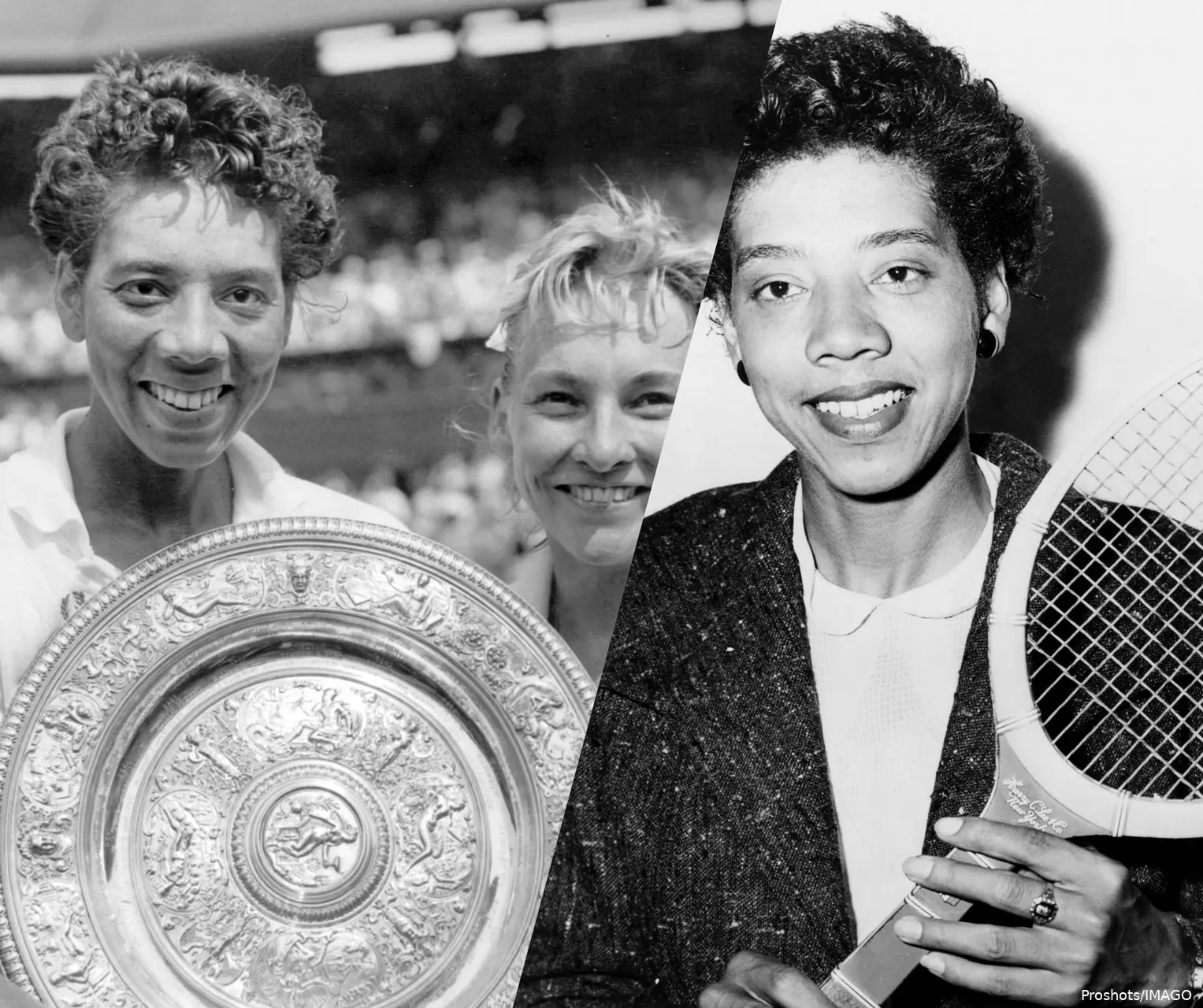
At the 2025 US Open, the US Tennis Association (USTA) marked the 75th anniversary of Althea Gibson becoming the first African American to play in the New York Grand Slam. Gibson blazed a trail for black players throughout the 1950s. A winner of five Grand Slam singles titles, Gibson’s legacy goes far deeper.
Althea Gibson: Early life and pushing through barriers
Born on August 25, 1927, in South Carolina, USA, to parents Daniel and Annie Bell Gibson, who worked as sharecroppers on a cotton farm. With the impact of the Great Depression disproportionately affecting the southern farmers, Gibson’s family opted to relocate to Harlem. This was when her four siblings - three sisters and a brother - were born.
Gibson quickly developed an aptitude for paddle tennis. By the age of 12, Gibson had become the New York women's paddle tennis champion. Aged just 13, Gibson quit school and concentrated on sport. She developed boxing skills through her dad's tutelage. Gibson also played a lot of basketball. Her father could be violent, and Gibson spent a period of time in a shelter for abused children.
In 1940, a collective of neighbours clubbed together to raise funds so Gibson could obtain membership at the Cosmopolitan Tennis Club in the Sugar Hill section of Harlem. Initially, Gibson was averse to tennis as she considered it a sport lacking toughness. This attitude thawed, and Gibson was triumphant the following year, in the American Tennis Association (ATA) New York State Championship. Success in ATA events continued through the 1940s. From 1947, Gibson won ten consecutive titles.
By the late 1940s, Gibson was now residing in Wilmington, North Carolina. Obtaining sponsorship from physician and activist Hubert A. Eaton enabled Gibson to join the racially segregated Williston Industrial High School.
Gibson’s fast-growing reputation led to calls for her to be allowed to enter the US National Championships (now the US Open). In 1950, the USTA allowed black players to play at the major, but to qualify for the tournament, players needed to acquire points at events held at clubs operating a whites-only policy. The USTA, under intense pressure, provided Gibson with an invitation to play at Forest Hills. One of that era's biggest stars, Alice Marble, had written a letter vehemently attacking the failure to facilitate a pathway for Gibson to take part. Her debut ended in round two at the hands of Louise Brough.
Participating was a huge success, though, in regard to smashing down barriers for black athletes. Comparisons were made with baseball player Jackie Robinson becoming the first African American to compete in Major League Baseball within the modern era.
Her maiden international title came in 1951 at the Caribbean Championships in Jamaica. It was a year that witnessed Gibson’s Wimbledon debut, losing in round three to Beverly Baker.
Building momentum
Her amateur career gradually built momentum as the decade wore on. She graduated as a teacher of physical education in 1953, going on to take a role teaching at Lincoln University. Her tennis career accelerated when she undertook a tour of Asia in 1955. This tour fuelled her belief, and once it was finished, Gibson went on to triumph in 16 of 18 tournaments across Europe and Asia.
May 27, 1956, is a landmark day in the history of tennis and for black athletes in sports. Gibson became the inaugural African American to win a Grand Slam title. Victory over Brit Angela Mortimer provided a breakthrough for powerful Gibson. Her power game was considered ahead of its time. Her near 6 ft stature made her an imposing presence when the average height of tour players was less than today.
Other titles in 1956 included the Italian and Asian Championships. Shirley Fry proved a thorn in her side this season, beating Gibson in the Wimbledon quarter-finals and the US Nationals final.
Zenith of Gibson's career
The 1957 season is widely regarded, including by herself, as the zenith of Gibson’s career. At Wimbledon, she became the first black champion after defeating compatriot Darlene Hard in the women's singles final. Gibson was the first winner to receive her trophy from Queen Elizabeth II. She made it back-to-back Grand Slam singles titles when toppling Louise Brough in the US Nationals showpiece. Her trailblazing continued at the season's end by being the first black player to compete in the Wightman Cup team event, assisting the USA in a 6-1 thrashing of Great Britain. A 55-match winning streak underlined dominance this term, a run eventually stopped at 57.

Althea Gibson - the American trailblazer.
Gibson retained both her Wimbledon and US National titles in 1958. When you consider Gibson missed both the French Opens in 1957/58 and the Australian Open in 1958, her tally of four major titles from five events played saw Gibson placing herself as the dominant force. Her run to the 1957 Australian Open final was Gibson’s solitary visit to the Melbourne major.
Her return home after a season of excessive glory resulted in Gibson receiving only the second ticker tape parade a black American had been awarded in New York, following in the footsteps of legendary Olympian Jesse Owens.
Gibson enjoyed an immensely successful doubles career in the amateur ranks. She triumphed in five of her seven Grand Slam finals. In tandem with the Brit, Angela Buxton, they won Wimbledon and the French Open in 1956. Gibson retained the Wimbledon title alongside Darlene Hard and won the Australian Open in alliance with Shirley Fry. The last of her Grand Slam doubles titles was a third consecutive success at Wimbledon, partnered on this occasion by Maria Bueno. Gibson claimed a solitary Mixed Doubles Grand Slam, from four finals, when emerging victorious at the 1957 US Nationals with Dane Kurt Nielsen.
From All-England Club membership denial, to saxophonist and golfer
After collecting 56 singles and doubles titles, including five Grand Slams from seven finals, Gibson opted to retire from amateur competition and turn professional. The glory was a great thrill, but the financial allure proved hard to resist as she once memorably said: “Being the Queen of Tennis is all well and good, but you can't eat a crown”.
At this point, professionalism in women’s tennis was limited primarily to exhibitions, a full scale tour nearly 15 years away. The most significant title she won in this period was the World Pro Championships in Cleveland.
She felt her ethnicity denied her greater opportunities as a professional, and despite her past success at Wimbledon, Gibson was denied membership of the All-England Club. As a result of these barriers, Gibson opted to pursue other career avenues, making use of her skills as a saxophonist and vocalist. She released an album, Althea Gibson Sings, in 1959. Gibson also played the part of an enslaved woman in the 1959 film The Horse Soldiers. Her income was supplemented by commentary work and a memoir release, "I Always Wanted to Be Somebody".
In 1964, now aged 37, Gibson made a return to competitive sport. She became the first African American woman to join the Ladies Professional Golf Association (LPGA). Her progress was again impeded by discrimination. A number of hotels forbade black guests. This made it difficult for Gibson to find a base to stay at a tournament. Her highest ranking was 27th, and a tie for second at the Len Immke Buick Open proved to be her tournament showing. She retired from golf in 1978.
Gibson, who briefly came out of tennis retirement in her early forties, took a role as a coach running Pepsi Cola’s mobile tennis project. It was a scheme that enabled underprivileged areas to benefit from a plethora of tennis equipment. Gibson ran many other clinics in the following years and coached juniors such as Leslie Allen and Zina Garrison, who cited Gibson’s influence in her memoir as vital in her career.
Gibson made a foray into politics when contesting the incumbent Essex County State Senator Frank J. Dodd in the Democratic primary for his seat. She finished second. Gibson undertook a number of governance roles, such as managing the Department of Recreation in East Orange, New Jersey.
William Darben became her first husband in 1965. They divorced in 1976. Seven years later Gibson married her former coach Sydney Llewellyn. They also divorced. Gibson never had any children.
Read also
Later life and legacy
Gibson’s health declined considerably in the 1980s, suffering two cerebral haemorrhages. In 1992, Gibson had a stroke. Shamefully, given her stellar career, Gibson received no support from several tennis organisations she'd asked for financial support to pay her medical expenses. Her close friend and past doubles partner, Angela Buxton, helped raise around a million dollars accumulated through donations raised from within the tennis community. Gibson survived a heart attack in 2003, but complications from bladder and respiratory affections saw her pass away later that year on September 28.
The Associated Press crowned Gibson as Athlete of the Year in 1957 and 1958. In 1980, Gibson was one of the first group of sportswomen to be included in the first-ever International Women's Sports Hall of Fame. It's one of many Hall of Fames that Gibson has been inducted into. This includes the Black Athletes Hall of Fame and the International Tennis Hall of Fame.
In 1991, Gibson became the first woman to receive the Theodore Roosevelt Award. It's the highest accolade you can receive from the National Collegiate Athletic Association. The award was in part due to her breaking through the glass ceiling for black athletes.
A column by journalist William C. Rhoden, in the New York Times, eulogised over Gibson’s impact in sports history, “Althea Gibson and Wilma Rudolph (athletics) are the two most significant athletic forces among black sports women in history. While Rudolph's accomplishments brought more visibility to women as athletes… Althea's accomplishments were more revolutionary because of the psychosocial impact on Black America.”
Billie Jean King, a great activist and pioneer herself, has often lauded the impact of Gibson, recognising how she made things easier for black players who followed her. Serena Williams became the next African American woman to win a major at the 1999 US Open, more than 40 years after Gibson’s last Slam title. Serena and sister Venus have been keen to point out they're standing on the shoulders of giants when it comes to Gibson.
Gibson has been honoured in various ways, including statues, postage stamps and a gymnasium named after her in Paris. Perhaps the best of all things named after Gibson is the bronze statue erected in 2019 on the site of the US Open.
In amongst all the chatter around her legacy as a trailblazer, it shouldn't be forgotten what an outstanding champion Gibson was. If the need for remuneration to turn professional had not been so important, Gibson is very likely to have at least doubled her tally of five Grand Slam singles titles. She was beginning to dominate women's tennis in the late 1950s, and her powerful game was overwhelming opponents. Some observers feel she could've even become the greatest ever. Bob Ryland, once a coach of the Williams sisters, was unequivocal in his praise, “Martina (Navratilova) couldn't touch her. I think she'd beat the Williams sisters”.
Althea Gibson was held back through discrimination, and her numbers as a consequence are not reflective of her talent and emerging dominance. However, Gibson’s legacy outstrips many of those who won more. Her success went beyond Majors - she defeated the bigots and changed the course of history.
Althea Gibson: Career Titles and Major Achievements
| Category | Achievement | Details |
| Singles Grand Slams | 5 | Wimbledon (2), US Nationals (2), French Championships (1) |
| Total Grand Slams | 11 | 5 Singles, 5 Women's Doubles, 1 Mixed Doubles |
| World No. 1 | 1957–1958 | Ranked as the top female player in the world for two years |
| Historic Milestone | Breaking the Color Barrier | First Black player to compete at the US Nationals (1950) |
| Wimbledon History | Trailblazer | First Black champion in the history of Wimbledon (1957) |
| Associated Press | Athlete of the Year | Won Female Athlete of the Year in 1957 and 1958 |
| Dual Sport Pro | Golf | First Black woman to compete on the LPGA Tour (1964) |
| Hall of Fame | Inductee | Inducted into the International Tennis Hall of Fame (1971) |
Althea Gibson: Major Finals and Milestones
| Year | Competition / Tournament | Result | Category |
| 1950 | US National Chp. | Debut | First Black player to enter the tournament |
| 1951 | Wimbledon | Debut | First Black player to compete at SW19 |
| 1956 | French Championships | Winner | 1st Grand Slam Singles Title (First Black Major winner) |
| 1956 | Wimbledon | Winner | 1st Grand Slam Doubles Title (w/ Angela Buxton) |
| 1957 | Wimbledon | Winner | 1st Wimbledon Singles Title (Presented by Queen Elizabeth II) |
| 1957 | US National Chp. | Winner | 1st US Singles Title (Defeated Louise Brough) |
| 1957 | US National Chp. | Winner | Mixed Doubles Title (w/ Kurt Nielsen) |
| 1958 | Wimbledon | Winner | Successfully defended her Wimbledon Singles Title |
| 1958 | US National Chp. | Winner | Final Grand Slam Singles Title (Defeated Darlene Hard) |
| 1958 | Retirement | Amateur Exit | Retired from amateur tennis at the top of the game |

Jay Brannon is a sports journalist from Sutton Coldfield, England, with a lifelong passion for athletic competition and storytelling. For the past 1.5 years, he has been a prominent voice at TennisUpToDate.com, where he has authored more than 3,000 articles, specializing in deep-dive columns, tactical analyses, liveblogs, and comprehensive match reports for the ATP and WTA tours.
Jay’s tennis reporting blends rigorous, real-time statistical analysis with on-the-ground coverage. He frequently travels to tournaments to cover the action firsthand from the press box and player press conferences. This direct access allows him to deliver sharp insight into player form and tour developments—a dedication sparked by his earliest sporting memory of the iconic 1991 Wimbledon final between Michael Stich and Boris Becker.
Beyond the court, Jay brings a versatile background in live broadcasting and media. His professional experience includes serving as a sports reporter for BHBN Hospital Radio—where he delivered live updates and analysis for West Bromwich Albion and Wolverhampton Wanderers matches—as well as working as a match reporter for Sutton Coldfield Town.
Jay holds a degree in Music Journalism and Broadcasting from Staffordshire University, a foundational training that shaped his voice as a thoughtful, authentic storyteller. Grounded in core journalistic ethics, he places a strict emphasis on careful sourcing, editorial accuracy, and swift, verified updates.
claps 0visitors 0
Just In


Popular News
Latest Comments
- A healthy Qinwen may be hard to stop next season. She was already scaring her opponents before her medical leave(s). Unfortunately, Zheng insisted on singing again. On the positive side -- Mirra did not sing!! ;~}
 mandoist11-10-2026
 - Where is it written that athletes, entertainers... People in general... are mandated to keep looking at -- or even using [anti]Social Media? Public & private figures consistently complain and reveal their concerns about negativity and violence thrown at them -- yet they insist on participating. Avoid it, don't use it, don't read it. It's okay to occasionally look up at the World instead beating your eyes & thumbs to death on The Inventions out there.mandoist11-10-2026
- great articlestennisseserver07-10-2026
- Medvedev was leading Djokovic 7-5, 3-5 when an attempted return..' NO you ignorants, Djokovic was leading .weiss05-10-2026
- No more bullshit "Wildcards" to these two. Qualify like everyone else -- there will be cameras there, too. Time to scream... WTF ????!!!!mandoist29-09-2026
- Let's not BS the general public -- Sabalenka started showing cracks in her game last season. Her losses and near-losses started at about the same time she began being distracted by Fame (constant Selfies, making TV commercials, magazine shoots, endless Social Media nonsense, etc., etc.) One would think even Saba could recognize the parallels with others who failed before her -- Raducanu, Giorgi, Bouchard to name a few.mandoist25-09-2026
- Gross!! Hey Raducanu, Giorgi, and Bouchard -- reserve a seat at your Social Media Selfie table for Saba + Naomi. They're heading in your direction soon enough.mandoist24-09-2026
- And then these same players will complain about how lengthy their season’s were and need more time-off. I’m all for more tennis but the amount of tennis we get now is actually kind of crazy! We all need a break, especially the players.DaveyWavey23-09-2026
- You should do a comparison article for "different kinds of justice" the courts decide for tennis players. I can think of at least three players who received very small bans of a few months, however Tara Moore has been fighting for her literal survival the past few years. It seems odd considering she is not a "name" player, unlike the other cases.DaveyWavey22-09-2026
- PRIZE MONEY & POINTS Winner - $185,500 Finalist - $114,500 Semi-Finalist - $66,003 Quarter-Finalist - $35,000 Round of 16 - $18,045 Round of 32 - $13,005 Winner - 500 Finalist - 325 Semi-Finalist - 195 Quarter-Finalist - 108 Round of 16 - 60 Round of 32 - 1DaveyWavey20-09-2026

Loading