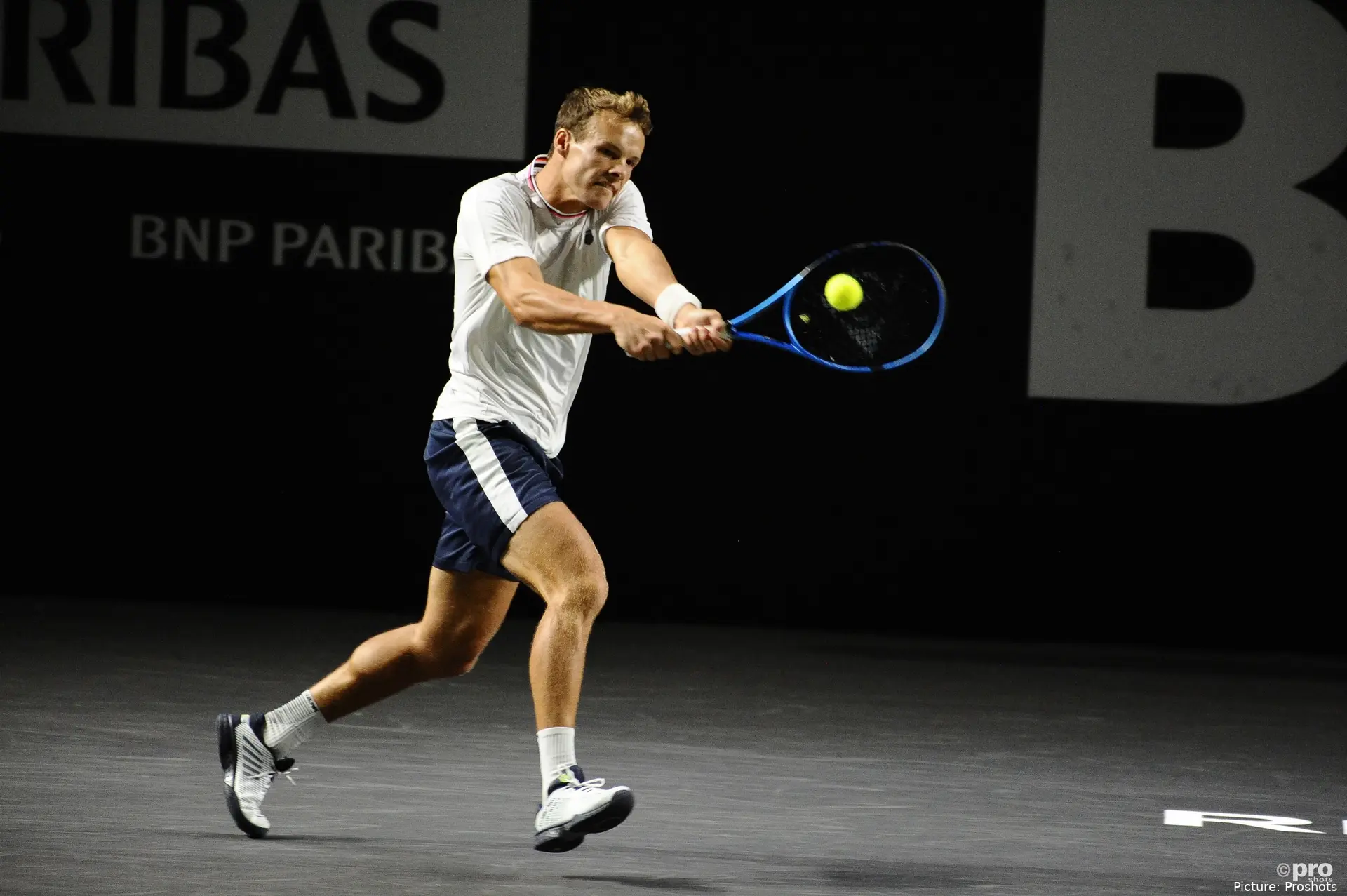
Belgian tennis player Michael Geerts has revealed he received serious threats linked to sports betting ahead of a match at the ATP Challenger event in Chersonissos, Crete. The 31-year-old said the intimidation included personal information about his family and a photograph of a firearm, raising concerns about the influence of gambling networks on lower-tier professional tennis tournaments.
Geerts, who has spent much of his career competing on the ATP Challenger circuit, described the messages as escalating quickly from what initially appeared to be a routine contact. The Belgian said the threats began the evening before his scheduled match and intensified on the morning of the contest, putting him under significant psychological pressure before stepping onto the court.
The Challenger Tour represents the second tier of men’s professional tennis, offering ranking points and modest prize money compared with ATP Tour events. For many players ranked outside the top levels of the sport, these tournaments are essential for maintaining rankings and funding their careers, but they can also attract scrutiny due to concerns about gambling activity and match manipulation.
Geerts reported the incident to tournament officials and informed his family immediately. Despite the tension surrounding the situation, the match ultimately went ahead. The Belgian later said the threats affected his mental state throughout the contest, which he eventually lost against Greek player Stefanos Sakellaridis.
Threats escalate from message to intimidation
Geerts said the situation began with a seemingly harmless text message from a British phone number. Competing at an international tournament, he initially assumed the message might be from a coach or contact related to the event.
However, the tone quickly shifted. After confirming his identity, Geerts received a threatening message instructing him to lose his upcoming match. The warning was accompanied by detailed personal information about his family, making it clear that the sender had access to sensitive data. “If you lose tomorrow, nothing happens. But if you win or retire, you are out of tennis.”
The intimidation escalated further when the sender followed up with additional details about Geerts’ family and a threatening image. “They sent the names of my parents, their address, and my father’s identification number. Everything matched. And then they also sent the photo of a gun. That’s when you know it’s not just words.”
Geerts said the messages also referenced his girlfriend, increasing his concerns about the safety of people close to him. While his parents initially believed the threat might not be genuine, the presence of specific personal information left the player deeply unsettled.
Read also
Playing under pressure
After receiving another threatening message on the morning of the match, Geerts reported the situation to tournament officials. He said he was visibly shaken when speaking with the supervisor, who delayed the match by around thirty minutes while organisers assessed the situation.
Despite the report, the match ultimately proceeded. Geerts attempted to focus on playing normally, but admitted the psychological impact of the threats remained present throughout the contest. “Between points, I kept thinking: ‘Am I safe? Can I win this point?’”
The Belgian started strongly against Sakellaridis but said the mental pressure remained difficult to ignore. The presence of threats linked to gambling activity, he believes, was designed specifically to disrupt his concentration. “I think that’s exactly what those gamblers wanted — to break your head so they can bet big on your opponent. They try to make money through fear.”
Wider concerns about betting influence
Abusive messages linked to gambling losses have become increasingly common for professional tennis players, particularly on social media platforms. Geerts acknowledged that receiving hostile comments after matches has become a routine part of life on tour.
However, he stressed that the situation in Crete felt fundamentally different because it involved direct threats and references to his family. For him, the line between online abuse and genuine intimidation was clearly crossed. “I always receive messages after my matches — the worst diseases and sometimes even death wishes. I’ve become used to it. It’s sad but true. But this? This is different.”
Read also
Authorities and tennis officials have been informed about the incident. According to Geerts, the national federation has opened an investigation, and there may have been similar cases reported in recent weeks. “Apparently there have been similar cases in the past weeks. This isn’t a lone lunatic sending threats. It seems to be a network.”
Geerts believes players competing on the Challenger Tour may be particularly vulnerable because of lower prize money and reduced visibility compared with ATP Tour events. While he acknowledges the problem may never disappear entirely, he argues that stronger measures could limit its impact. “At this level they think players are weaker. The prize money is lower, the visibility is lower. They assume we’re more vulnerable. If nobody says anything, they keep winning.”

Cristhián AvilaTennis Journalist
Cristhián Ávila is a tennis journalist based in Santiago, Chile, and has been part of the TennisUpToDate team since early 2023. He covers the ATP and WTA Tours as well as all four Grand Slams, producing breaking news, match reports, analysis, and regular liveblogs from major tournaments.
His reporting combines statistical analysis with clear explanation, helping readers understand tactical developments, player form, and broader storylines across the tour. Working fluently in both Spanish and English, Cristhián collaborates with an international editorial team and contributes to comprehensive global coverage. As part of his work, he has conducted interviews and media interactions with leading figures in the sport, including Caroline Wozniacki and John McEnroe.
In his journalism, Cristhián places strong emphasis on careful sourcing, editorial accuracy, and updating articles promptly when new, verified information becomes available. His coverage is grounded in research, context, and direct engagement with professional tennis.
claps 0visitors 0
Just In


Popular News
Latest Comments
- Two Things: 1. Stop allowing these Spoiled Trust-Fund Elitists to behave badly. Your little hand-slaps do not deter them. 2. STOP the incessantly annoying "towel wiping" nonsense!!!!
 mandoist15-10-2026
 - A healthy Qinwen may be hard to stop next season. She was already scaring her opponents before her medical leave(s). Unfortunately, Zheng insisted on singing again. On the positive side -- Mirra did not sing!! ;~}mandoist11-10-2026
- Where is it written that athletes, entertainers... People in general... are mandated to keep looking at -- or even using [anti]Social Media? Public & private figures consistently complain and reveal their concerns about negativity and violence thrown at them -- yet they insist on participating. Avoid it, don't use it, don't read it. It's okay to occasionally look up at the World instead beating your eyes & thumbs to death on The Inventions out there.mandoist11-10-2026
- great articlestennisseserver07-10-2026
- Medvedev was leading Djokovic 7-5, 3-5 when an attempted return..' NO you ignorants, Djokovic was leading .weiss05-10-2026
- No more bullshit "Wildcards" to these two. Qualify like everyone else -- there will be cameras there, too. Time to scream... WTF ????!!!!mandoist29-09-2026
- Let's not BS the general public -- Sabalenka started showing cracks in her game last season. Her losses and near-losses started at about the same time she began being distracted by Fame (constant Selfies, making TV commercials, magazine shoots, endless Social Media nonsense, etc., etc.) One would think even Saba could recognize the parallels with others who failed before her -- Raducanu, Giorgi, Bouchard to name a few.mandoist25-09-2026
- Gross!! Hey Raducanu, Giorgi, and Bouchard -- reserve a seat at your Social Media Selfie table for Saba + Naomi. They're heading in your direction soon enough.mandoist24-09-2026
- And then these same players will complain about how lengthy their season’s were and need more time-off. I’m all for more tennis but the amount of tennis we get now is actually kind of crazy! We all need a break, especially the players.DaveyWavey23-09-2026
- You should do a comparison article for "different kinds of justice" the courts decide for tennis players. I can think of at least three players who received very small bans of a few months, however Tara Moore has been fighting for her literal survival the past few years. It seems odd considering she is not a "name" player, unlike the other cases.DaveyWavey22-09-2026

Loading