“We had to evacuate the hotel”: Daniil Medvedev explains chaotic Dubai escape after Indian Wells win
ATP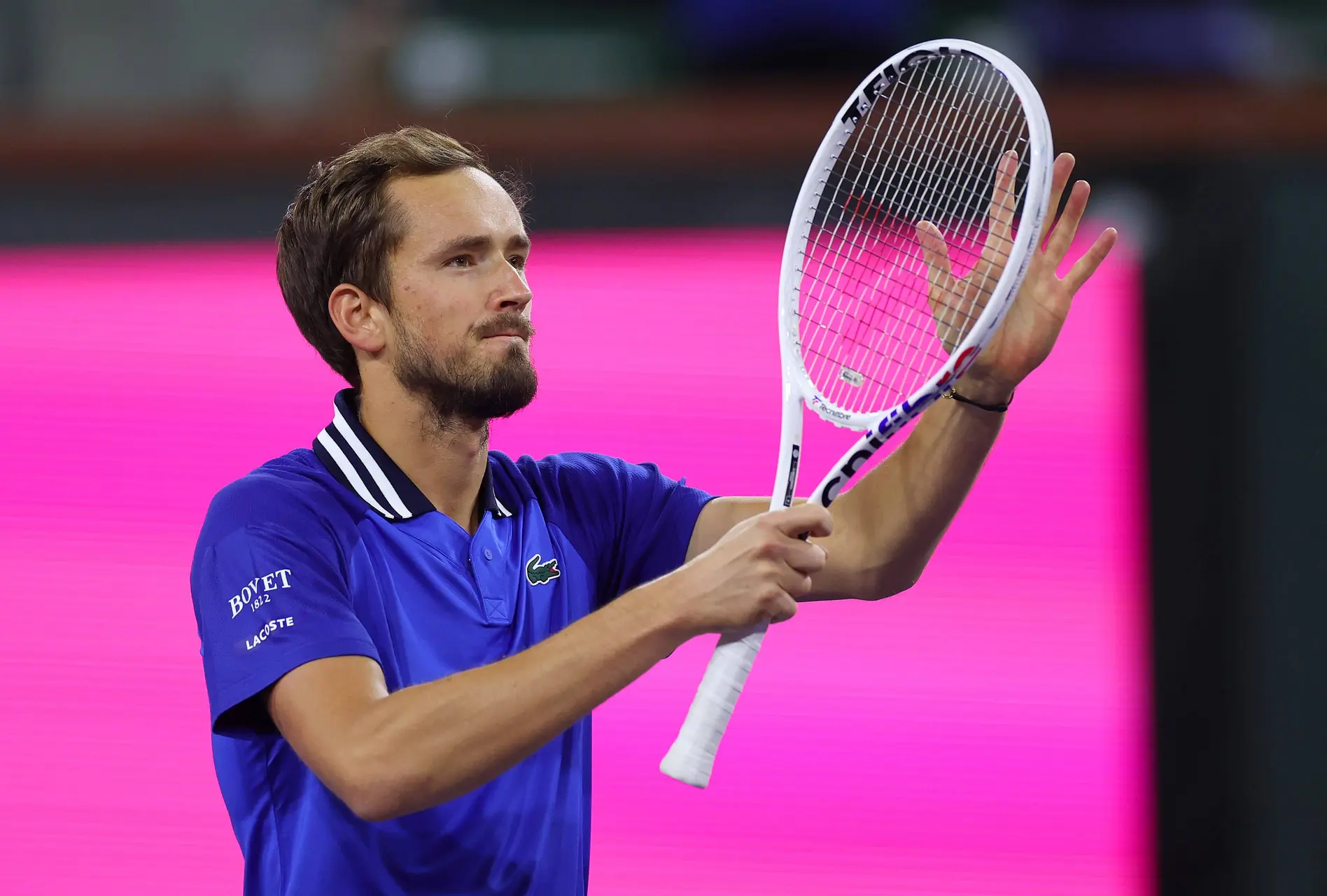
Daniil Medvedev began his BNP Paribas Open campaign with a convincing win, but the Russian arrived in California after a turbulent week shaped by travel uncertainty and rising military tensions in the Middle East. The 2021 US Open champion defeated Chile’s Alejandro Tabilo 6-4, 6-2 in his opening match at Indian Wells, later saying he felt “kind of on top of him” for much of the contest.
The victory came only days after Medvedev’s title run at the Dubai Duty Free Tennis Championships. The former world No. 1 lifted the ATP 500 trophy after Tallon Griekspoor withdrew shortly before the final, but celebrations were quickly replaced by logistical complications as the escalation of the Iran conflict led to temporary airspace closures across parts of the region, disrupting departures from Dubai.
The situation forced Medvedev to reconsider his route to the United States, eventually requiring a multi-stage journey that included long drives, border crossings and connecting flights. Despite the unusual circumstances, the Russian insisted he felt physically ready for competition and arrived in California confident that “the jet lag is done.”
Medvedev, seeded 11th at Indian Wells and a finalist at the tournament in both 2023 and 2024, opened his campaign with a composed performance. The Russian explained that he “did everything well” against Tabilo, applying constant pressure from the baseline to secure a straight-sets victory that set up a third-round meeting with Argentina’s Sebastian Baez.
Dominant start against Tabilo
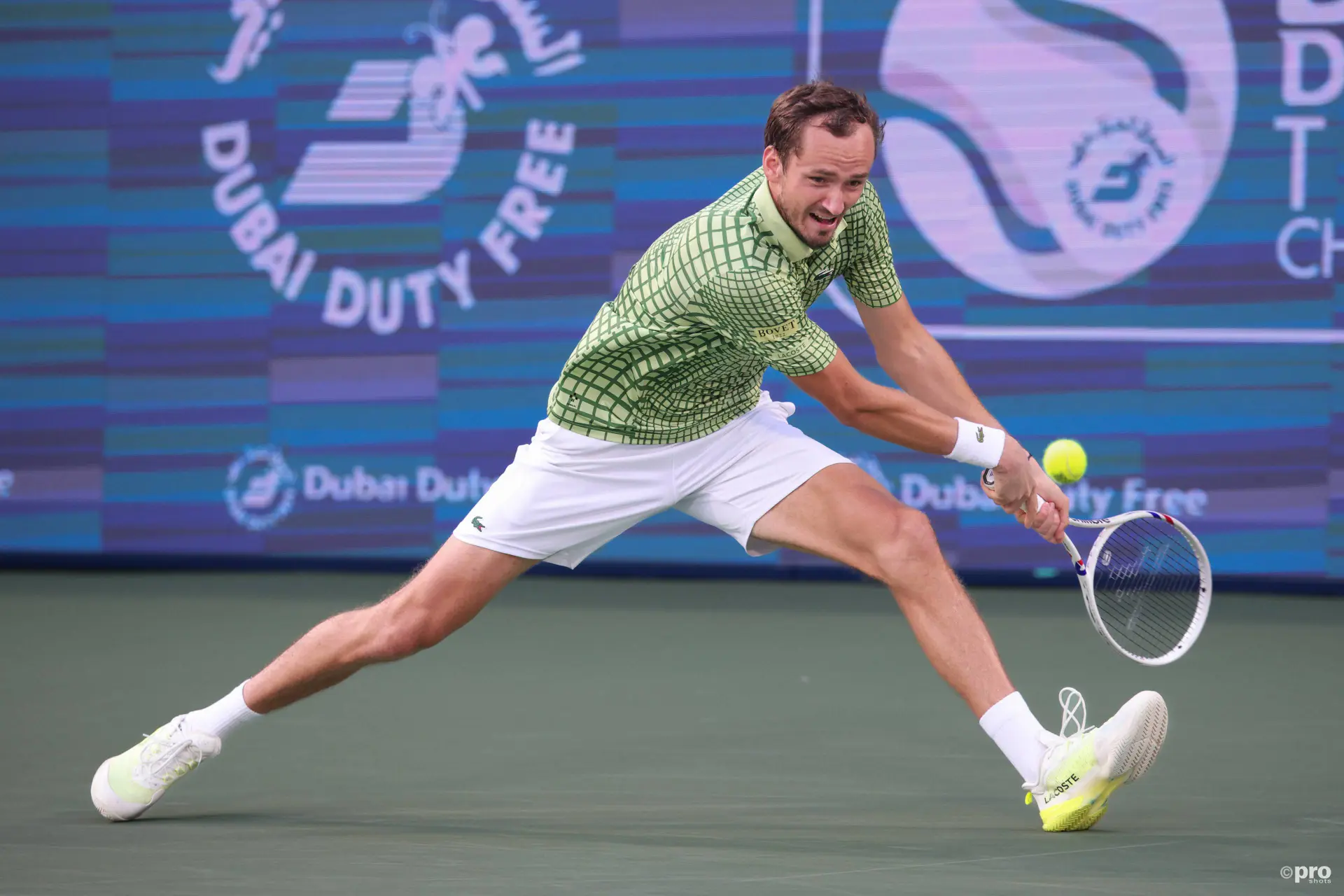
Medvedev’s performance against Tabilo reflected the level that has made him one of the most consistent hard-court players of the past decade. The Russian controlled most of the baseline exchanges and notably did not face a single break point during the match, a statistic he highlighted when analysing the win.
“I think today was a great match for me. I did everything well. I had zero break points to save, even if some games had a bit of pressure on my serve," Medvedev said during his press conference. "I think I put a lot of pressure on him from baseline points. I felt like I was kind of on top of him. So his only chance left was to serve well, which can make you stay in any match in the world. But I managed to return pretty well in important moments, and it was enough to win today. I’m super happy, because Alejandro is a tough opponent.”
The result continues Medvedev’s strong record in the California desert. Although he has often spoken about the difficulties of adjusting from Dubai’s faster conditions to the slower courts of Indian Wells, the Russian has reached the final twice in the past two editions of the tournament, losing both times to Carlos Alcaraz.
He acknowledged that the adjustment period is rarely comfortable, especially given the 12-hour time difference and the distinct playing conditions. Yet once the tournament begins, the Russian has repeatedly found his rhythm.
“Indian Wells is a strange place for me. When I arrive, especially the first few days, the jet lag is huge coming from Dubai. I always play Dubai before this tournament, so there’s a 12-hour time difference. The courts are completely different from Dubai. Even the balls feel different because of the surface. During the first two or three days I usually feel like there’s no chance I’m going to win the first round. But the last three years have been unbelievable here, and I love coming back.”
Evacuation and complex journey from Dubai
While Medvedev’s performance on court appeared controlled, the journey to California had been far from routine. The Russian revealed that he had been staying in a Dubai hotel that was evacuated overnight as military tensions escalated across parts of the Middle East, forcing temporary disruptions to regional airspace and complicating travel plans for players leaving the Emirates.
“I stayed in one of the hotels where something happened, so we had to evacuate at night with my wife. It depends on the kind of person you are and the situation you’re in. If I had been there with my kids, I would probably have been more stressed. But the kids were back home in Monaco. My focus was mainly on how we could get to Indian Wells and how to get my wife back to the kids in Monaco.”
Leaving the region proved challenging as flights became scarce following the temporary closure of parts of the airspace. Medvedev explained that fellow Russian players Andrey Rublev and Karen Khachanov were also trying to leave the region, prompting them to coordinate possible routes out of Dubai.
“It was not easy to decide what to do. At one moment we were texting a lot with Andrey and Karen. Andrey and I decided to go to Oman and try to find something there. It wasn’t easy because everyone was trying to leave and there were not many slots or planes available. But we managed to find a plane. Karen joined us, and the next day we flew to Istanbul and then from Istanbul to Los Angeles.”
Read also
The logistical complications required hours of coordination and constant communication, something Medvedev admitted added an extra layer of fatigue before the start of the Masters 1000 event. "It was longer and a bit more stressful in terms of logistics than usual. I spent a lot of time on the phone, which drains you. I try not to be on my phone 24/7, and when you are it becomes physically tiring. So I arrived a bit more tired physically than usual, but I managed to deal with it well.”
Medvedev reflects on tennis IQ and rising talent
During the press conference, Medvedev was also asked about the idea of “tennis IQ,” a concept often associated with his analytical approach to matches. The Russian suggested the term overlaps with mental strength but remains difficult to define precisely.
“I think tennis IQ is a very vague term. It’s very close to mental strength, but at the same time it’s completely different things. For example, Novak probably has a very high tennis IQ, but is it the highest in the history of tennis, or is he mentally the strongest in the history of tennis, or is it both? It’s very tough to say.”
Medvedev added that his own approach to tennis involves constantly analysing patterns and looking for ways to use his strengths against an opponent’s weaknesses. When asked about younger players who demonstrate a strong tactical understanding of the game, the Russian pointed to American prospect Learner Tien.
“From the younger players, I would say Learner. I’ve played him four times now and every match was different," the Russian said. "The way he manages to control the court and the point in his favour is really impressive. We’re playing doubles together tomorrow, and I really like his game. I’m hoping he can do well in his career.”
With the opening victory secured, Medvedev now turns his attention to the next stage of the tournament. As a two-time finalist at Indian Wells, the Russian remains one of the most consistent performers on hard courts, and his composed debut suggests the unusual journey from Dubai has not disrupted his ambitions in the California desert.


Cristhián AvilaTennis Journalist
Cristhián Ávila is a tennis journalist based in Santiago, Chile, and has been part of the TennisUpToDate team since early 2023. He covers the ATP and WTA Tours as well as all four Grand Slams, producing breaking news, match reports, analysis, and regular liveblogs from major tournaments.
His reporting combines statistical analysis with clear explanation, helping readers understand tactical developments, player form, and broader storylines across the tour. Working fluently in both Spanish and English, Cristhián collaborates with an international editorial team and contributes to comprehensive global coverage. As part of his work, he has conducted interviews and media interactions with leading figures in the sport, including Caroline Wozniacki and John McEnroe.
In his journalism, Cristhián places strong emphasis on careful sourcing, editorial accuracy, and updating articles promptly when new, verified information becomes available. His coverage is grounded in research, context, and direct engagement with professional tennis.
claps 0visitors 0
Just In


Popular News

Latest Comments
- Does Sinner need that 4.5 mil? I doubt it. He can make that with three modelling gigs!😅🤣Rapunzel21-10-2026
- Did "People Magazine" purchase this website? This nonstop storyline is bullshit.
 mandoist21-10-2026
 - Listen... this is of no concern to anyone but these two. Deal with your own issues -- most of us have our own. Thanks, media, for these insignificant follow-ups which are meaningless.mandoist21-10-2026
- This is so very very sad, for all three of them. I truly thought they had an unbreakable bond, but life throws up so many differing challenges. Having your homeland suffering in such a terrible way, makes happiness lose out to guilt as well. Our thoughts are with them. X💔bjsexton20-10-2026
- I have lost all respect for Svitolina! Could she not have waited until he had played at the Paris Masters!!! She is selfish and don't give a damn about Gael. That is NOT how love is demonstrated Elina!!Rapunzel19-10-2026
- Perhaps convenient tennis tour sex is not a strong enough experience in which to base a marriage?mandoist19-10-2026
- Fight the Good Fight... Tennis (sports in general) need more Humans such as yourself.mandoist18-10-2026
- When is WTA going to mandate Genetic Testing (DNA) ???mandoist18-10-2026
- Hey, Dan... you just wake up from a coma? Regardless -- Thanks for the comedy this morning!mandoist18-10-2026
- Two Things: 1. Stop allowing these Spoiled Trust-Fund Elitists to behave badly. Your little hand-slaps do not deter them. 2. STOP the incessantly annoying "towel wiping" nonsense!!!!mandoist15-10-2026

Loading