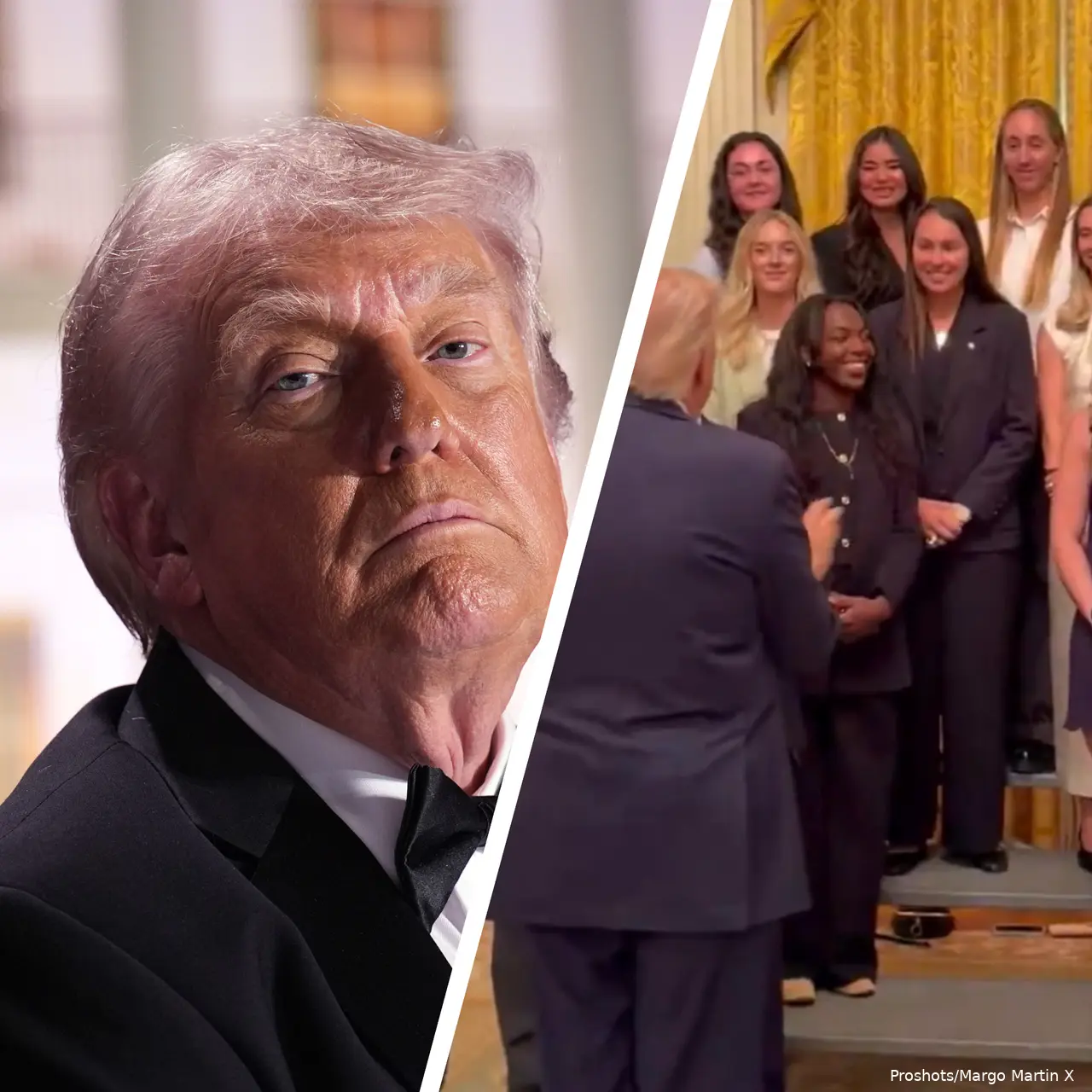
The now-viral White House photo of Georgia Bulldogs women's tennis team standing behind a row of men, with Donald Trump front and center, has been mocked for its composition. Fair enough. It is awkward. It is tone-deaf. It looks like someone staged it without understanding what they were staging.
But the real issue is not the photo. It is how unsurprising the photo feels.
That is the tell. Because if you follow tennis closely, especially the women’s game, you recognize this dynamic instantly. The visual hierarchy in that image is not an accident. It reflects a broader, deeply embedded assumption about where women’s tennis sits in the sport’s ecosystem. And that assumption is wrong.
The better product not a supporting act
Let’s be blunt about it. The women’s game today, across the Women's Tennis Association, the International Tennis Federation circuit, and NCAA competition, is not a secondary product. It is not an add-on. In many respects, it is the better product.
The depth is stronger. The matches are often more competitive. The storylines are fresher. The global diversity of talent is undeniable. Week in and week out, the level of engagement and unpredictability exceeds what we see on the men’s side.
And yet, culturally, the women’s game continues to be treated like a supporting act. That disconnect has consequences.
It shows up in media coverage. It shows up in sponsorship dollars. It shows up in scheduling decisions that still, in subtle and not-so-subtle ways, signal what matters and what does not. And yes, it shows up in moments like this—where a championship team is quite literally positioned behind the people who are supposed to be honoring them.
This is not new. When the U.S. women’s hockey team won Olympic gold, they were, at best, an afterthought in the broader political theater that followed. The pattern is familiar: celebrate selectively, prioritize optics over substance, and default to a hierarchy that places women’s achievements just out of the spotlight.
Tennis should be different. In many ways, it already is. The sport has a long history of pushing for equality, from equal prize money at Grand Slams to global stars who have transcended the game. But history does not guarantee momentum. And right now, the momentum feels stalled.
Part of the problem is perception. Most casual fans still see women’s tennis as something adjacent to the “main event.” That perception is not grounded in the current reality of the sport, but it persists anyway. And once a perception hardens, it shapes everything around it.
Congratulations, Georgia Women’s Tennis! 🇺🇸 pic.twitter.com/v10nwRskuU
— Margo Martin (@MargoMartin47) April 21, 2026
Leadership matters here. The Women's Tennis Association has an opportunity, and frankly an obligation, to be more aggressive in how it positions its players, its tournaments, and its value. Not incrementally better. Not cautiously improved. Fundamentally reimagined.
Because this is not a talent problem. It is not a quality problem. It is a storytelling and positioning problem.
Fixable issue but only if acknowledged
Right now, the women’s game is being undersold to the very audience that would embrace it if it were presented differently. That is a fixable issue, but only if it is acknowledged.
And that brings us back to the photo. People laughed at it because it looked absurd. A championship team, pushed to the background, while others occupied the foreground. But what made it resonate is that it did not feel like an outlier. It felt like a snapshot of a much larger truth.
If you think that is just about politics, you are missing it. This is about how we see women’s tennis. Or more precisely, how most of the world still fails to see it.
The uncomfortable reality is that those who truly appreciate the women’s game—its quality, its competitiveness, its significance—are still in the minority. Call it ten percent, maybe less. That is not enough to move markets, shift narratives, or force structural change. But it is enough to start asking better questions.
Why is the better product not being treated like one? Why are the most compelling matches not always framed as must-watch events?Why does a sport that prides itself on equality still tolerate this kind of imbalance in perception?
Until those questions are answered honestly, moments like this will keep happening. Maybe not at the White House. Maybe not as obviously. But in ways that matter just as much.
The photo was poorly staged. That much is clear. What is less comfortable, and far more important, is what it revealed.

Aron SolomonGuest Author
A Pulitzer Prize-nominated journalist for his groundbreaking op-ed in The Independent exposing the NFL’s “race-norming” policies, Aron Solomon, JD, is a globally recognized thought leader in law, media, and strategy.
As Chief Strategy Officer for AMPLIFY, he leverages his deep expertise to shape the future of legal marketing. Aron has taught entrepreneurship at McGill University and the University of Pennsylvania and was honored as a Fastcase 50 recipient, recognizing him among the world’s top legal innovators. A prolific commentator on law, business, and culture, his insights regularly appear in Newsweek, The Hill, Crunchbase News, and Literary Hub.
He has also been featured in The New York Times, Fast Company, Fortune, Forbes, CBS News, CNBC, USA Today, ESPN, TechCrunch, BuzzFeed, Venture Beat and countless other leading global media outlets. We are proud to have Aron on board at TennisUpToDate, where his deep tennis expertise enriches the site with sharp, original columns that connect the sport to wider cultural debates.
claps 0visitors 0
Just In




Popular News
Latest Comments
- Boss move, Sinner !Rapunzel27-10-2026
- Apparently still refusing to seek 'help' ...and still playing Dress-Up like a 10 year-old.
 mandoist27-10-2026
 - Lena... Takin' care of businessmandoist25-10-2026
- Can you please stop publishing this nonsense? Stick to Tennis.mandoist25-10-2026
- Does Sinner need that 4.5 mil? I doubt it. He can make that with three modelling gigs!😅🤣Rapunzel21-10-2026
- Did "People Magazine" purchase this website? This nonstop storyline is bullshit.mandoist21-10-2026
- Listen... this is of no concern to anyone but these two. Deal with your own issues -- most of us have our own. Thanks, media, for these insignificant follow-ups which are meaningless.mandoist21-10-2026
- This is so very very sad, for all three of them. I truly thought they had an unbreakable bond, but life throws up so many differing challenges. Having your homeland suffering in such a terrible way, makes happiness lose out to guilt as well. Our thoughts are with them. X💔bjsexton20-10-2026
- I have lost all respect for Svitolina! Could she not have waited until he had played at the Paris Masters!!! She is selfish and don't give a damn about Gael. That is NOT how love is demonstrated Elina!!Rapunzel19-10-2026
- Perhaps convenient tennis tour sex is not a strong enough experience in which to base a marriage?mandoist19-10-2026

Loading